Chapter 13
Understanding Students with Traumatic Brain Injury
Chapter Objectives
After studying this chapter, you should be able to:
• Identify and define the characteristics and causes of students with traumatic brain
injury.
Chapter Overview/Presentation Outline
I: Introduction
Slide 2: Chapter 13 Objectives
-Present slide 2 and review the chapter objectives
II. Identifying Students with TBI
Slide 3: Defining Traumatic Brain Injury
-Present slide 3 and discuss the definition of traumatic brain injury
III. Evaluating Students with TBI
Slide 7: Determining the Presence of TBI
-Present slide 7 and discuss the Glasgow Outcomes Scale
IV. Designing an Appropriate IEP
Slide 9: Partnering for Special Education and Related Services
-Present slide 10 and discuss memory aids
V. Using Effective Instructional Strategies
Slide 12: Early Childhood Students
-Present slide 12 and discuss collaborative teaming
VI. Assessing Students’ Progress
Slide 16: Measuring Students’ Progress
-Present slide 16 and discuss analytic rubrics
Class Activities
1. At the beginning of class, have students read the case study at the beginning of the chapter.
2. Have students create a brochure about the disability addressed in the chapter. The brochure
can be trifold and include: a definition of the disability, causes of the disability, characteristics of
3. Assign each student or pair of students a disability. Have the students prepare a class
presentation of the disability to include definition of the disability, causes and prevalence,

4. Classroom observation checklist. The classroom observation checklist for students with TBI
5. Regarding Henry © 1991, 108 minutes—Show a portion or all of Regarding Henry and allow
students to discuss the film.
6. At the end of class, have students revisit the case study at the beginning of the chapter. Use the
questions at the end of the chapter, “What do you think?” to facilitate discussion.
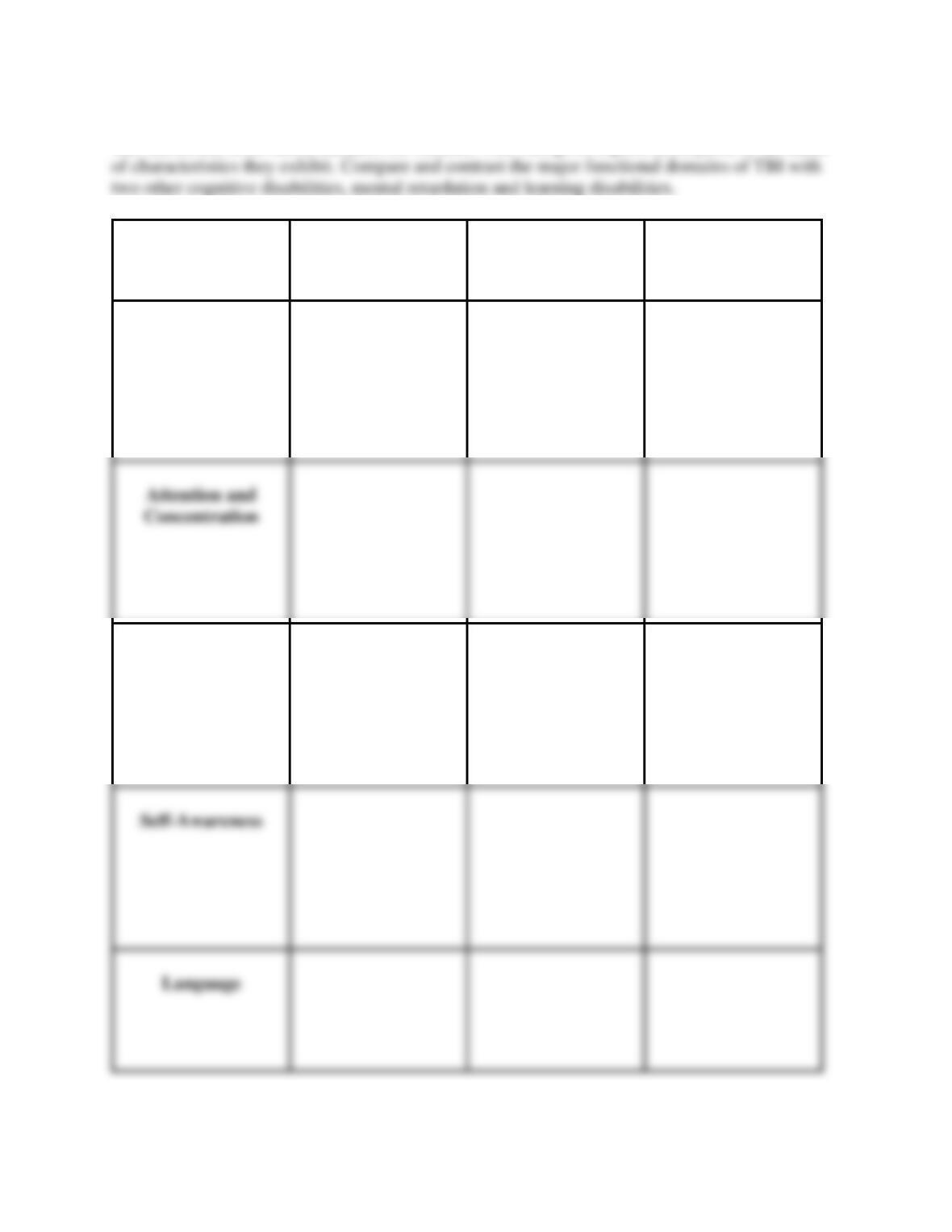
Activity 13.4 — Classroom observation checklist.
The classroom observation checklist for students with TBI gives a good description of the kinds
Functional Domain
Traumatic Brain
Injury
Mental Retardation
Learning
Disabilities
Memory
Executive
Functioning