Chapter 12
Students with Autism
Learning Outcomes
• 12.1: Identify changes in the definition of autism, describe the characteristics in the
DSM-5 pertaining to communication and behavior, and discuss how these characteristics
result in student isolation and low rates of inclusion.
• 12.2: Consider how positive behavior supports and student-directed learning strategies
might support the inclusion of students with autism and consider how social stories might
support inclusive practices.
Chapter Heading
Learning
Objectives
Activities in the MyLab with E-text
Additional Class
Activities
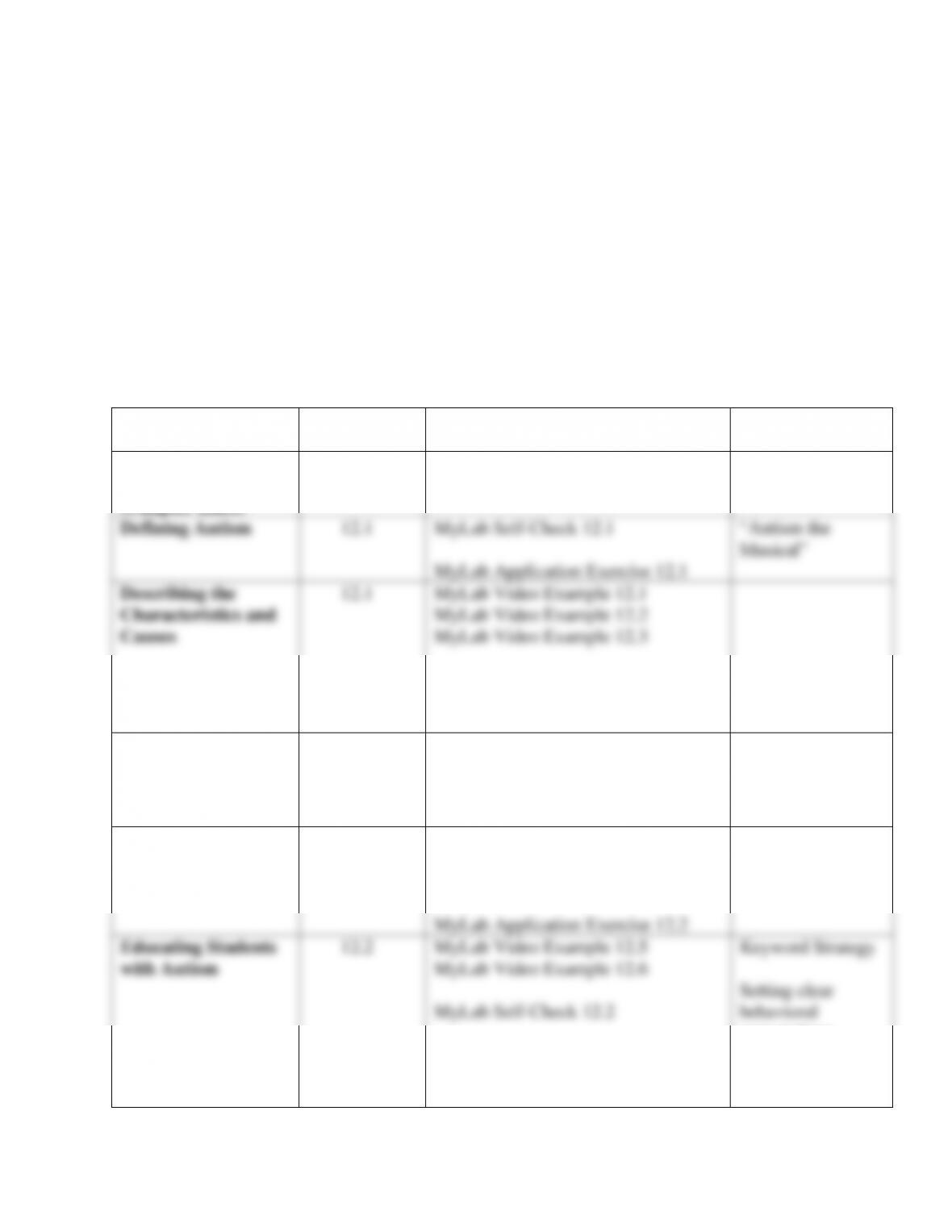
Meet Thasya
Lumingkewas
(Chapter Intro)
My Lab Vignette Video 12.1 (Located
in Chapter Intro)
Defining Autism
12.1
MyLab Self-Check 12.1
MyLab Application Exercise 12.1
“Autism the
Musical”
Describing the
Characteristics and
Causes
12.1
MyLab Video Example 12.1
MyLab Video Example 12.2
MyLab Video Example 12.3
MyLab Self-Check 12.1
MyLab Application Exercise 12.1
Evaluating Students
with Autism
12.1
MyLab Self-Check 12.1
MyLab Application Exercise 12.1
Functional
Behavioral
Assessment
Including Students
with Autism
12.2
MyLab Video Example 12.4
MyLab Self-Check 12.2
MyLab Application Exercise 12.2
Daily Schedule
Educating Students
with Autism
12.2
MyLab Video Example 12.5
MyLab Video Example 12.6
MyLab Self-Check 12.2
MyLab Application Exercise 12.2
Keyword Strategy
Setting clear
behavioral
expectations
Checklist
Assessment
Class Activities in Addition to MyLab Activities
Watch “Autism the Musical” and have students categorize each of the main characters into the
new DSM V categories. What are the characteristics present in each person exemplified?
Using the example in the book, have students work together to complete an FBA for a student
with mid-level autism.
Have students work in small groups to create a keyword strategy for essential vocabulary from
the text.