Chapter 10: Play-Focused Interventions for Young Children with Autism
Summary:
Play is an important of early childhood development, and children with ASD often have
difficulties in this area, including lack of pretend play and failure to play socially. Additionally,
characteristics of ASD, such as motor stereotypies, limited speech, or restricted patterns of interest may
make learning to play or developing skills through play difficult. Three broad types of play are described
in this chapter.
Functional play involves using play things in the manner in which they were intended. Most
typically developing children will engage in functional play by their first birthday. This type of play may
also involve others and is a precursor to the development of symbolic play. Children with ASD may not
use items or toys in a functional play, such as rolling a toy car; instead they may engage in stereotyped
behavior with the item (e.g., spinning its wheels). Because so much attention is spent on the object, and
not another person who may be present, children with ASD may miss opportunities for imitation or joint
attention, which are involved in typical play.
The third area of play, which develops between 1.5 and 2 years of age, is symbolic play. This is a
form of play has three types: substituting one object for another, attribution of false properties, and
attribution of presence to imaginary objects. Symbolic play often frequently involves pretend play and
Because of their differences in learning style, access to play materials may be more difficult for
children with ASD without some adaptations. The chapter describes methods for adapting the play
environment so that the child is more likely to engage with a variety of specific play things. Adapting
play materials involves the following three components:
• Incorporating interests
• Using Visual instructions
Objectives:
1. Describe the characteristics of play in young children with autism.
3. Discuss pros and cons of various methods used to teach children with autism to play.
5. Discuss why adapted play materials are beneficial for individuals with ASD.
Focus Questions:
1. What are the characteristics of play in young children with ASD?
2. What are the types of play and what are examples of each?
3. What are the pros and cons of various methods used to teach children with ASD to play?
Key Terms:
Adaptation
Functional play
Imitation
Joint attention
Object manipulation
Pretend play
Restricted interests
Social play
Stereotypical behaviors
Symbolic play
Instructional Strategies:
Strategy
Rationale
Description/Steps
Modifications/
Alternative Options
Play Skills
Assessment Activity
Real world practice
may enhance
students’
understanding of
concepts
1. Have students conduct two
observations of children
playing; one with a young
child with ASD and one with
a child without ASD during a
play activity
2. Have students conduct an
anecdotal recording of the
play behaviors of the children
during each observation
3. Have students identify the
types of play seen during the
observation for each child
and the child without ASD
for the child with ASD to
Allow students to
work in teams
Have students
observe videos if
actual children cannot
be seen
Adapting play
materials activity
Provides students the
opportunity to apply
concepts from class
to a real world
problem
1. Have students visit a
preschool, day care center, or
other location where young
children play
2. Have students identify 2-3
items within the environment
that could be adapted for a
child with autism (based on
recommendations from the
text)
3. Have students share their
ideas with classmates and
describe the potential
benefits for a child with ASD
Have students work in
teams
Assign a particular
play area to each
person/team
Allow students to
watch videos instead
of in-person visits
Use the setting/video
from the first strategy
and incorporate
specific adaptations
for the child with
ASD whom they
assessed
Research Synthesis
Activity
Provide opportunity
to engage with the
current literature
1. Have students read a
research study on teaching
children with ASD to play
2. Have students share the
study, including design, and
results with the class
3. Have the class develop a
list of teaching strategies that
may be effective for children
with ASD based on their
research
Allow students to
work in teams
Allow students to
present their results in
whole group, small
group, or poster
presentation format
23-38.
Lang, R. , Kuriakose, S., Lyons, G., Mulloy, A., Boutot, A., Britt, C. (TX), Caruthers, S. (TX), Ortega,
L., O’Reilly, M., & Lancioni, G. (2111). Use of School Recess Time in the Education and
Treatment of Children with Autism Spectrum Disorders: A Systematic Review. Research in
Chapter 10: Play-Focused Interventions for Young Children with Autism
Guided Notes
Outline
• Importance of Play in Development
• Three Types of Play
• Play Characteristics in Typically Developing Children
• Teaching Children with ASD to Play
• Adapting Play Materials
Importance of Play in Development
• Social skills
• _______________ skills
• Opportunities to learn about their environment
• Language _______________
Three Types of Play
• Object _______________
Definition
Characteristics of Children
Issues for Children with ASD
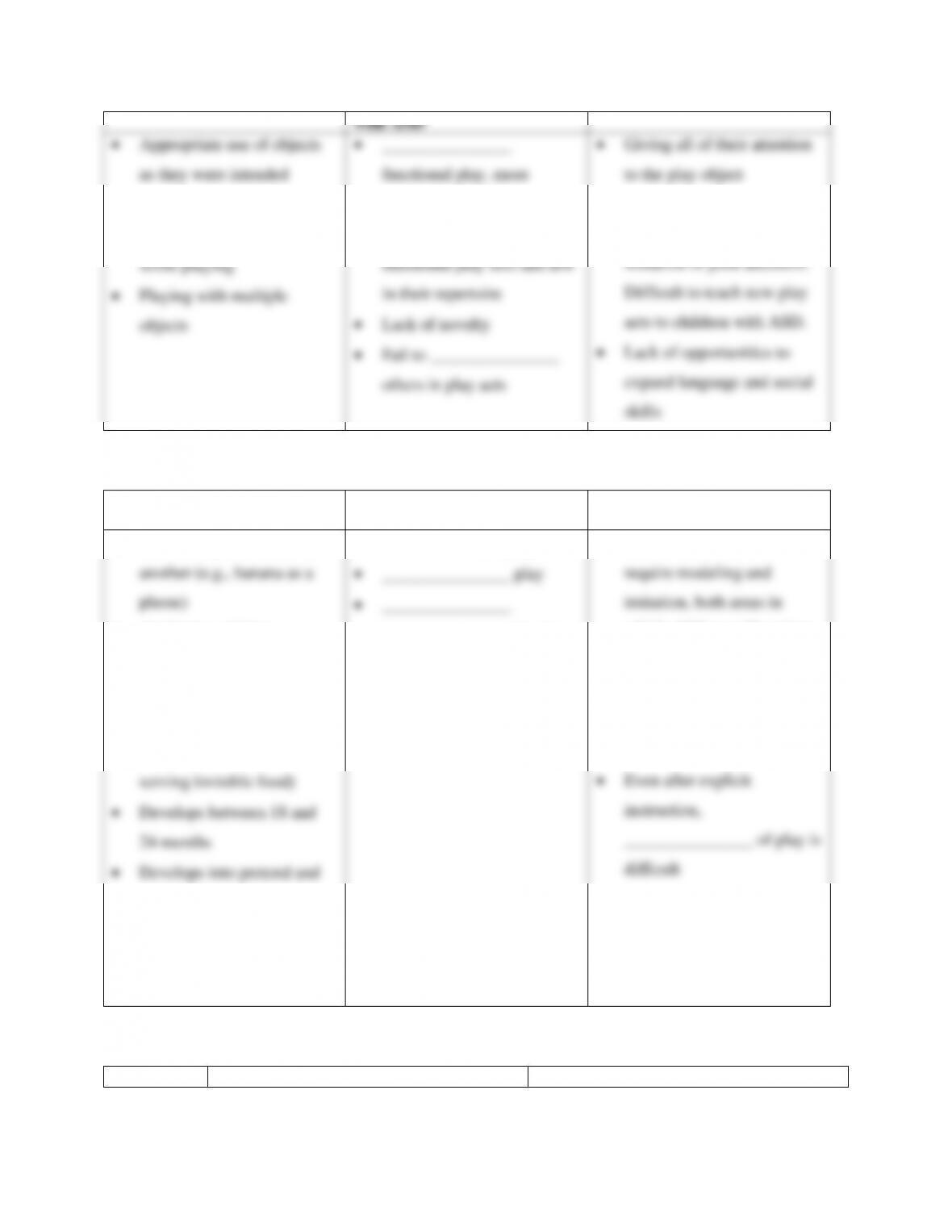
with ASD
• Appropriate use of objects
as they were intended
• Develops by first birthday
• May engage with others
while playing
• Playing with multiple
objects
• _______________
functional play, more
repetitive
• _______________
functional play acts and few
in their repertoire
• Lack of novelty
• Fail to _______________
others in play acts
• Giving all of their attention
to the play object
_______________
opportunities to develop
imitation or joint attention.
Difficult to teach new play
acts to children with ASD.
• Lack of opportunities to
expand language and social
skills
Symbolic Play
Definition
Characteristics of Children
with ASD
Issues for Children with ASD
• Substituting one object for
another (e.g., banana as a
phone)
• Attribution of false
properties (e.g., holding a
bottle in a doll’s hand)
• Attribution of presence to
imaginary objects (e.g.,
serving invisible food)
24 months
• Develops into pretend and
then social play
• Develops between 18 and
instruction,
• Preference for playing alone
• _______________ play
• _______________
spontaneous symbolic play
• Limited _______________
of one object for another
• Repetitive play
• Pretend play activities
require modeling and
imitation, both areas in
which children with autism
typical have
_______________, as such,
pretend play tends to not
develop typically.
• Even after explicit
_______________ of play is
difficult
• _______________ in
receptive and expressive
difficult
Play Characteristics in Typically Developing Children
AGES
PRETEND PLAY
SOCIAL PLAY
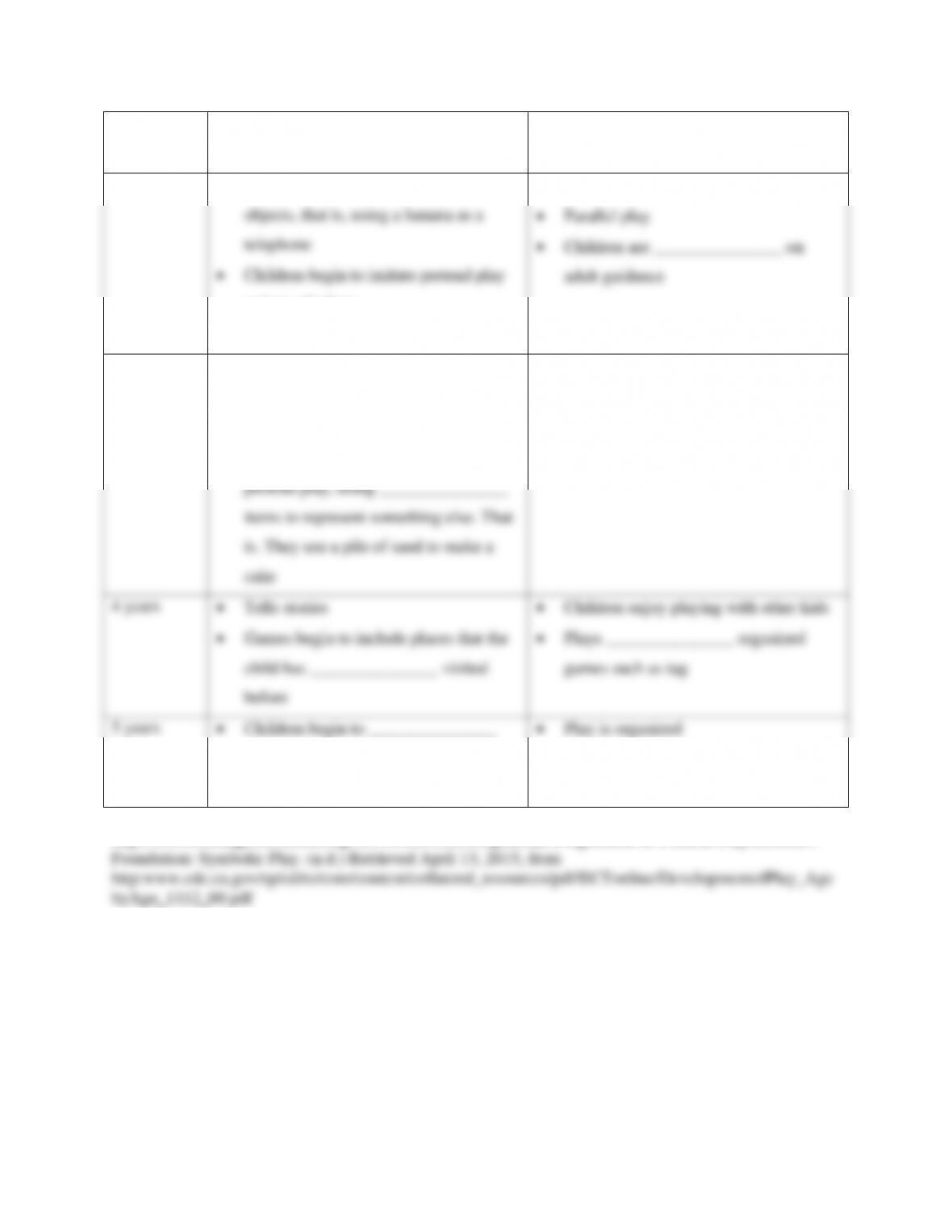
1 year
• Children do __________ yet engage in
pretend play or it is random
• Children do __________ yet engage in
social play
2 years
• Children begin to _______________
objects, that is, using a banana as a
telephone
• Children begin to imitate pretend play
actions of others
• Prefer to play alone
• Children prefer to play alone
• Parallel play
• Children are _______________ on
adult guidance
3 years
• Children begin to make-believe play
• They begin _______________ roles in
play
• Children begin to engage in extended
pretend play, using _______________
items to represent something else. That
is. They use a pile of sand to make a
cake
• Parallel play
• Children enjoy playing
_______________ group games that do
not require rules
4 years
• Tells stories
• Games begin to include places that the
child has _______________ visited
before
• Children enjoy playing with other kids
• Plays _______________ organized
games such as tag
5 years
• Children begin to _______________
their pretend play
• Play is organized
• Children begin to play and negotiate
with others
Source: Johnson, S. (2013, July 8). Life Stages Inc. Retrieved from
http://www.lifestagesinc.com/blog/4557419691/Developmental-Progression-of-Pretend-Play/6090627.
Foundation: Symbolic Play. (n.d.) Retrieved April 13, 2015, from
http:www.cde.ca.gov/sp/cd/re/com/content/collateral_resources/pdf/ECTonline/DevelopmentofPlay_Age
byAge_1112_00.pdf
Teaching Children with ASD to Play
• Research supports the importance of teaching play skills as part of basic _______________ for
youngsters with ASD
• _________________________ strategies can be used to teach play:
− Naturalistic instruction
− Contingent reinforcement
− Milieu teaching
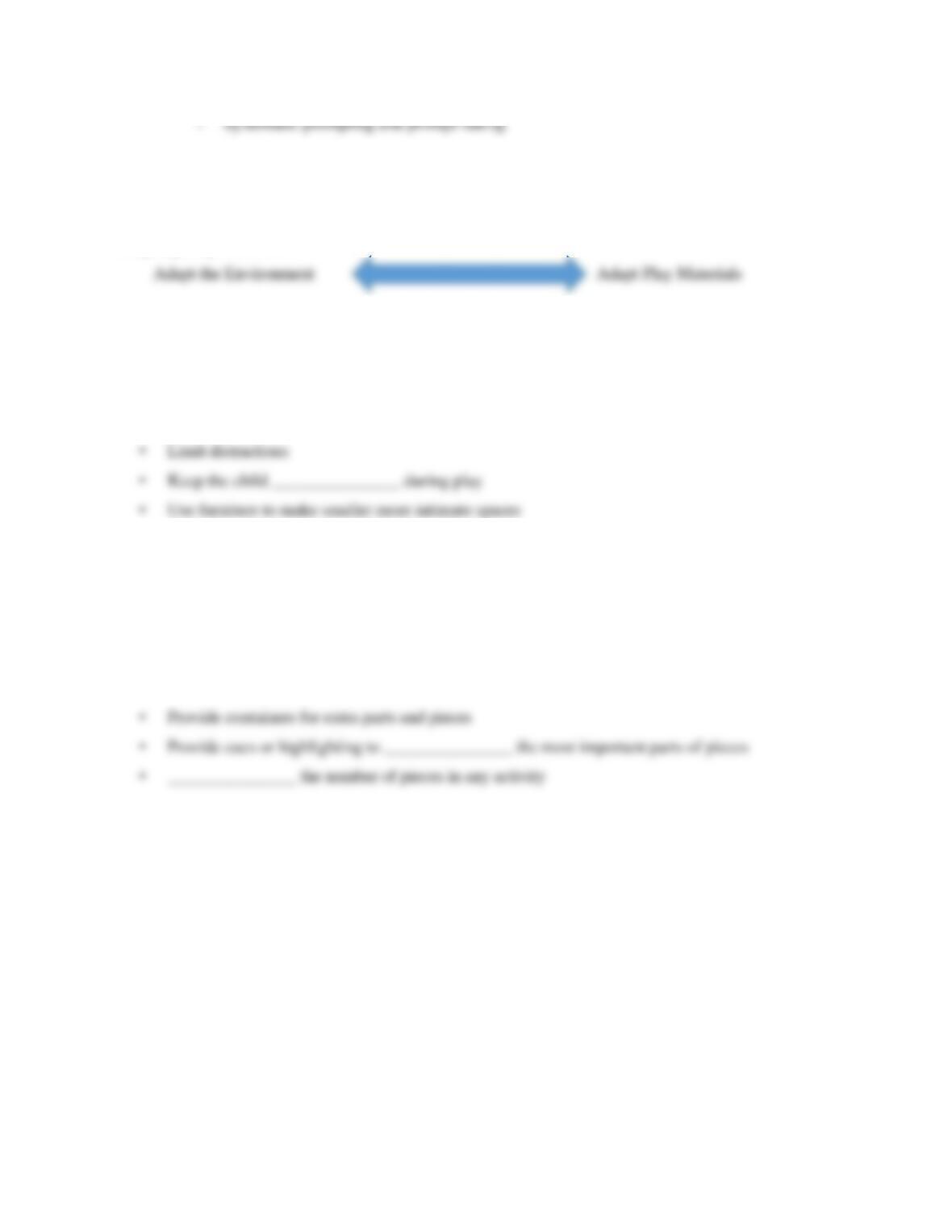
Adapting Play Materials
Adapt the Environment
Adapt Play Materials
Adapting the Environment
• Provide _______________ cues about activities
• Provide behavioral expectations for each space
• Set up a defined space with physical and visual _______________
Adapting Play Materials
• Incorporate child _______________
• Use visual instructions
• Use visual examples
• Stabilize activities on a tray