Chapter 1: Overview of Autism Spectrum Disorders
Chapter Summary
Autism Spectrum Disorder (ASD) is one of the fastest growing of all childhood disorders, with a
prevalence rate of one in every 68 individuals in the United States.
There are three main characteristics related to ASD: language deficits, lack of social awareness
and skills, and repetitive patterns of behavior or interests. Many children with ASD are nonverbal while
some develop echolalia, repetitions of what they hear from others. Some individuals with ASD rock back
and forth, flap, develop other repetitive behaviors, while others may have a tendency to prefer sameness
and dislike changes in routine. ASD can affect several other areas of function as well. These include
memory, metacognition, effective functioning, central coherence and abstract thought.
The Diagnostic and Statistical Manual of the American Psychiatric Association, 5th Edition
(DSM-V, APA, 2015) lists two main areas for diagnostic criteria, deficits in social communication and
social interaction, and restricted, repetitive patterns of behavior, interests, or activities. Symptoms can
range from mild to severe and include varying degrees of language deficit or delay. The disorder is
diagnosed using a variety of commercially available tests, as well as parent interview and child
observation, by licensed and trained physicians, psychologists and school psychologists.
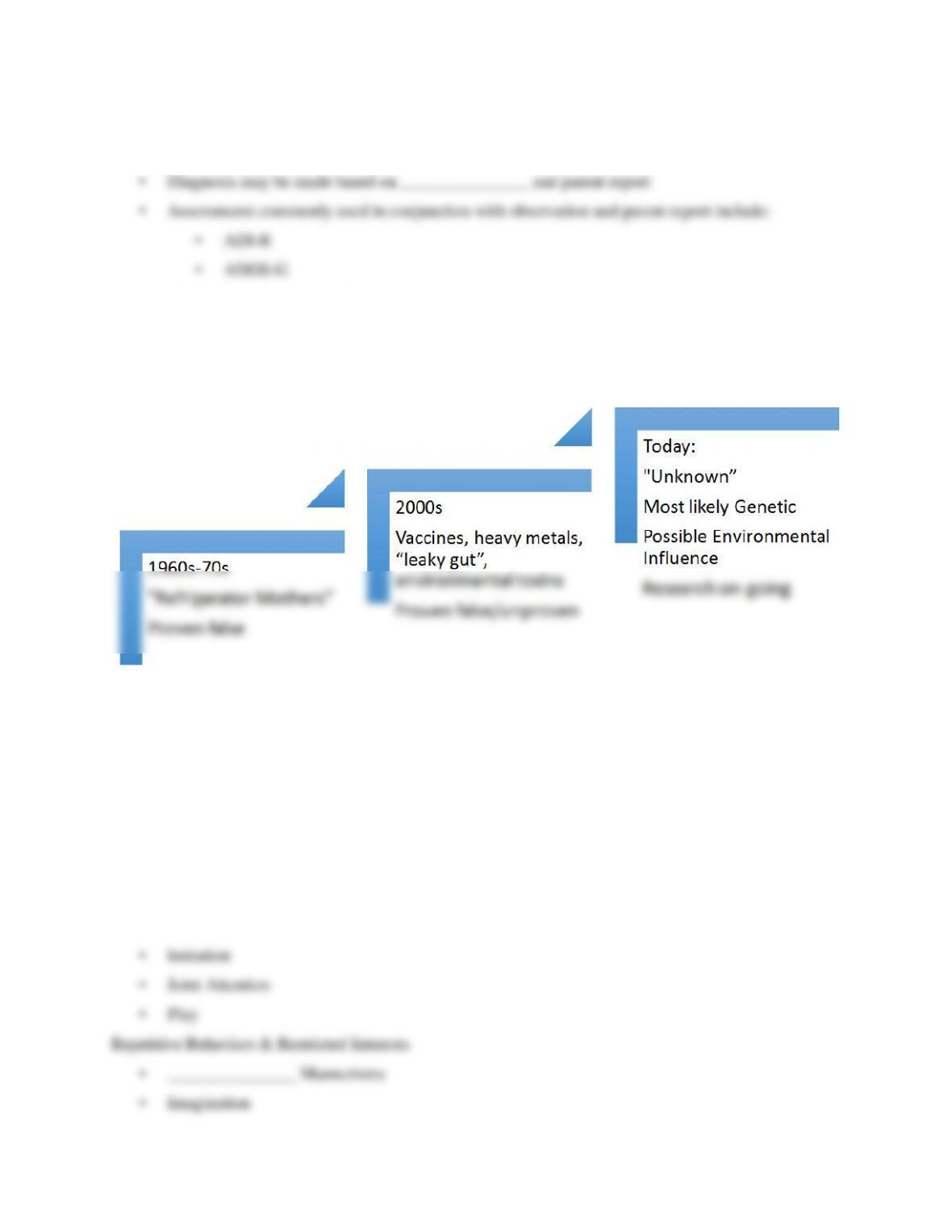
The exact cause of autism remains unknown. The initial cause was thought to be due to the lack
of love and affection from the mother (Bettelheirm, 1967). Bernard Rimland (1964) disputed this idea,
and today we know that parenting is not a cause of autism. Some theories on the cause of autism include
environmental factors and genetics. Research supports a relationship between genetics and autism.
Chapter Objectives
1. Describe the characteristic of Autism Spectrum Disorders (ASD).
2. Explain how ASD are identified and diagnosed.
4. Discuss causal theories associated with autism.
Chapter Focus Questions
1. What are the characteristics of Autism Spectrum Disorders (ASD)?
2. How are Autism Spectrum Disorders identified and diagnosed?
Chapter Key Terms
Adaptive Behavior
ADI-R
DSM-V
ADOS-G
Generalization
Goals
Asperger Syndrome
Maintenance
Objectives
Prevalence
Autism Spectrum Disorder
Repetitive behaviors
Social skills
Stimulus overselectivity
Instructional Strategies/Activities
Strategy
Rationale
Description/Steps
Modifications/
Alternative Options
Have students
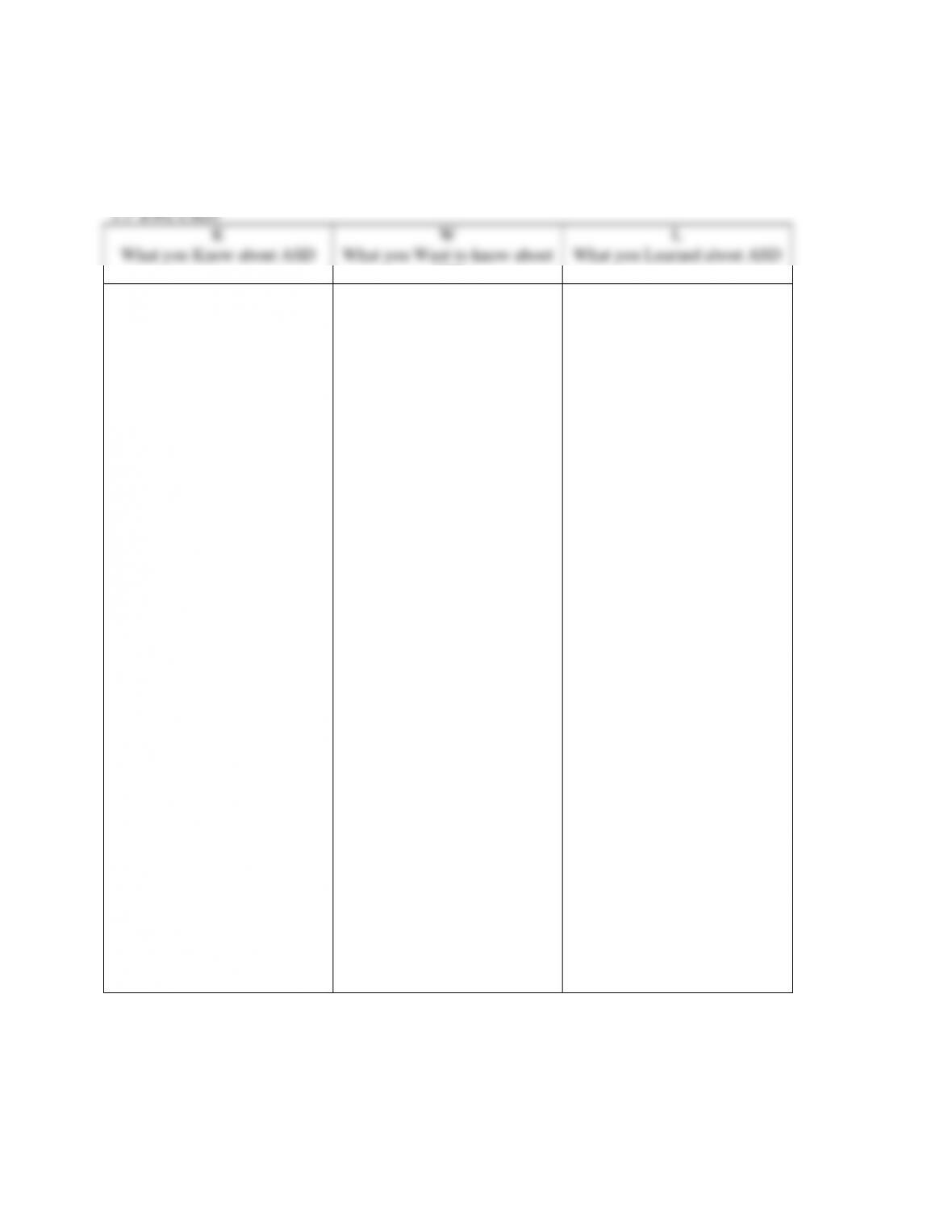
complete a KWL
chart on the first day
of class (Handout 1.1)
Serves to activate
prior knowledge
Allows instructor to
access students’ level
of experience and
knowledge with ASD
Serves to expose any
misconceptions
1. Put students into small
groups for discussion
2. Provide a handout to
each student group or
put a model on the
board; the KWL chart is
a three-column chart
with a K in the first
column, W in the
second, and L in the
leave space on the third
column to record what
they Learn about ASD
4. Have groups share their
Allow students to
complete the KWL
chart individually
Use chart paper and
allow groups to
complete posters of
their information
class
Show/Provide DSM-V
severity tables
Serves as a visual
depicting the Autism
Spectrum Disorder
severity and
diagnostic criteria
Discuss the different
severity levels and the
required supports, and why
those may be necessary.
Use videos of
children representing
the different severity
levels and have
students attempt to
match severity level
based on observation
Relate the case studies
to the criteria for
diagnosis
Real-life examples
may aid students’
understanding of the
diagnostic
characteristics of the
disorders
1. In small groups have
students discuss each of
the case studies in terms
of the diagnostic criteria
for autism, AS, or PDD-
NOS
2. Have students discuss
which diagnosis most
closely fits with each
case study and why
Assign each group
only one case study to
discuss and then share
their discussion with
the class
Etiological debate
Students may have
limited experience
with ASD but may
have heard/read
much in the media
regarding
vaccinations as
causing ASD. This
debate activity will
allow both sides of
the issue to be
discussed based on
research
1. Identify peer-reviewed
literature on vaccines
(or other
unsubstantiated theory)
as cause for ASD
2. Divide class into two
groups, one looking at
evidence suggesting
that vaccines cause
autism, the other
looking at research
illustrating that
vaccines do not cause
autism
3. Have the teams build
cases for or against
vaccinations as the
cause of autism and
present to the class
A third group could
review media reports
and anecdotal
accounts of
vaccinations causing
autism, including
resulting “cures”
developed based on
the theory and share
what they find
Students could further
discuss issues with
quality research,
media involvement in
the debate, and the
impact of both on
families
IEP Component
Provide examples of
Allow small groups of
Have students
Suggested Chapter Readings/Resources
American Psychiatric Association. (2013). Diagnostic and Statistical manual of mental disorders (5th
ed.). Washington, DC: Author.
Autism Diagnostics Observation Schedule:
Autism Speaks: http://www.autismspeaks.org/
Autism Speaks has grown into the nation’s largest autism science and advocacy organization,
Bettleheim, B. (1967). The empty fortress. Toronto, CA: Collier-MacMillan.
Bettelheim believed that autism did not have an organic basis, but resulted when mothers
Description of ADOS and ADI: http://www.umaccweb.com/diagnostic_tools/index.html
The ADOS is a semi-structured, standardized assessment of communication, social interaction,
Diagnosing Autism: One Family’s Journey: http://childnett.tv/videos/services?page=1
This web site is for families, clinicians, and educators and provides information related to autism
Kanner, L. (1943). Autistic disturbances of affective contact. Nervous Child, 2, 217-250.
Lathe, R. (2006). Autism, Brain, and Environment. London: Jessica Kingsley.
National Institute of Mental Health: http://www.nimh.nih.gov/publicat/autism.cfm
Comprehensive website addressing the research, funding and science behind ASD.
Rimland, B. (1964). Infantile autism: The syndrome and its implications for a neutral theory of
behavior. Upper Saddle River, NJ: Prentice Hall.
Whitman, T. L. (2004). The development of autism: A self-regulatory perspective. London: Jessica
Kingsley.
Chapter 1: Overview of Autism Spectrum Disorders
Guided Notes
Outline
• Introduction: What is Autism Spectrum Disorder (ASD)?
• Introduction: The Numbers
• Autism Spectrum Disorder: Diagnostic Criteria
• DSM-V Diagnostic Criteria for Autism Spectrum Disorder, 299.00
• DSM-V Severity Levels for ASD
• Diagnosing ASD
• What Causes ASD?
• Characteristics of Students with ASD
• Developing Individualized Education Programs for Students with ASD
• Creating Annual Goals and Objectives
• Commercially Available Assessments for Curricular Planning
• Skill Areas to be Addressed in IEPs for Students with ASD
Introduction: What is Autism Spectrum Disorder (ASD)?
• IDEA defines Autism as:
• “A _______________ disabilities significantly affecting verbal and nonverbal
_______________ and _______________ interaction, generally evident before age 3,
Introduction: The Numbers
• CDC estimates the prevalence of ASD to be 1 in _________ (2014)
• In 1990, the rate was 5-10 in 10,000.
• ASD is the _______________ growing childhood disorder.
Autism Spectrum Disorder: Diagnostic Criteria
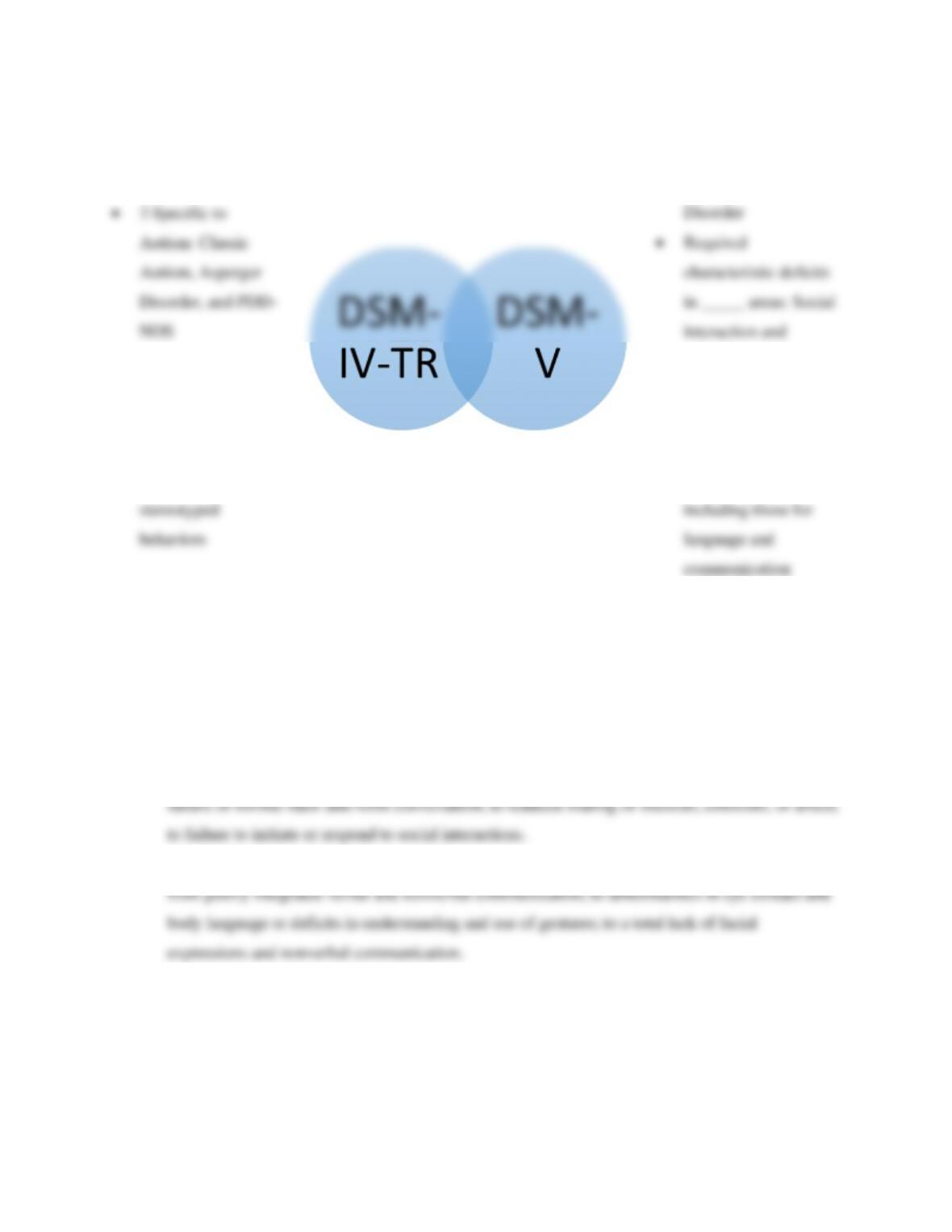
• 5 Pervasive
Developmental
Disorders
• 3 Specific to
Autism: Classic
Autism, Asperger
Disorder, and PDD-
NOS
• Required
characteristic
deficits in 3 areas:
Social interaction,
Communication, and
stereotyped
behaviors
• _____________
diagnosis for Autism:
Autism Spectrum
Disorder
• Required
characteristic deficits
in _____ areas: Social
interaction and
stereotyped behaviors
• Includes 3 Severity
______________,
which relate to needed
____________,
including those for
language and
communication
DSM-V Diagnostic Criteria for Autism Spectrum Disorder, 299.00
Social Communication & Interaction
A. Persistent deficits in social communication and social interaction across multiple contexts, as
manifested by the following, currently or by history (examples are illustrative, not exhaustive, see
text):
1. Deficits in social-emotional reciprocity, ranging, for example, from abnormal social approach and
3. Deficits in developing, maintaining, and understanding relationships, ranging, for example, from
difficulties adjusting behavior to suit various social contexts; to difficulties in sharing imaginative
play or in making friends; to absence of interest in peers.
Restricted, Repetitive Patterns of Behavior
B. Restricted, repetitive patterns of behavior, interests, or activities, as manifested by at least two of the
following, currently or by history (examples are illustrative, not exhaustive; see text):
1. Stereotyped or repetitive motor movements, use of objects, or speech (e.g., simple motor
stereotypies, lining up toys or flipping objects, echolalia, idiosyncratic phrases).
2. Insistence on sameness, inflexible adherence to routines, or ritualized patterns or verbal nonverbal
4. Hyper- or hypo-reactivity to sensory input or unusual interests in sensory aspects of the
environment (e.g., apparent indifference to pain/temperature, adverse response to specific sounds
DSM-V Additional Diagnostic Criteria/Requirements
C. Symptoms must be present in the early developmental period (but may not become fully manifest
until social demands exceed limited capacities, or may be masked by learned strategies in later life).
D. Symptoms cause clinically significant impairment in social, occupational, or other important areas
of current functioning.
E. These disturbances are not better explained by intellectual disability (intellectual developmental
disorder) or global developmental delay. Intellectual disability and autism spectrum disorder frequently
Specify if:
• With or without accompanying intellectual impairment
• With or without accompanying language impairment
• Associated with a known medical or genetic condition or environmental factor
(Coding note: Use additional code to identify the associated medical or genetic condition.)
• Associated with another neurodevelopmental, mental, or behavioral disorder
• With catatonia (refer to the criteria for catatonia associated with another mental disorder, pp.
DSM-V Severity Levels for ASD
Level 1: Requiring
Support
Level 2: Requiring
Substantial Support
Level 3: Requiring Very
Substantial Support
Social
Communication
Without supports in place,
deficits in social
communication cause
noticeable impairments.
Difficulty initiating social
interactions, and clear
examples of atypical or
unsuccessful response to
social overtures of others.
May appear to have
decreased interest in
social interactions. For
example, a person who is
able to speak in full
sentences and engages in
communication but whose
to– and-fro conversation
with others fails, and
whose attempts to make
friends are odd and
typically unsuccessful
Marked deficits in verbal
and nonverbal social
communication skills;
social impairments
apparent even with
supports in place; limited
initiation of social
interactions; and reduced
or abnormal responses to
social overtures from
others. For example, a
person who speaks simple
sentences, whose
interaction is limited to
narrow special interests,
and how has markedly
odd nonverbal
communication.
Severe deficits in verbal
and nonverbal social
communication skills
cause severe impairments
in functioning, very
limited initiation of social
interactions, and minimal
response to social
overtures from others. For
example, a person with
few words of intelligible
speech who rarely initiates
interaction and, when he
or she does, makes
unusual approaches to
meet needs only and
responds to only very
direct social approaches
Restricted,
Repetitive
Behaviors
Inflexibility of behavior
causes significant
interference with
functioning in one or
more contexts. Difficulty
switching between
activities. Problems of
organization and planning
hamper independence.
Inflexibility of behavior,
difficulty coping with
change, or other
restricted/repetitive
behaviors appear
frequently enough to be
obvious to the casual
observer and interfere
with functioning in a
variety of contexts.
Distress and/or difficulty
changing focus or action.
Inflexibility of behavior,
extreme difficulty coping
with change, or other
restricted/repetitive
behaviors markedly
interfere with functioning
in all spheres. Great
distress/difficulty
changing focus or action.
• Diagnosis must come from _______________ _______________ _______________
(psychiatrist, developmental pediatrician, pediatric neurologist) or psychologist
• Screening instrument used by pediatricians as part of well-checks:
• MCHAT
What Causes ASD?
Characteristics of Students with ASD
_______________
• Pragmatic Language
• Using Language in Odd Ways
• Literal Interpretation of Language
_______________
• Theory of Mind
• Emotional Expressions & Affect
Characteristics of ASD
Motor Deficits
• Dyspraxia
Learning Challenges
• Generalization
• Stimulus Over-selectivity
• _______________
Developing Individualized Education Programs for Students with ASD
1. Describe the child’s _______________ level of performance or functioning
3. Describe necessary related services
5. Describe time and duration of services
6. Specify how _______________ will be measured and evaluated
Creating Annual Goals and Objectives
Annual _______________:
• Clearly state what the student is expected to accomplish in a 1-year time frame
• Word the goals as _______________ statements (what the student will do vs. not do)
Commercially Available Assessments for Curricular Planning
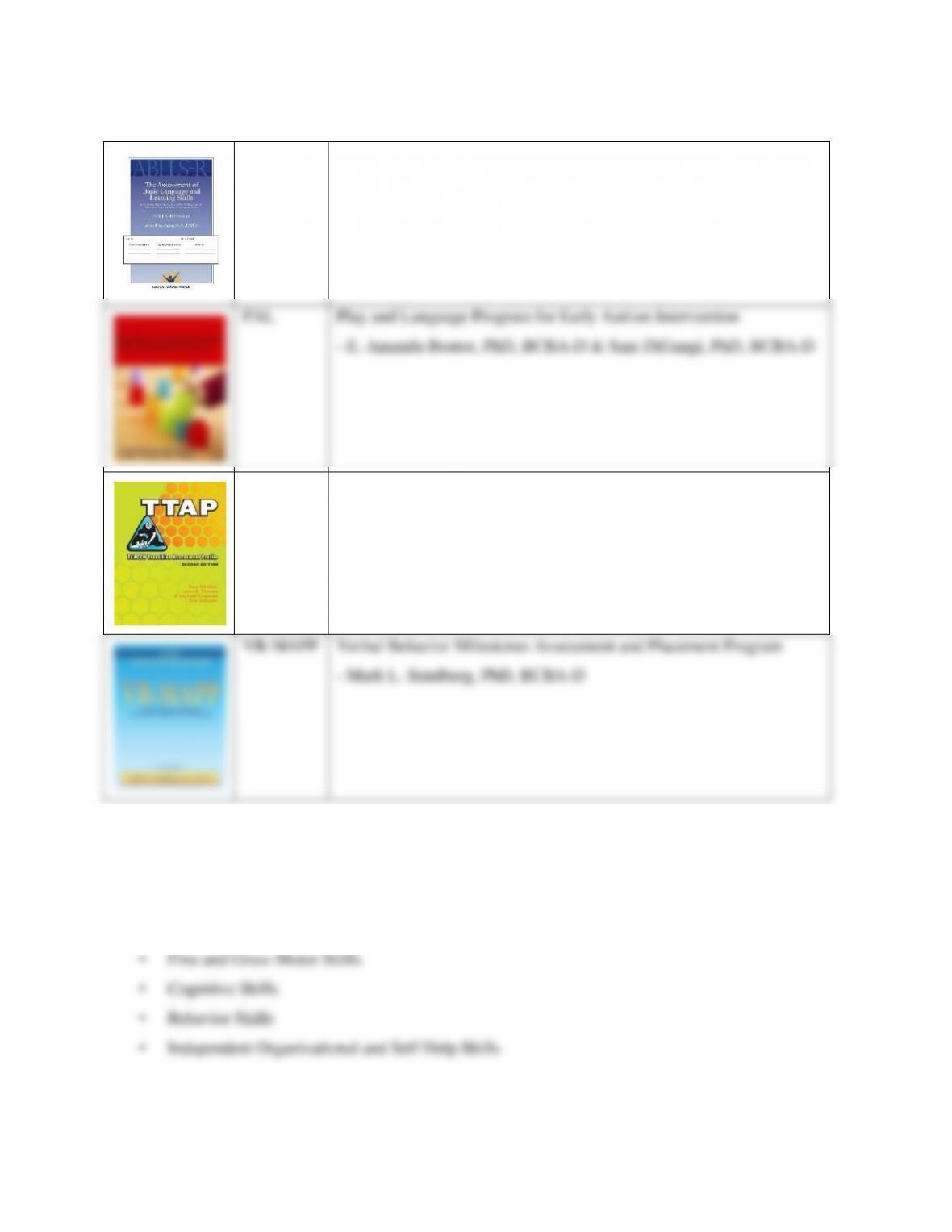
ABLLS-R
Assessment of Basic Language and Learning Skills – Revised
– James W. Partington, PhD, BCBA-D
PAL
Play and Language Program for Early Autism Intervention
– E. Amanda Boutot, PhD, BCBA-D & Sam DiGangi, PhD, BCBA-D
TTAP
TEACCH Transition Assessment Profile
– Gary Mesibov, John B. Thomas, S. Michael Chapman, & Eric
Schopler
VB-MAPP
Verbal Behavior Milestones Assessment and Placement Program
– Mark L. Sundberg, PhD, BCBA-D
Skill Areas to be Addressed in IEPs for Students with ASD
• Social Skills
• Language and Nonverbal Communication Skills
• Functional and Symbolic Communication Systems
Instructional Activity Handouts
Chapter 1
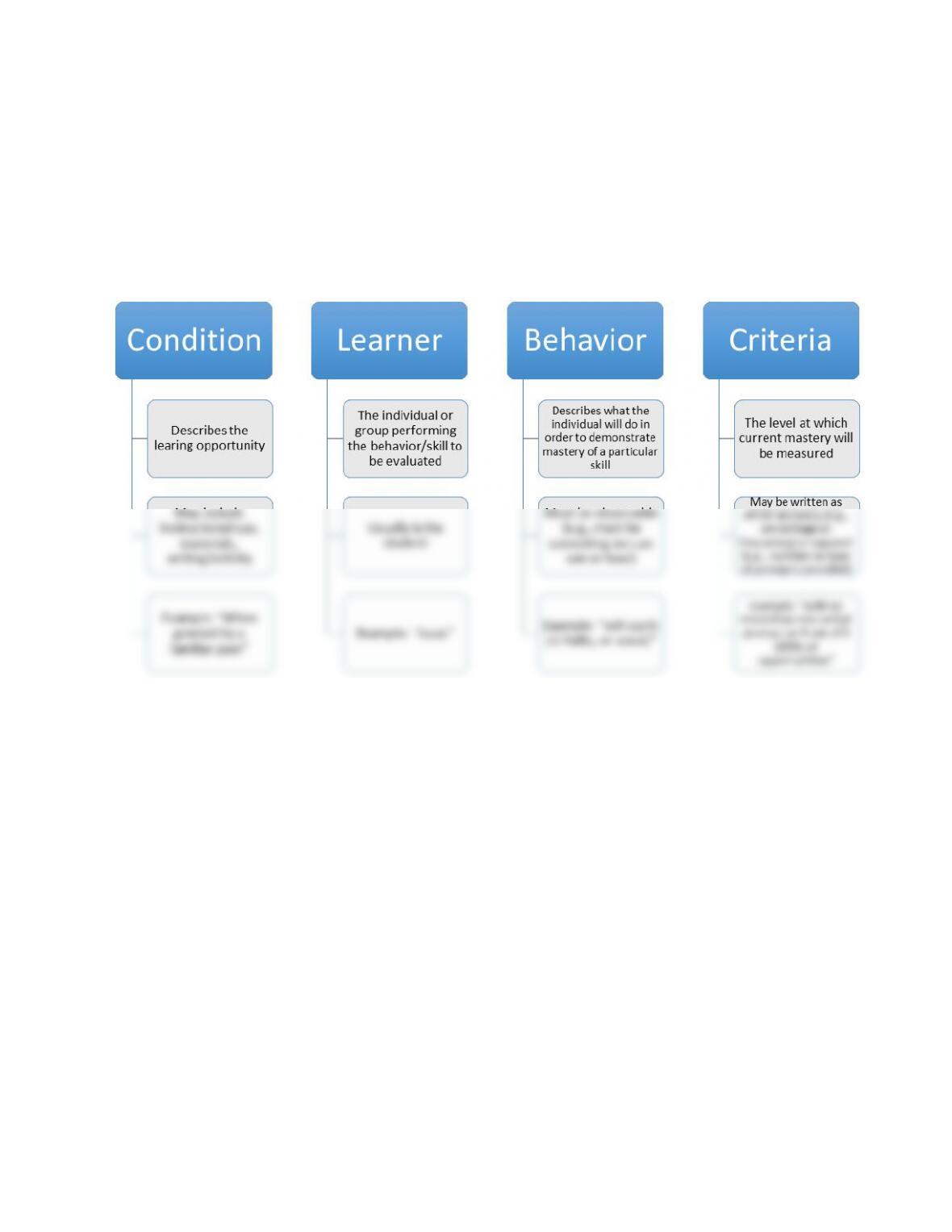
1.2 IEP Components