Chap 19 solutions
19.1.1
The difference between strict and nonstrict locking for this example is only in the matter
of whether the lock on A is released prior to the write of B. That is, the lock on A must be
19.1.2a)
T1 wrote only B, but that value was later read by T3. Thus, T3 must be rolled back. T3
19.1.2b)
T2 rolled back since it reads B written by T1.
19.1.2c)
T2 rolled back since it reads B written by T1.
19.1.2d)
T3 rolled back as it reads B written by T1.
19.1.3a)
Inserting commit actions we get the following schedule:
r1(A)r2(B)w1(B)c1w2(C)c2r3(B)r3(C)w3(D)c3
i) If the lost tail of log begins before c1, T1, T2 and T3 are considered
19.1.3b)
r1(A)w1(B)c1r2(B)w2(C)c2r3(C)w3(D)c3
19.1.3c)
r2(A)r3(A)r1(A)w1(B)c1r2(B)r3(B)w2(C)c2r3(C)c3
i) If lost tail begins before c1, T1, T2 and T3 considered uncommitted. If lost
19.1.3d)
r2(A)r3(A)r1(A)w1(B)c1r3(B)w2(C)c2r3(C)c3
i) If lost tail before c1, T1, T2 and T3 considered uncommitted. If lost tail
19.1.4a)
For Recoverable schedules, each transaction must commit only after the transaction it
read from commits. There is one read in each transaction.
Therefore the constraints are
(i) When r1(C) follows w2(C) , c1 must follow c2
There are 10 transactions that violate (i) viz.
w2(A) r2(B) w2(C) w1(A) w1(B) r1(C) c_1 c_2
w2(A) r2(B) w1(A) w2(C) w1(B) r1(C) c_1 c_2
There are 13 transactions that violate (ii) viz.
w2(A) w1(A) w1(B) r2(B) w2(C) c_2 r1(C) c_1
w2(A) w1(A) w1(B) r2(B) w2(C) r1(C) c_2 c_1
w2(A) w1(A) w1(B) r2(B) r1(C) w2(C) c_2 c_1
19.1.4b)
In an ACR schedule, transactions only read values written by committed transactions.
Again each transaction has one read.
Therefore the constraints are
(i) When r1(C) follows w2(c), r1(c) must also follow c2
18 schedules that violate (i) only are
w2(A) r2(B) w2(C) w1(A) w1(B) r1(C) c_2 c_1
w2(A) r2(B) w2(C) w1(A) w1(B) r1(C) c_1 c_2
w2(A) r2(B) w1(A) w2(C) w1(B) r1(C) c_2 c_1
w2(A) r2(B) w1(A) w2(C) w1(B) r1(C) c_1 c_2
w1(A) w1(B) w2(A) r2(B) w2(C) r1(C) c_1 c_2
9 schedules that violate only (ii) are
w2(A) w1(A) w1(B) r2(B) w2(C) c_2 r1(C) c_1
w2(A) w1(A) w1(B) r2(B) r1(C) w2(C) c_2 c_1
19.1.4c)
All corresponding actions of the two transactions on same element are possible comflicts
i.e. cannot be swapped without affcting the serializale nature.
Of the 47 recoverable schedules, below 19 are not serializable due to conflicts.
w2(A) r2(B) w1(A) w1(B) r1(C) w2(C) c_2 c_1
w2(A) r2(B) w1(A) w1(B) r1(C) w2(C) c_1 c_2
19.1.4d)
Of the 41 ACR schedules, following 13 are not conflict serializable.
w2(A) r2(B) w1(A) w1(B) r1(C) w2(C) c_2 c_1
w2(A) r2(B) w1(A) w1(B) r1(C) w2(C) c_1 c_2
19.1.5
Example of ACR schedule (tx reads values only written by committed trans):
w1(A)w1(B)w2(A)c1r2(B)c2
19.2.1a)
After inserting the appropriate lock and unlock requests, the schedule becomes(assuming
no delays):
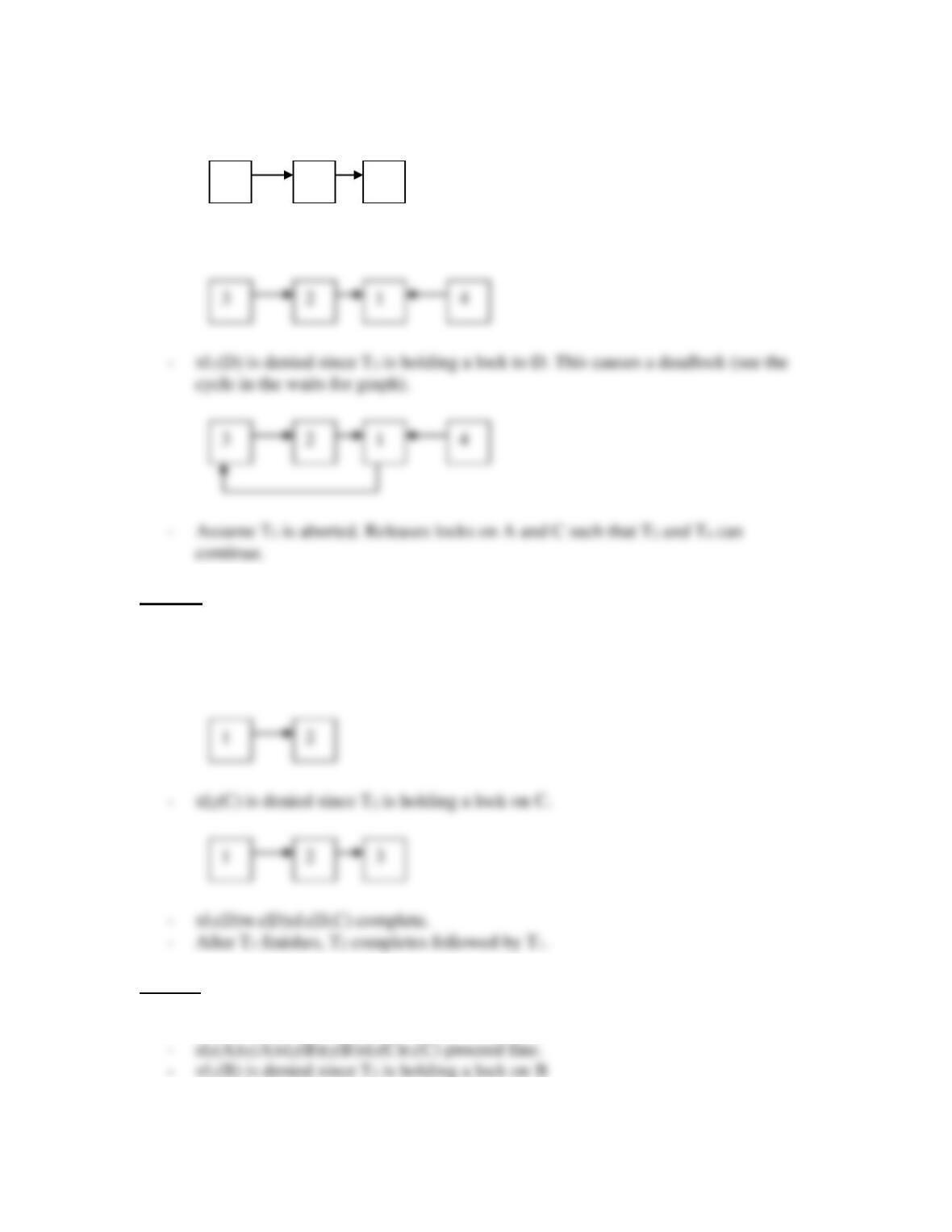
sl1(A)r1(A)sl2(B)r2(B)xl1(C)w1(C)sl3(D)r3(D)sl4(E)r4(E)xl3(B)w3(B)ul3(B,D)xl2(C)w2(C)u
3
2
1
4
3
2
1
4
1
2
3
1
2
– xl4(A) is denied since T1 is holding a lock to A
19.2.1b)
sl1(A)r1(A)sl2(B)r2(B)sl3(C)r3(C)xl1(B)w1(B)ul1(B,A)xl2(C)w2(C)ul2(C,B)xl3(D)w3(D)ul3(
D,C)
– sl1(A)r1(A)sl2(B)r2(B)sl3(C)r3(C) proceed fine
– xl1(B) is denied since T2 is holding lock to B
19.2.1c)
sl1(A)r1(A)sl2(B)r2(B)sl3(C)r3(C)xl1(B)w1(B)ul1(A,B)xl2(C)w2(C)ul2(C,B)xl3(A)w3(A)ul3(
A,C)
3
2
1
3
1
2
4
3
1
2
3
1
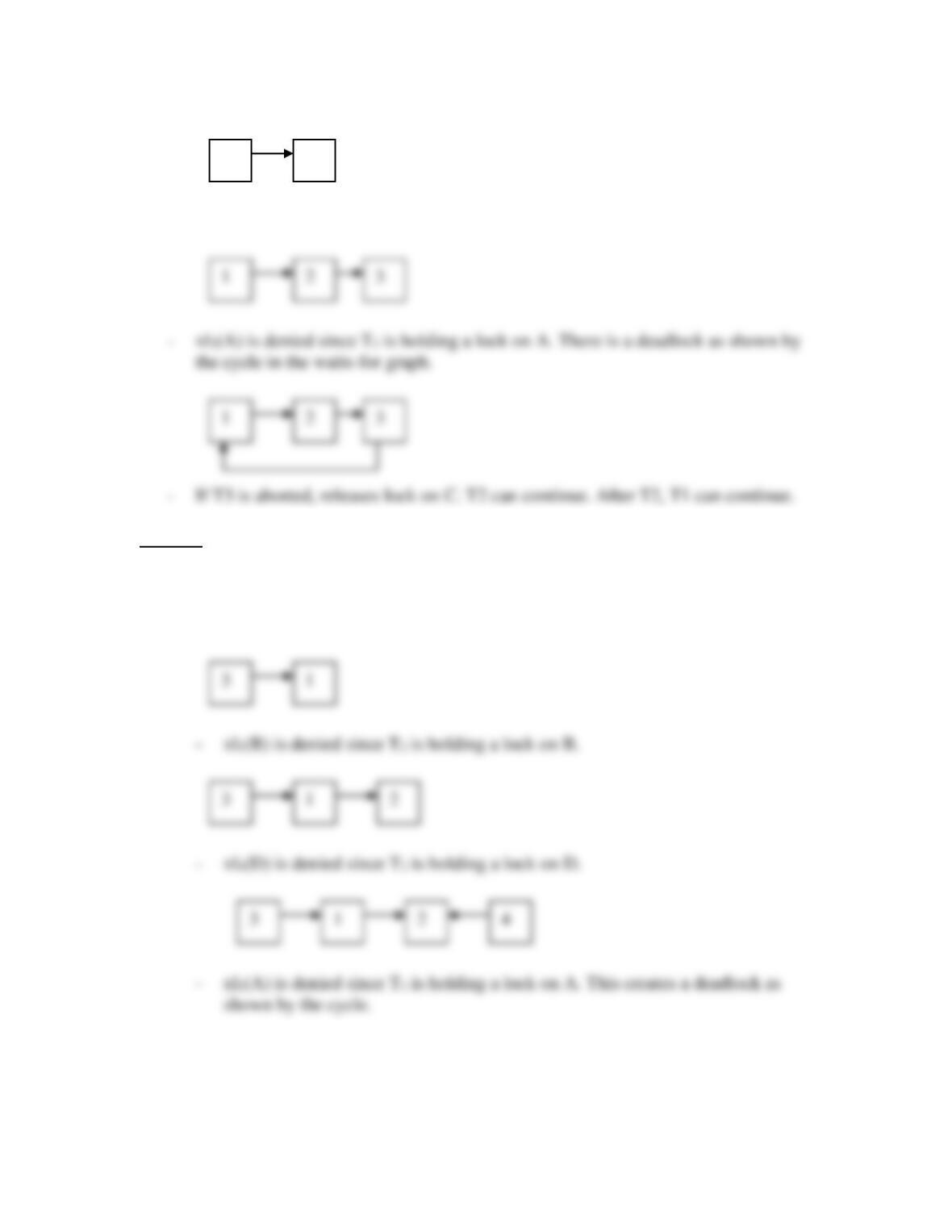
– xl2(C) is denied since T3 holds a lock on C
19.2.1d)
sl1(A)r1(A)sl2(B)r2(B)xl1(C)w1(C)xl2(D)w2(D)sl3(C)r3(C)ul3(C)xl1(B)w1(B)ul1(B,A,C)xl4(
D)ul4(D)xl2(A)w2(A)ul2(A,B,D)
– sl1(A)r1(A)sl2(B)r2(B)xl1(C)w1(C)xl2(D)w2(D) proceed fine.
– sl3(C) is denied since T1 is holding a lock on C.
1
2
1
2
3
1
2
3
19.2.2a)
T1
T2
T3
T4
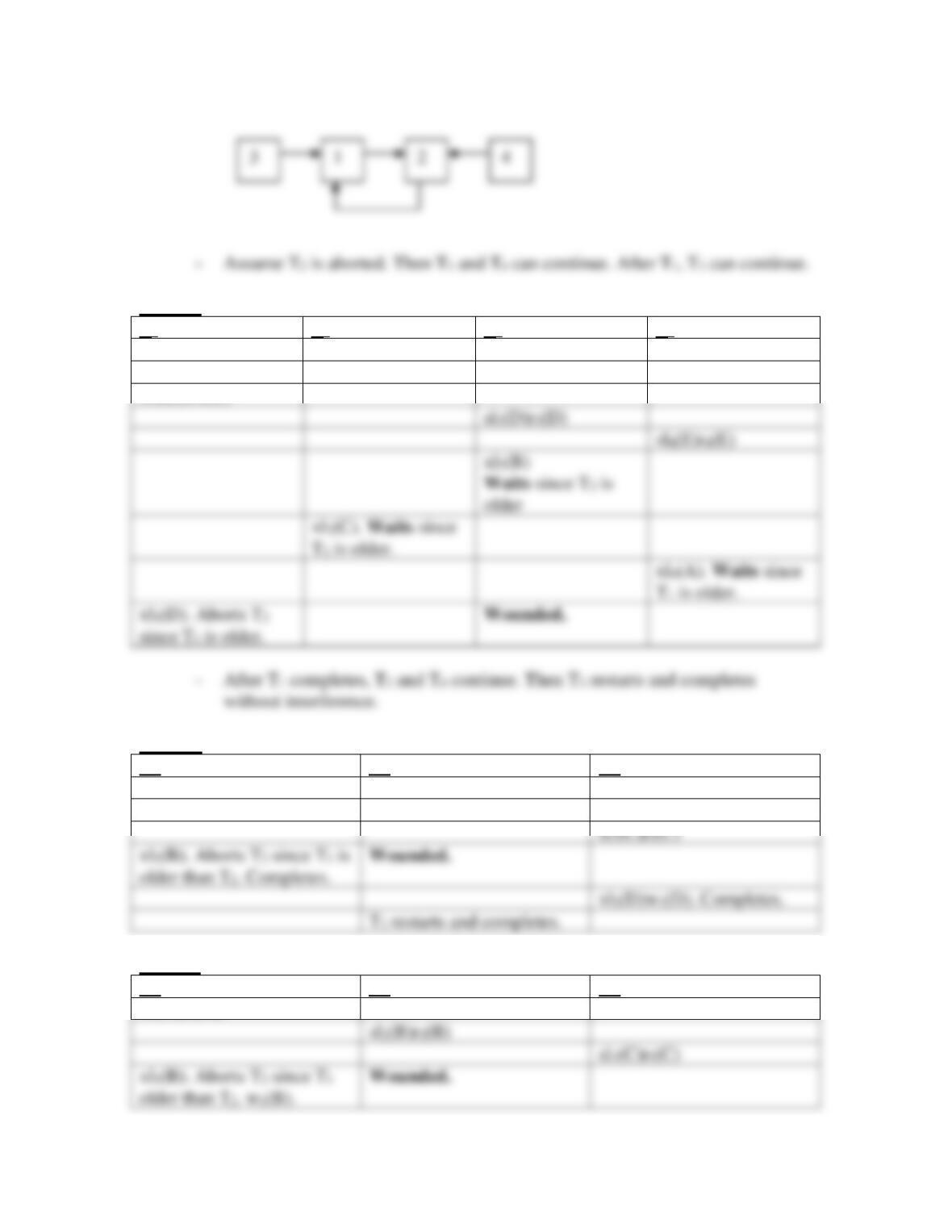
sl1(A)r1(A)
sl2(B)r2(B)
xl1(C)w1(C)
sl3(D)r3(D)
sl4(E)r4(E)
older
T1 is older.
T1 is older.
since T1 is older.
19.2.2b)
T1
T2
T3
sl1(A)r1(A)
sl(B)r2(B)
sl3(C)r3(C)
older than T2. Completes.
xl3(D)w3(D). Completes.
T2 restarts and completes.
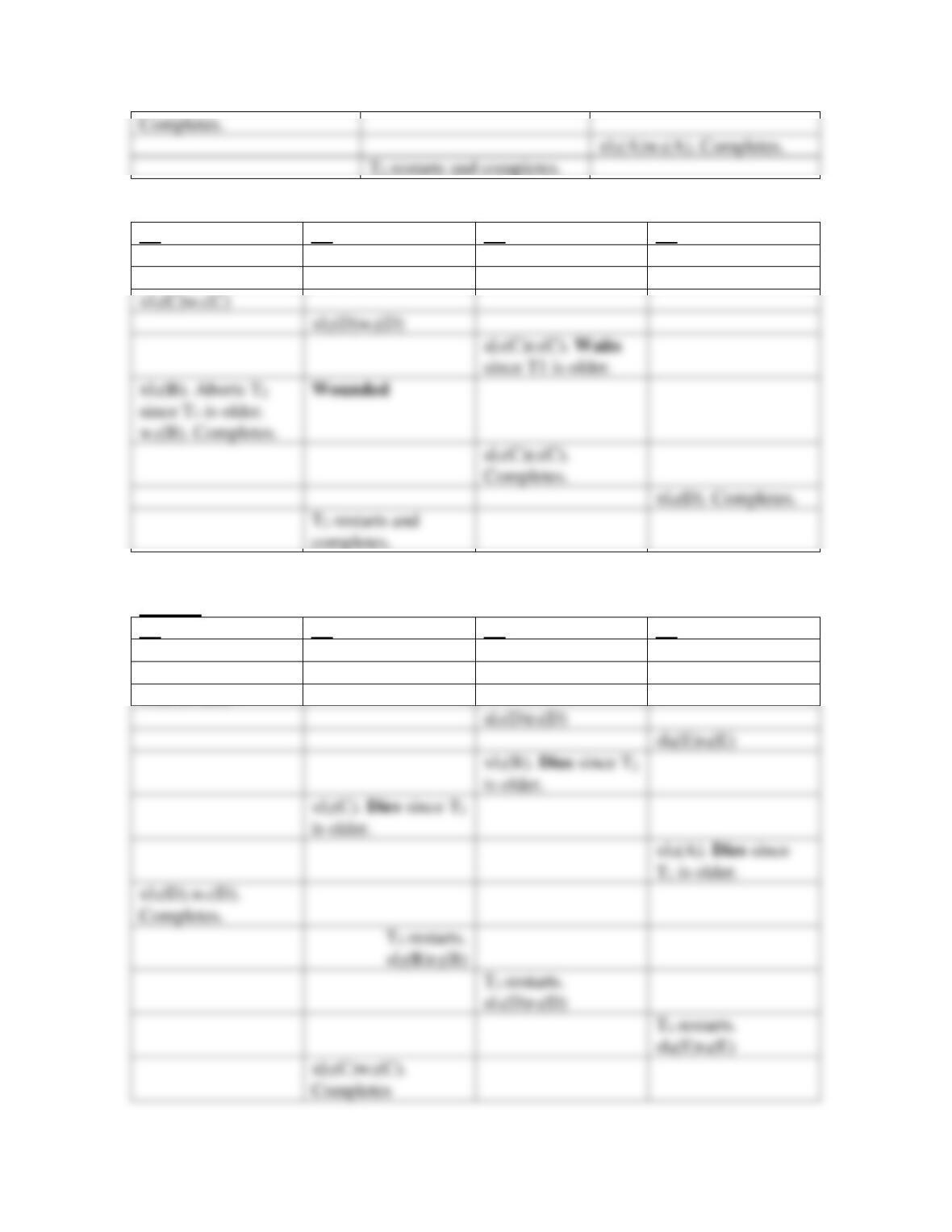
19.2.2c)
T1
T2
T3
sl1(A)r1(A)
sl2(B)r2(B)
sl3(C)r3(C)
older than T2. w1(B).
19.2.2d)
T1
T2
T3
T4
sl1(A)r1(A)
sl2(B)r2(B)
xl1(C)w1(C)
xl2(D)w2(D)
since T1 is older.
w1(B). Completes.
Completes.
xl4(D). Completes.
completes.
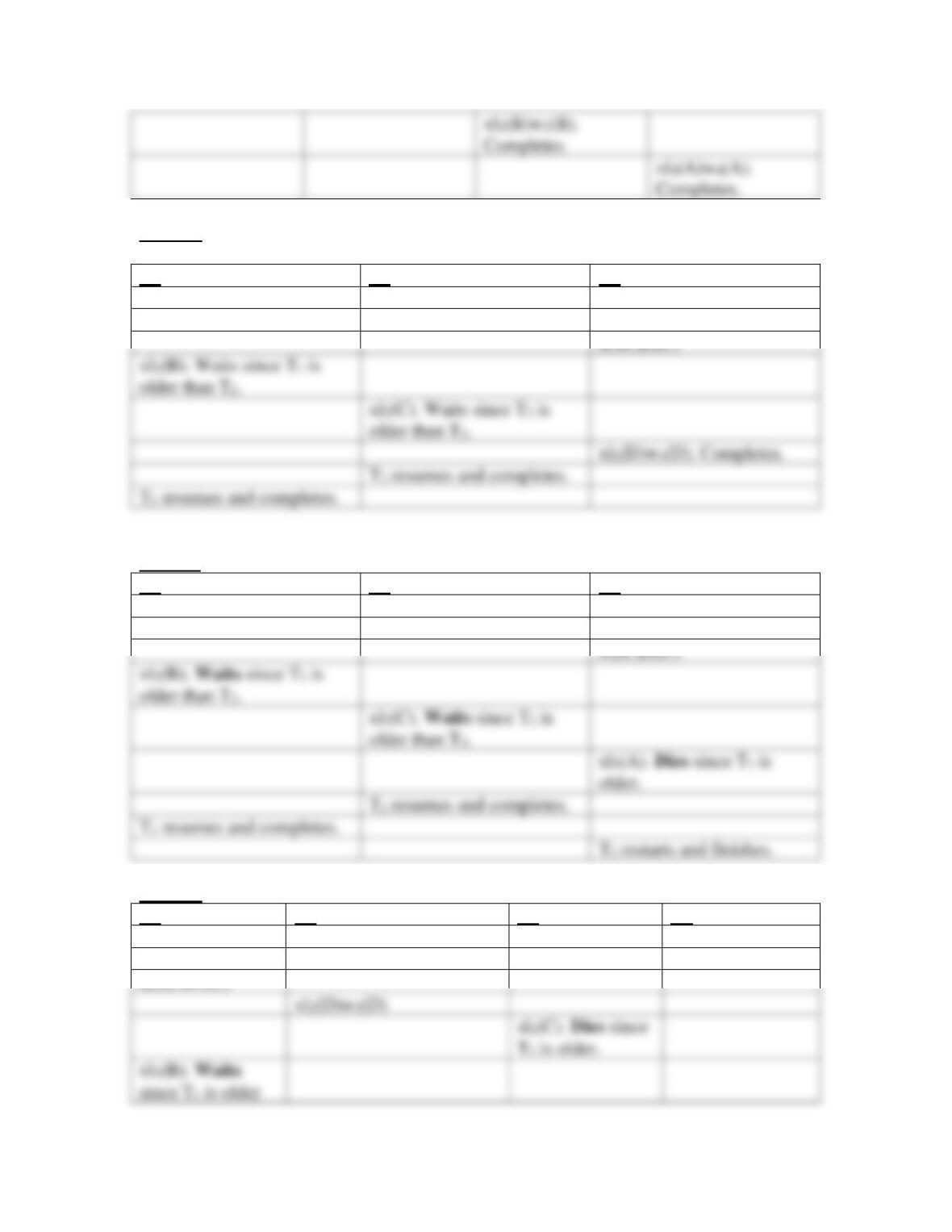
19.2.3a)
T1
T2
T3
T4
sl1(A)r1(A)
sl2(B)r2(B)
xl1(C)w1(C)
sl3(D)r3(D)
sl4(E)r4(E)
is older.
is older.
T1 is older.
Completes.
sl3(D)r3(D)
sl4(E)r4(E)
Completes
xl3(A)w3(A). Completes.
T2 restarts and completes.
19.2.3b)
T1
T2
T3
sl1(A)r1(A)
sl2(B)r2(B)
sl3(C)r3(C)
older than T2.
older than T3.
xl3(D)w3(D). Completes.
T2 resumes and completes.
T1 resumes and completes.
19.2.3c)
T1
T2
T3
sl1(A)r1(A)
sl2(B)r2(B)
sl3(C)r3(C)
older than T2.
older than T3.
older.
T2 resumes and completes.
T1 resumes and completes.
T3 restarts and finishes.
19.2.3d)
T1
T2
T3
T4
sl1(A)r1(A)
sl2(B)r2(B)
xl1(C)w1(C)
xl2(D)w2(D)
T1 is older.
since T1 is older
Completes
Completes.
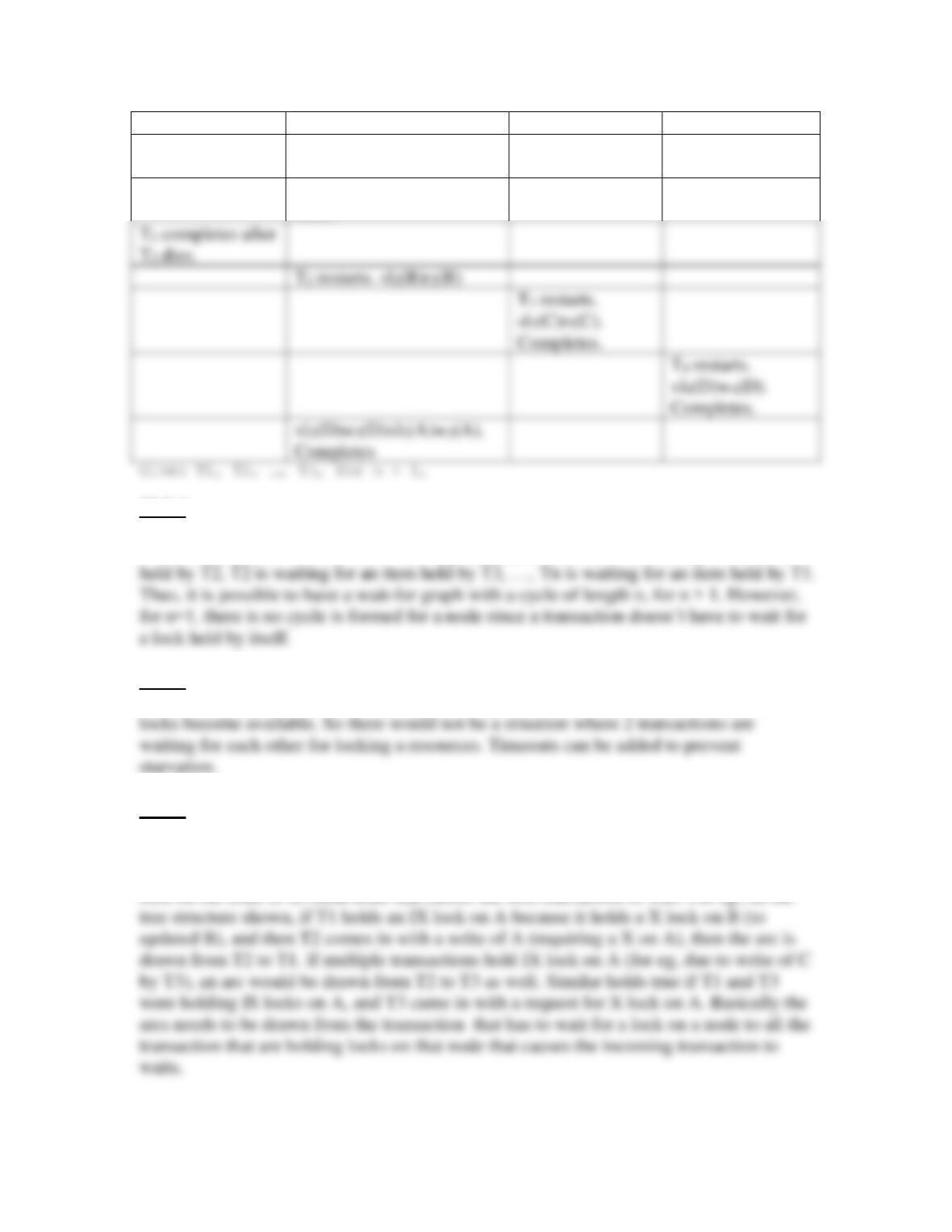
than T2.
xl4(D). Dies since
T2 is older.
xl2(A). Dies since T1 is
older.
19.2.4
There exists a {T1, T2, …, Tn} of waiting transaction such as T1 is waiting for an item
19.2.5
Yes this approach would avoid deadlocks since a transaction would never start until all
19.2.6
To construct a waits-for graph for an intention-locking system, the arcs need to be drawn
such that:
– the arc goes from transaction waiting for a lock on a node to the transaction holding the
lock on the node or its child node that causes the first transaction to wait. For eg., In the
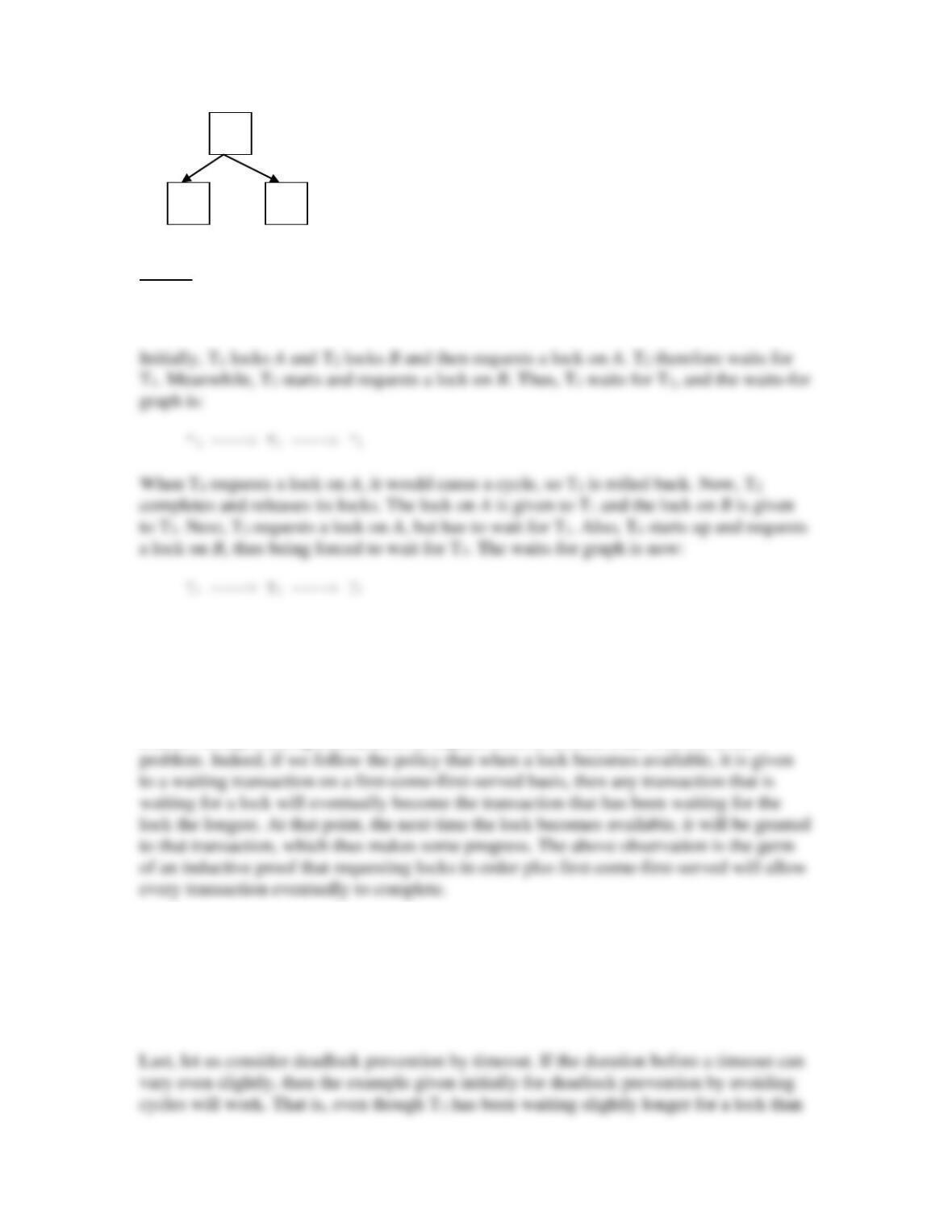
T2 dies.
Completes.
Completes.
Completes
19.2.7)
Suppose T1 is a transaction that tries to lock elements A and B in that order. There are
also an indefinitely long sequence of transactions T2, T3,… that lock B and then A.
The above graph is just like the first, except T4 and T3 have replaced T3 and T2,
respectively. As long as there is a supply of transactions like T2, T3, and T4, they can
prevent T1 from finishing ever.
Notice that the transactions in the example above request locks on A and B in different
orders. Perhaps forcing transactions to request locks in a fixed order will solve the
However, if the scheduler is able to give locks to any transaction it wishes, then it is easy
to make a transaction starve. Suppose T1 wants a lock on A when some other transaction
has that lock. As long as there is always another transaction besides T1 waiting for a lock
on A, and the scheduler always chooses to give the lock to some transaction other than T1
when the lock becomes available, T1 never makes any progress.
A
B
C
T1, if we allow that T1 might timeout first, then the sequence of events described above
could also occur with timeout-based deadlock prevention.
If timeouts occur for any transaction at exactly t seconds from when it first started to wait,
19.3.5
The task of the compensating transaction is first to determine whether the file f is still the
present one with that name, or whether it has been replaced with a later version.
1. If f is still in place, then the compensating transaction must
To see that this compensation works, we can consider all the possible cases above, and
check that the file system, after compensation, is the same as would be the case had f
never been written. If f was overwritten before compensation, then we surely leave the
There are two interesting issues. First, in order for there to be a compensating transaction,
it seems we must both remember the time at which the installation occurred (so we can
tell whether the file f has been overwritten when the uninstallation occurs), and we must
19.3.2
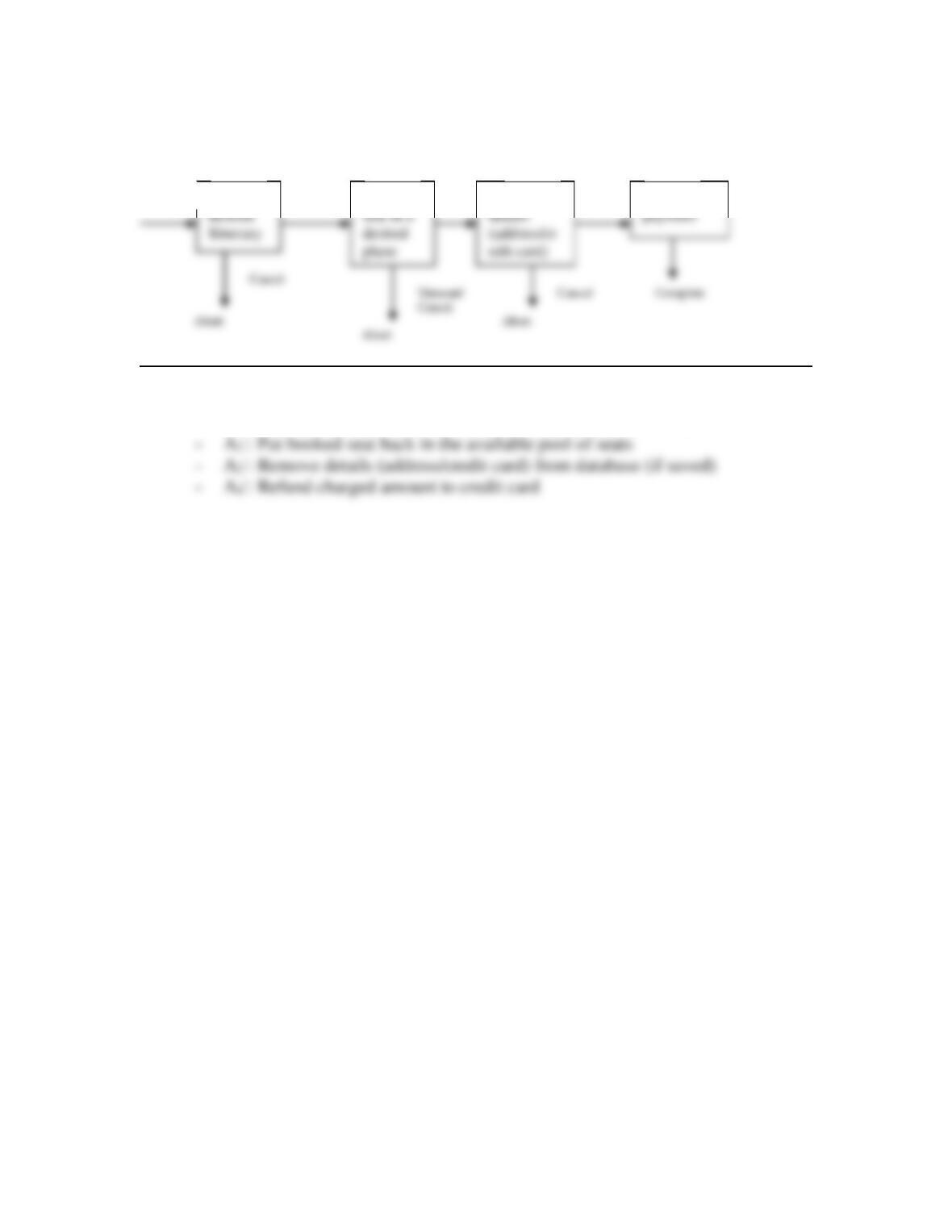
List of compensating actions:
– A1– : Remove desired itinerary details from database (if saved)
Cancel
Look for
Book a
Enter
Confirm
Start
A1
A2
A3
A4