
Solutions Manual
Chapter 14
Section 14.1
Exercise 14.1.1
(a) For dense index we need a key-pointer pair for each record, and so will need
n
10 blocks. For the data, we will need n
3blocks, and so the total number of
Exercise 14.1.2
(a) For dense index we need a key-pointer pair for each record, and so will need
(b) For the sparse index we need a key-pointer pair for each of the data block,
2
Exercise 14.1.3
(a) We need the same amount of blocks for the data as in 14.1.1 (a). We will
need log10nlevels of the index with total number of blocks of 1 +10 +102+
Exercise 14.1.4
Since the records could start at any location in the block the number of blocks
needed is m
10+1 (e.g. for m=0 we would need one block and for m=10 we
Exercise 14.1.5
(a) We would need 1000 (for records) +3000
50 (for pointers) +300
10 (for pointer-
value pairs), for the total of 1090.
Exercise 14.1.6
In the best case, we will only need to read one index file block to locate the key-
value pair we need. Further, in the best case, the records with the same value
would be clustered (i.e. 3 records per block). Therefore, we would need 1 (for
3
index) +1 (for pointers) +&10
3‘=6 I/O’s.
In the worst case, we would need to read all of the index file to locate the key-
Exercise 14.1.7
(a) The average number of words per document is
10000
X
n=1
100000
√n
1000 ≈20000
(b) In the worst case, each word will appear in each document at least once,
10 (for the word-pointer pairs) =201000.
(c) There are total of 20000000 word occurrences (from (a)), so we would need
20000000
50 (for the bucket pointers) +10000
10 (for the word-pointer pairs) =
401000.
Exercise 14.1.8
(a) We could first construct a relation C containing the bucket entries for ”cat”,
and relation D, containing the bucket entries for ”dog”. Then we would
4
join C and D picking only the document pointers such that D.type =C.type
Section 14.2
Exercise 14.2.1
(a) We would need 1000000
10 =100000 blocks for the data +1000000
69 =14493
blocks for the leaf nodes +14493
70 =208 blocks for the next B-tree level,
208
70 =3 for the next level, and one block for the root. The total would be
114705 blocks. We would need 5 I/O’s (4 for the B-tree levels +data page).
4 I/O’s (4 for the B-tree levels).
5
(e) We would need 1000000
15 =66667 blocks for the primary data +66667 for
the overflow blocks, 66667
Exercise 14.2.2
Note that the number of blocks does not change. We only need to calculate the
average number of disk I/O’s.
(a) We would need 4 I/O’s to get to the first leaf block. To match 1000 records
we need to examine 1000
Exercise 14.2.3
12n+4(n+1) 616384, so 1023 keys and 1024 pointers.
Exercise 14.2.4
(a) 5 keys and 6 pointers for the interior nodes, 5 keys and 5 pointers in the leaf
nodes
6
(b) 5 keys and 6 pointers for the interior nodes, 6 keys and 6 pointers in the leaf
nodes
Exercise 14.2.5
(a) Start at the root. 41 >13 so follow the second pointer. 31 641 <43 so
follow the third pointer. We find one of the keys is 41 so we follow the third
pointer to the data block.
(d) Start at the root. Follow leftmost pointers until the leaf node. For each of
the keys, if it less than 30, follow the pointer to the data block. Thus we
will follow data pointers for keys 2, 3, 5. Since 30 >5 follow the next leaf
pointer and repeat. Thus we will follow the data pointers for keys 7, 11,
then next leaf, 13, 17, 19, next, 23, 29, next. 30 <31 so we are done.
(e) Start at the root. 30 >13 so follow the second pointer. 23 630 <31 so
follow the second pointer. We find none of the keys is greater than 30 so we
7
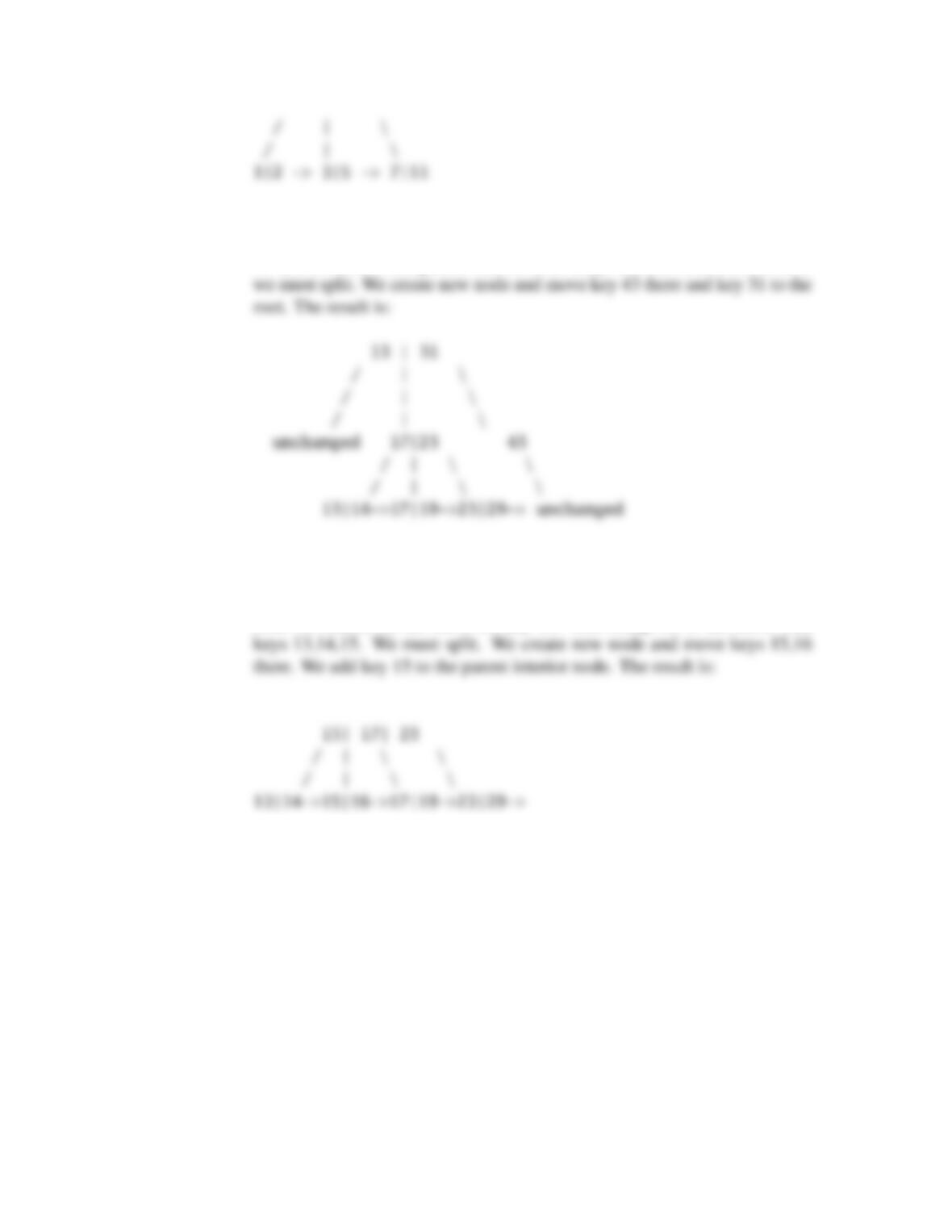
(g) We search for the key 14, this brings us to the leave with keys 13,17,19.
There is no room for 14 so we split. We create new block and move keys
17 and 19 there. The parent interior node (keys 23,31,43) has no room so
Next we search for the key 15. This brings us to the leave with keys 13,14.
We insert 15. No other changes.
Next we search for the leave for key 16. This brings us to the leave with
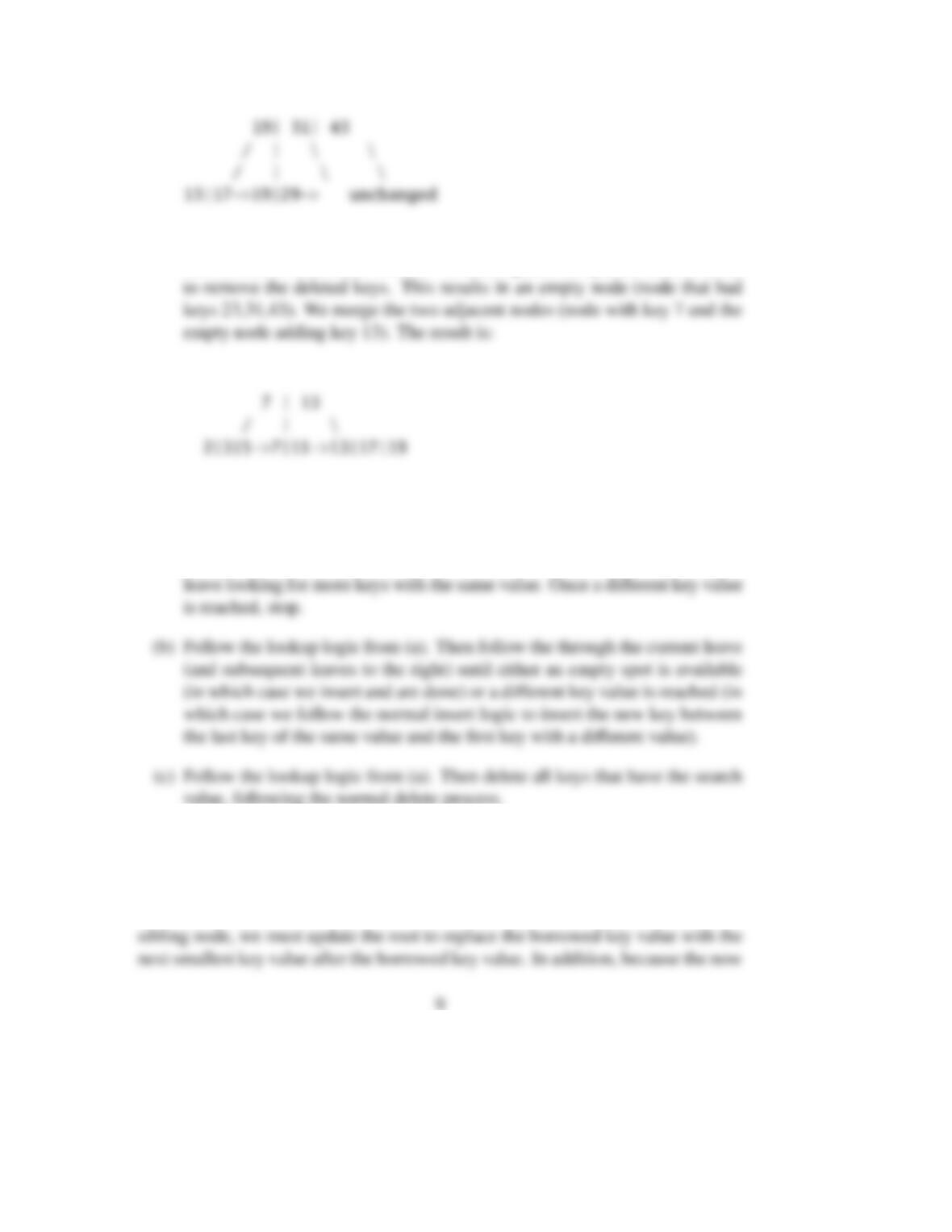
(h) We search for the key 23. This brings us to the leave node with keys 23,
29. We delete key 23 and borrow the highest key (19) from the neighboring
leave node. We also update the parent interior node to include key 19. The
result is:
8
(i) As in (h) we locate the leave node with keys 23,29. We delete the node
and all leave nodes that follow. We also update the parent interior node
Exercise 14.2.6
(a) Follow the same lookup procedure as for ”non-duplicate” B-tree. If the key
is found, follow through the current (and subsequent leaves to the right)
Exercise 14.2.7
When borrowing from the left adjacent non-sibling node, no additional logic in
the existing algorithm is required. When borrowing from the right adjacent non-
Exercise 14.2.8
Interior nodes must have at least 2 pointers and at least 1 key and leaf nodes must
have at least 2 pointers and at least 2 keys (the max is 3 keys).
(a) The only possible layouts for the leaf nodes are 2-2-2 and 3-3. For both
cases the next level must be the root. So there are two different B-trees.
(b) The only possible layouts for the leaf nodes are: 2-2-2-2-2, 2-2-3-3, 2-3-
2-3, 2-3-3-2, 3-2-2-3, 3-2-3-2, 3-3-2-2. For the case with 4 leaves, we can
(c) The maximum number of leaf nodes we could have is 7 where one node
must have 3 keys and the rest of the nodes must have 2 keys (e.g. 2-2-2-2-2-
2-3). There are 7C1=7 combinations. For each of these combinations we
Exercise 14.2.9
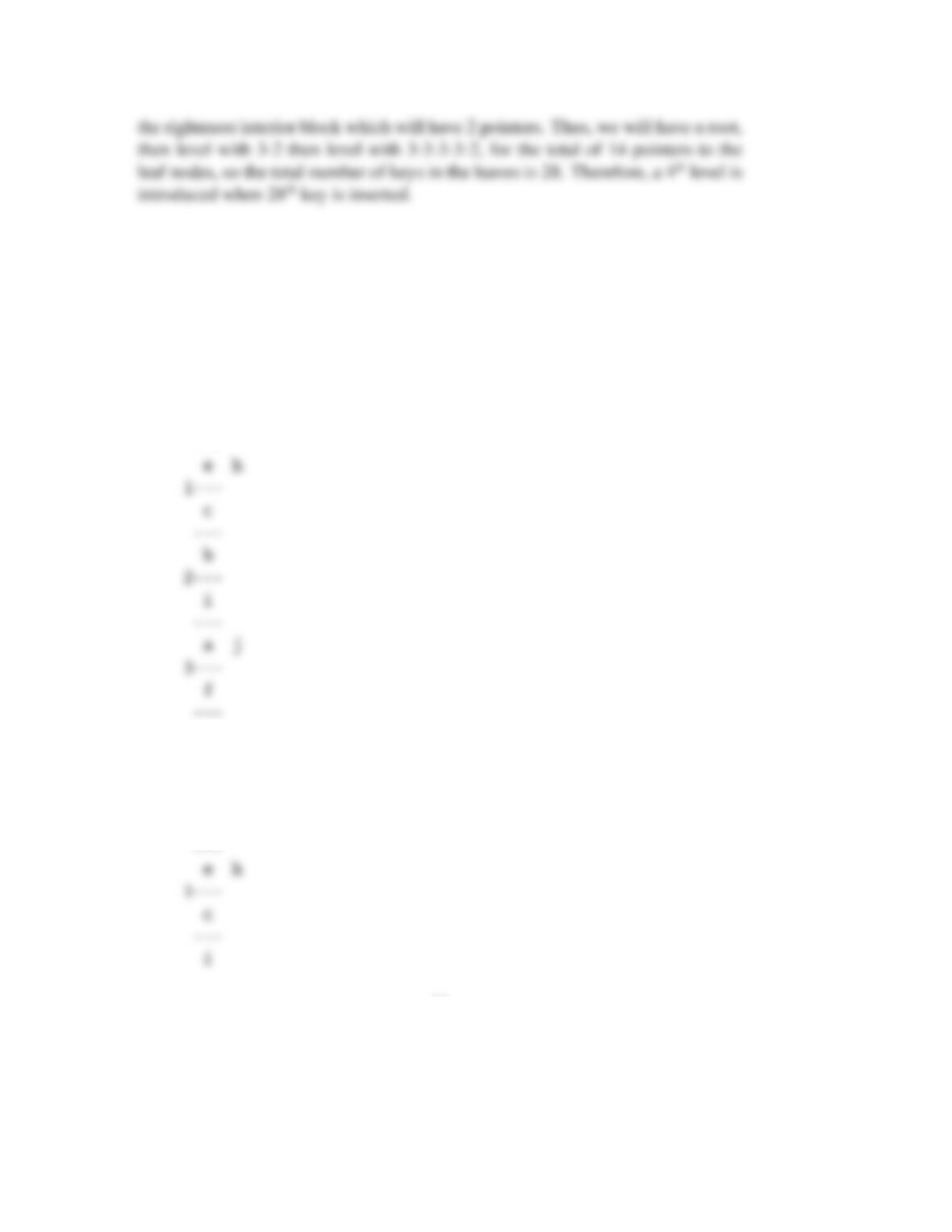
When we split the leaf blocks we divide pointers 2 and 2, so at the time of 4th level
added we will have only pairs of keys at each leaf. Similarly, because we split 3
Section 14.3
Exercise 14.3.1
(a) —
d
0—
g
—
(b) —
d
0—
g
11
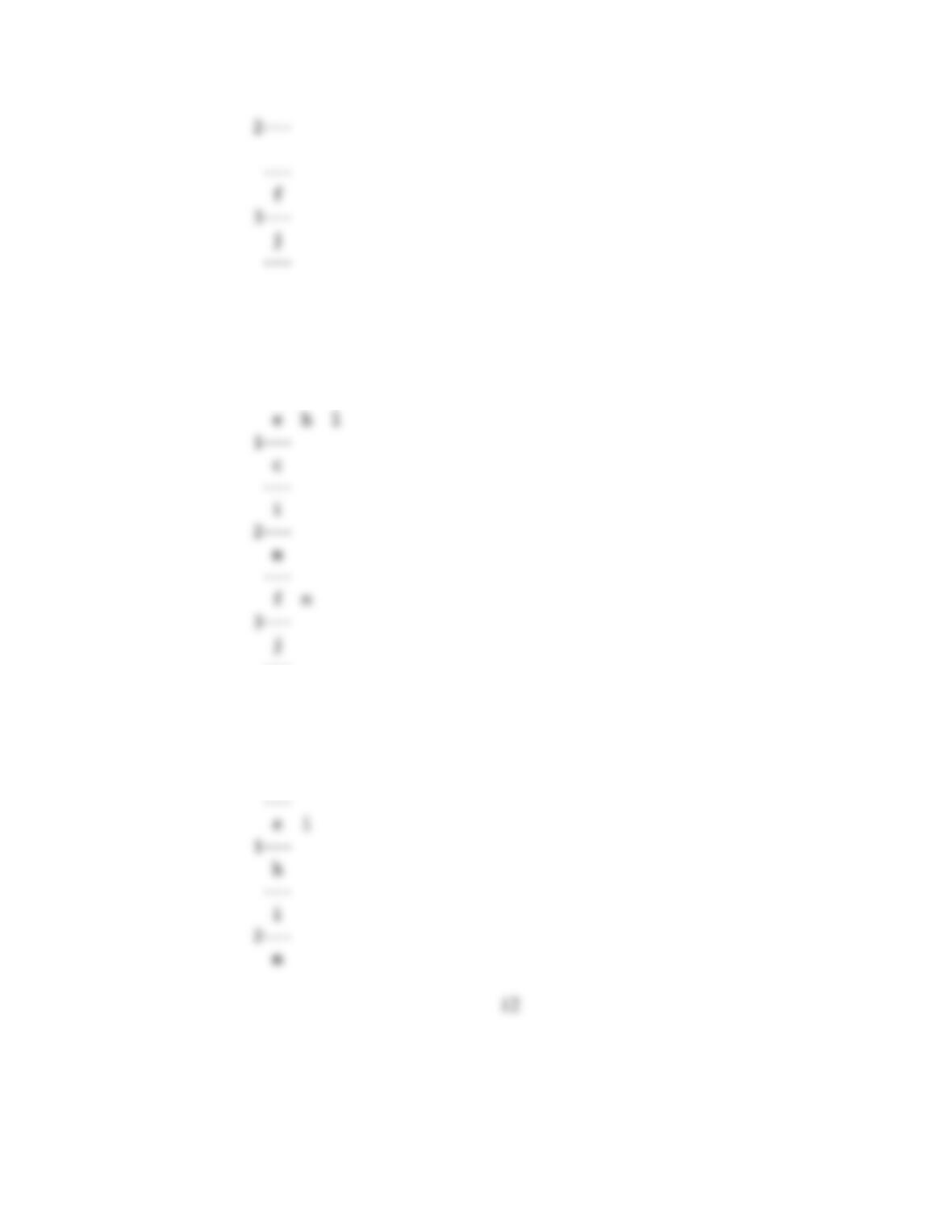
(c) —
d k
0—
g
—
—
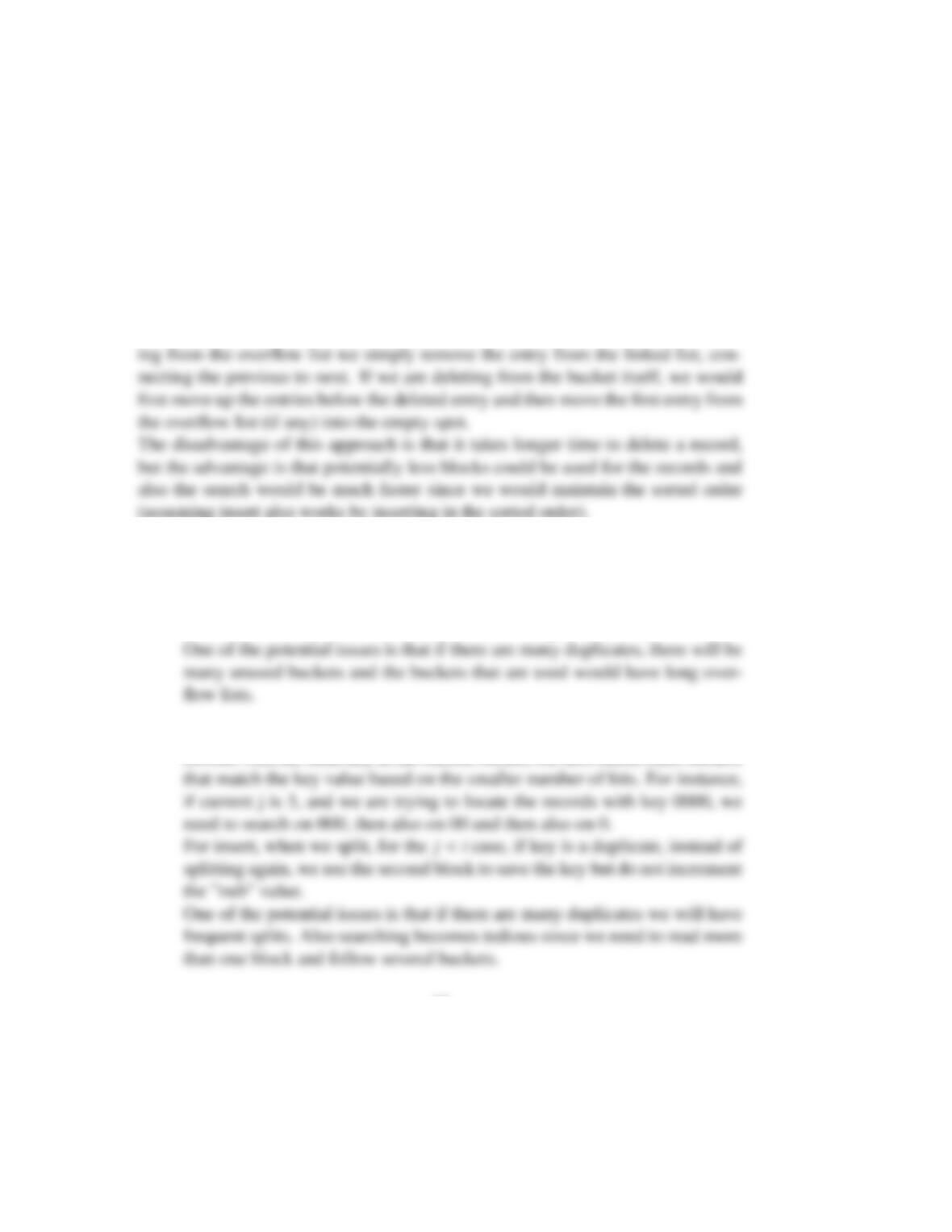
(d) —
g
0—
k
—
f n
3—
j
—
Exercise 14.3.2
For deletion, we would locate the record by applying hash function and then
searching within the bucket (following the overflow linked list if needed). If delet-
Exercise 14.3.3
(a) For lookup and deletion we simply need to continue looking for other records
with the same key in the current bucket. No changes for insert.
(b) For lookup and deletion we not only need to continue looking for other
records with the same key in the current bucket, but also check other buckets
13
Exercise 14.3.4
(a) Since each integer can be represented as 10a+bwhere 0 6b<10 and so
its square modulo 10 is the same as b2modulo 10. The squares of 0 to 9
Exercise 14.3.5
In order for all members of the block to go to the same created block, they must
Exercise 14.3.6
(a) —
0000
000
0001
—
—
1000
100
1001
—
1010
101
(b) i = 3, n = 6, r = 16
—
0000
000 1000
15
—
(c) —
0001
000
0000
—
0011
001
0010
—
101
1010
—
1101
110
1100
16