Sample Syllabus
CSCI 1301 – Introduction to Programming Principles
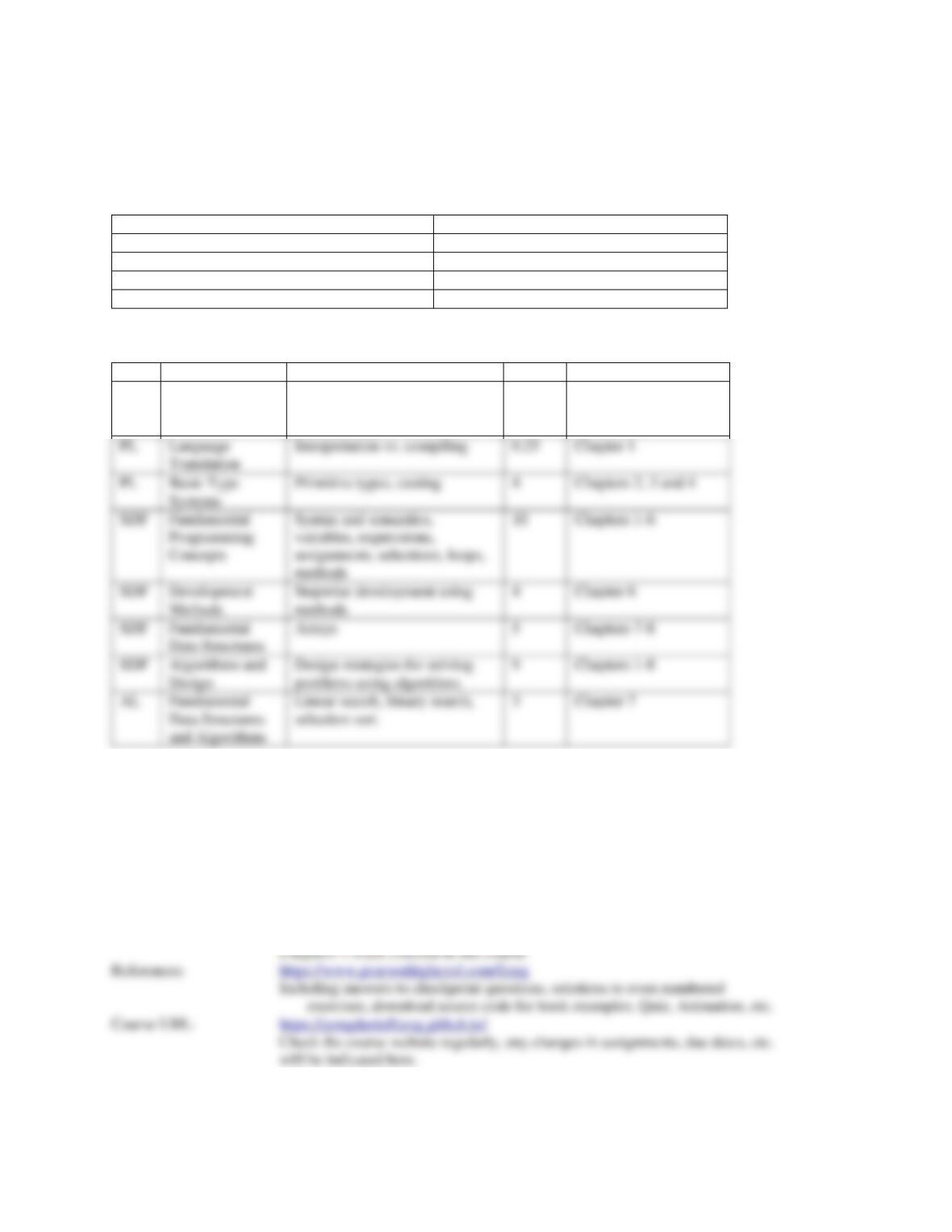
Knowledge Areas that contain topics and learning outcomes covered in the course
Knowledge Areas
Total Hours of Coverage
Software Development Fundamentals (SDF)
28
Programming Languages (PL)
4.25
Algorithm and Complexity (AL)
3
Social Issues and Professional Practice (SP)
0.75
Body of Knowledge coverage
KA
Knowledge Unit
Topics Covered
Hours
Reference in the Text
SP
History
History of computers,
programming languages,
Internet, Web
0.75
Chapter 1
COURSE INFORMATION
Meeting: Class
Section 01 MWF 9:00-9:50 a.m. 02 MWF 1:00-1:50 a.m. Science Center
1503B
Instructor:
Dr. Y. Daniel Liang
Office:
Science Center 272
Office Phone:
(912) 344 – 3264
email:
y.daniel.liang@gmail.com
Office Hours:
MWF 8:00 – 9:00 a.m., 2:00 – 3:00 p.m., or by appointment
Text:
will be indicated here.
Introduction to Java Programming, Twelfth Brief Edition, Prentice–Hall.
PREREQUISITES
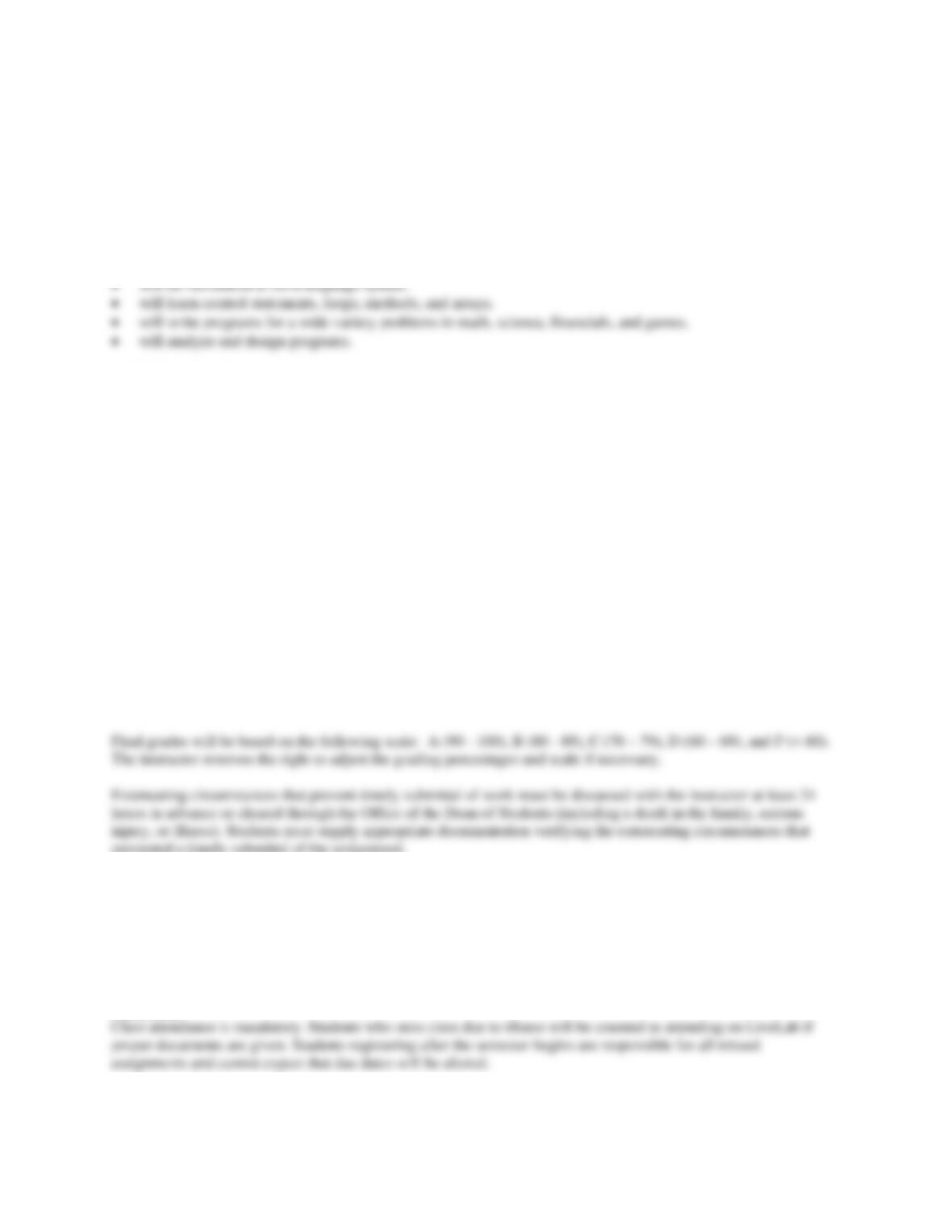
Translation
Interpretation vs. compiling
Primitive types, casting
Chapters 2, 3 and 4
methods
methods
Data Structures
Algorithms and
Design strategies for solving
problems using algorithms
and Algorithms
Linear search, binary search,
Chapter 7
Math 1113 Pre–Calculus or equivalent
CATALOG DESCRIPTION
Overview of computers and programming. Fundamentals of structured computer programming; primitive data types,
expressions, control statements, methods, arrays, searching, sorting; debugging techniques.
COURSE OBJECTIVES
As part of this course, students
• will be introduced to programming concepts and techniques.
ABET COURSE OUTCOMES
Upon successful completion of this course, students will be able to
• analyze and design strategies for solving basic programming problems.
• use primitive data types, selection statements, loops, methods to write programs.
• develop programs to solve a variety of problems in math, science, business, and games.
• use the step–wise refinement approach.
• use arrays to store, process, and sort data.
• use an IDE to develop programs.
CLASS
Class time will be used for short lectures, design examples, in class exercises, and quizzes and exams. Class
attendance is expected and students are responsible for all material covered in class. Missed work, quizzes, or exams
will receive a grade of zero. Class disruption (cell phones, sleeping, talking, etc.) during class will not be tolerated.
A warning will be given on the first instance and you will be asked to leave the class on any subsequent instances.
GRADING
Grades will be determined from: attendance (5% Attendance will be checked regularly, but not for every class),
programming exercises (25%), three exams (15% each), and final exam (25%). Evaluation scheme is subject to
change with a prior notice. Dates for exams will be announced in the class.
prevented a timely submittal of the assignment.
ASSIGNMENTS
Due dates for programming assignments will be announced in the class. Missed quizzes and late or missed
assignments will receive a grade of zero. Programming assignments must be done individually. Source file
printout must be submitted in the class on the due day regardless its status (complete or incomplete). In addition to
submitting a hard copy, students must also submit the programs to LiveLab. Your grades will be recorded on
LiveLab.
ABSENCES
EMAIL POLICY

For a prompt response, put your name, course number, and class time in the subject of the email.
HELP
Before you ask for help on programs, explain to yourself what the program is doing step–by–step. When you visit me
during office hours, make sure you have already submitted your program on LiveLab and bring a printed copy of the
program. You can resubmit the program on LiveLab before it is due.
COMPUTER LABS
The following Georgia Southern labs have the software necessary for this course: SC 129, SC 2016
DISABILITIES OR SPECIAL NEEDS
If you have a physical, psychological, and/or learning disability that might affect your performance in this class, please
contact the Office of Disability Services which is located in Memorial College Center Room 207A, phone 912 344–2744. The
ACADEMIC HONESTY
Students must abide by the Georgia Southern Honor Code and Student Code of Conduct. Students are expected to
perform their work individually unless otherwise specified by the instructor. Plagiarism will be checked by LiveLab.
Submission to LiveLab with the intention to deceive LiveLab is considered as cheating.
All instances of academic misconduct will receive a zero for the assignment and be reported to the Dean of Students.
A second instance of academic misconduct will result in an automatic F in the course and possible disciplinary
action.
Sample Syllabus
CSCI 1302 – Advanced Programming Principles
Knowledge Areas that contain topics and learning outcomes covered in the course
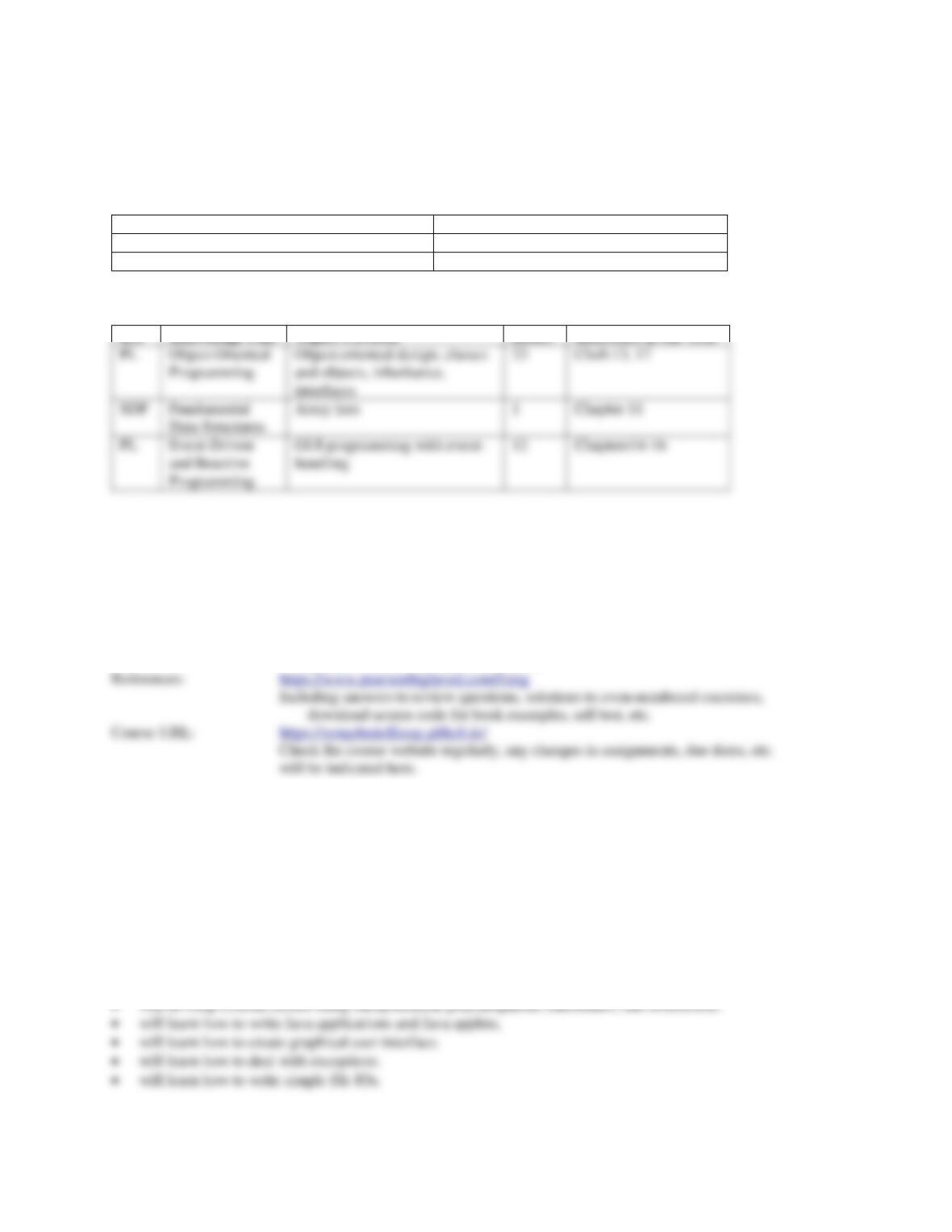
Knowledge Areas
Total Hours of Coverage
Software Development Fundamentals (SDF)
1
Programming Languages (PL)
35
Body of Knowledge coverage
KA
Knowledge Unit
Topics Covered
Hours
Reference in the Text
COURSE INFORMATION
Instructor:
Dr. Y. Daniel Liang
Office:
Science Center 272
Office Phone:
(912) 344 – 3264
email:
y.daniel.liang@gamil.com
Office Hours:
MWF 8:00 – 9:00 a.m., 2:00 – 3:00 p.m., or by appointment
Text:
Introduction to Java Programming, Twelfth Brief Edition, Prentice–Hall, 2012.
Chapters 9–17 are covered in this course
will be indicated here.
PREREQUISITES
CSCI 1301 Introduction to Programming Principles
CATALOG DESCRIPTION
Object–oriented design and implementation. Topics include: object and class design, inheritance, polymorphism,
interfaces, graphical user interfaces and event–driven programming, exception handling, file input and output.
COURSE OBJECTIVES
As part of this course, students
• will learn reusing software through a collection of Java predefined classes.
• will understand the differences between procedural and object–oriented paradigms.
Data Structures
COURSE OUTCOMES
Upon successful completion of this course, students will be able to
• understand OO concepts: encapsulation, inheritance, polymorphism, interfaces, abstract classes
• use Unified Modeling Language for design, analysis, and documentation
• develop graphical user interfaces
CLASS
Class time will be used for short lectures, design examples, in class exercises, and quizzes and exams. Class
attendance is expected and students are responsible for all material covered in class. Missed work, quizzes, or exams
will receive a grade of zero. Class disruption (cell phones, sleeping, talking, etc.) during class will not be tolerated.
A warning will be given on the first instance and you will be asked to leave the class on any subsequent instances.
GRADING
Grades will be determined from: attendance (5%), programming exercises (25%), two exams (20% each), and final
exam (30%). Evaluation scheme is subject to change with a prior notice. Dates for exams will be announced in the
class.
Attendance will be checked regularly. Missing classes frequently will be automatically dropped out of class.
Final grades will be based on the following scale: A (90 – 100), B (80 – 89), C (70 – 79), D (60 – 69), and F (< 60).
The instructor reserves the right to adjust the grading percentages and scale if necessary.
Extenuating circumstances that prevent timely submittal of work must be discussed with the instructor at least 24
hours in advance or cleared through the Office of the Dean of Students (including a death in the family, serious
injury, or illness). Students must supply appropriate documentation verifying the extenuating circumstances that
prevented a timely submittal of the assignment.
ASSIGNMENTS
EMAIL POLICY
For a prompt response, put CSCI 1302 in the subject of the email.
HELP
Before you ask for help on programs, explain to yourself what the program is doing step–by–step. When you visit me
during office hours, make sure you have already submitted your program on LiveLab and bring a printed copy of the
program. You can resubmit the program on LiveLab before it is due.
COMPUTER LABS
The following Georgia Southern labs have the software necessary for this course: SC 129, SC 2016
DISABILITIES OR SPECIAL NEEDS
If you have a physical, psychological, and/or learning disability that might affect your performance in this class, please
the start of each exam or assignment, whether you will need any accommodation. Notification after the start of an exam or
last minute notification on an assignment will not be accepted.
ACADEMIC HONESTY
Students must abide by the Georgia Southern Honor Code. Students are expected to perform their work individually
Sample Syllabus
CSCI 3230 – Data Structures and Algorithms
Knowledge Areas that contain topics and learning outcomes covered in the course
Knowledge Areas
Total Hours of Coverage
Software Development Fundamentals (SDF)
3
Programming Languages (PL)
1
Algorithm and Complexity (AL)
31
Body of Knowledge coverage
KA
Knowledge Unit
Topics Covered
Hours
Reference in the Text
SDF
Algorithms and
Solve problems using recursion
3
Chapter 18
COURSE INFORMATION
Meeting: Class
MWF 11:00–11:50 a.m. Science Center 2506
Instructor:
Dr. Y. Daniel Liang
Office:
Science Center 272
Office Phone:
(912) 344 – 3264
email:
y.daniel.liang@gmail.com
Office Hours:
MWF 8:00 – 9:00 a.m., 2:00 – 3:00 p.m., or by appointment
Text:
Introduction to Java Programming, Twelfth Comprehensive Edition, Prentice–
Hall
will be indicated here.
PREREQUISITES
CSCI 1302 Advanced Programming Principles and MATH 1161 Calculus I
CATALOG DESCRIPTION
Topics include: recursion, generics, linked lists, stacks, queues, hash tables, trees, graphs, heaps,) sorting algorithms,
and time and space complexity analysis. Use of application program interfaces (API’s).
COURSE OBJECTIVES
efficiency, order of magnitude
Algorithm
Advanced DS
Balanced binary tree, AVL tree
2
As part of this course, students
• will learn the concepts and techniques for recursion.
• will learn how to parameterize data types using generics.
• will learn how to measure the algorithm complexity using the Big O notation.
COURSE OUTCOMES
Upon successful completion of this course, students will be able to
• design recursive solutions.
• analyze algorithm complexities.
• describe and analyze sorting algorithms.
CLASS
Class time will be used for short lectures, design examples, in class exercises, and quizzes and exams. Class
attendance is expected and students are responsible for all material covered in class. Missed work, quizzes, or exams
will receive a grade of zero. Class disruption (cell phones, sleeping, talking, etc.) during class will not be tolerated.
A warning will be given on the first instance and you will be asked to leave the class on any subsequent instances.
GRADING
Grades will be determined from: attendance (5% Attendance will be checked regularly, but not for every class),
programming exercises (40%), two exams (15% each), and final exam (25%). Evaluation scheme is subject to
change with a prior notice. Dates for exams will be announced in the class.
Attendance will be checked regularly. Missing classes frequently will be automatically dropped out of class.
Final grades will be based on the following scale: A (90 – 100), B (80 – 89), C (70 – 79), D (60 – 69), and F (< 60).
The instructor reserves the right to adjust the grading percentages and scale if necessary.
Extenuating circumstances that prevent timely submittal of work must be discussed with the instructor at least 24
hours in advance or cleared through the Office of the Dean of Students (including a death in the family, serious
injury, or illness). Students must supply appropriate documentation verifying the extenuating circumstances that
prevented a timely submittal of the assignment.
ASSIGNMENTS
Due dates for programming assignments will be announced in the class. Missed quizzes and late or missed
assignments will receive a grade of zero. Programming assignments must be done individually. Source file
ABSENCES
Class attendance is mandatory. Students who miss class due to illness will be counted as attending on LiveLab if
proper documents are given. Students registering after the semester begins are responsible for all missed
assignments and cannot expect that due dates will be altered.
EMAIL POLICY
For a prompt response, put CSCI 3230 in the subject of the email.
HELP
Before you ask for help on programs, explain to yourself what the program is doing step–by–step. When you visit me
during office hours, make sure you have already submitted your program on LiveLab and bring a printed copy of the
program. You can resubmit the program on LiveLab before it is due.
COMPUTER LABS
The following Georgia Southern labs have the software necessary for this course: SC 129, SC 2016
DISABILITIES OR SPECIAL NEEDS
If you have a physical, psychological, and/or learning disability that might affect your performance in this class, please
contact the Office of Disability Services which is located in Memorial College Center Room 207A, phone 912 344–2744. The
Disability Services Office will determine appropriate accommodations based on testing and medical documentation. Please
ACADEMIC HONESTY
Students must abide by the Georgia Southern Honor Code and Student Code of Conduct. Students are expected to
perform their work individually unless otherwise specified by the instructor. Plagiarism will be checked by LiveLab.
Students may discuss assignments in general terms with other students and may receive assistance from the
instructor or classmates. Assistance does not mean obtaining working designs or solutions and modifying them; this
is considered copying.
Submission to LiveLab with the intention to deceive LiveLab is considered as cheating.