1
Name:__________________
Covers chs 1-10
CSCI 1301 Final
Georgia Southern University
Instructor: Dr. Y. Daniel Liang
Please note that the university policy prohibits giving the exam score by email. If you need to know your
final exam score, come to see me during my office hours next semester.
I pledge by honor that I will not discuss the contents of this exam with
anyone.
Signed by ___________________ Date ___________________
Part I. (2pts each)
a. How many times is the following loop body repeated? What is the
output of the loop?
b. Convert the following for loop into a do–while loop.
}
c. Convert the following if statement using a switch statement
// Find interest rate based on year
Part II: Show the output of the following code:
a: (2 pts)
Add the static keyword in the place of ? if appropriate.
2
public class Test {
int count;
b. (2 pts)
Suppose the input is 2 3 4 5 0. What is the output of the following
code?
import java.util.Scanner;
c. (2 pts)
public class Test {
3
d. (2 pts)
public class Test {
public static void main(String[] args) {
int number = 0;
int[] numbers = new int[1];
e. (3 pts) Describe the difference between passing a parameter of a primitive type and passing a
parameter of a reference type. Show the output of the following programs:
public class Test {
4
}
}
f. (3 pts) Fill in the code in the following program.
public class Circle {
/** The radius of the circle */
private double radius = 1;
5
Part III: (Write programs)
1. (15 pts) Write the following method that returns true if the list is already sorted in increasing order.
public static boolean isSorted(int[] list)
Write a test program that prompts the user to enter a list and displays
whether the list is sorted or not. Here is a sample run. Note that the
first number in the input indicates the number of the elements in the
list.
<Output>
<End Output>
<Output>
<End Output>
See the next page for the outline of the program:
6
public class Test {
}
}
}

7
2. (15 pts) (Occurrences of a specified character) Write a method that
finds the number of occurrences of a specified character in the string
using the following header:
8
3. (15 pts) (Draw UML diagram and implement the class) Design a class named MyPoint to represent a
point with x– and y-coordinates. The class contains:
9
Part IV: Multiple Choice Questions: (1 pts each)
(1. Mark your answers on the sheet. 2. Login and click Take Instructor
Assigned Quiz for QFinal. 3. Submit it online within 5 mins. 4. Close
the Internet browser.)
URL: http://tiger.armstrong.edu/JavaLiveLab
1. ________ is invoked to create an object.
a. A constructor
b. The main method
c. A method with a return type
d. A method with the void return type
#
2. Analyze the following code.
class TempClass {
int i;
public void TempClass(int j) {
int i = j;
}
}
#
3. Variables that are shared by every instance of a class are __________.
a. public variables
b. private variables
c. instance variables
d. class variables
#
4. To create an instance of BigInteger for 454, use
a. BigInteger(454);
b. new BigInteger(454);
c. BigInteger(“454”);
d. new BigInteger(“454”);
#
5. What is the output of the following code?
public class Test {
public static void main(String[] args) {
java.math.BigInteger x = new java.math.BigInteger(“3”);
10
java.math.BigInteger y = new java.math.BigInteger(“7”);
x.add(y);
System.out.println(x);
}
}
a. 3
b. 4
c. 10
d. 11
#
6. The “less than or equal to” comparison operator in Java is __________.
#
7. Analyze the following code fragments that assign a boolean value to the variable even.
Code 1:
if (number % 2 == 0)
even = true;
else
even = false;
Code 2:
even = (number % 2 == 0) ? true: false;
Code 3:
even = number % 2 == 0;
A. Code 3 has a syntax error, because you attempt to assign number to even.
B. Code 2 has a syntax error, because you cannot have true and false literals in the conditional expression.
C. All three are correct, but Code 1 is preferred.
D. All three are correct, but Code 2 is preferred.
E. All three are correct, but Code 3 is preferred.
#
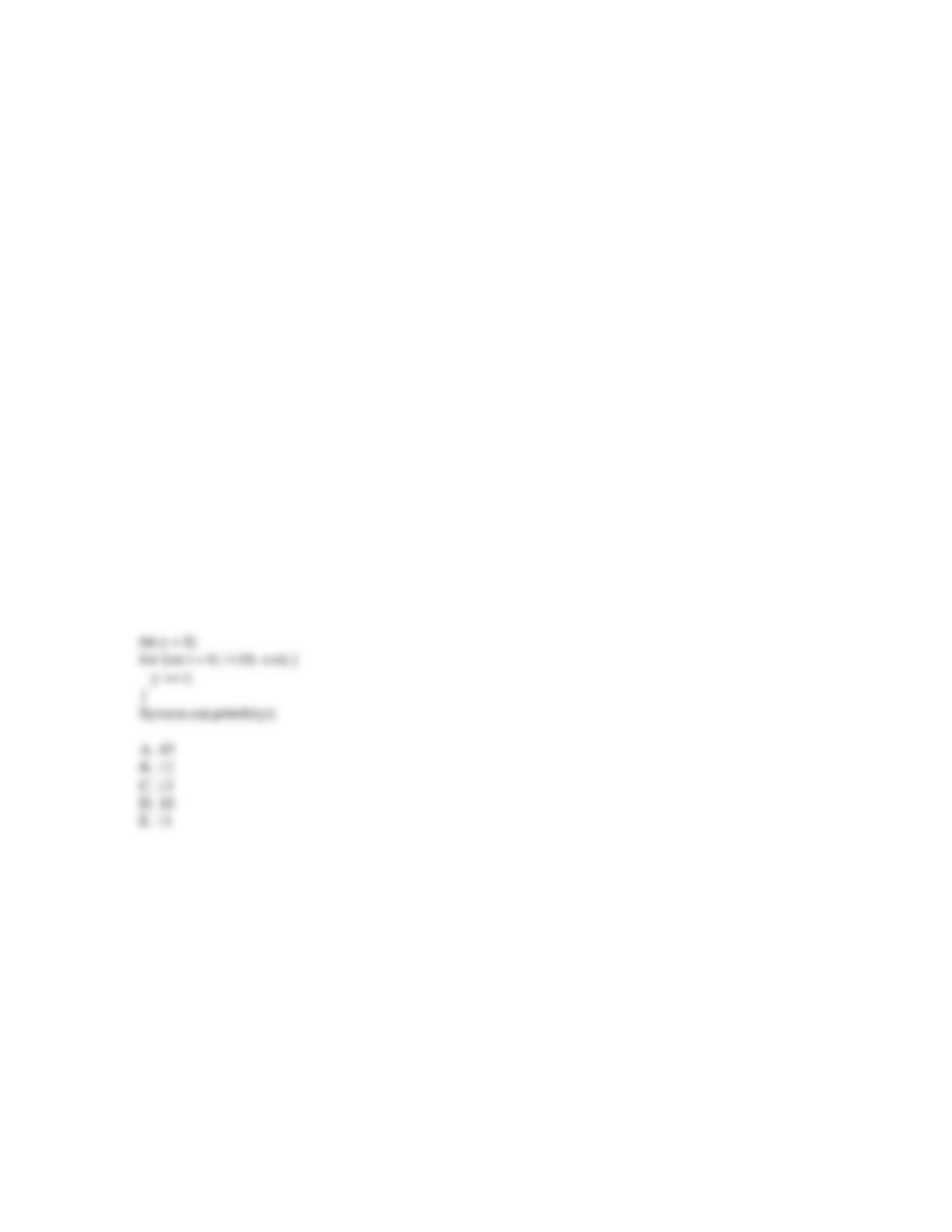
8. How many times will the following code print “Welcome to Java”?
#
11
9. What is the value in count after the following loop is executed?
int count = 0;
do {
System.out.println(“Welcome to Java”);
} while (count++ < 9);
System.out.println(count);
A. 11
B. 0
C. 9
D. 8
E. 10
#
10. What is the number of iterations in the following loop:
for (int i = 1; i <= n; i++) {
// iteration
}
A. 2*n
B. n
C. n – 1
D. n + 1
#
11. What is the output for y?
#
12. What is i after the following for loop?
int y = 0;
for (int i = 0; i<10; ++i) {
y += i;
}
A. 9
B. 10
C. undefined
D. 11
#
13. __________ is to implement one method in the structure chart at a time from the top to the bottom.
12
#
14. Analyze the following code.
public class Test {
public static void main(String[] args) {
System.out.println(max(1, 2));
}
public static double max(int num1, double num2) {
System.out.println(“max(int, double) is invoked”);
A. The program runs and prints 2 followed by “max(double, int)” is invoked.
B. The program cannot compile because the compiler cannot determine which max method should be
invoked.
C. The program runs and prints “max(int, double) is invoked” followed by 2.
D. The program runs and prints 2 followed by “max(int, double)” is invoked.
E. The program cannot compile because you cannot have the print statement in a non-void method.
#
15. Analyze the following code:
public class Test {
public static void main(String[] args) {
System.out.println(xMethod(5, 500L));
}
public static int xMethod(int n, long l) {
System.out.println(“int, long”);
return n;
}
public static long xMethod(long n, long l) {
System.out.println(“long, long”);
return n;
13
#
16. What is Math.floor(3.6)?
A. 5.0
B. 3
C. 3.0
D. 4
#
17. How many elements are in array double[] list = new double[5]?
A. 5
B. 4
C. 6
D. 0
#
18. The reverse method is defined in the textbook. What is list1 after executing the following statements?
int[] list1 = {1, 2, 3, 4, 5, 6};
list1 = reverse(list1);
A. list1 is 6 5 4 3 2 1
B. list1 is 1 2 3 4 5 6
C. list1 is 0 0 0 0 0 0
D. list1 is 6 6 6 6 6 6
#
19. If you declare an array double[] list = {3.4, 2.0, 3.5, 5.5}, list[1] is ________.
a. 3.4
b. 2.0
c. 3.5
d. 5.5
e. undefined
#
20. In the following code, what is the output for list2?
14
}
a. 1 2 3
b. 1 1 1
c. 0 1 2
d. 0 1 3
#
21. What is the output of the following code?
double[] myList = {1, 5, 5, 5, 5, 1};
double max = myList[0];
int indexOfMax = 0;
for (int i = 1; i < myList.length; i++) {
if (myList[i] >= max) {
max = myList[i];
indexOfMax = i;
}
}
System.out.println(indexOfMax);
a. 0
b. 1
c. 2
d. 3
e. 4
#
22. Suppose a method p has the following heading:
public static int[][] p()
What return statement may be used in p()?
Please double check your answer before clicking the Submit button.
Whatever submitted to LiveLab is FINAL and counted for your grade.
Have you submitted your answer to LiveLib? ______________
What is your score? ______________