
Chapter 1 – Managing IT in a Digital World
vii
PREFACE
for achieving their strategic and operational objectives. Over the past decade alone, enterprise
systems have been expanded to provide secure, electronic linkages with suppliers and customers,
and the Internet has become a mainstream channel for communications and business transactions.
As a result, decision-making about information technology resources has also become even more
visible as the roles and accountabilities of the IS function have become important not only
operationally but also strategically.
The overall objectives and targeted audience for this edition remain the same as for the prior sixth
edition: to provide comprehensive coverage of IS management practices and technology trends
NEW TO THIS EDITION
All 15 chapters in this edition have been revised to reflect up-to-date technology trends
and state-of-the-art IS management practices.
The total number of chapters has been reduced from 17 to 15 to better match the semester
schedules of many of our textbook adopters.
Overall topical coverage has been retained, but we have reduced some presentations of
the content as follows:
o Chapter 2 (Computer Systems) includes content from separate chapters on
computer hardware and computer software in the sixth edition.
o The content from Chapter 13 of the sixth edition has now been incorporated into
THE CHAPTER CONTENT
Following an introductory chapter that sets the stage for learning about IS management roles and
technology trends, the textbook chapters are presented in four parts:
Part I Information Technology provides background knowledge about major information
technology components: hardware and software, networks, and data. Depending on the targeted
audience, these chapters may be –
students from different educational and work backgrounds and experiences.
Part II Applying Information Technology introduces in detail the capabilities of three
categories of software applications: enterprise systems, managerial support systems, and e–
business systems.
viii
Part III Acquiring Information Systems prepares the reader for leading and participating in
projects to design or select, implement, and support the utilization of software applications
including methodologies for custom-developed systems and purchased software packages, as well
as IT project management.
Part IV The Information Management System provides knowledge about effectively
THE TEACHING CASES
To demonstrate real-world IS management challenges, this textbook also includes a set of six to
eight full-length case studies for each of the four parts of the textbook. These full-length case
studies are based on research by academic authors with access to Fortune 500 companies,
midsized companies, and some not-for-profit or government organizations. Some of the company
names are camouflaged, but many are not.
Each of the 30 case studies in this seventh edition provides rich descriptions of both successful
and problematic real-world situations so that students can learn about the challenges of
implementing new information systems, the capabilities of different types of software
applications including those that leverage the Internet, the difficulties encountered when
managing IS projects with different levels of complexity, and approaches to effectively address
systems integration and other technology leadership challenges from both IS manager and non-
IS manager perspectives. The five completely new case studies in the seventh edition address
these specific topics:
Implementing technologies to support mobile clinics (Case Study I-4)
Instructor Resource Center
The following Instructor Resources are available on the secure faculty section of the Brown Web
site:
The Instructor s Manual includes syllabi for several courses (both
on each chapter, answers to the review and discussion questions at the end of each chapter, and
teaching notes on the case studies that have been prepared by the textbook authors.
ix
Test Item File and TestGen Software The Test Item File includes multiple-choice and
True/False questions for each chapter in this textbook. The Test Item File is available in
PowerPoint Slides The PowerPoint slides that have been developed for this edition emphasize
the key concepts in the text, include many of the figures in the text, and provide some Web links
to enhance student learning. Faculty instructors can customize these presentations by adding their
own slides and links to Web resources and/or by editing the existing ones.
The Image Library is a collection of the text art organized by chapter. This collection includes
all of the figures, tables, and screenshots (as permission allows) from the book. These images can
be used to enhance class lectures and PowerPoint slides.
The Graduate Information Technology Management Course
This book is written for students who are, or aspire to be, either business managers or IS
managers, as well as for students who are, or aspire to be, primarily technology specialists who
will work in and for different types of businesses including consultant firms and other firms
competing in an IT services industry. The content of the book is therefore intentionally broad in
its coverage, with an emphasis on what managers and IS professionals need to know about IT
management.
Part I of the textbook can be used as background reading only especially if the course is for IT
specialists familiar with most of these IT concepts. For business students with less familiarity,
There are many variations of MBA and MSIS courses for which this book can be used. In the
past, the textbook authors have used the textbook for different courses over the years at Indiana
University: an IT management course in the full-time MBA program at the Bloomington campus
x
and the evening MBA program at the Indianapolis campus; a course in our full-time MBA in
Our experience is that graduate-level courses are most effective when students are involved in
discussions and projects. The following course outline therefore uses the case studies in the book
to obtain student involvement. All of these cases are based on data collected from real
organizations. Although some of the companies are disguised, only non-essential contextual
information and names have been changed to camouflage these sources.
Case studies can of course be used in many ways. For each case study in the textbook, we provide
in this Instructor s Manual the case study objectives, an overview, and some discussion
Another approach for graduate classes involves dividing the class into teams of 4 or 5 students,
and having each team prepare a written analysis of one case study and make a formal presentation
of that case study to the entire class. A second team could also be given the assignment to critique
the in-class presentation. (See the
follows the graduate course outlines below.) The instructor can then ask follow-up questions of
both teams to ensure that the most important points have been discussed. Each member of the
The first two course outlines below follow the book very closely, but it can easily be modified in
many ways to suit instructor preferences. For example, the chapters have been written to be as
independent as possible, but we sometimes vary the order in which the chapters are covered. You
can also modify the amount of time devoted to the various topics. For example, one outline

xi
xii
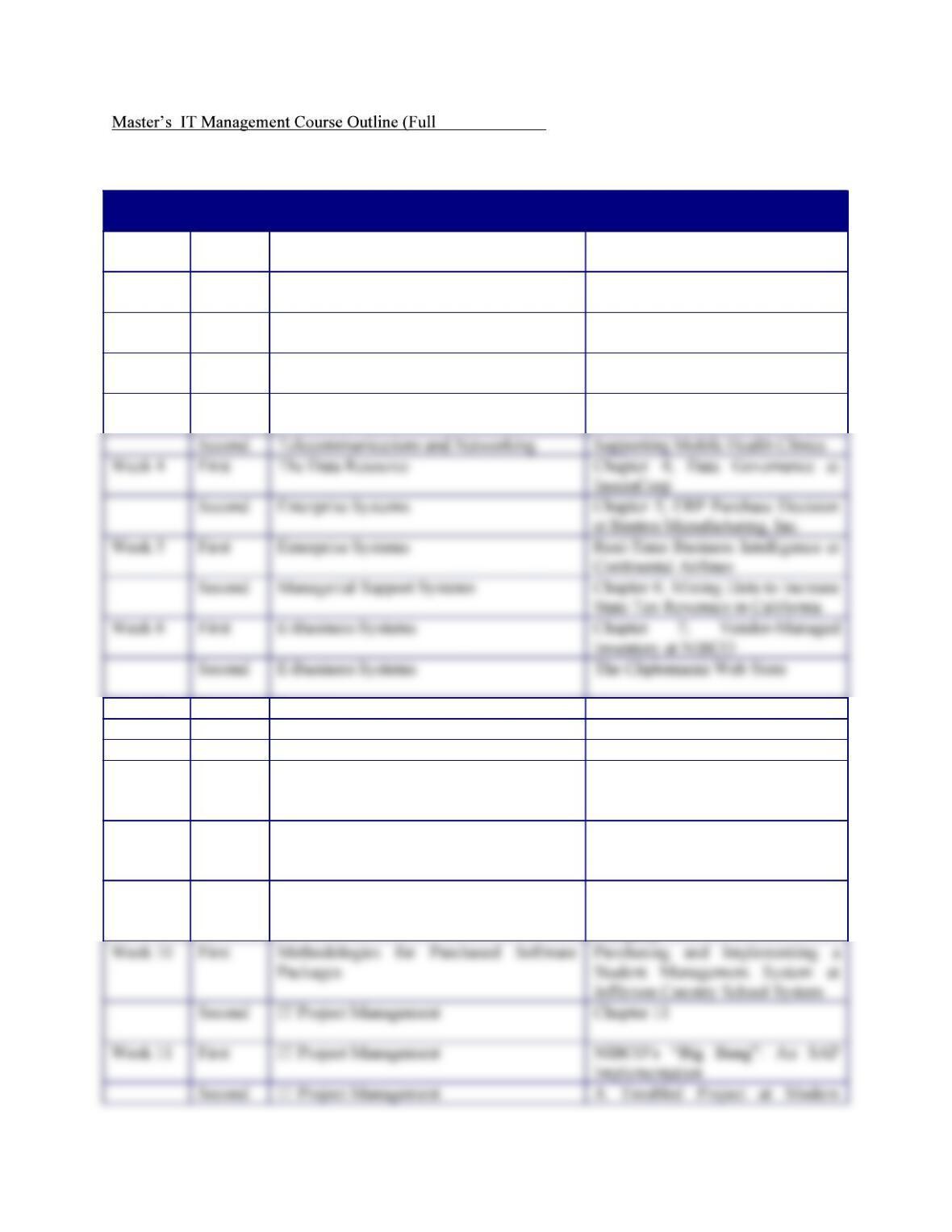
-Time Students)
The following course outline is for full-time students. The schedule is two 75-minute classroom
sessions per week, a fifteen-week semester, and a separate final examination period.
Week Session Topic
Reading Assignment / Case
Study Assignment
Week 1 First Course Introduction;
Managing IT in a Digital World
Chapter 1
Second Managing IT in a Digital World
Midsouth Chamber of Commerce
(A)
Week 2 First Computer Systems (Hardware)
Chapter 2; IMT Custom Machine
Company, Inc.
Second Computer Systems (Software) Chapter 2
Week 3 First Telecommunications and Networking Chapter 3
Week 7 First Review
Second
MIDTERM EXAMINATION
Week 8
First
Basic Systems Concepts
Chapter 8
Second
Methodologies for Custom Software
Development
Chapter 9
Week 9 First
Methodologies for Custom Software
Development
Managing a Systems Development
Project at
Consumer & Industrial
Products, Inc.
Second Methodologies for
Purchased Software
Packages
Chapter 10; A Make-or-
Buy
Decision at Baxter Manufacturing
Company
Methodologies for Purchased Software
a
Student Management System at
Jefferson Country School System
A Troubled Project at Modern
; Data Governance at
; ERP Purchase Decision
Time Business Intelligence at
Mining Data to Increase
Managed
Inventory at NIBCO
xiii
Week Session Topic
Reading Assignment / Case
Study Assignment
Materials, Inc. or
Kuali Financial
Systems: An Open Source Project
Week 12 First Planning Information Systems Resources
Applicances, Inc.: Deciding on a
New IT Platform
Second Planning Information Systems Resources The Clarion School for Boys, Inc. –
Milwaukee Division
Week 13 First Leading the IS Function Chapter 13
Second Leading the IS Function
IT Infrastructure Outsourcing at
Schaeffer (A) and (B)
FastTrack IT Integration for the
axter
Deciding Which IT Company to
xiv
Saturday.
This syllabus also includes team project presentations (a Web Site Analysis project described in
this Instructor s Manual for Ch. 7), a guest speaker (as recommended for Ch.13), and two exams.
Week Topic
Reading Assignment / Case Study
Assignment
Week 1 Course Introduction; Managing IT in
a Digital
World
Chapter 1; Midsouth Chamber of
Commerce (A)
Week 2 Computer Systems
Chapter 2; Web Site Analysis
assignment introduced
Week 3
Telecommunications and Networking; The Data
Resource
Chapter 3; Chapter 4;
Supporting
Mobile Health Clinics
; Data Governance
at InsuraCorp.
Week 4
Enterprise Systems; Using IT to Redesign
Processes
Chapter 5
Week 5 Managerial Support Systems
Chapter 6; Real-
Time Business
Intelligence at Continental Airlines
Managed Inventory
xv
A course outline for an online course that takes place during a 12-week trimester schedule is
given below. In this alternative, a readings packet (including Harvard Business Review, Sloan
Management Review, and MIS Quarterly Executive articles) and digitized mini-lectures are used
in addition to the textbook. For this course, the Chapters from different Parts of the textbook are
assigned together, and online quizzes are provided to test for basic understanding of the
technology concepts in Part 2.
Week Topic
Reading Assignment / Case Study
Assignment
Unit 1: Introduction
Video: Introduction to the Course and
Unit 1
Week 1 Course Introduction; Managing IT in a
Digital
World
Chapter 1; Chapter 15
Unit 2: Understanding Business Opportunities
Enabled by IT
Video: Introduction to Unit 2
Week 2
Recognizing Disruptive Technologies;
Technology Concepts Hardware and Software
Chapter 8
on BPR; reading on disruptive
t
echnologies; Chapter 2; IMT Custom
Machine Company, Inc.
Week 3 Leveraging E-Business; Technology Concepts
Telecommunications and Networking
Chapter 7; reading on e-
business
leadership and influence of the Internet
on competitive forces; Vendor-
Managed
Inventory at NIBCO;
Rock Island
Chocolate Company; Chapter 3
Week 4 The IT Business Case Chapter 12
; online PowerPoint
presentations on a business case
(in
general and IT-specific);
Appliances
Week 5 MIDTERM EXAMINATION
Unit 3: Acquiring Information Systems
Video: Introduction to Unit 3
Weeks 6
and 7
Group Project Signup: Technologies in Business Familiarization with tools for
group
project
Mining Data to
Tax Revenues in
reading on
Week 9
Sourcing IT Work
Chapter 13
; readings on outsourcing
xvi
Week Topic
Reading Assignment / Case Study
Assignment
trends, including BPO; IT Infrastructure
Outsourcing at Schaeffer (A) and (B)
Week 10 Managing in a Global Digital World
Chapter 14; readings on
managing
global IT organizations;
The MaxFli
Sales Force Automation System at BAT
Week 11 Team Projects Due: Technologies in Business
Team Case Assignments
Team Presentation
A problem-solving approach to case analysis will be introduced in class. For this approach, the
team should take a consultant role, and assume that it was hired by the organization to:
Make use of your knowledge of IS management; Provide an objective opinion on one or
more problems; Provide realistic options for action for this organization
For other cases, a problem-solving approach may not be relevant, and the team should take an
other class readings and/or experience.
Written Presentation
The text should be a maximum of 6 double-spaced pages. You should include copies of all
tables, diagrams, etc. used in your presentation. The cover sheet should include team member
names. Provide copies to each member of the critiquing team and 2 copies to the instructor.
Oral Presentation
The presentation should be your professional best, last no more than 30 minutes, and each team
Oral Critique
There will be a 5-minute break after the oral presentation while the critiquing team prepares.
During this time the other class members will complete a presentation evaluation form for each
presenter.
The critiquing team should point out the positive aspects of the case presentation as well as those
areas where there may be room for improvement or alternative conclusions. If a problem-solving
approach was appropriate for this case, the critiquing team should evaluate the case presentation
for the following:
xvii
The Undergraduate Information Technology Management Course
This text has also been used with success at the undergraduate level. For the undergraduate
student, the review and discussion questions at the end of each chapter can be used to help them
focus on specific aspects of each chapter. We sometimes require that written answers be prepared
for a small subset of these questions; these are evaluated by the instructor, but perhaps with only
3 grades given: A+, satisfactory, and unsatisfactory.
Several case studies are also assigned. Our experience is that this course may be the first one that
students take that involves the use of case studies. If so, the instructor needs to provide some
Several other points should be made about the course coverage. First, while a significant number
of case study discussions are listed, these discussions do not tend to be as long or in as much
depth as they would be in a graduate course. Our usual approach is to distribute the case study
discussion questions via electronic mail two to three days before the class session, and then use
these discussion questions to channel the case study discussion. Second, more complex case
studies are assigned at the end of the course; by this time, the students should have increased their
skills in case study problem-solving, but preparation questions should be used to help them focus
on specific aspects of the case study. Third, we have shown the scheduling of a single guest
speaker, but it may be useful to bring in more than one guest speaker for short presentations at
other points during the semester.
xviii
Example of Undergraduate Level Course
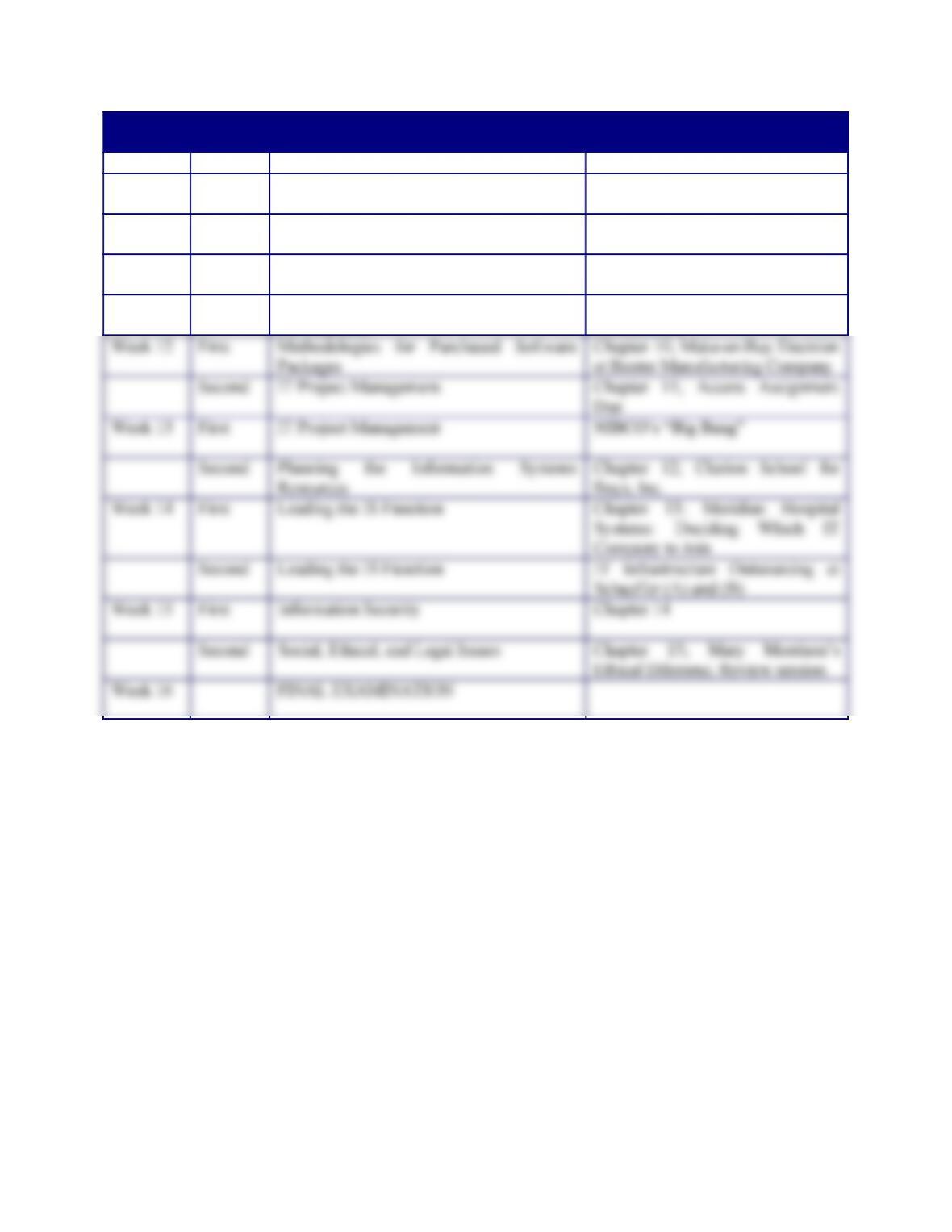
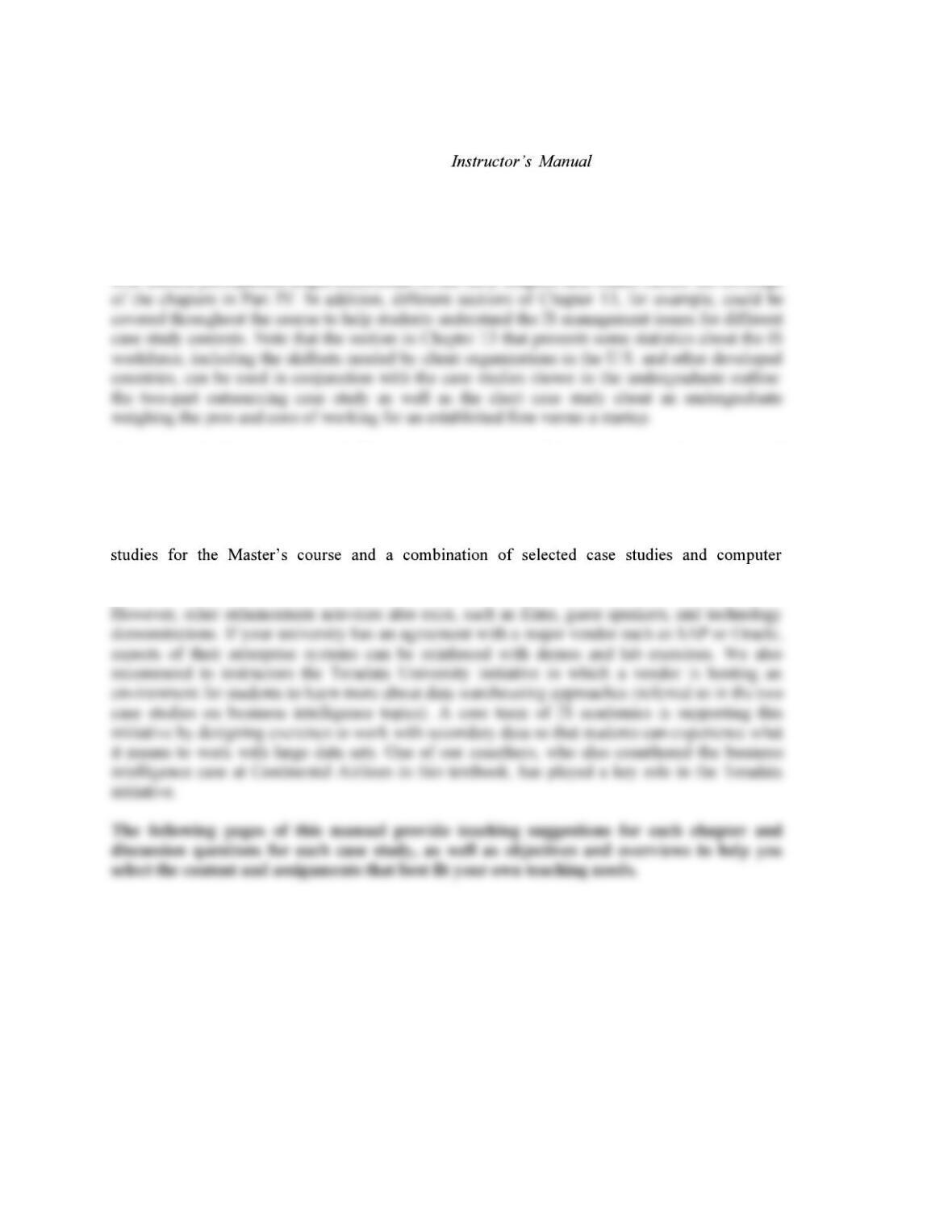
Undergraduate IT Management Course Outline
This course outline assumes two 75-minute classroom sessions per week, a fifteen-week
semester, and several lab sessions, and 3 examinations.
Week Session Topic
Reading Assignment / Case
Study Assignment
Week 1 First Course Introduction; Using Web resources Web Mini-
Assignment given with
a focus on resources for learning
about the topics in this course
Second Managing Information Technology in
a
Digital World
Chapter 1; Midsouth Chamber of
Commerce (A); Web Mini-
Assignment Due
Week 2 First Computer Systems
Chapter 2
Second In-
Class Lab Session: Advanced Hardware
Concepts (How does a
supercomputer
work?)
Week 3 First Computer Systems
Deciding on a New IT Platform
Second Telecommunications and Networking Chapter 3
Week 4 First Telecommunications and Networking Supporting Mobile Health Clinics
Second
Laboratory Session: Geographic
Information Systems (GIS)
GIS Assignment Given
Second
Managerial Support Systems (including
several demonstrations)
Chapter 6
Week 8 First E-Business Systems Chapter 7
; The Cliptomania Web
Store
Second Laboratory Session: Web Site Analyses
Decision Support Systems
Assignment Due
Week 9 First E-Business Systems
Rock Island Chocolate Company
Second
Guest Speaker: Leveraging an ERP System
Assignment to prepare for Guest
VoIP Adoption at Butler
University; Review session
Laboratory Session: Decision Support
Assignment Due; Decision
Support Systems Assignment
xix
Week Session Topic
Reading Assignment / Case
Study Assignment
Speaker presentation
Week 10 First Laboratory Session: Microsoft Access
Web Site Analyses Due; Access
Assignment Given
Second SECOND EXAMINATION
Week 11 First Basic System Concepts
Chapter 8
Second
Methodologies for Custom Software
Development
Chapter 9
; Consumer and Industrial
Products, Inc.
Planning the Information Systems
Clarion School for
; Meridian Hospital
xx
Additional Course Syllabus Suggestions
The four course outlines presented here in this represent only four of the
many possible ways in which Managing Information Technology can be used in an IT
management course. For example, in a course with experienced managers (such as an Executive
MBA Program), coverage of the early portion of the book (especially Chapters 2 and 3) could be
greatly reduced to permit more time and discussion of the content in the later chapters on
different types of applications and e-business opportunities. Conversely, an undergraduate course
In our view, the key to a successful IT management course at all levels rests in the frequent use of
real-world examples, including Web-based resources, and enhancement activities that go beyond
a classroom lecture format. We believe that this particular textbook affords a special opportunity
to use the unique case studies that have been written by the same textbook authors who have
also authored the IS management chapters. In the course outlines we have emphasized case
laboratories for the undergraduate course.