38
Solutions to Problems in
Chapter 9: Beta Decay
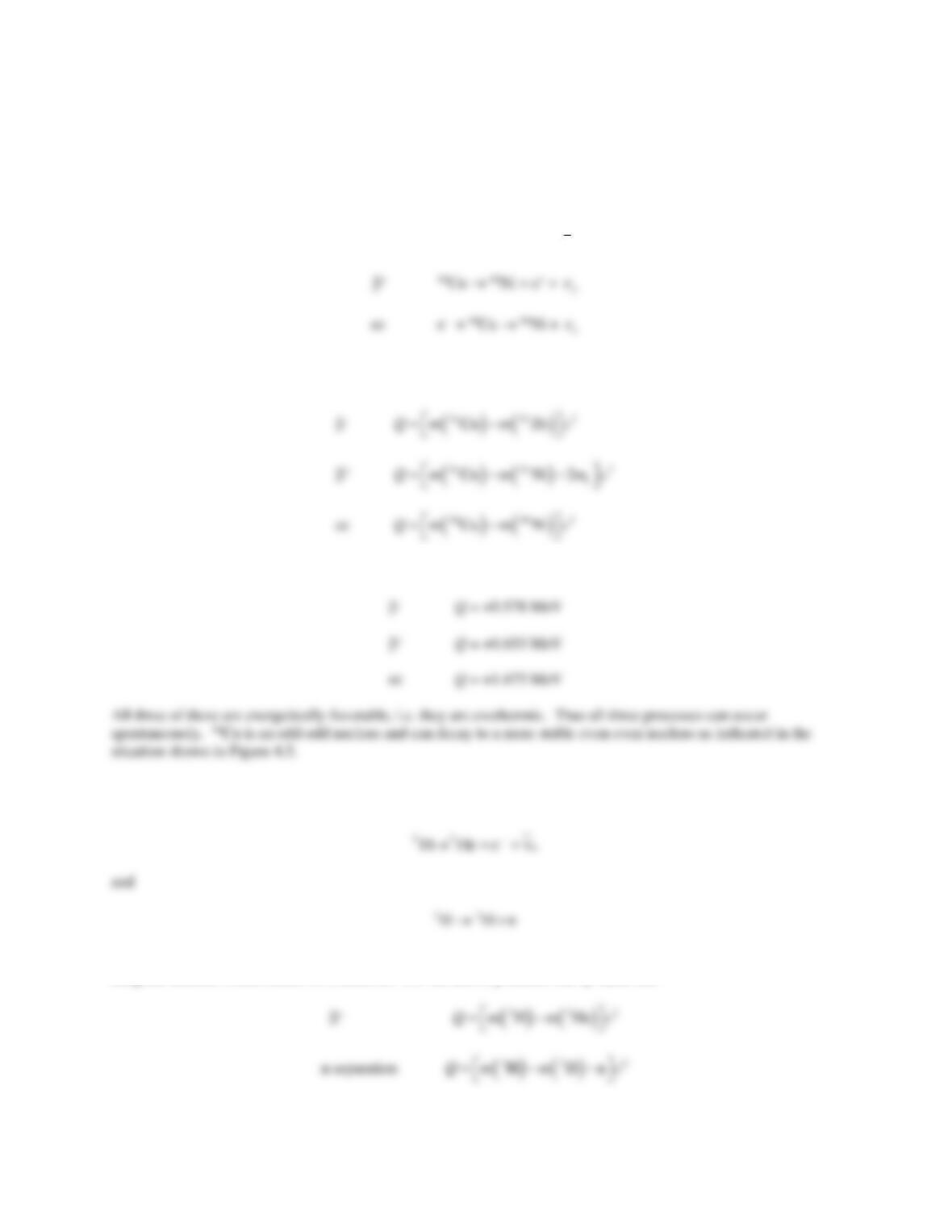
9.1. We need to consider –, + and ec decay. These correspond to the following process.
– 64Cu → 64Zn + e– +
e
The values of Q for these processes are
Using the tabulate mass values gives values for Q of
– Q = +0.578 MeV
9.2. Tritium consists of a nucleus with 1 proton and 2 neutrons with 1 atomic electron. Possible decays are
+ (ec) cannot occur as it would produce a daughter nucleus with 3 neutrons. Proton separation cannot occur as the
daughter nucleus would consist of 2 neutrons. For the above processes the Q values are
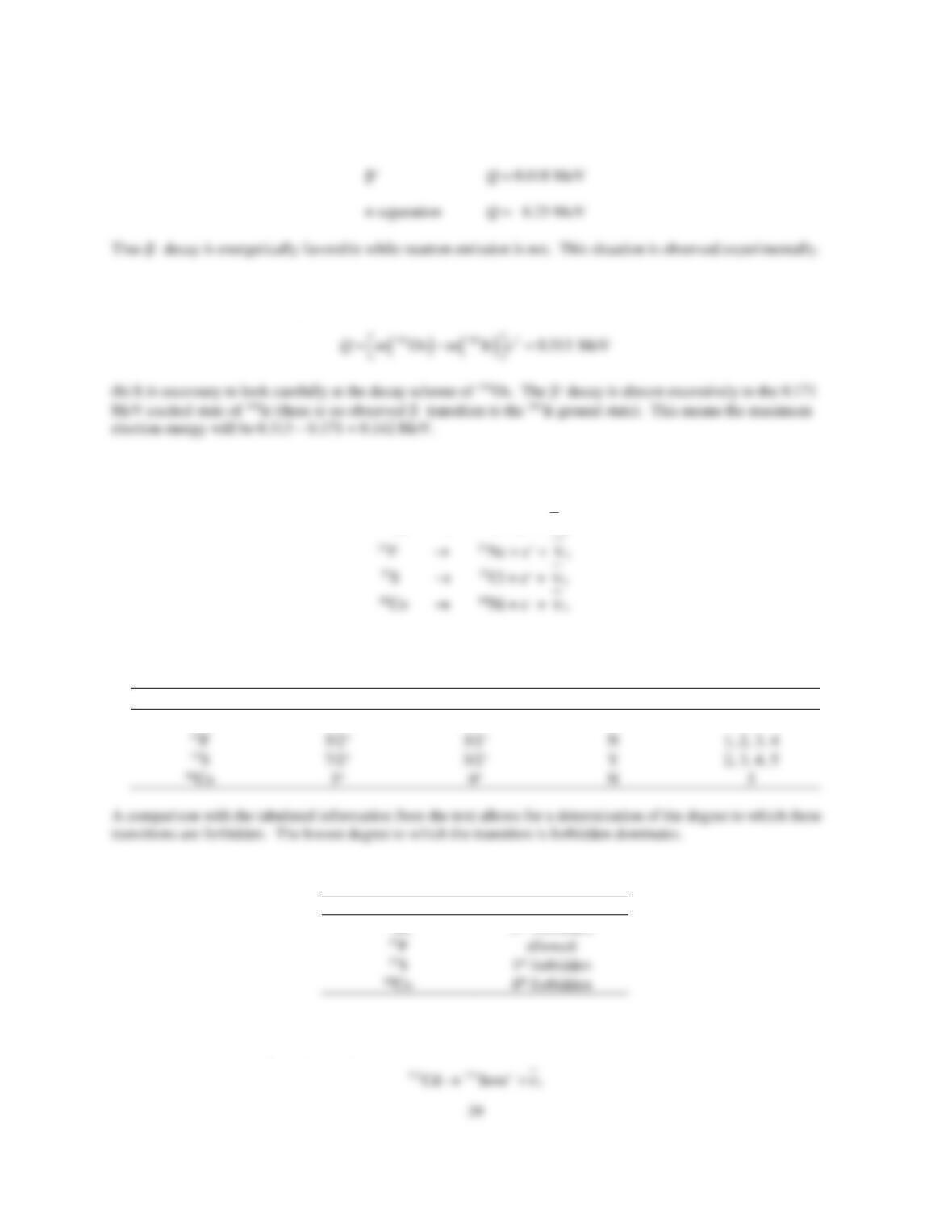
From the measured masses this gives
9.3. (a) The Q for – decay is given as
9.4. For the following decays
10Be → 10B + e– +
e
we can tabulate the J
for the parent (P) and daughter (D) as well as the change in parity. From these the allowed
values of J are determined.
parent
JP
JD
change
allowed J
10Be
0+
3+
N
3
N
60Co
5+
0+
N
5
parent
decay
10Be
2nd forbidden
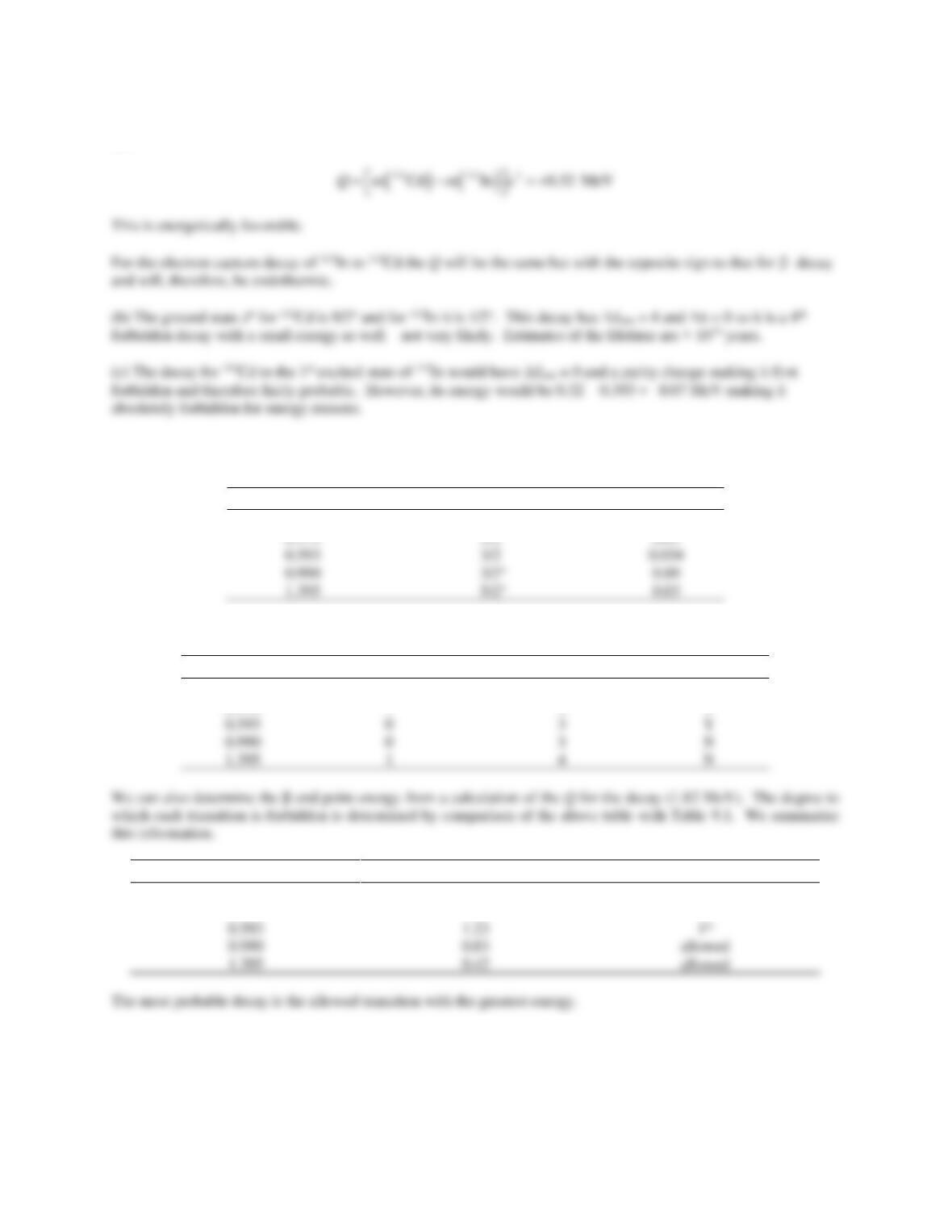
9.5. (a) We calculate the Q for – decay;
40
and
9.6. The decay of the 3/2+ ground state of 43K has the branching ratios for the following 43Ca states.
43Ca state (MeV)
J
f
0
7/2–
0.015
0.373
0.593
0.034
0.990
3/2+
1.395
5/2+
We must consider the change in J and for each transition as follows.
43Ca state
Jmin
Jmax
parity change
0
2
5
Y
0.373
1
4
Y
0.593
0
3
Y
0.990
0
3
N
1.395
1
4
N
43Ca state (MeV)
end point (MeV)
forbidden
0
1.82
1st
0.373
1.45
1st
0.593
1.23
1st
0.990
0.83
1.395
0.42
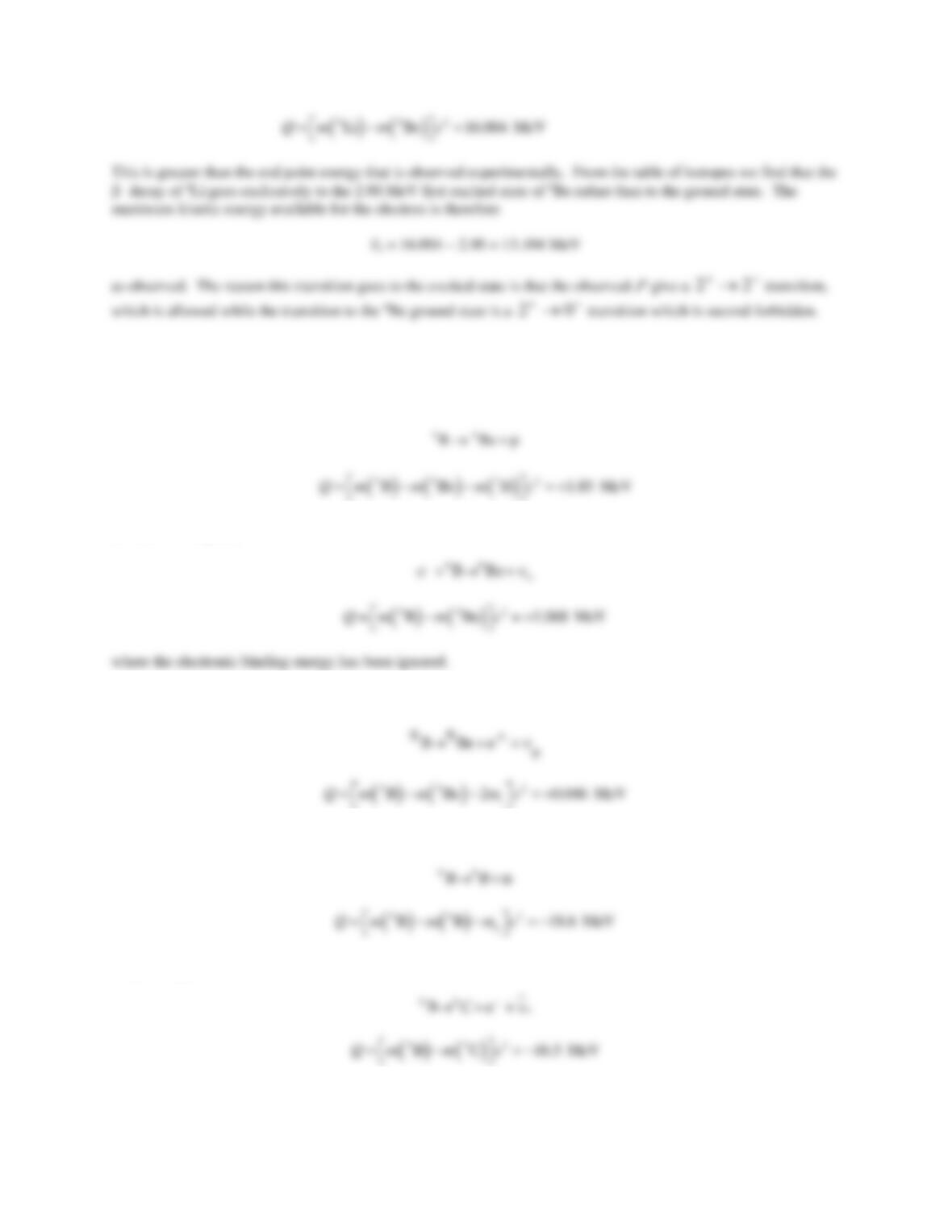
9.7. We calculate the Q for the – decay of 8Li to be
41
9.8. For each of the processes mentioned we need to calculate the values of Q;
(i) Proton emission;
(ii) Electron capture;
(iii) + decay;
(iv) Neutron emission;
(v) – decay;
42
9.9. (a) From the measured atomic masses the Q for – decay of 46Ti:
46 46 e
Sc Ti+e
−
→+
is found to be 2.37 MeV. We can summarize the transitions for the 46Sc ground state (J = 4+) as follows.
46Ti state (MeV)
J
E (MeV)
J
change
transition type
ground
0+
2.37
4
N
4th forbidden
2+
1.48
2
N
4+
0.36
0
N
9.10. Referring to the energy level diagram as shown, we need to calculate EB and Q.
EB is given in terms of nuclear mass as
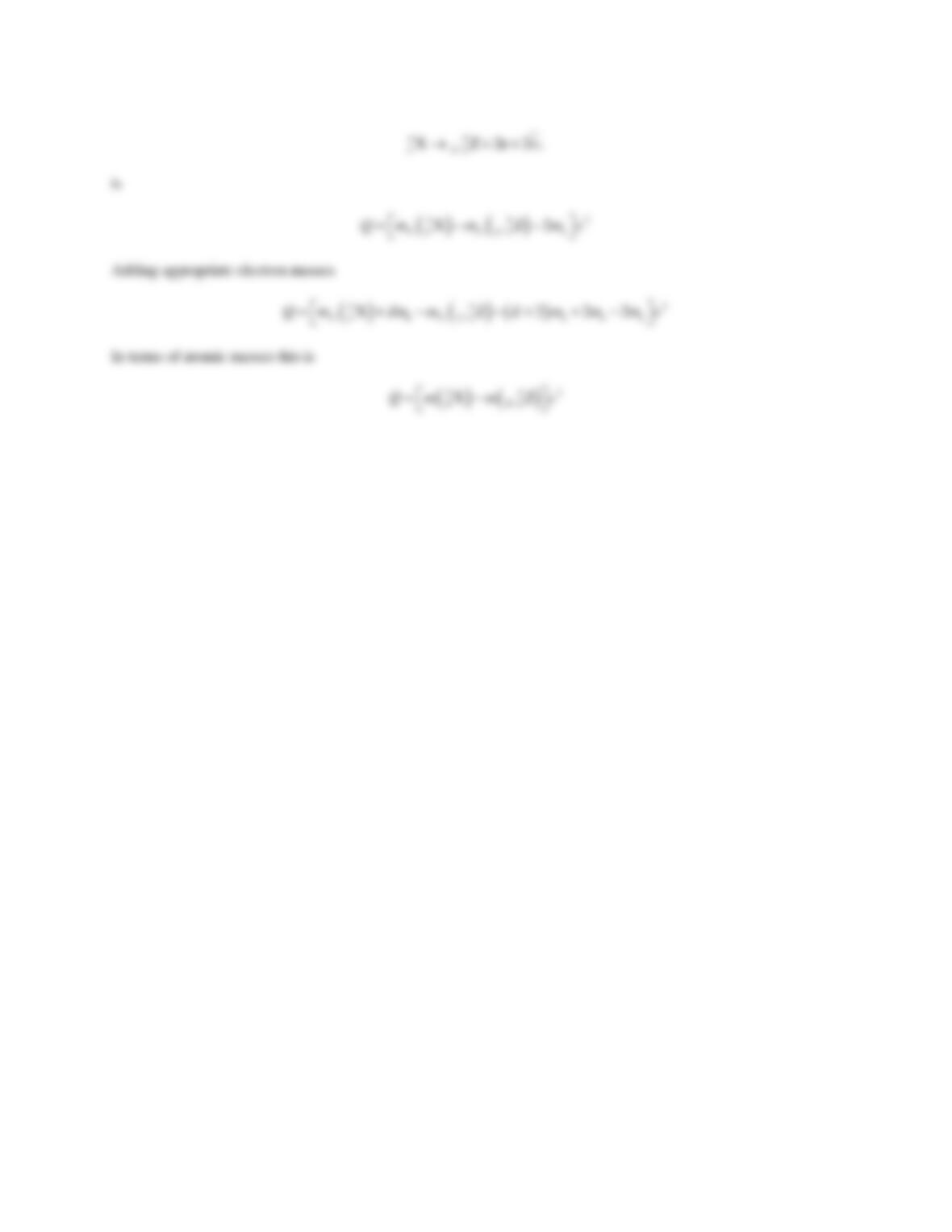
The energy, Q, of the process
Z+1
43