GEOLOGIC TIME 9
INTRODUCTION
Geologic Time
CHAPTER OUTLINE
1.
148
2.
149
3.
150
4.
151
5.
152
6.
LEARNING OBJECTIVES/FOCUS ON CONCEPTS
9.2 Define discuss
List and describe
153
9.4 Discuss
9.6 Explain
TEACHING STRATEGIES
Clicker Questions:
Muddiest Point:
A. Immensity of Geologic Time
154
B. How Scientists Determine Rock Ages (Radiometric and Relative Dating)
155
C.
TEACHER RESOURCES
Web Resources:
Geologic Time
USGS
156
157

NOVA GeoBlog Some Great Unconformities
Fossils
The Dino Directory From the Natural History Museum
National Geographic Resources
o Prehistoric Time Line
158
Imagery and Animations:
Images
UCMP Berkeley Fossil Gallery
159
Animations
Interactive Geologic Time Scale From the Smithsonian
ANSWERS TO QUESTIONS IN THE CHAPTER:
CONCEPT CHECKS
9.1 CREATING A TIME SCALERELATIVE DATING PRINCIPLES
2. Superposition:
Original Horizontality
160
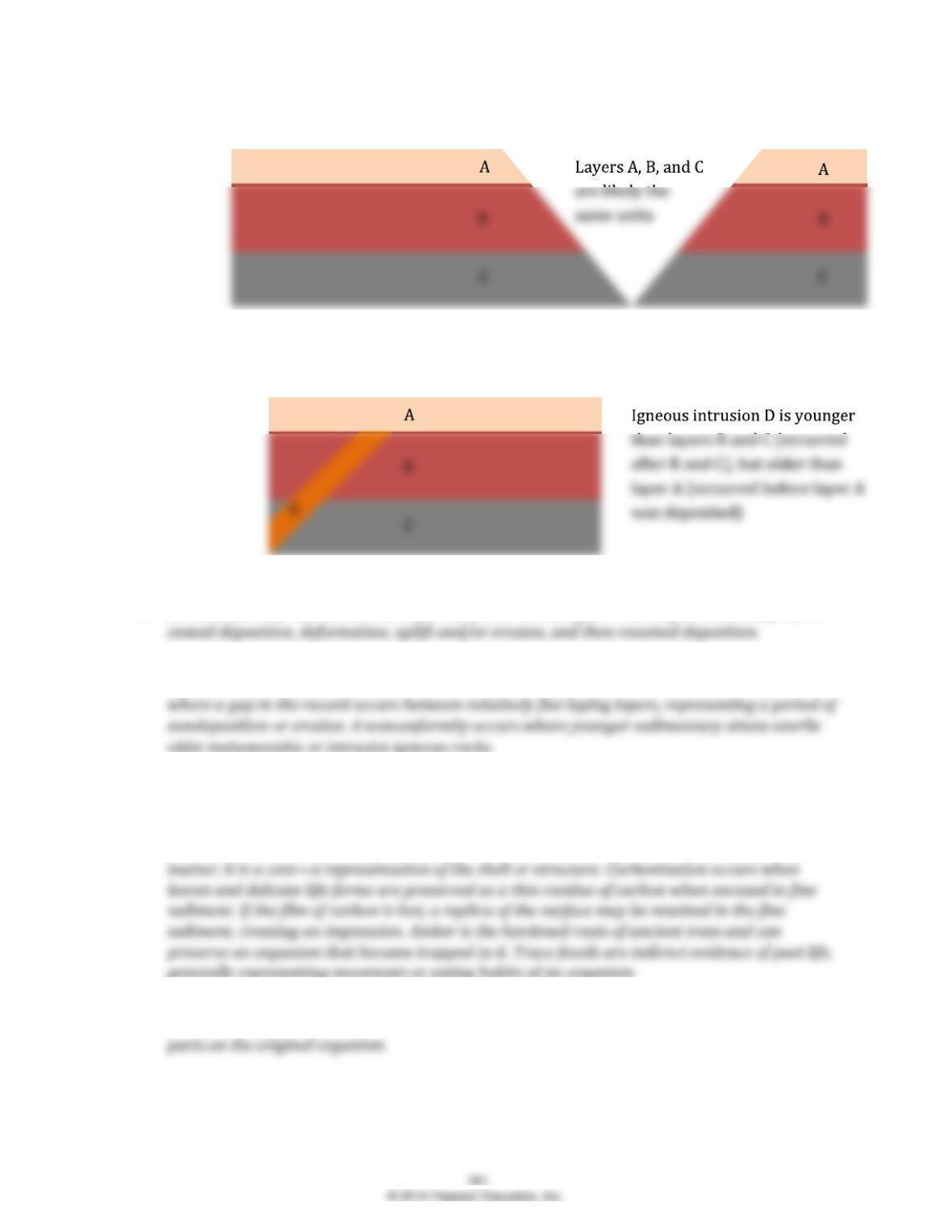
Lateral Continuity
Cross-Cutting Relationships
3. An unconformity tells us that some period of time is missing in a rock layer, most likely due to
4. An angular unconformity occurs where tilted strata are overlain by horizontal strata,
representing a deformation and erosion event followed by deposition. A disconformity occurs
9.2 FOSSILS: EVIDENCE OF PAST LIFE
1. Permineralization occurs when minerals precipitate out of groundwater and fill porous tissues
of bones or wood. Molds occur when a shell or other structure is buried and dissolved by
groundwater, creating an imprint of the fossil in the sediment. If the mold is filled with mineral
2. Examples of trace fossils include tracks, burrows, coprolites, and gastroliths.
3. Preservation of an organism as a fossil is favored by rapid burial and/or the presence of hard
9.3 CORRELATION OF ROCK LAYERS
1. The goal of correlation is to develop a time scale applicable to the large regions and the entire
Earth, thus providing a more comprehensive view of Earth history.
2. The principle of faunal succession tells us that past life evolved over time and specific
3. Index fossils are individual fossil organisms that are widespread geographically but that are
4. Fossils can also give us clues about past environments and conditions of those environments.
9.4 DATING WITH RADIOACTIVITY
1. The three types of radioactive decay are alpha ( ) emission, beta ( ) emission, and electron
2. In emission, a beta particle (an electron) is emitted from the nucleus. Because electrons
1. With electron capture, an electron is captured by the nucleus and combines with a proton to
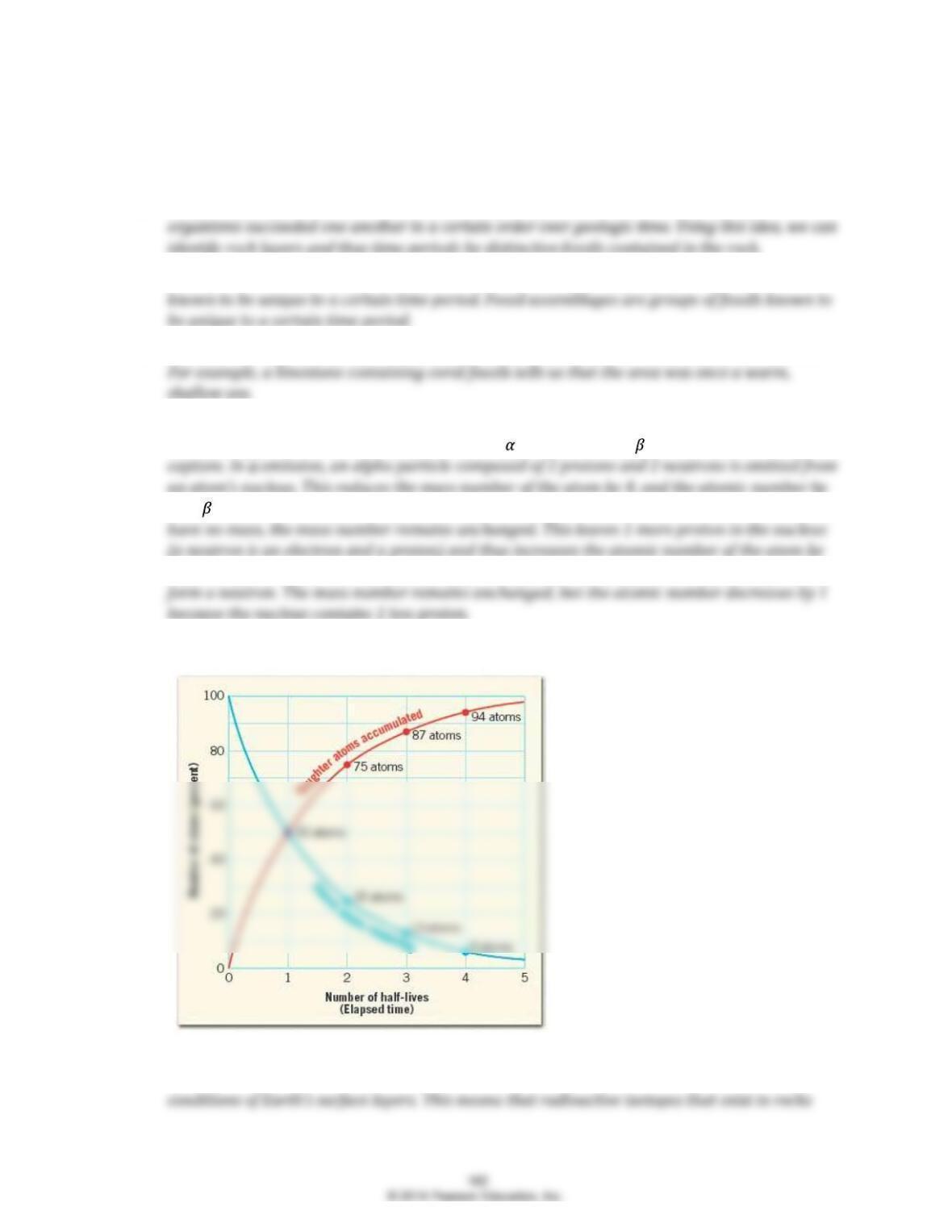
2. Diagram should be similar to Figure 9.22:
3. Radioactive dating is a reliable means of calculating ages of rocks because the rates of decay
of many isotopes have been precisely measured, and these rates do not vary under the physical
9.5 THE GEOLOGIC TIME SCALE
2. -zoic refers to life and many of the subdivisions of geologic time are based on large changes
in life-forms on Earth.
3. All geologic time prior to the Phanerozoic is referred to as Precambrian. This time period is
not divided into as many smaller units because we know much less about the history of the
4. The term refers to the portion of the time scale before the oldest-known rocks on
9.6 DETERMINING NUMERICAL DATES FOR SEDIMENTARY STRATA
1. Sedimentary rocks are composed of clasts of pre-existing rocks. Therefore, the minerals in a
2. Geoscientists use datable igneous masses to bracket the ages of sedimentary strata. For
EYE ON EARTH
EOE #1 WEST CEDAR MOUNTAIN, UTAH
1. The likely order of events from oldest to youngest: deposition of sandstone, deposition of
shale, uplift and igneous intrusions, erosion. The law of superposition tells us the sandstone
2. Because we put these rock layers and events in order of sequence without knowing their
numerical ages, we applied relative dating techniques to deduce the history of this
EOE #2 DIORITE, GRANITE, AND QUARTZ
1. The pieces of diorite are called inclusions. They are pieces of a rock encased within another
rock.
EOE #3 GLACIER NATIONAL PARK PRECAMBRIAN ROCKS
2. A lava flow would most likely contain vesicles because it would be exposed to the relatively
EOE #4 GRAND CANYON INNER GORGE ROCKS
1. Here, the only Precambrian rocks we see are granite and schist. It is fortunate we can see
these rocks here, because the Colorado River carved this large canyon. This process of deep
2. The Zoroaster granite cuts into the Vishnu schist; therefore, the Vishnu schist must have
formed first, then later was intruded by the Zoroaster granite.
EOE #5 CONGLOMERATE
1. Conglomerate is a sedimentary rock composed of large clasts of other rocks cemented
2. Because of the nature of the clasts sizes, we know this rock formed fairly close to its source. We
could date many of the rocks in the conglomerate to get an age range for the clasts that make
GIVE IT SOME THOUGHT
1. The gneiss occurred first, then the dike, then the fault. The gneiss must have been present for
2. If the sandstone was deposited atop the granite, we might expect to find pieces of the granitic
rock included in the sandstone. We would also expect to see parallel beds of sandstone atop the
164
3. These layers are not conformable, because we see evidence of some erosional event between the
4.
a. This feature represents a series of depositional and erosional events, as well as
deformation events. Here, beds of sandstone and shale below the unconformity were
deposited horizontally, then tilted and uplifted into their now nearly vertical position.
c. The Earth system is powered by solar energy, and energy from the interior of the Earth.
forces within Earth.
5. Gastroliths are the highly polished stomach stones used for grinding food in some extinct
reptiles. These are considered fossils because they once existed within the bodies of now extinct
6. Alpha particles are composed of 2 protons and 2 neutrons and beta particles consist of 1
electron. Emission of an alpha particle results in an atomic number decrease of 2 and a mass
number decrease of 4. Beta particle emission results in an atomic number increase of 1 and no
7. The ratio of 1:3 tells us that 25 percent of the parent remains to 75 percent of the daughter.
8. Recall that percentage is parts per hundred.
165
a. If we round Earths age to 5 billion years, the percentage of recorded history can be
in 10.8% of all Earth history.
9. Story of Earth is 281 pages total: Precambrian represents 49 pages, last 23 million years
100). Of 281 pages, 49 are devoted to the Precambrian; this represents 17 percent of the
book (49/281*100).
10. The order of events in this diagram, from oldest to youngest, is: A, B, C, D, E, Dike L, Pluton K,
166