31
Solutions to Problems in
Chapter 8: Alpha Decay
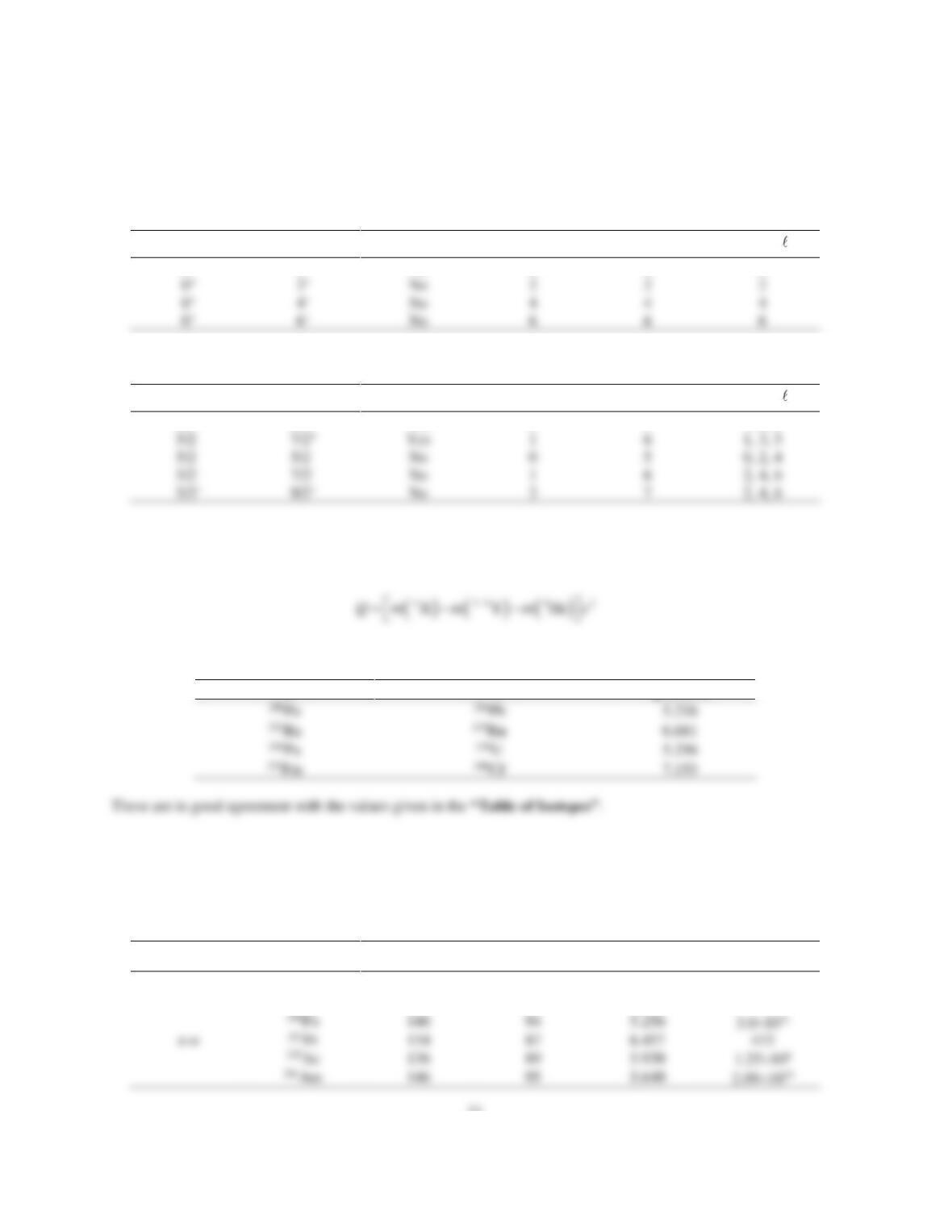
8.1. For the 244Cm decay
parent
J
daughter
J
parity change
Jmin
Jmax
allowed
0+
0+
No
0
0
0
For the 243Am decay
parent
J
daughter
J
parity change
Jmin
Jmax
allowed
5/2–
5/2+
Yes
0
5
1, 3, 5
5/2–
7/2+
Yes
1
6
1, 3, 5
5/2–
5/2–
No
0
5
0, 2, 4
5/2–
No
1
6
2, 4, 6
5/2–
9/2–
No
2
7
2, 4, 6
8.2. The Q for -decay is given by
in terms of the atomic masses. Using values from the table of masses gives the following:
AX
A–4Y
Q (MeV)
5.216
6.681
7.153
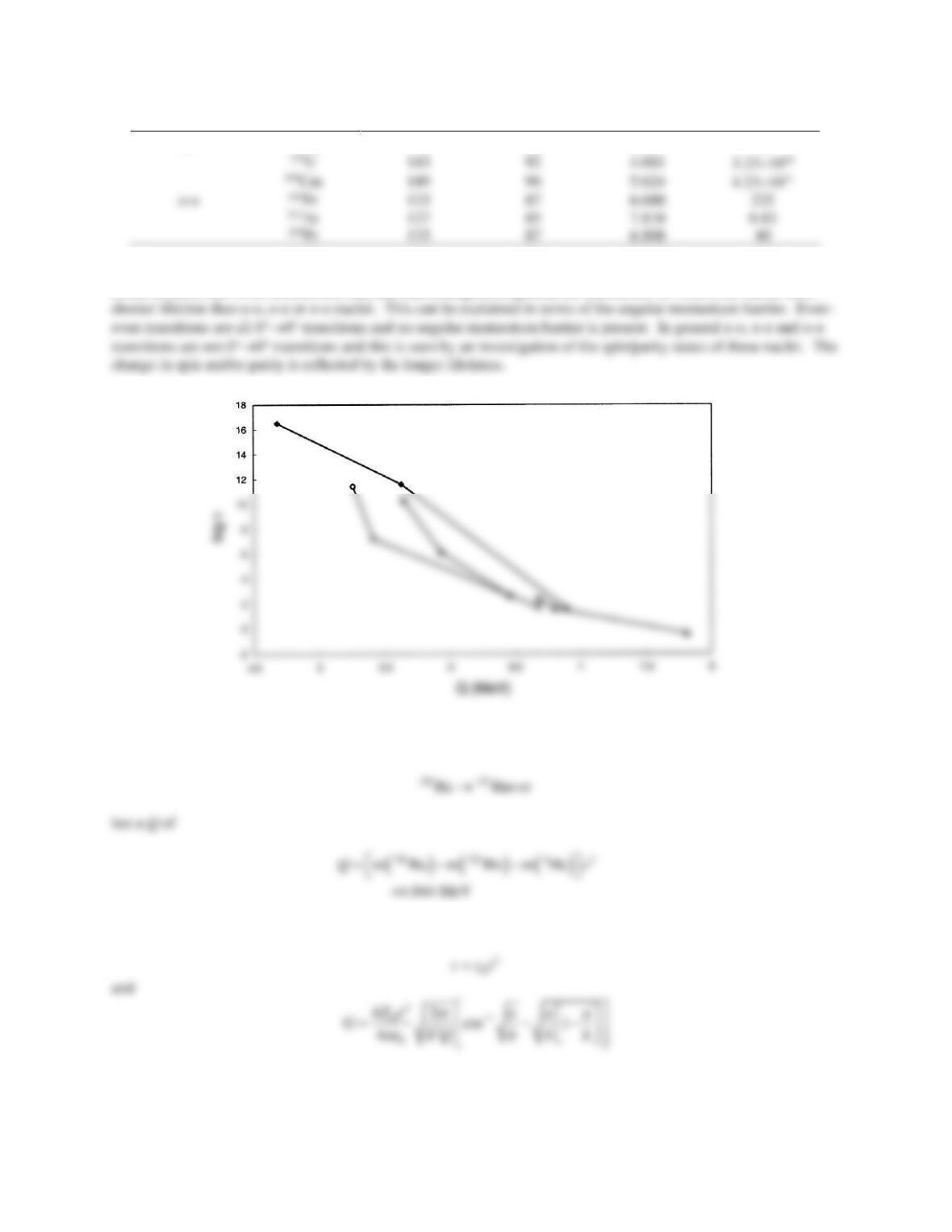
8.3. From the “Table of Isotopes” we obtain the following information. Note that these are only one possible set of
suitable nuclides and that we have chosen nuclides where -decay is the only mode of decay (or at least other modes
have very small branching ratios).
type
nuclide
N
Z
Q (MeV)
(s)
e-e
210Po
126
84
5.408
1.73107
222Ra
134
88
6.680
55
240Pu
146
94
5.256
134
87
6.457
415
136
89
5.930
146
95
5.640
0+
2+
No
2
2
2
0+
4+
No
4
4
4
0+
6+
No
6
6
6
32
type
nuclide
N
Z
Q (MeV)
(s)
o-e
221Ra
133
88
6.891
43
There results are illustrated in the figure below where the symbols correspond to even-even (open circles), even-odd
(solid circles), odd—even (diamonds) and odd-odd (triangles).In general the transitions for even-even nuclei have
8.4. The decay
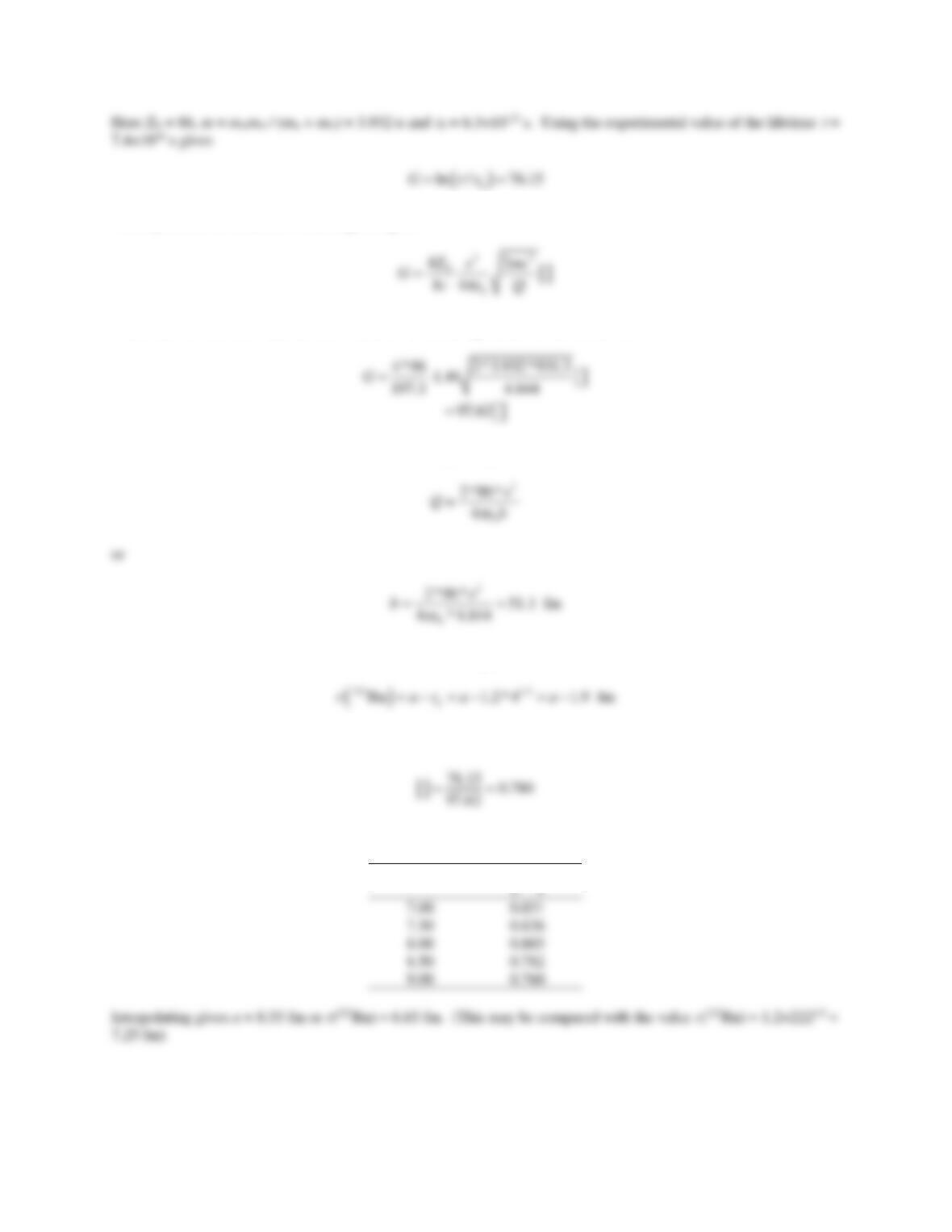
The theoretical value of the lifetime is given by equations (8.17) and (8.18) where
33
The expression for G above is rearranged to give
where the [ ] is the cos-1 term as shown above. Substituting values for the constants
Note that the value of G is unitless. The value of b is given by the Coulomb relation
The value of a is the combined radii of the 222Rn and the -particle where
It is easiest to solve for a using an iterative method and
The following table illustrates the process.
a
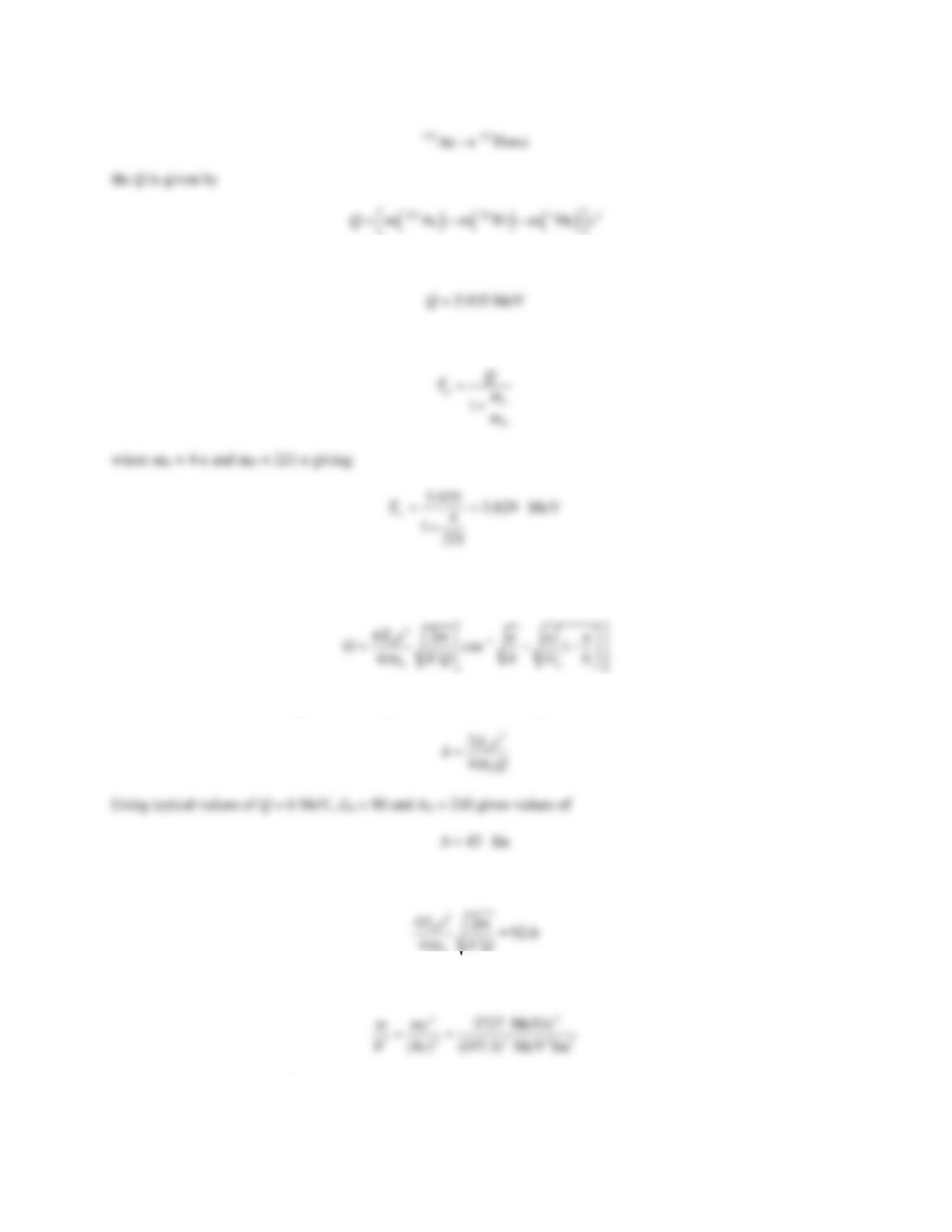
8.5. For the decay
34
Using tabulated atomic masses gives
The -particle kinetic energy is given by equation (8.5) as
8.6. (a) The decay probability is e-G where G is given by equation (8.17) as
Here a is the radius of the daughter nucleus plus the radius of the -particle and b is defined as
and
0
Here we have used the relation
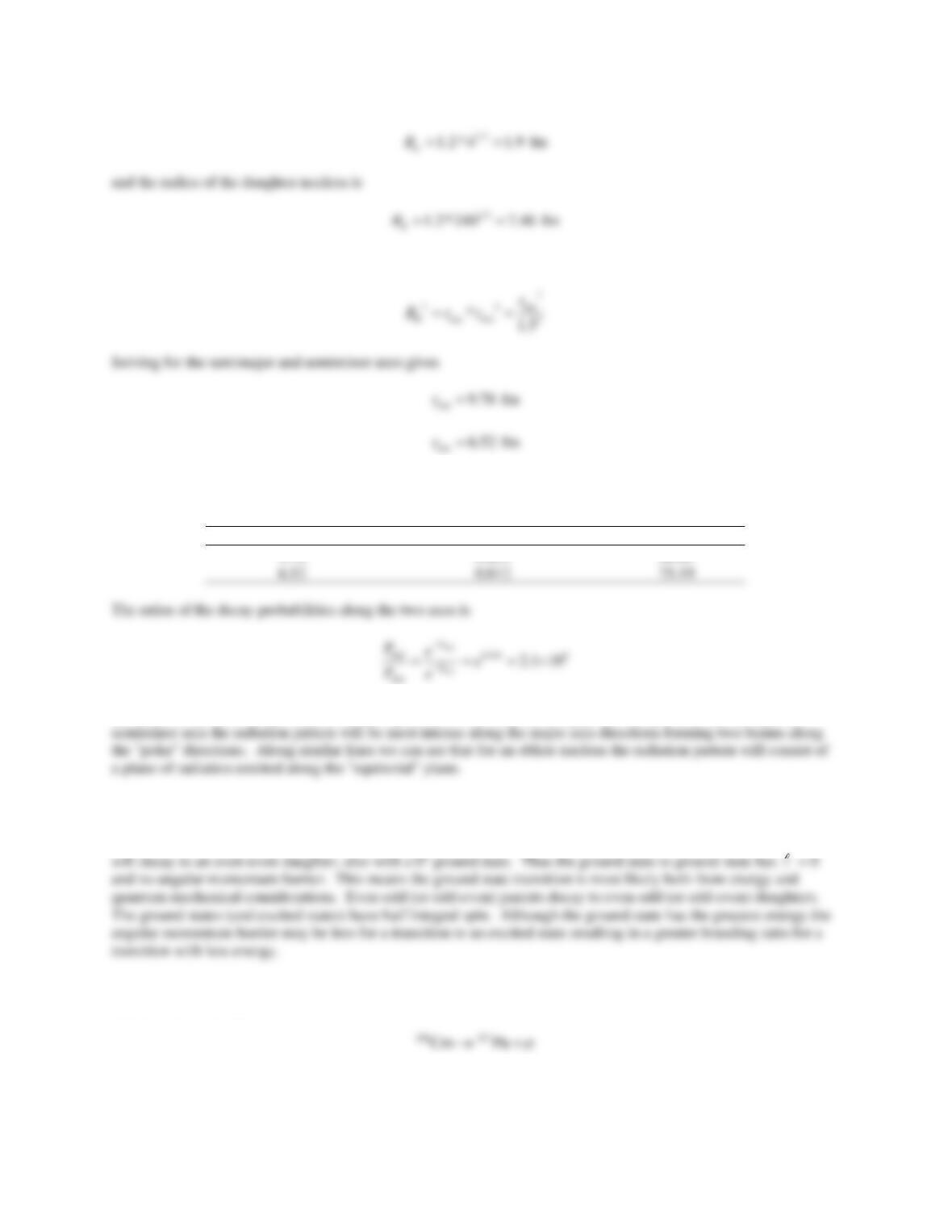
to simplify the calculation. The radius of the –particle is
35
If the nucleus is a prolate ellipsoid with a ration of the major/minor axes of 1.5 then from equation (12.3) we have
We now need to calculate the term in [ ] from eqaution (8.17) and thus G with the value of a taking on the values of
the semimajor and semiminor axes. This gives
a (fm)
[ ]
G
9.78
0.655
60.65
6.52
0.812
75.19
(b) Since it is much more probable that the -particle will be emitted along the semimajor axis than along the
8.7. The decay to the daughter ground state maximizes the transition energy. It is necessary to consider the spin of
the -particle to determine if this transition is most likely. An even–even parent will have a 0+ ground state. This
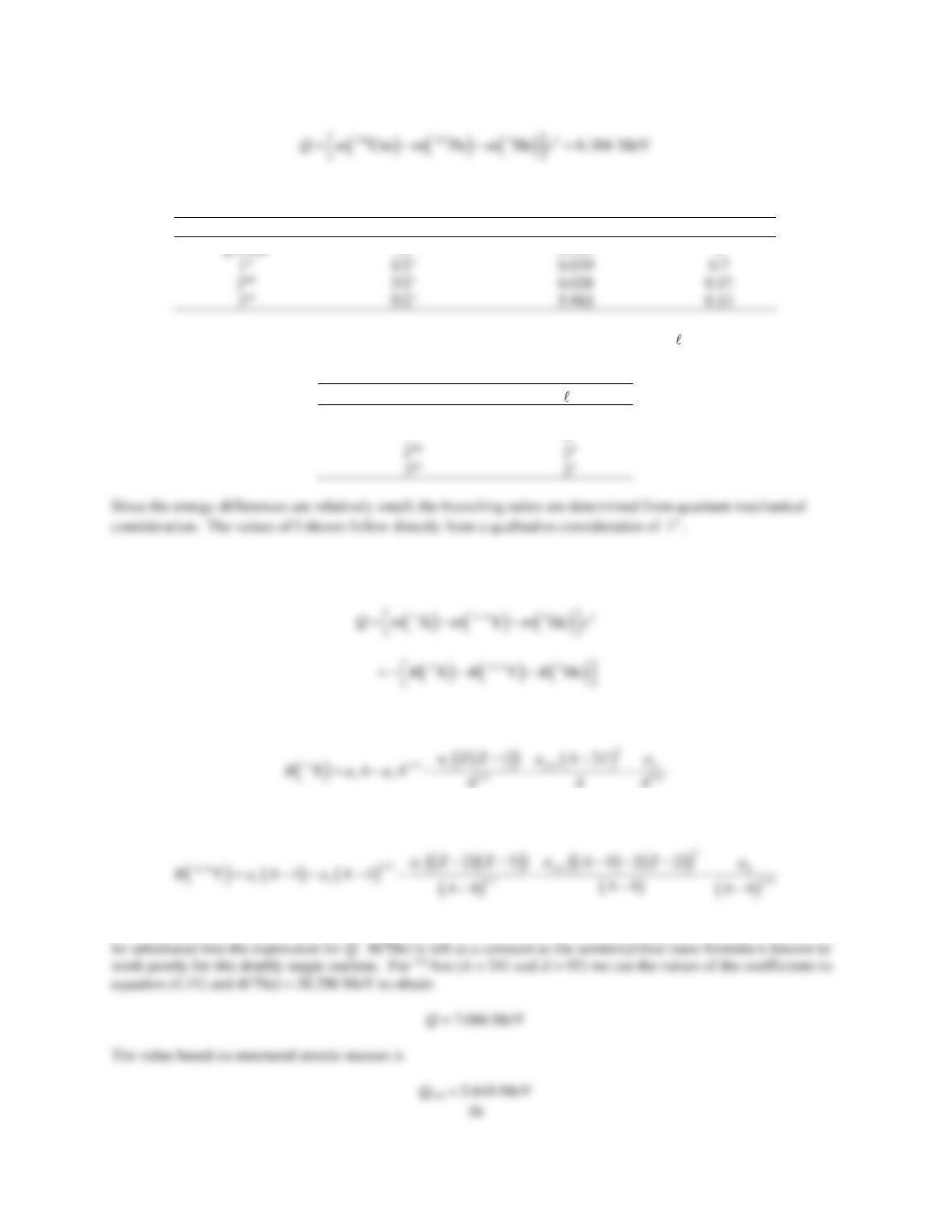
8.8. (a) For the decay
the Q is given by
(b) The 241Cm ground state has J
= 1/2+. The transitions to the various 237Pu states are described as follows.
daughter state
J
E (MeV)
f
ground
7/2–
6.184
0
6.039
6.028
5.982
Conservation of angular momentum and parity allows for the calculation of the minimum
for the -particle for
each transition.
daughter state
ground
3–
1st
0+
2+
2+
8.9. We can write
Using equation (4.10) and multiplying through by A gives
and
Note that the value of ap does not change as the even/odd nature of the parent and daughter are the same. These may
37
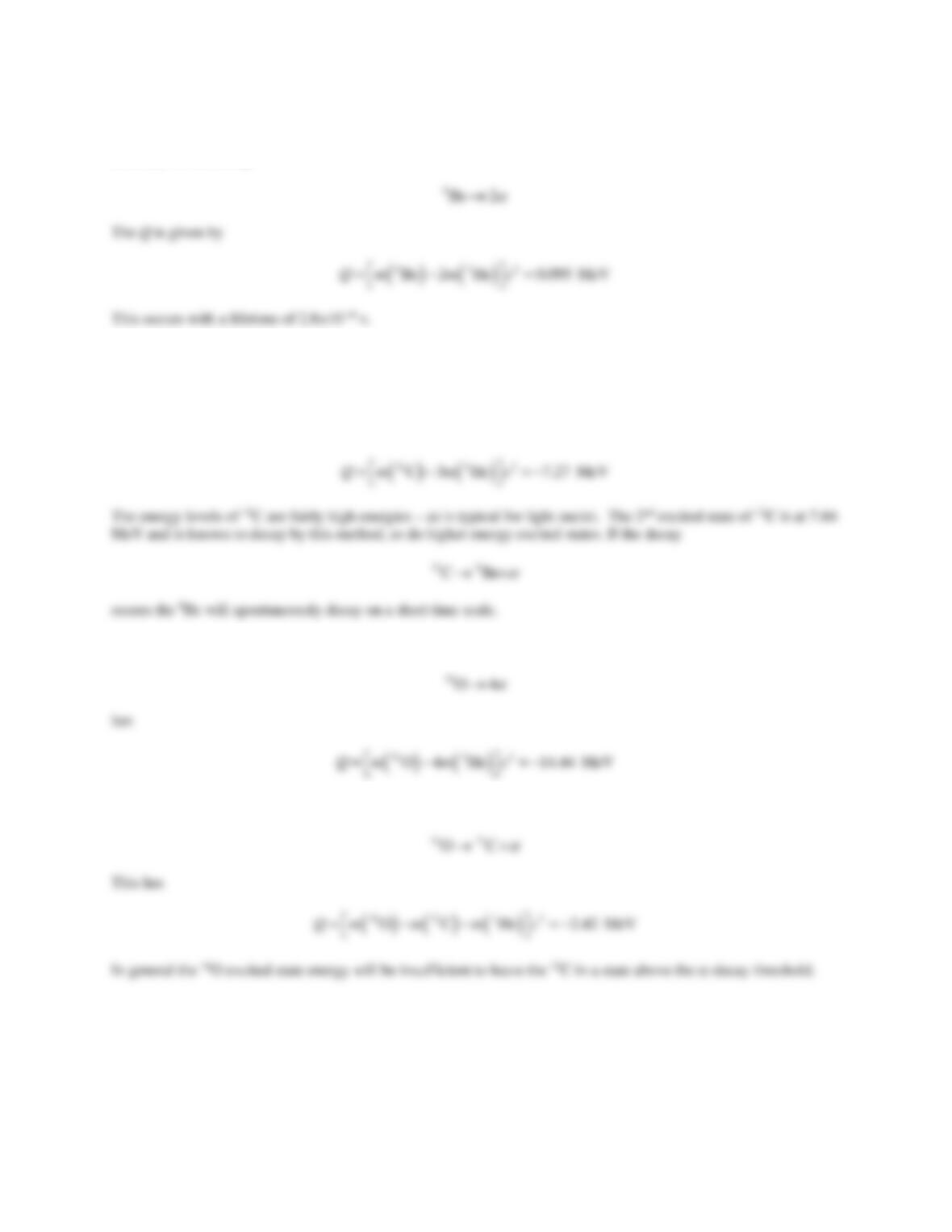
8.10. (a) For the decay
(b) For the decay
12C3
→
The Q is given by
(c) The decay
This is not known to occur from 16O excited states. However some excited states are known to decay by