25
Solutions to Problems in
Chapter 7: General Properties of Decay Processes
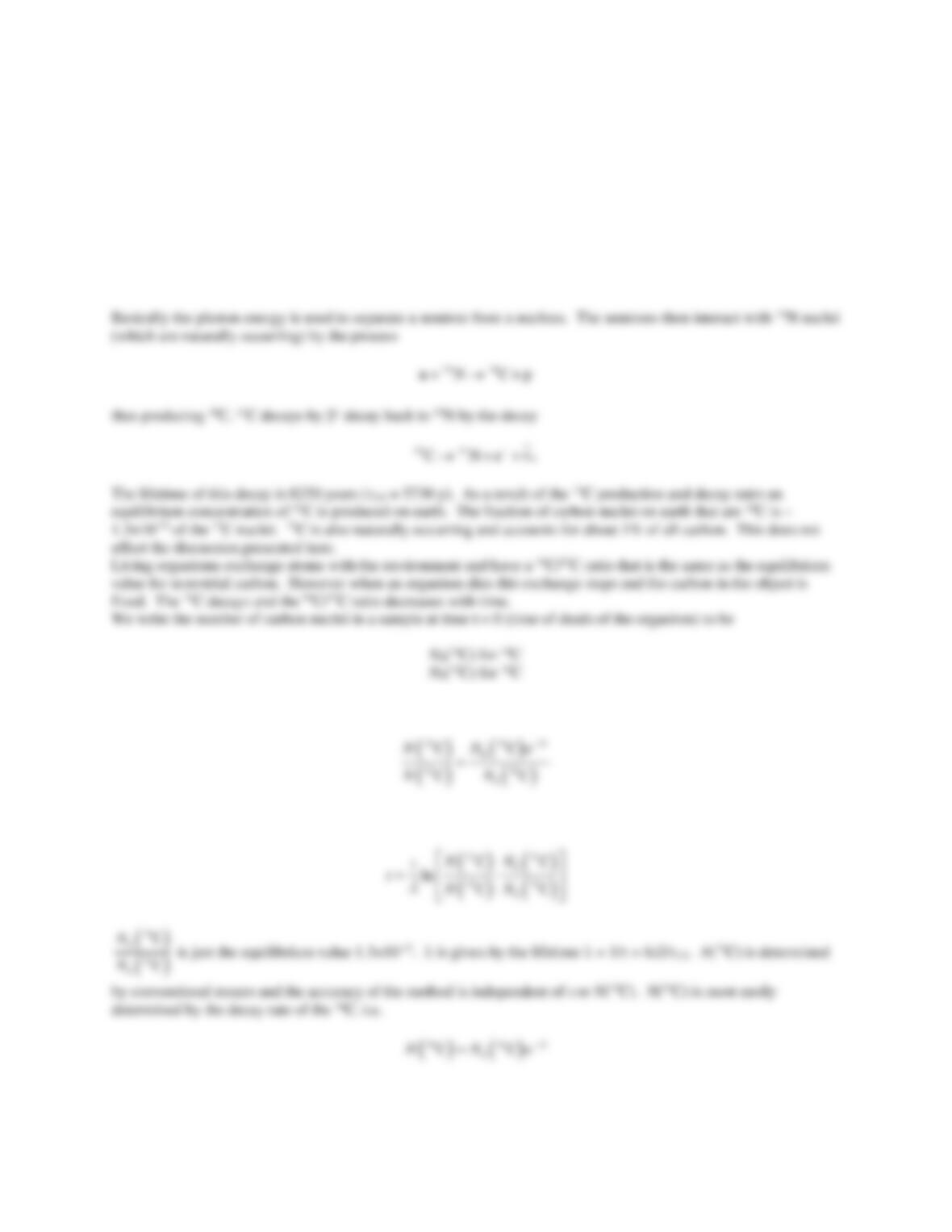
7.1. 14C is a radioactive nuclide that is formed in the earth’s atmosphere through the interaction of cosmic rays.
Cosmic rays are high energy photons of extraterrestrial origin. They interact with various nuclei in the atmosphere
to produce neutrons by the process
1
1
X X n
A Z A Z
NN
−
−
+ → +
As a function of time the ratio N(14C)/N(12C) is written as (since the 12C is stable)
thus solving for t
then
26
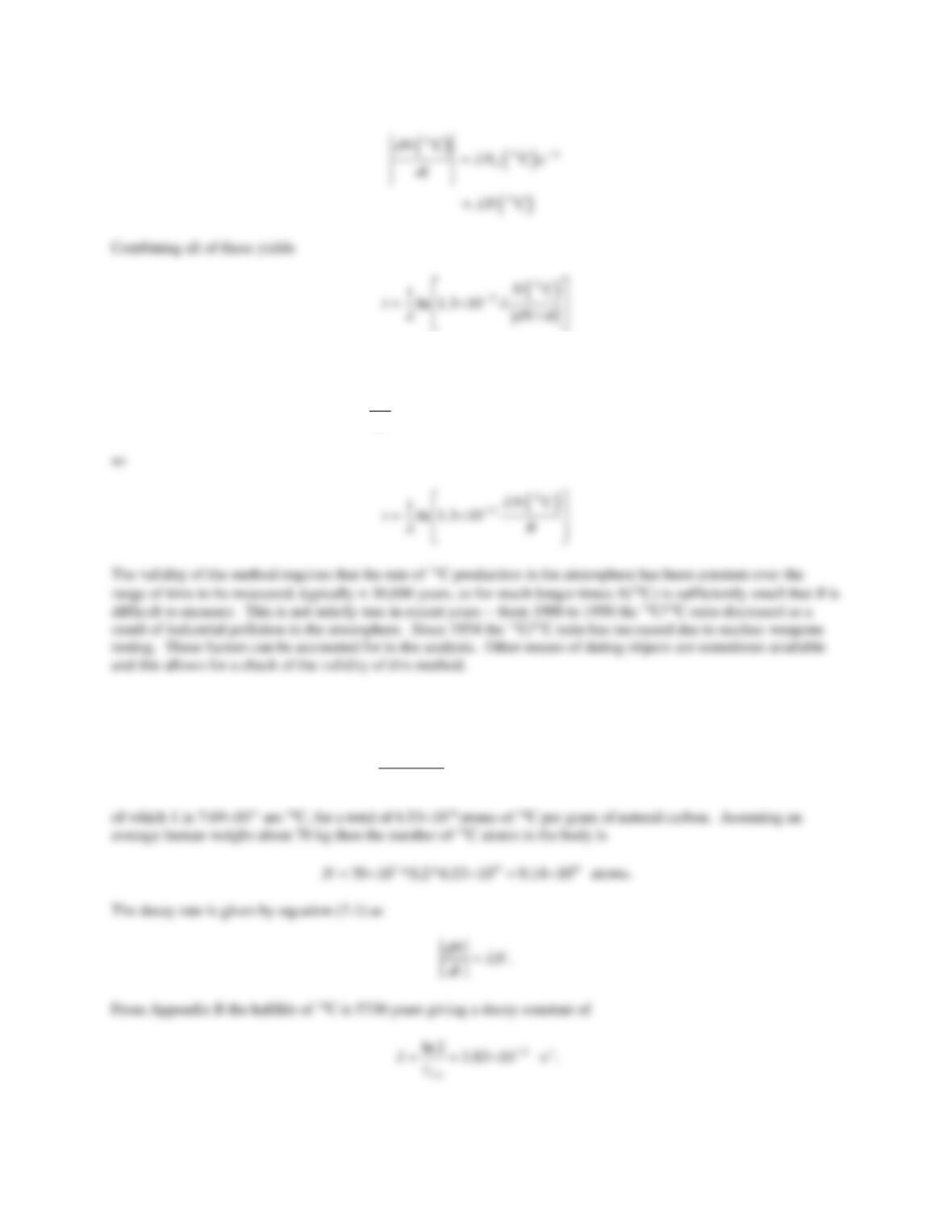
Since each decay of 14C yields 1 electron then
dN R
dt =
(rate of electron emission)
7.2. One gram of natural carbon contains
23 22
6.02 10 5.02 10
12
=
atoms
27
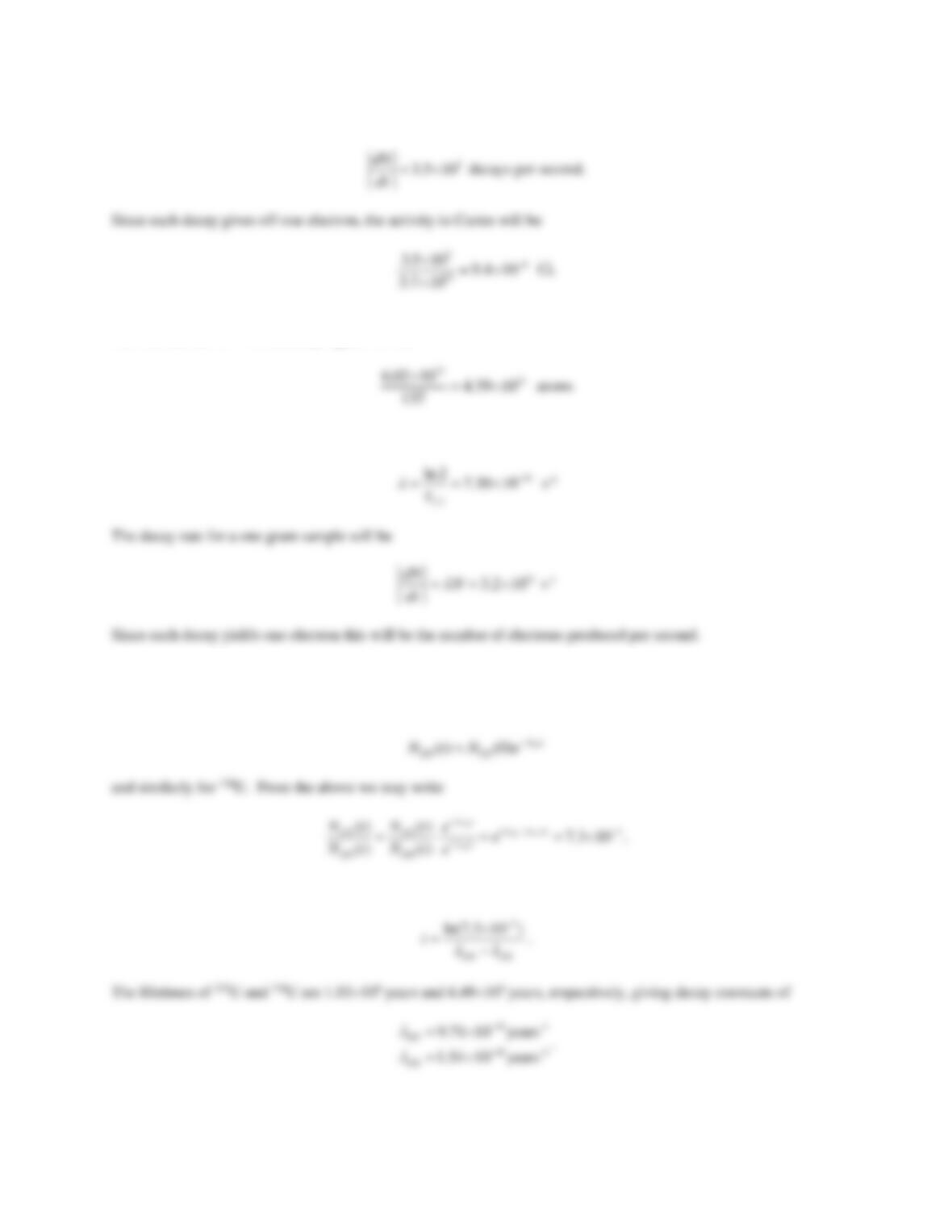
Solving for the decay rate gives
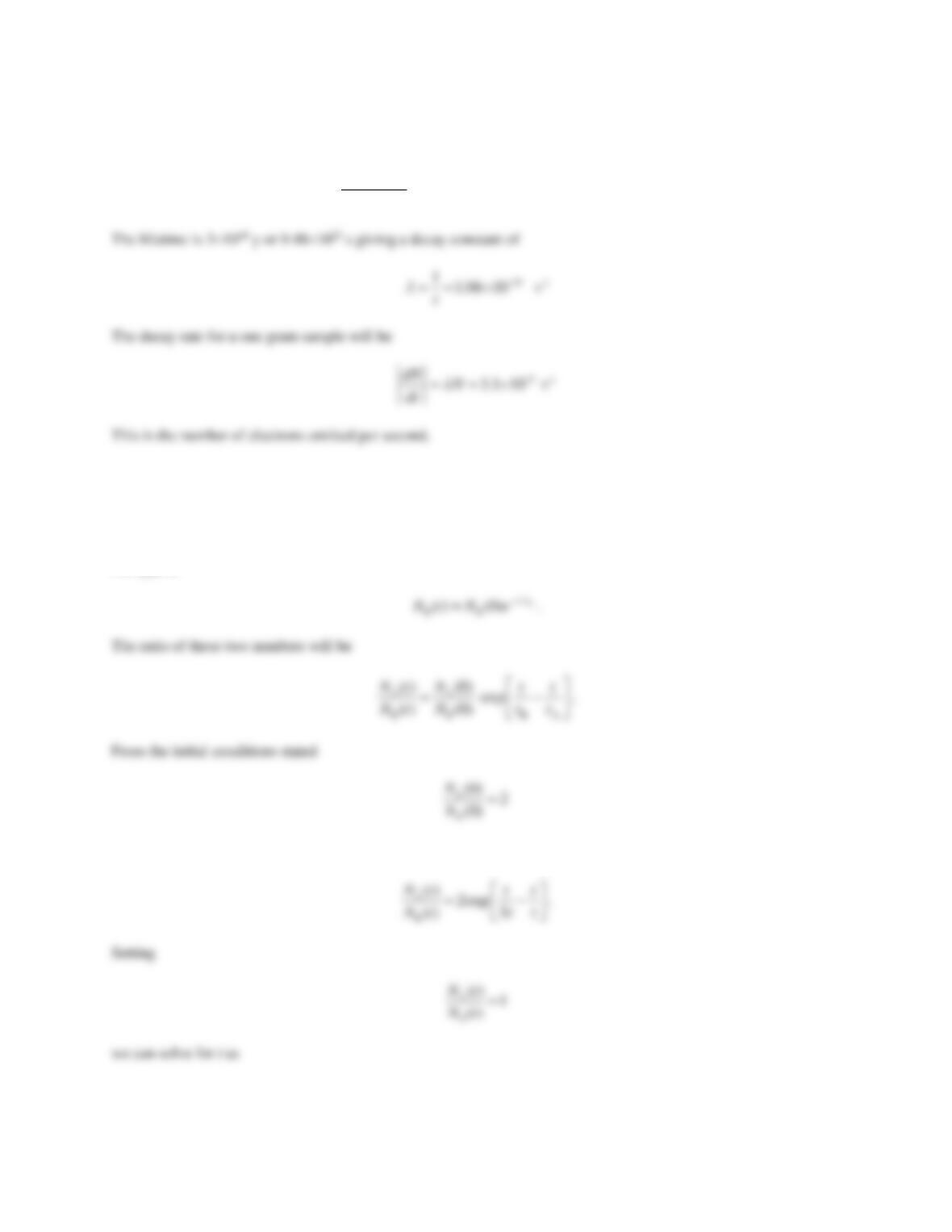
7.3. The number of 137Cs atoms per gram will be
The halflife of 137Cs is 30.07 years giving a decay constant
7.4. We know that N235(0)/N238(0)=1 and that N235(t)/N238(t)=7.310-3 where t is the age of the earth. The number of
nuclei of each species may be written as
Solving for t gives
28
7.5. Accounting for the branching ratio, the total transition rate is 27*(0.89)-1 = 30 s-1. The number of nuclei as
found from the atomic weight (39.089) and the natural abundance of 40K (0.0117 %) is
For nuclei with long lifetimes we write
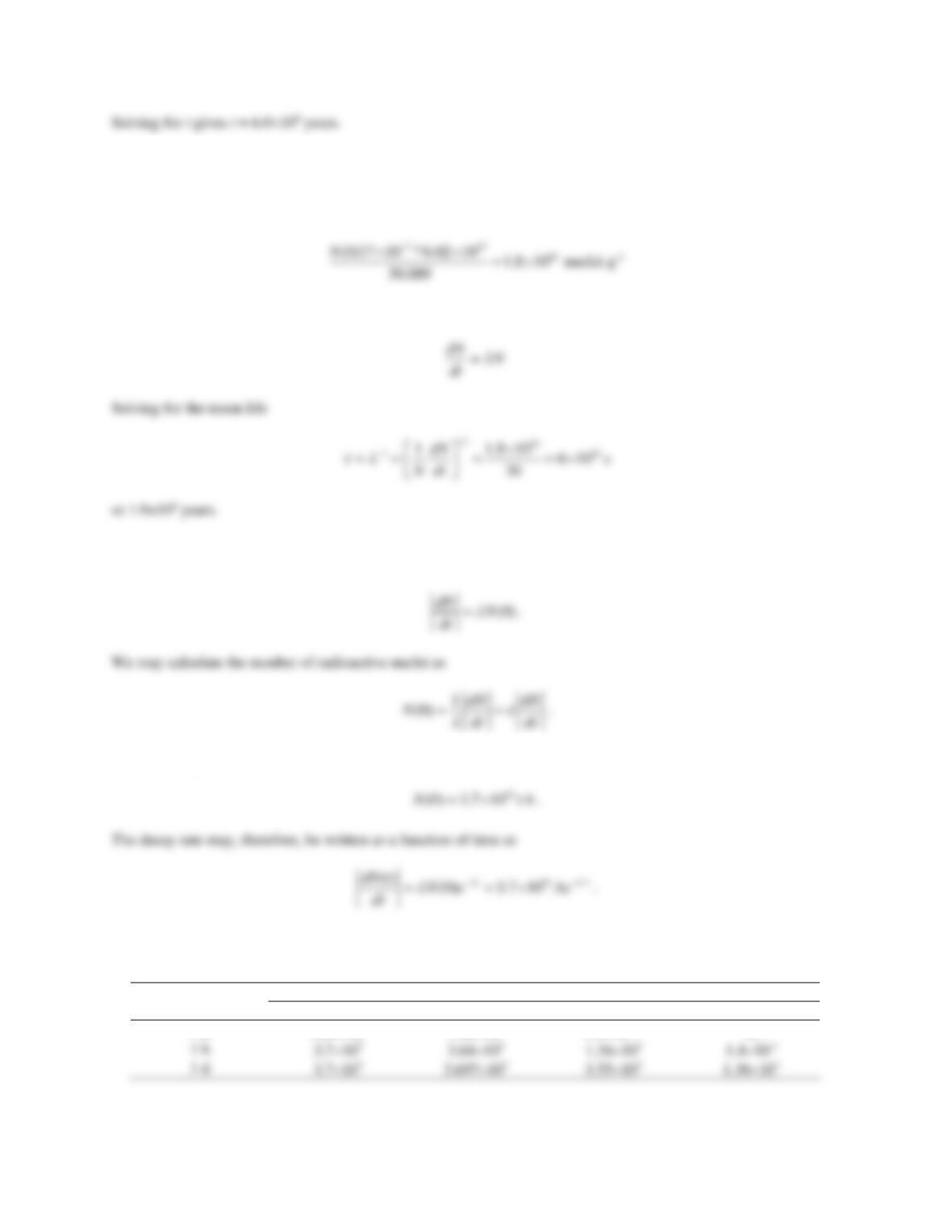
7.6. For a given species the activity at t=0 will be given by
For an activity A (in Ci)
Here A=1 mCi and for the lifetimes given in the problem we can construct the following table (where the results are
in decays per second).
t
1 s
1 m
1 h
1 d
1 m
3.64107
1.36107
3.210-19
0
29
7.7. One gram of natural vanadium will contain
23 19
6.02 10 0.0025 2.95 10
51
=
51V atoms
7.8. The number of nuclei of type A will be
A
/
AA
( ) (0) t
N t N e
−
=
.
For type B
and the lifetimes are
A =
and
B = 3
giving
30
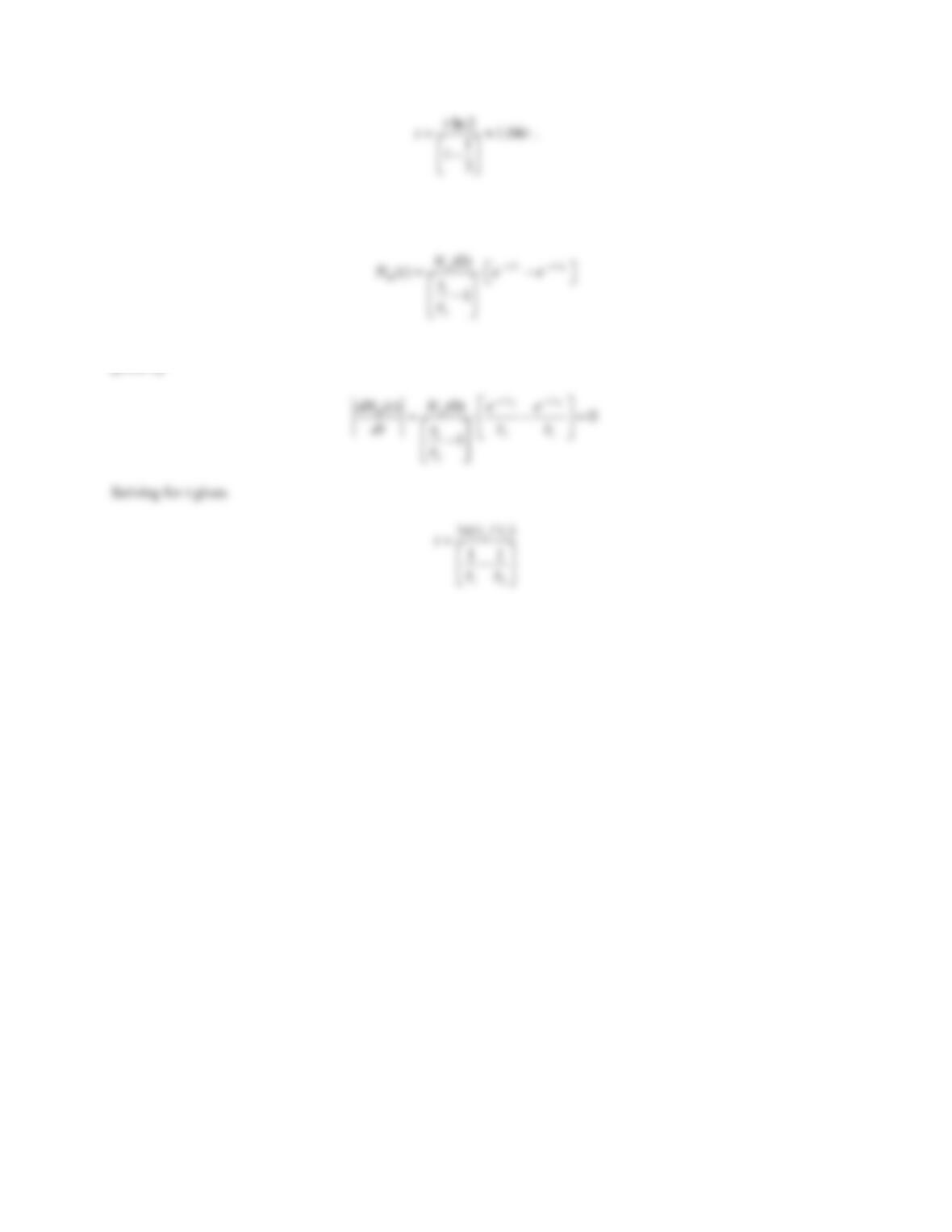
7.9. Equation (7.18) with NB(0)=0 gives
The decay rate for nuclei of type B will be a maximum when the number of nuclei of type B is a maximum. this is
given by