20
Solutions to Problems in
Chapter 6: Properties of the Nucleus
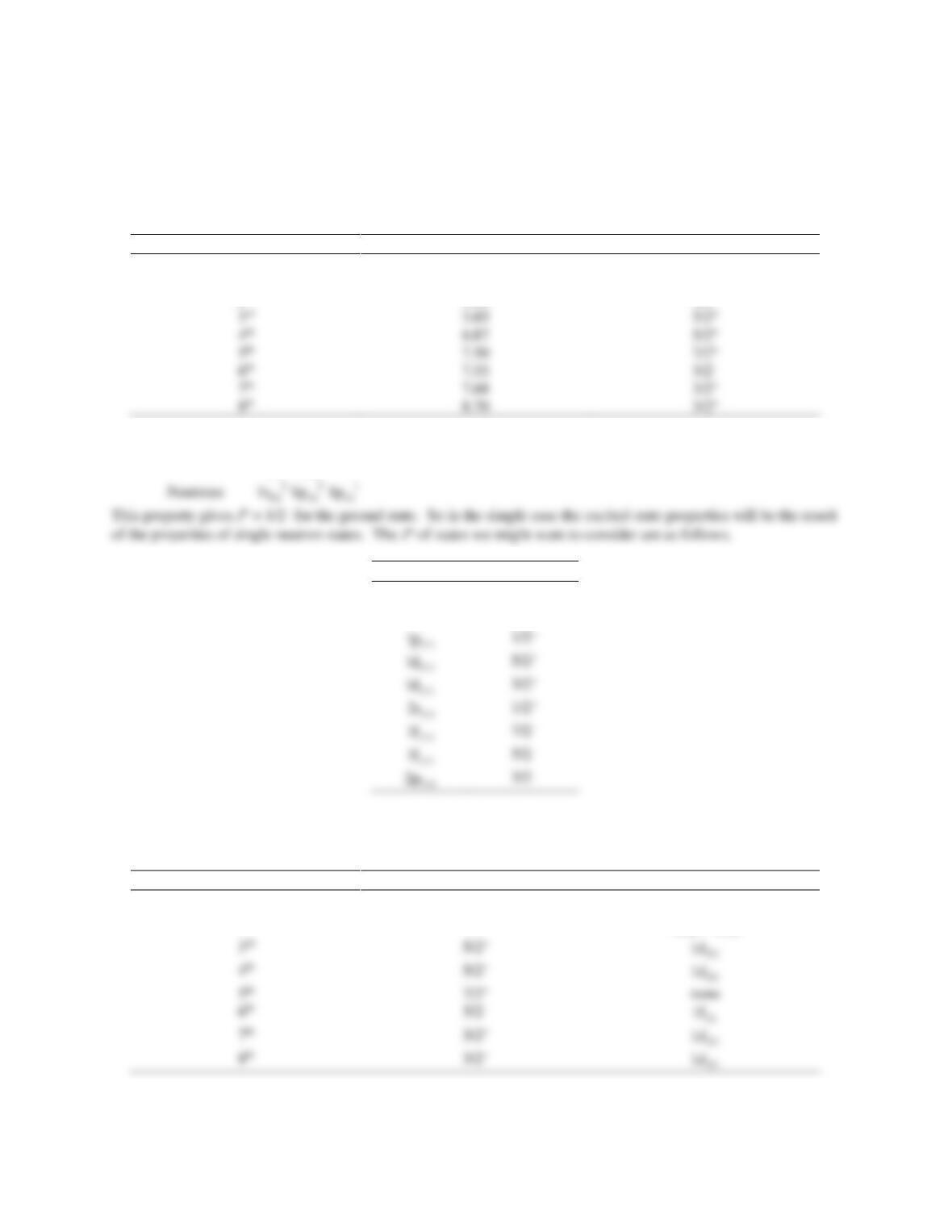
6.1. From the “Table of Isotopes” we find the following state properties for 13C.
state
Energy (MeV)
J
ground
0
1/2–
1st
3.09
1/2+
2nd
3.68
3/2–
The ground state configuration for the 6 protons and 7 neutrons will be
Protons
2
1/ 2
1s
6
3/2
1p
6
3/2
1p
state
J
1/ 2
1s
1/2+
3/ 2
1p
3/2–
5/ 2
5/2+
3/ 2
3/2+
1/2+
5/ 2
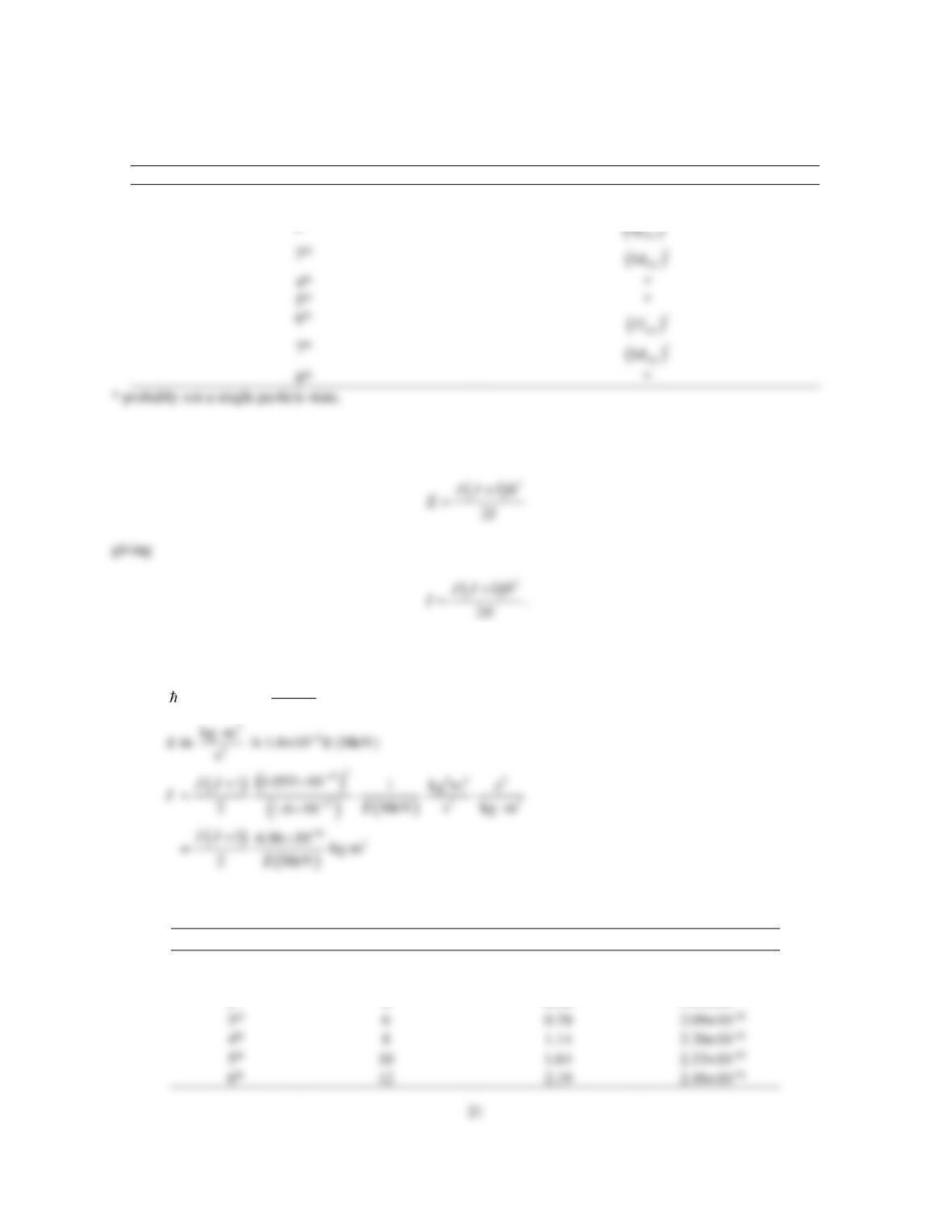
We tabulate possible single particle states that would give the proper J for the various excited states (including
states up to
3/ 2
2p
).
state
J
possible neutron states
1st
1/2+
1/2
1s
,
1/2
2s
2nd
3/2–
3/2
1p
,
3/2
2p
3rd
5/2+
5/2+
5th
7/2+
5/2–
5/2
1f
3/2+
3/2+
3rd
3.85
5/2+
4th
6.87
5/2+
5th
7.50
7/2+
6th
7.55
5/2–
7th
7.68
3/2+
8th
8.70
3/2+
We can use these to consider reasonable state assignments based on an assessment of the state energies. The
following reasonable conclusions can be drawn.
state
neutron state
1st
( )
-1
1/2
1s
2nd
1d
-1
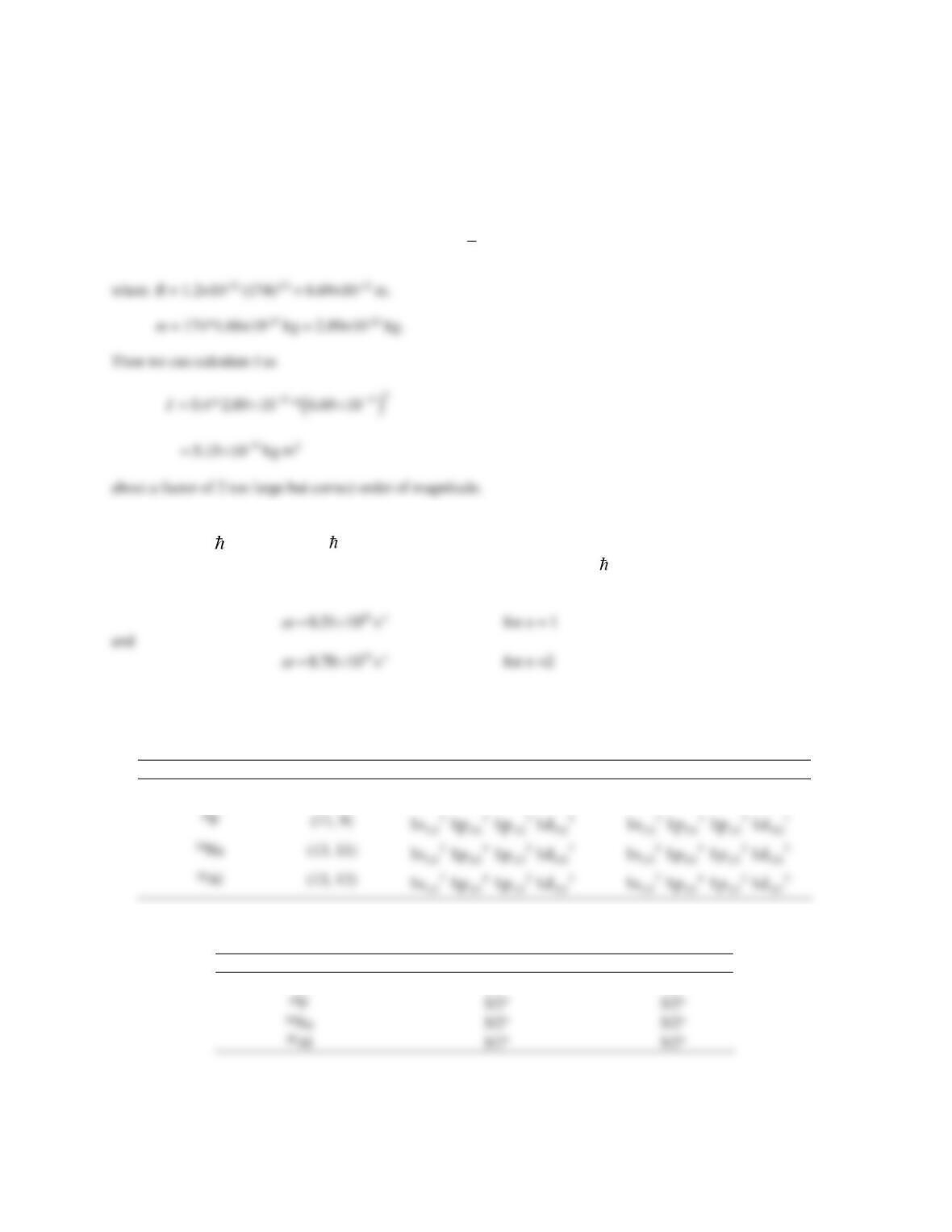
6.2. (a)The energy associated with the (quantum) rotated levels is
Units are as follows
2
34 kg m
1.055 10 s
−
=
This is the correct SI unit for I. The following information is tabulated from Figure 6.11.
level
J
E
I (kg m2)
ground
0
–––––
–––––
1st
2
0.11
1.90×10-54
2nd
4
0.36
1.93×10-54
6
0.70
2.09×10-54
8
1.14
2.20×10-54
1.64
2.33×10-54
2.19
2.48×10-54
22
The slight increase as a function of J (or E) results from the greater deformation of nuclei with higher rotational
energy.
(b) Classically for a sphere
2
2
5
I mR=
6.3. Since E =
then = E/ . From the figure E = 0.560 MeV for n = 1 and E = 1.156 MeV for n = 2
corresponding to one and two phonons, respectively. Substituting for E and in the above and normalizing to the
number of phonons gives
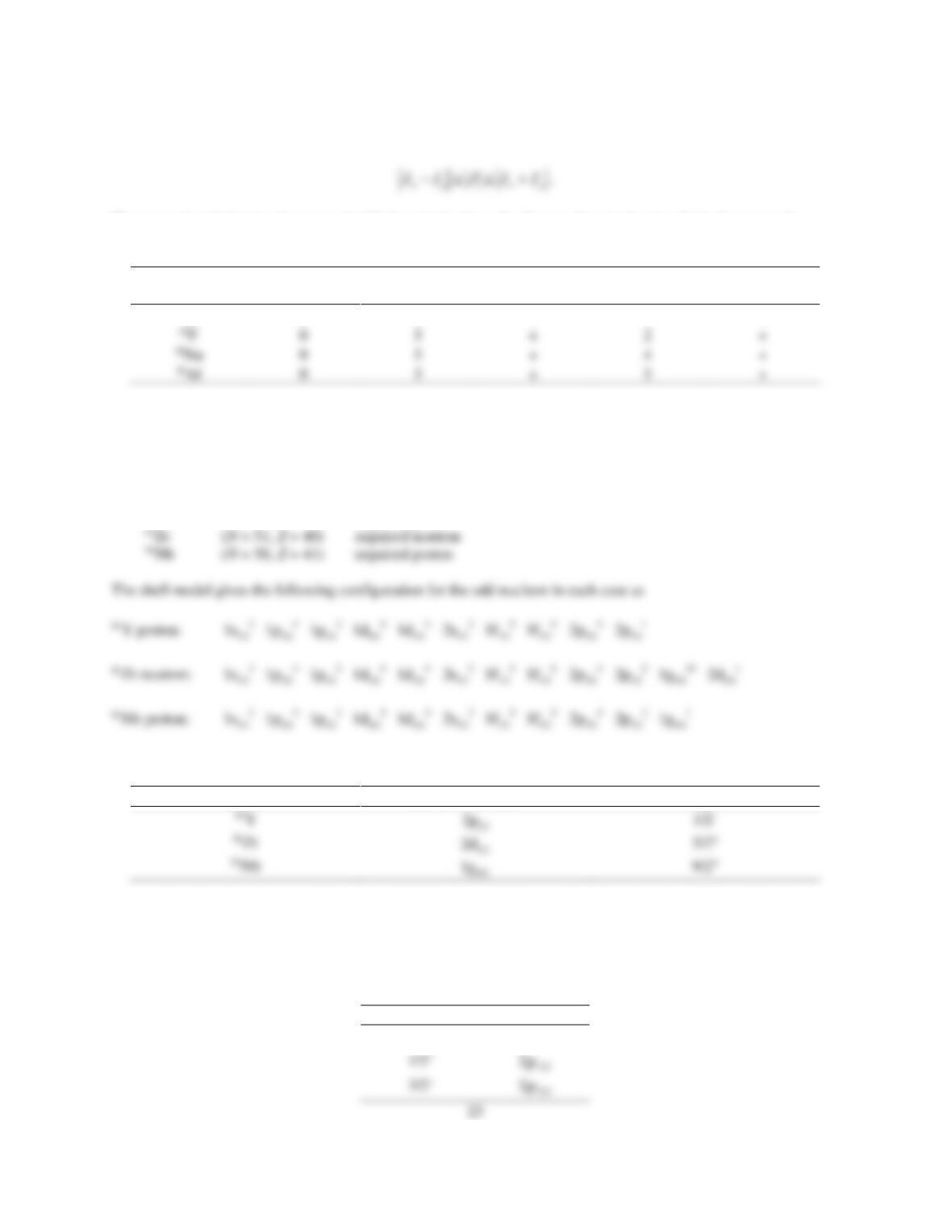
6.4. The ground state neutron and proton states may be determined from the degeneracy of each of the shell model
states as follows:
nuclide
(N, Z)
neutron configuration
proton configuration
14N
(7, 7)
2
1/2
1s
4
3/2
1p
1
1/2
1p
2
1/2
1s
4
3/2
1p
1
1/2
1p
4
3/2
1p
The J of the unpaired nucleons are therefore;
nuclide
neutron
proton
14N
1/2–
1/2–
20F
5/2+
5/2+
5/2+
The parities follow immediately by combining the neutron and proton parities. The range of J for the nucleus is
given by
These may be tabulated and compared with the actual values. In all cases the actual values lie in the range of
predicted values and the parity is in agreement.
nuclide
calculated
actual
Jmin
Jmax
J
14N
0
1
+
1
+
6.5. For odd A nuclei the overall ground state spin and parity are determined by the properties of the unpaired
nucleon.
These nuclides have
91Y (N = 52, Z = 39) unpaired proton
Thus the unpaired nucleon gives the following J
nuclide
unpaired nucleon state
J
6.6. The spin and parity of 59Ni are due to the properties of the unpaired neutron (N = 31). The configuration for the
neutrons is
3
3/2
8
7/2
2
1/2
4
3/2
6
5/2
2
1/2
4
3/2
2
1/2 2p1f2s1d1d1p1p1s
. The ground state J
= 3/2– is given by the
unpaired
3/2
2p
neutron. For the excited state J
we have the possible configurations
J
state
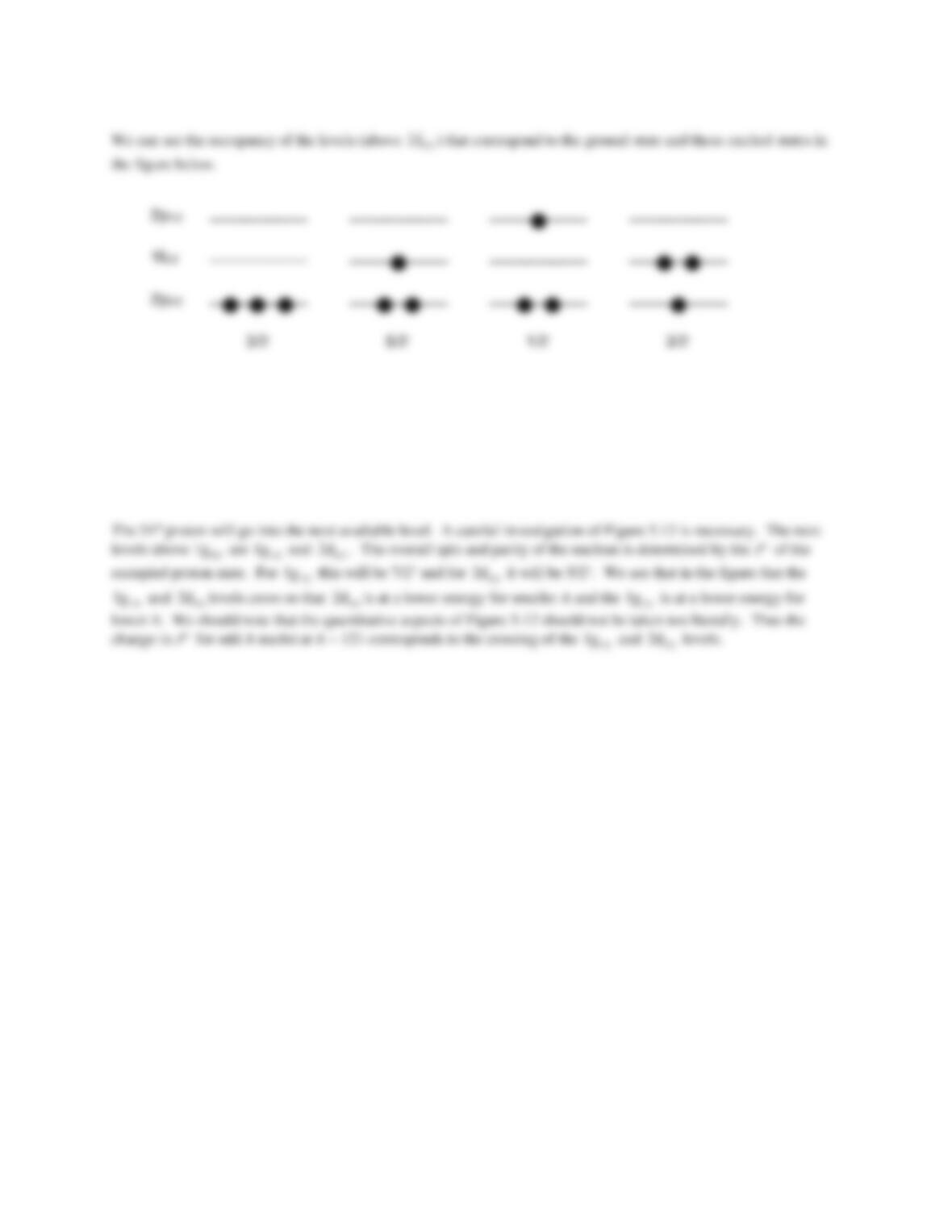
5/2–
5/2
1f
24
6.7. Antimony has Z = 51 and for odd A then N must be even. The spin and parity are, therefore, determined by the
properties of the odd proton. The first 50 protons constitute a filled shell (50 = magic number) with occupancy of
the levels
2
1/2
1s
4
3/2
1p
2
1/2
1p
6
5/2
1d
4
3/2
1d
2
1/2
2s
8
7/2
1f
6
5/2
1f
4
3/2
2p
2
1/2
2p
10
9/2
1g