15
Solutions to Problems in
Chapter 5: The Shell Model
5.1. For the infinite square well potential without –s coupling the j states are degenerate so the good quantum
numbers are n, , s. From equation (5.9) these energy levels are
From Tables 5.5 and 5.6 we chose the relevant Zn as
state
Zn( )
1s
3.14
1p
4.49
1d
5.76
2s
6.28
Now we can calculate the actual state energies in MeV for different A. Some examples are shown in the table.
state
E (MeV)
A = 16
A = 57
A = 109
A = 210
1s
22.3
9.6
6.2
4.0
45.8
19.6
12.7
8.2
75.2
32.3
20.9
13.5
2s
89.3
38.3
24.8
16.1
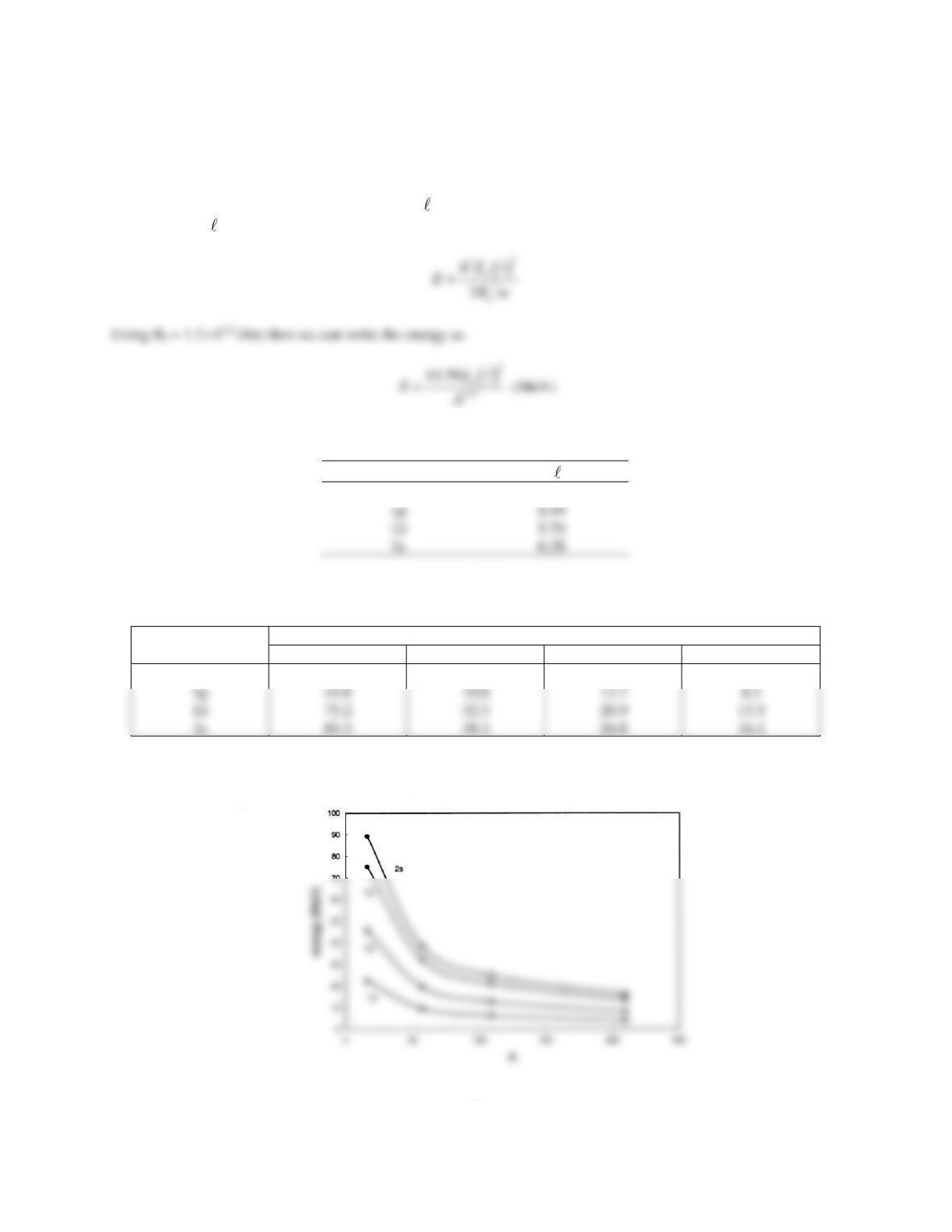
These can be plotted along the lines of Figure 5.12 as shown.
5.2. (a) A nice description of the quantum harmonic oscillator can be found in J. Powell and B. Craseman
“Quantum Mechanics” Addison-Wesley (1961). The energy levels are given in terms of the principal quantum
number, n, as
7ħω/2
5ħω/2
3ħω/2
3
2
1
(b) The energy level diagram as given by the above expression is shown below.
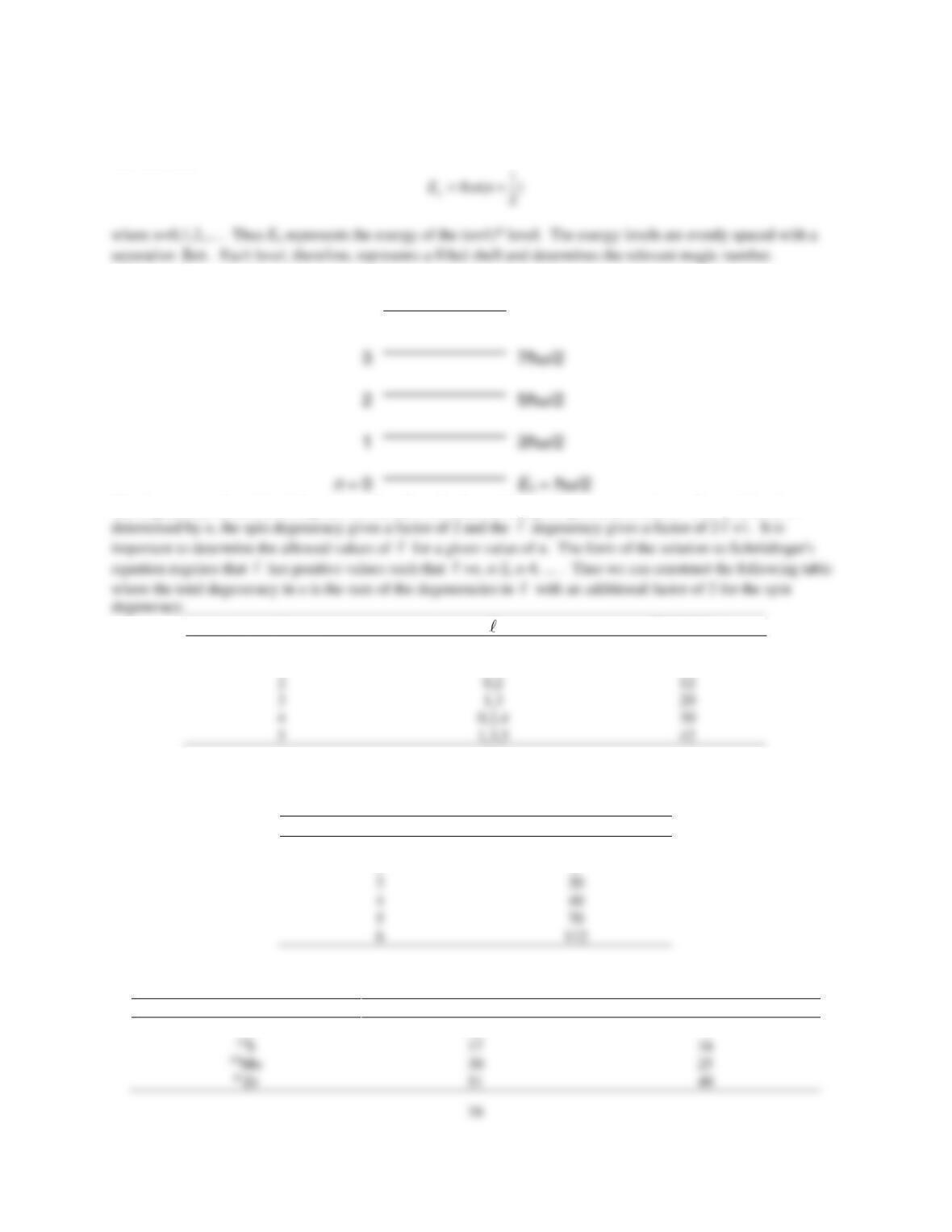
The degeneracy of each level depends on the allowed values of the good quantum numbers. For each level as
n
degeneracy
0
0
2
1
1
6
2
3
4
5
(c) The magic numbers are given by the total degeneracy up to a given energy level as shown in the table.
energy level (n+1)
magic number
1
2
2
8
3
4
5
6
5.3. Values of N and Z for these nuclides are as follows:
nuclide
N
Z
19F
10
9
9ħω/2
4
33S
17
16
30
25
51
40
17
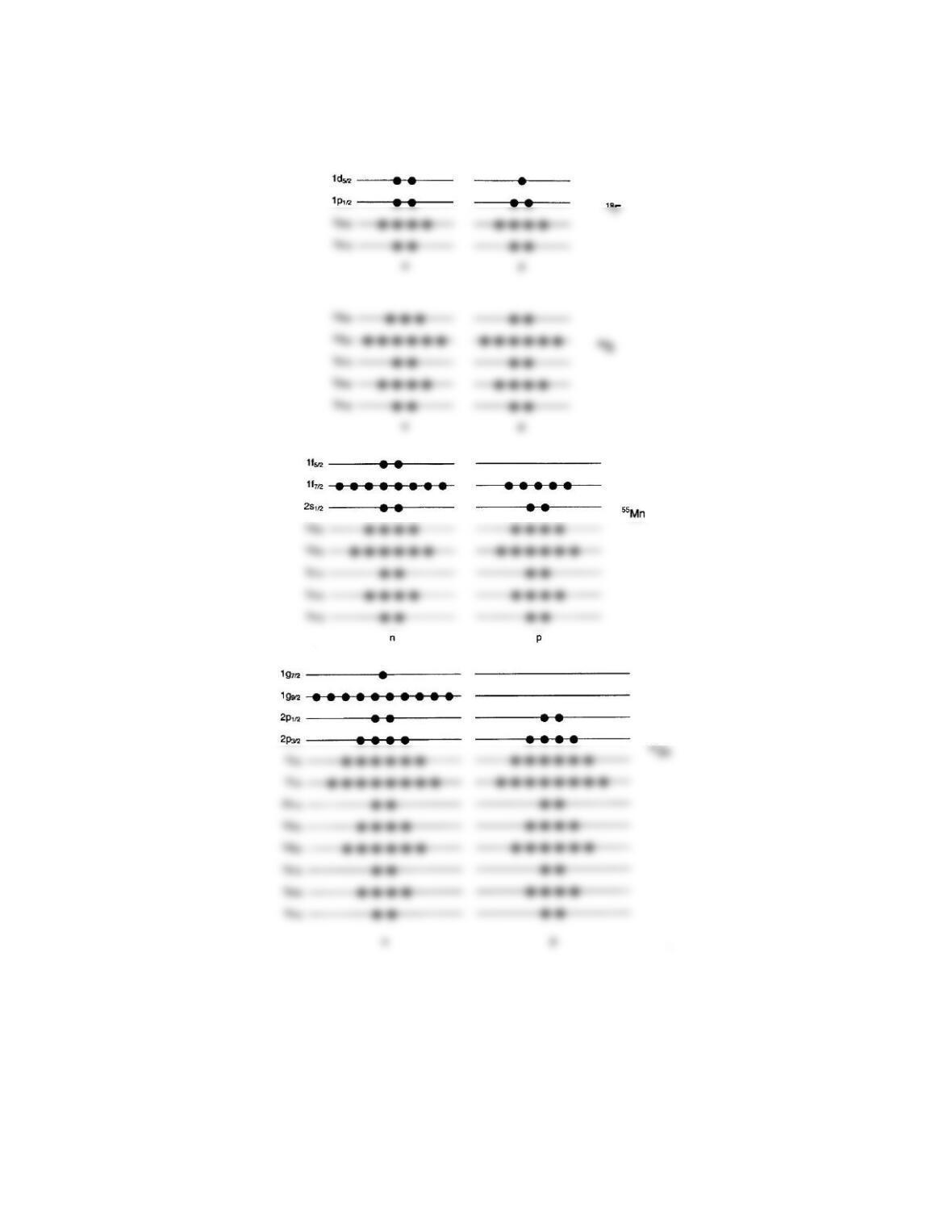
From the degeneracies shown in Figure 5.11, the occupancy of the various energy levels is determined as shown in
the figures below.
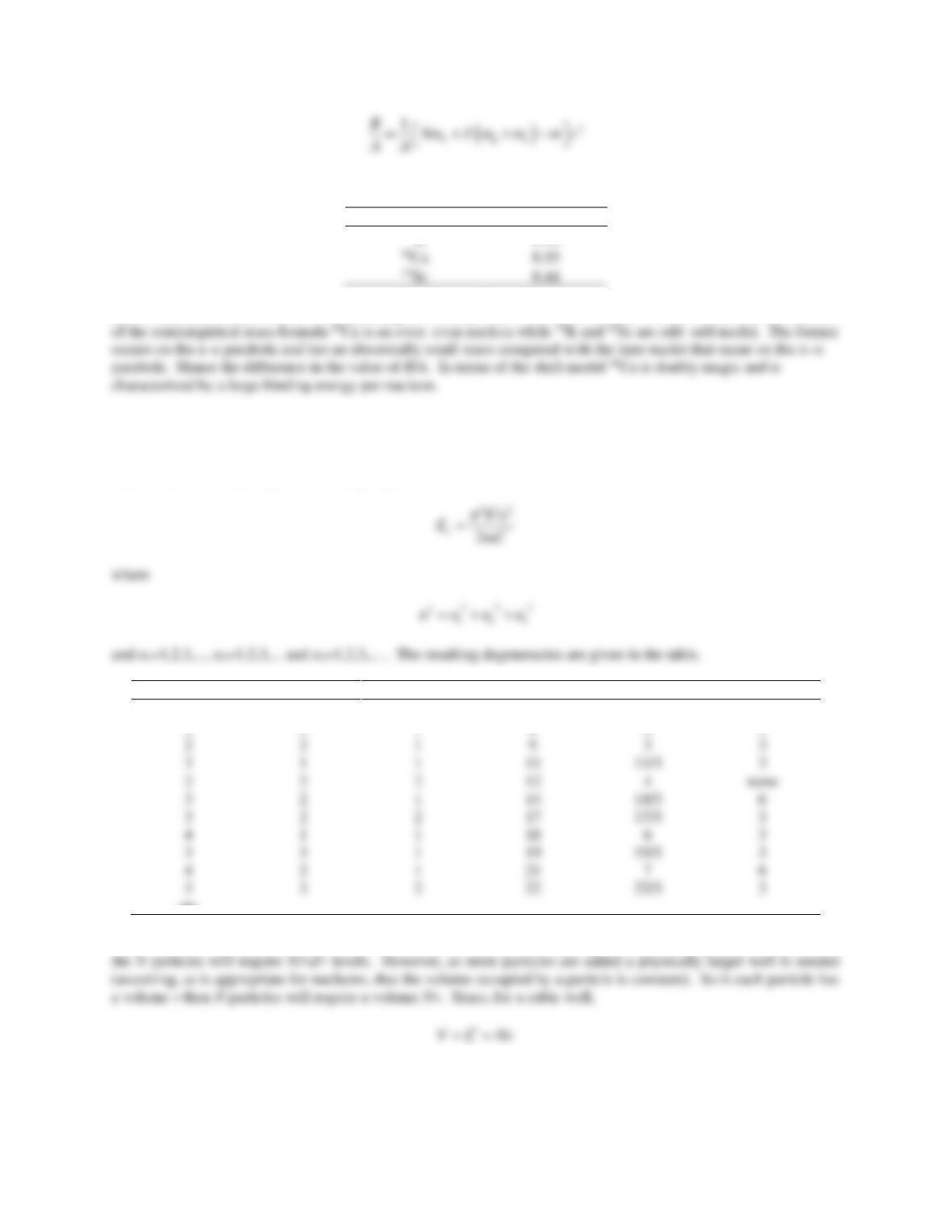
5.4. (a) From equation (4.2) we find
( )
2
n p e
B Nm Z m m m c
= + + −
where we have ignored the electronic binding energy. Thus
18
and using tabulated values of the masses we find
nuclide
B/A (MeV)
38K
8.44
8.55
8.44
(b) We see that 40Ca (N = 20, Z = 20) has a higher B/A than 38K (N = 19, Z = 19) and 42Sc (N = 21, Z = 21). In terms
5.5. As an example we consider the solution to Schrödinger’s equation for a three dimensional infinite square well in
Cartesian coordinates where the potential V(x,y,z)=0 inside the well (0 x,y,z L) and V(x,y,z)= outside the well
(x,y,z > L). The solution gives the energy eigenvalues as
n1
n2
n3
n2
En/E1
degeneracy
1
1
1
3
1
none
2
1
1
6
2
3
2
2
1
9
3
3
3
1
1
3
2
2
2
4
none
3
2
1
6
3
2
2
3
4
1
1
6
3
3
3
1
3
4
2
1
7
6
3
3
2
3
etc
As particles are added to the well more levels are needed to accommodate them. If the average degeneracy is <d>
then
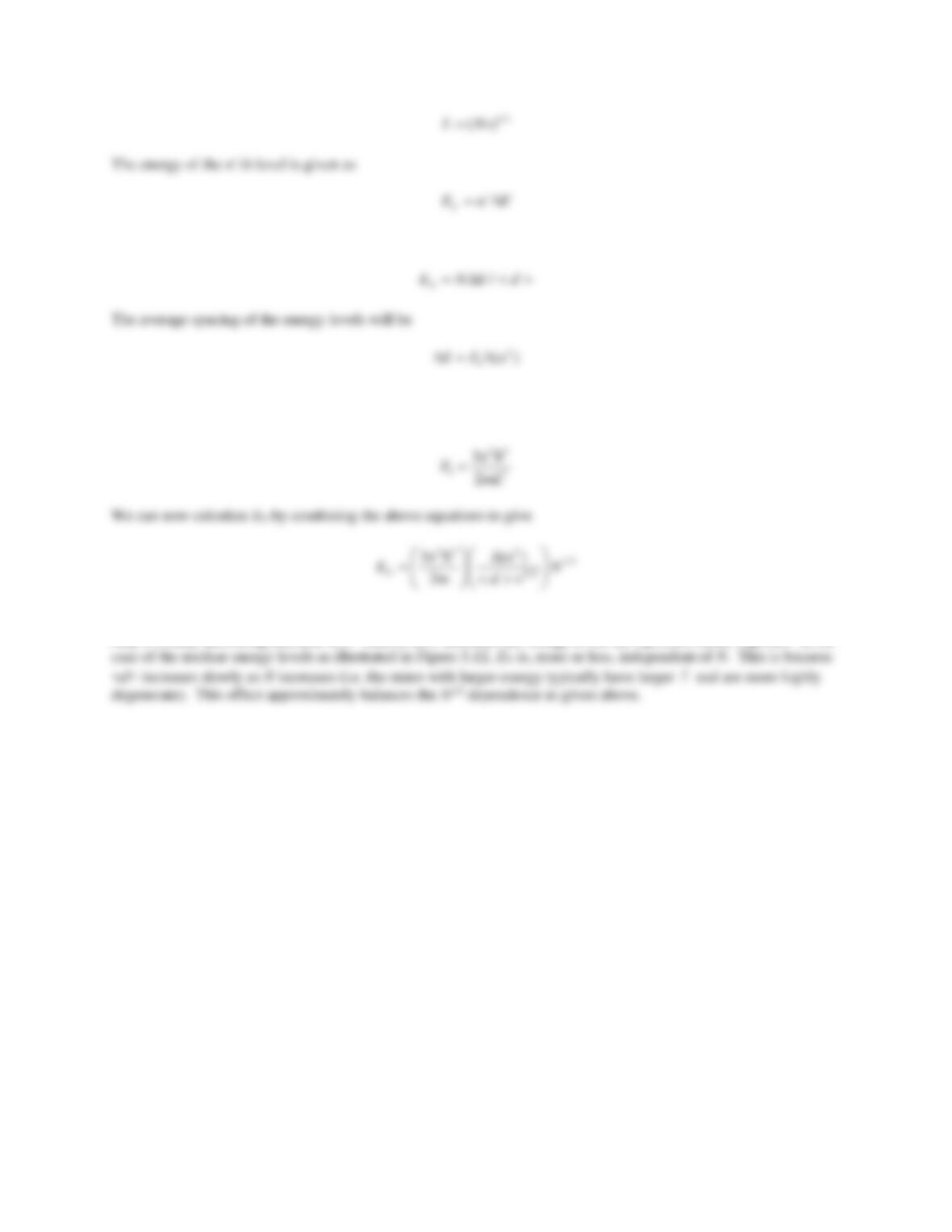
19
where E is the average spacing between levels. N particles will, therefore, fill levels up to an energy EN,
where (n2) is the average spacing in n2 between adjacent levels as given above in the table. E1 is the lowest energy
given for the n1=n2=n3=1 level, or
The first term on the right hand side is a constant. The second term is, more or less, independent of N. Thus, EN is
only a weakly increasing function of N That is, as N increases the energy levels are squeezed closer together. In the