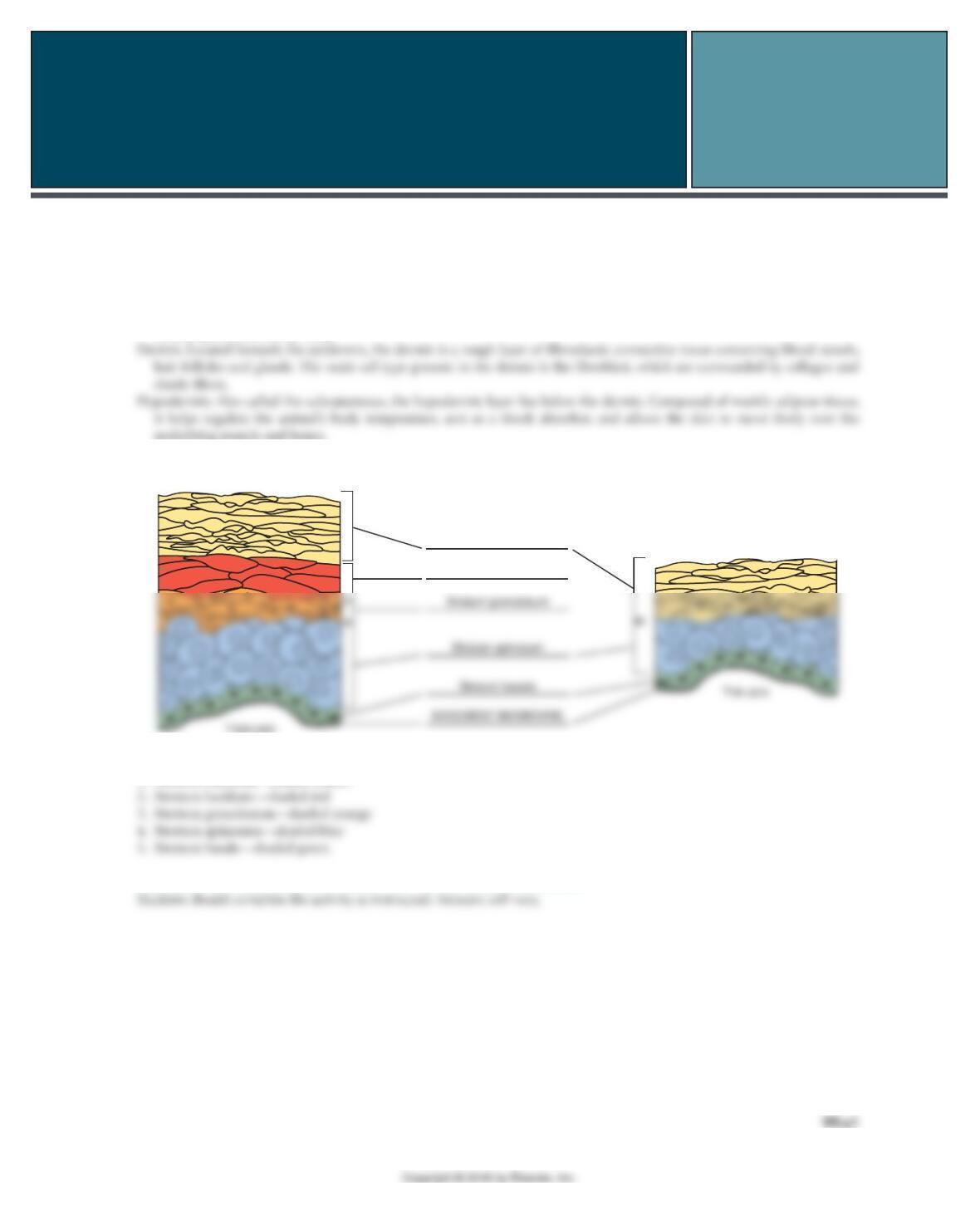
EXERCISE 1. DESCRIBE TISSUE DIFFERENCES
Epidermis: The epidermis is the outermost layer composed of stratifi ed squamous epithelium. It is waterproof and provides
external protection to the body.
EXERCISE 2. COMPARE AND CONTRAST THICK AND THIN SKIN
1. Stratum corneum—shaded yellow
EXERCISE 3. MICROSCOPIC EXAM OF THICK AND THIN SKIN
The Integumentary System
CHAPTER
5
Stratum corneum
Stratum lucidum
CHAPTER 5 The Integumentary System
99.e2
EXERCISE 6. DRAW NOSE AND PAW PADS OF DOG
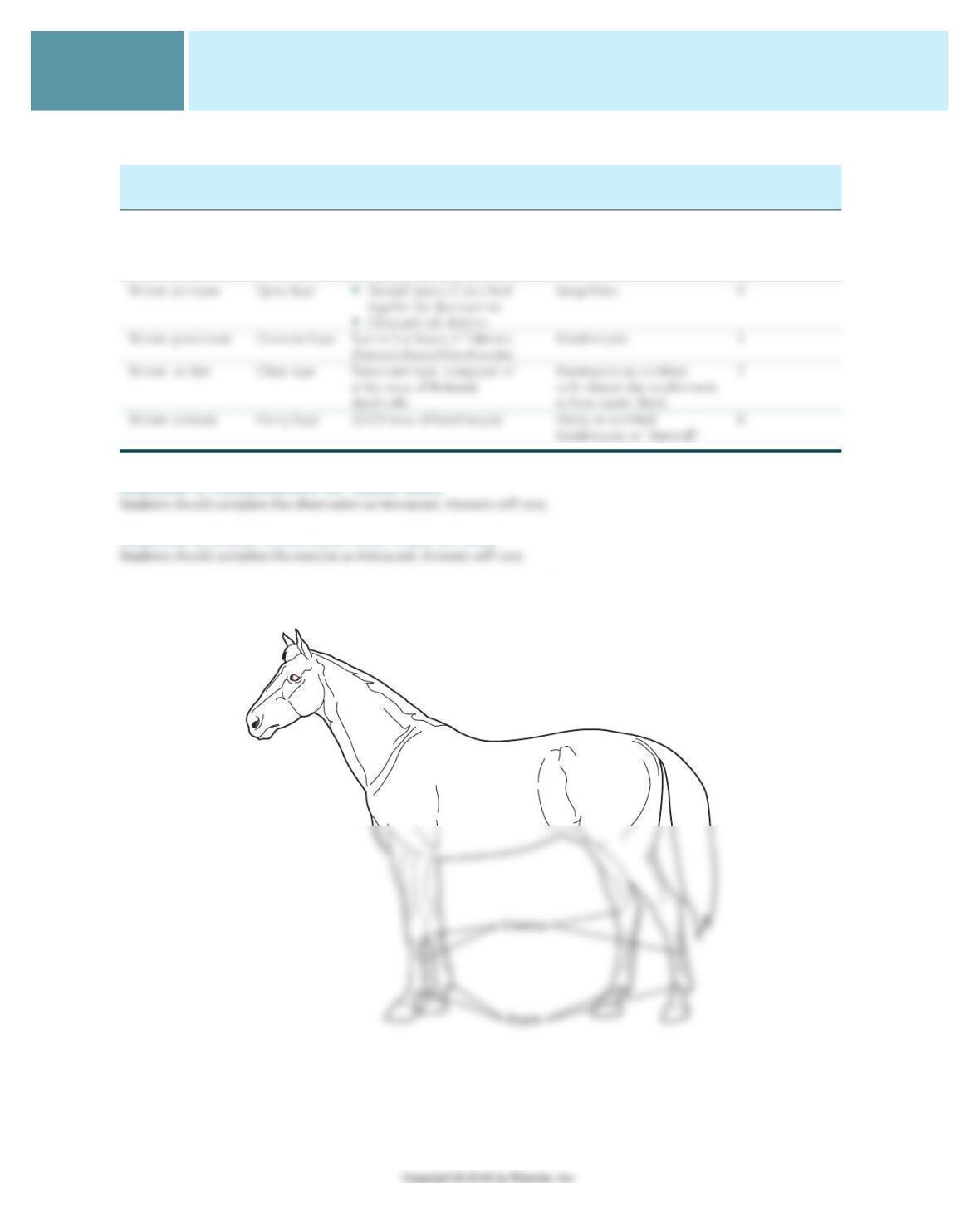
EXERCISE 7. IDENTIFY LOCATION OF CHESTNUTS AND ERGOTS
EXERCISE 4. HISTOLOGIC DESCRIPTION OF THE EPIDERMIS
LAYER
LATIN NAME
COMMON
NAME
HISTOLOGIC
PRESENTATION
CELLS COMMON
TO THE LAYER
PRESENT IN ANIMALS
(A ALWAYS)
(B RARELY)
Stratum germinativum
or Stratum basale Basal layer • Single row of keratinocytes
fi rmly attached to the basement
membrane
• Dynamic cell division
Merkel cells, melanocytes,
keratinocytes A

99.e3
CHAPTER 5 The Integumentary System
EXERCISE 8. LABEL AND COLOR PIG SKIN
1. Hair shaft
2. Epidermis
12. Vein (if it is blue)
EXERCISE 9. DESCRIBE TYPES OF HAIR
NAMES QUALITY QUANTITY
Primary or guard Straight or arched
Thicker and longer than other types Dominant in the follicle
EXERCISE 10. COLOR STRUCTURES OF A HAIR FOLLICLE
EXERCISE 11. MICROSCOPIC EXAM OF HAIR FOLLICLES
EXERCISE 12. FUNCTION AND LOCATION OF CORIUM LAYERS IN THE EQUINE FOOT
LAYER LOCATION FUNCTION
Laminar corium Between the hoof wall and third phalanx Provides nutrients to the stratum internum
EXERCISE 13. COLOR STRUCTURES IN A FELINE CLAW
Students should complete the exercise as instructed.
EXERCISE 14. LABEL AN EQUINE FOOT
A
5 . H e e l
B
11. Proximal phalanx
CHAPTER 5 The Integumentary System
99.e4
7 . F r o g
C
4. Sole
EXERCISE 15. COLOR STRUCTURES IN THE RUMINANT HORN
Students should complete the exercise as instructed.
EXERCISE 16. APPEARANCE OF CANCER OF THE SKIN
CLINICAL PRESENTATION POSSIBLE NEOPLASM
A white cat presents with circular ulcerated lesions on its nose. Tissue has been eroded by
the lesion. Squamous cell carcinoma
EXERCISE 17. EXPLORING ALLERGY AND MANGE
CLINICAL PRESENTATION POSSIBLE CONDITION
A dog presents with a black pigmented excoriated, hairless area on a front limb.
The owner reports the dog has been constantly scratching the area for months. Chronic allergy
EXERCISE 18. MATCHING TERMS AND DEFINITIONS
r . E p i d e r m i s
g . D e r m i s
99.e5
CHAPTER 5 The Integumentary System
EXERCISE 19. CLINICAL THINKING CHALLENGE
1. The dermis is composed of two layers: the thin, superfi –
cial papillary layer and the thick, deeper reticular layer.
Unlike the epidermis, which is primarily cellular, the
dermis is highly fi brous.
2. Tension lines are important to surgeons because the heal-
ing of an incision occurs best if the incision is made
parallel to the direction of the collagen bundles, so fewer
3. These include (1) the carpal pads, which reside on the
caudal surfaces of the “wrist”; (2) the metacarpal and
metatarsal pads, which are the central weight-bearing
pads of the foot; and (3) the digital pads, which protect
each of the digits.
protecting the animal via camoufl age.
7. When a hair is produced, dead keratinized epithelial cells
push up and away from the dermal papilla and are orga-
addition, hair that stands erect can better trap insulating
layers of air than nonerect hair. So animals with erect
hair coats stay warmer than animals with fl at coats.
9. When the arrector pili muscle contracts, it compresses
the sebaceous gland, and the sebum is forced from the
alveolus through the duct into the hair follicle. Here
sebum coats the base of the hair and the surrounding
skin and plays an important role in trapping moisture to
prevent excessive drying.
become a formidable weapon, a status symbol, and an
attractive male secondary sex characteristic. With time,
the bony connection between the antler and the skull
breaks down, the antlers fall off, and new growth begins.
11. As with all inflammation, laminitis involves swelling;
fatal to the animal.
12. Predisposing factors for laminitis include the following:
1. Engorgement of foods high in carbohydrates