VOLCANOES AND VOLCANIC HAZARDS 5
INTRODUCTION
Volcanoes and Volcanic Hazards
CHAPTER OUTLINE
1.
2.
76
77
3.
4.
78
5.
6.
7.
79
8.
80
9.
10.
LEARNING OBJECTIVES/FOCUS ON CONCEPTS
5.1 Explain
5.3 Label
5.5 Describe
5.7 Discuss
81
5.9 Relate
TEACHING STRATEGIES
Clicker Questions:
A. Viscosity
B. Volcanic Structures
82
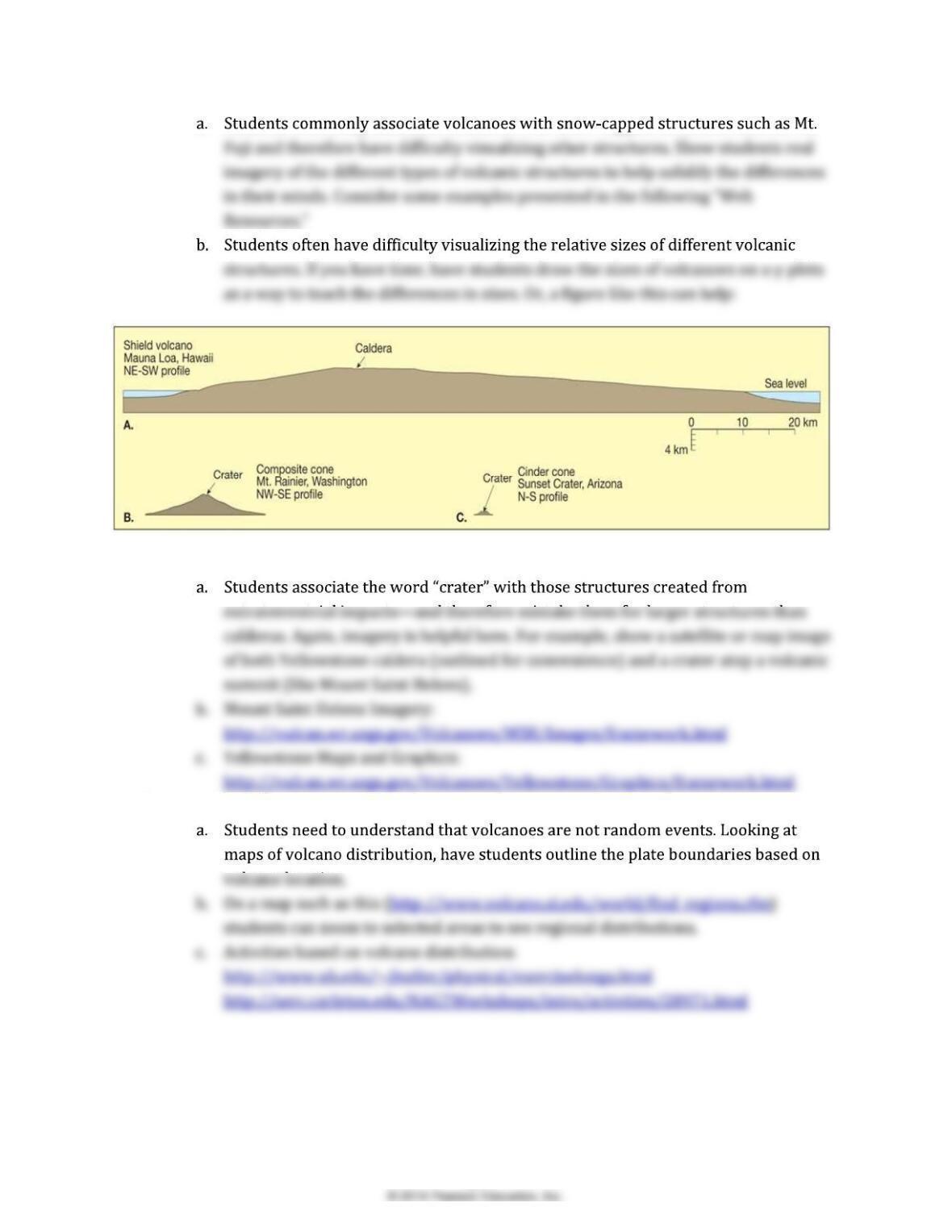
C. Craters vs. Calderas
D. Connections to Plate Tectonics
83
TEACHER RESOURCES
Web Resources:
USGS Volcano Resources.
o Volcano Resources for Educators.
Global Volcanism Program.
84
How Volcanoes Work.
Imagery and Video Resources:
NASA Earth Observatory: Natural Hazards: Volcanoes and Earthquakes.
85
Webcams:
ANSWERS TO QUESTIONS IN THE CHAPTER:
CONCEPT CHECKS
5.1 THE NATURE OF VOLCANIC ERUPTIONS
1. Viscosity is defined as a materials resistance to flow; in magmas, viscosity is the mobility of
magma. Viscosity can be thought of as the stickiness of a magma, less viscous magmas are
2. More viscous magmas create more explosive eruptions and less viscous magmas create less
3. Most silica rich Rhyolitic magma, andesitic magma, basaltic magma least silica rich
5.2 MATERIALS EXTRUDED DURING AN ERUPTION
1. Aa and pahoehoe lava flows are basaltic in composition and form when basaltic lava escapes a
vent. Aa flows are created from cooler, less fluid basaltic flows. Aa flows are relatively thick
2. Block lavas form from viscous andesitic and rhyolitic lavas and are much shorter than aa
3. Pillow lavas form along oceanic ridges on the ocean floor as basaltic magma is released from
86
4. The main gases released in an eruption are water vapor (H2O), carbon dioxide (CO2), sulfur,
Pyroclastic (tephra) materials are those rock and lava fragments ejected from a volcanic vent.
These materials range from very fine dust to boulders weighing several tons. Examples of
6. Scoria is a red or black vesicular rock created from basaltic to andesitic lavas. Vesicles are
5.3 ANATOMY OF A VOLCANO
1. Craters and calderas are both funnel-shaped depressions at the summit of a volcano formed
2. The conduit of a volcano is the circular path that the magma takes as it moves up through a
3. Parasitic cones are accumulations of volcanic materials that sometimes form on the flanks of
5.4 SHIELD VOLCANOES
1. Shield volcanoes are created from the accumulation basaltic, low-viscosity lavas. These lavas
2. Pyroclastics are not a significant component of shield volcanoes because of the low viscosity of
the lava that creates these structures. However, in the final stage of growth of a shield volcano
3. The majority of shield volcanoes are formed on the ocean floor, although we do find a few
4. Lava tubes are created under the solidified surface of a lava flow as very hot, fast-moving lava
5. Mauna Loa and the other Hawaiian Islands are perhaps the best known shield volcanoes on
Earth. Other examples include the Canary Islands off the west coast of Africa, the Galapagos
5.5 CINDER CONES
1. Cinder cones are composed of basaltic scoria, most commonly pea- to walnut- sized. Scoria is
2. Cinder cones are smaller in size, and steeper in slope than shield volcanoes because they are
3. Cinder cones generally form over very short time periods; 95 percent of cinder cones form in
5.6 COMPOSITE VOLCANOES
2. Composite volcanoes are composed of alternating layers of silica-rich pyroclastic material and
3. Composite volcanoes are composed of more viscous, silica-rich lava flows of andesitic and
rhyolitic composition. Basaltic flows can be emitted, but are not the primary constituent of
5.7 VOLCANIC HAZARDS
1. Pyroclastic flows are incandescent mixtures of gases, ash and pyroclastic material. These
2. Lahar is a mudflow created when glacial meltwater or rainwater mixes with volcanic debris
creating a fast-moving, muddy liquid. Lahar is common on glaciated volcanoes, such as those
3. Volcanic hazards also include tsunami triggered by flank collapses and eruptions into the
5.8 OTHER VOLCANIC LANDFORMS
1. Crater Lake, in Oregon, formed about 7000 years ago when ancient Mt. Mazma, a composite
volcano, explosively erupted pyroclastic material. After the large eruption, the summit of the
2. Pyroclastic flows can be associated with volcanic domes of composite volcanoes. When these
3. The eruptions that created the Columbia Plateau are called fissure eruptions. These are
characterized by the eruption of large amounts of fluid basalt from cracks in the Earths crust.
4. A lava dome is created as highly viscous lava is pushed out of a volcanic vent, creating a dome-
shaped plug at the vent. These structures are relatively small (10s of meters in height) and
5. Shiprock, New Mexico, is a 510 meter (1500 feet) tall structure that is the remnant conduit of
5.9 PLATE TECTONICS AND VOLCANIC ACTIVITY
1. Ring of Fire volcanoes are often the result of continental-oceanic convergence. As the
subducting oceanic plate melts, the molten material rises in the continental crust. This magma
2. The subducting plate sinks into the mantle and higher temperatures drive water and carbon
3. Basalt is most often associated with divergent plate boundary volcanism. As two plates spread,
4. Intraplate volcanism is thought to be caused by plumes of superheated mantle material that
5.10 MONITORING VOLCANIC ACTIVITY
1. Changes in earthquake patterns triggered by a movement of magma, inflation of a volcano
2. The overriding goal of volcano monitoring is to discover precursors of an imminent eruption in
EYE ON EARTH
EOE #1 MOUNT PINATUBO
2. 100 kilometers per hour or more
EOE #2 TAUNG KALAT
2. Most likely a composite cone, as this represents the eruptive conduit of the volcano from
which the less resistant slopes have since eroded. The conduits of less resistant cinder
GIVE IT SOME THOUGHT
1.
a. convergent plate boundaries
b. intraplate volcanism
2.
a. Composite volcano (stratovolcano). Very large, symmetrical shape with steep summit
and gentler sloping flanks.
3.
a. Hot mantle rock is the source of divergent boundary basalts.
b. Melting temperatures of rock-forming minerals increase with higher pressure and
decrease with lower pressure. As mantle material rises to fill the void of diverging
4.
A. Convergent Boundary volcanism at an oceanic-continental convergence. This would
produce most explosive eruptions as melted material assimilates with crustal material
5. Imminent volcanic activity can be measured in several ways. One, we might look at the
historical pattern of earthquakes in the area including their frequency, magnitude, and
depth. If we find that earthquakes are increasing in intensity, frequency, and/or becoming
6. This image shows a lava dome. These structures form as silica-rich lava is squeezed out of a
7. **This is a more open-ended question. Student criteria should demonstrate an
understanding of how we monitor volcanoes, and an understanding of hazards presented
by volcanos. **
We would want to choose volcanoes that are activeso we should study the known history
of many volcanos and choose those with a recent eruptive history and therefore predicted
**These are just a few examples. Student answers should integrate their knowledge of
volcanic eruption hazards and monitoring techniques. Choices should reflect those reasons
chosen as most important in site selection. **
Using this reasoning, we could consider monitoring any of the following volcanoes:
92
8. Mountt Rainier is covered with a greater volume of glacial ice than Mount St. Helens, and
would most likely produce a greater number of destructive lahars. Also, Mt. Rainier is a
9.
a. This is a pyroclastic flowa mixture of gases and volcanic fragments that moves
b. This is a lava dome, a structure built of viscous lava emitting from the volcanic vent
and creating a dome-like structure at the summit of the volcano. Domes such as this
CLASSROOM DEMONSTRATION
BEHAVIOR OF MAGMA AND LAVA CONTAINING DISSOLVED GASES
Contributed by: Richard M. Buschrbusch@wcupa.edu
West Chester University of Pennsylvania
Materials per group of students:
Preparation Time: 10 minutes to assemble small clear bottles of corn syrup.
Demonstration Time: 1015 minutes (depending on time for brief writing and/or discussion)
Background:
This demo can be used as a guided inquiry method for having students understand how dissolved gases
affect the behavior of magma.
93
Soda Bottle Magma and Lava Procedures
1. Have students observe an unopened bottle of soda, and describe/record their observations of the soda
(i.e., they should notice that there are few or no bubbles).
2. Have students remove the cap from the bottle of soda, and then describe/record what they hear and
Corn Syrup Lava Procedures
1. Have students shake vigorously one of their two small bottles of corn syrup, then have them infer
2. Have students form a tentative notion (hypothesis) about whether an abundance of gases makes lava
94