1
Solutions to Problems in
Chapter 3: Nuclear Composition and Size
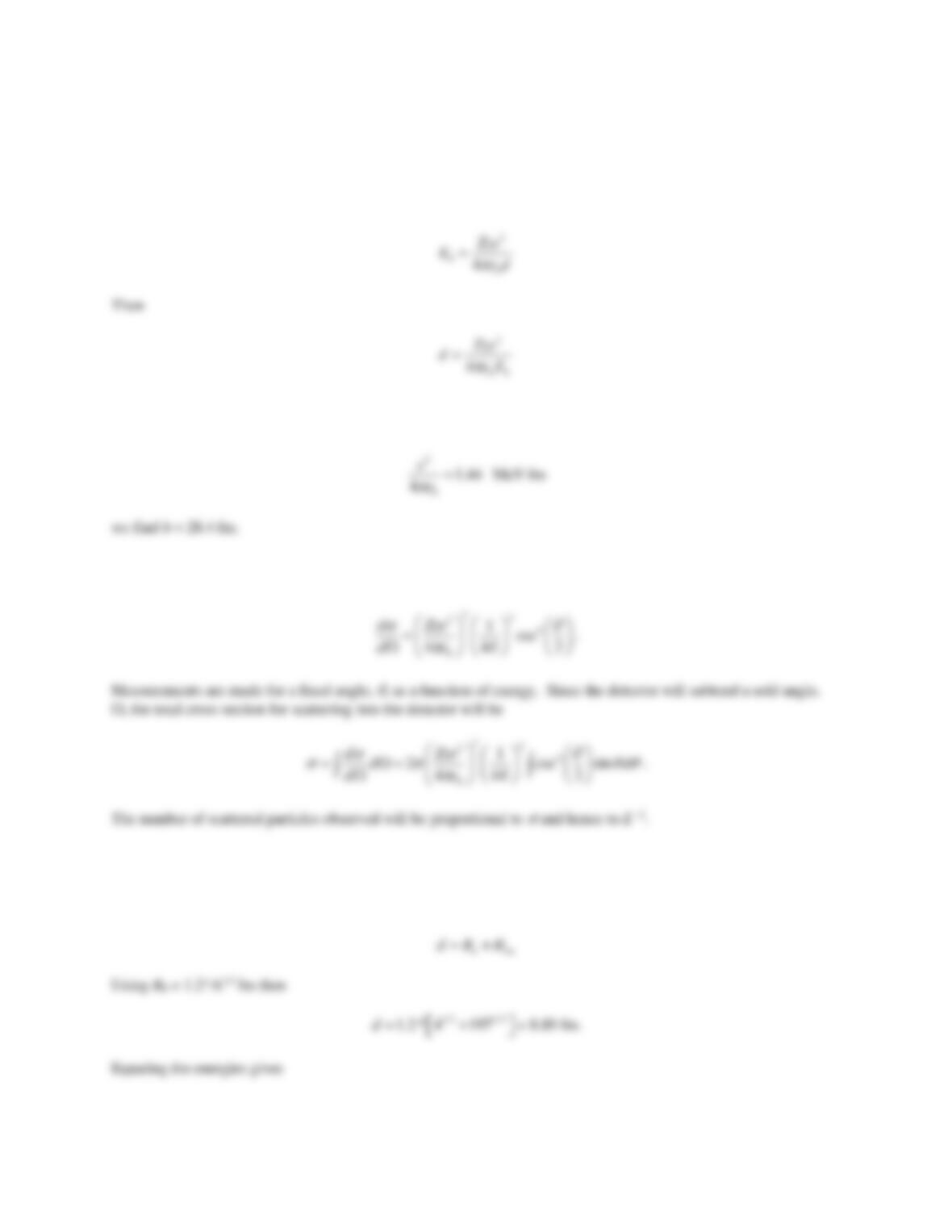
3.1. (a) The initial kinetic energy, E0, is equal to the Coulombic potential at the point of closest approach, so
(b) Using E0 = 8 MeV, Z = 79, z = 2 and the value of the Coulomb constant
3.2. Data may be analyzed on the basis of equation (3.12). This may be written in terms of the incident energy, E, as
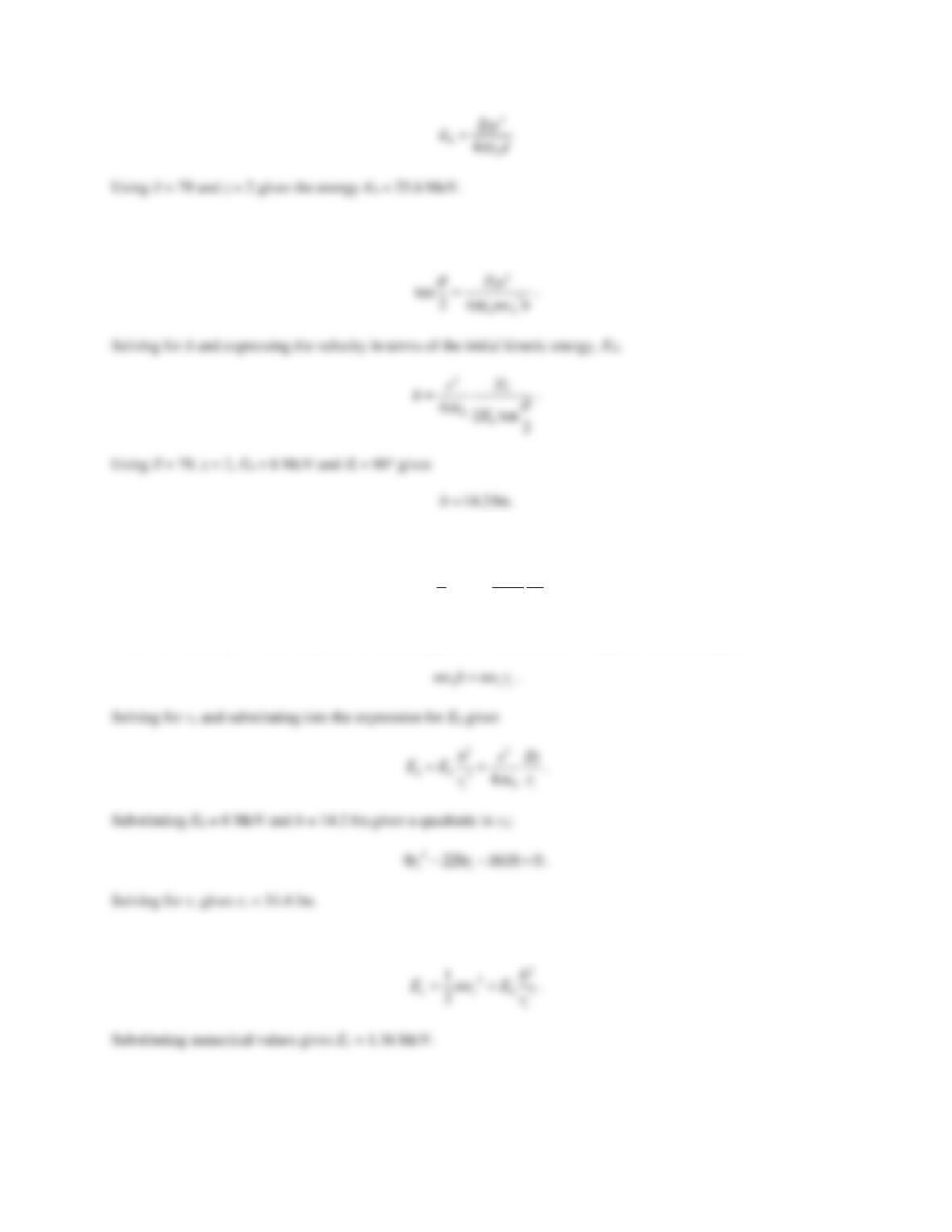
3.3. The minimum energy will occur for an impact parameter b = 0. In this case the initial kinetic energy, E0, is
equal to the Coulomb potential when the distance between the nuclei is such that their surfaces are just in contact.
This distance is
2
3.4. (a) The scattering angle,
, is related to the impact parameter, b, as
(b) Conservation of energy gives
2
2
0
0
1
24
c
c
e Zz
E mv r
=+
where the subscript c denotes the point of closest approach. Conservation of angular momentum gives
(c) The kinetic energy will be
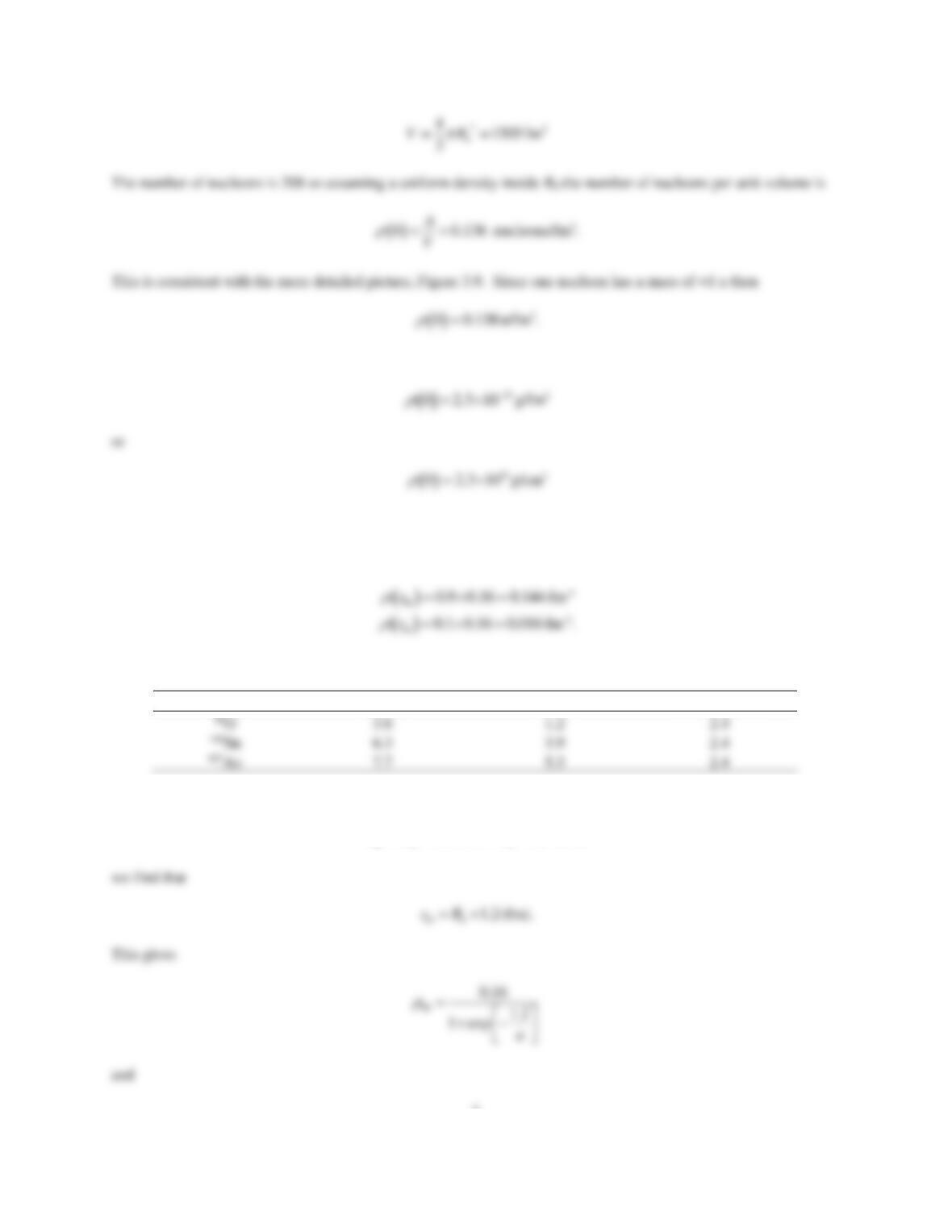
3.5. The radius of a 208Pb nucleus is R0 = 1.2*A1/3 = 7.11 fm. The volume (assuming a well defined edge at R0) is
3
In more conventional units this is
3.6. (a) All three nuclei have
(0) 0.16 fm-3. The values of r90 and r10 are found so that
The width of the surface region is then given as r10 – r90. Reading values from the graph gives values in the table.
nucleus
r10 (fm)
r90 (fm)
(r10 – r90) (fm)
(b) Using equation (2.4) and assuming
)fm(2.14.22.1 0090 −=−= RRr
4
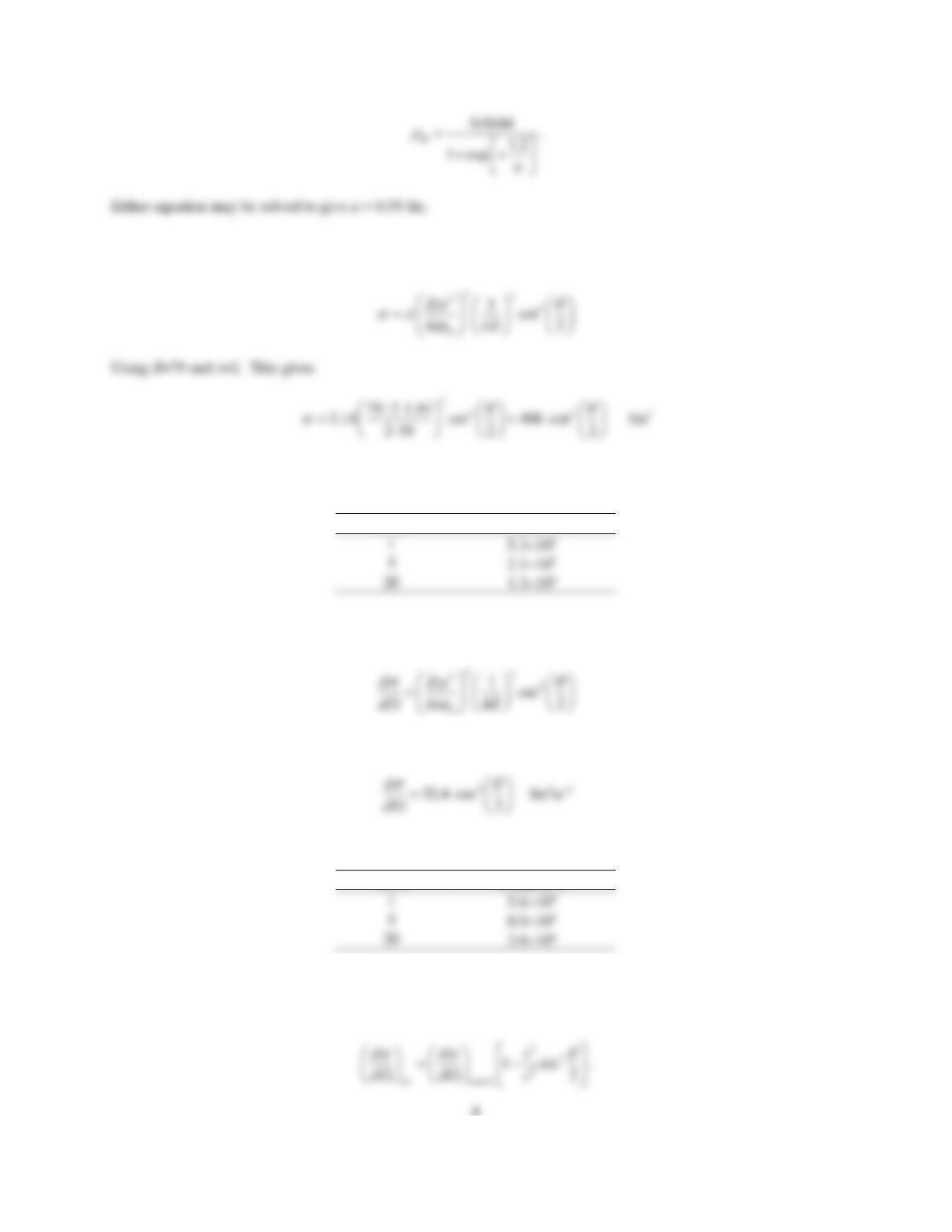
3.7. (a) We write equation (3.9) as
For the angles given we find
()
(fm2)
(b) We write equation (3.12) as
And substituting values as above
This gives the following results
()
(fm2sr-1)
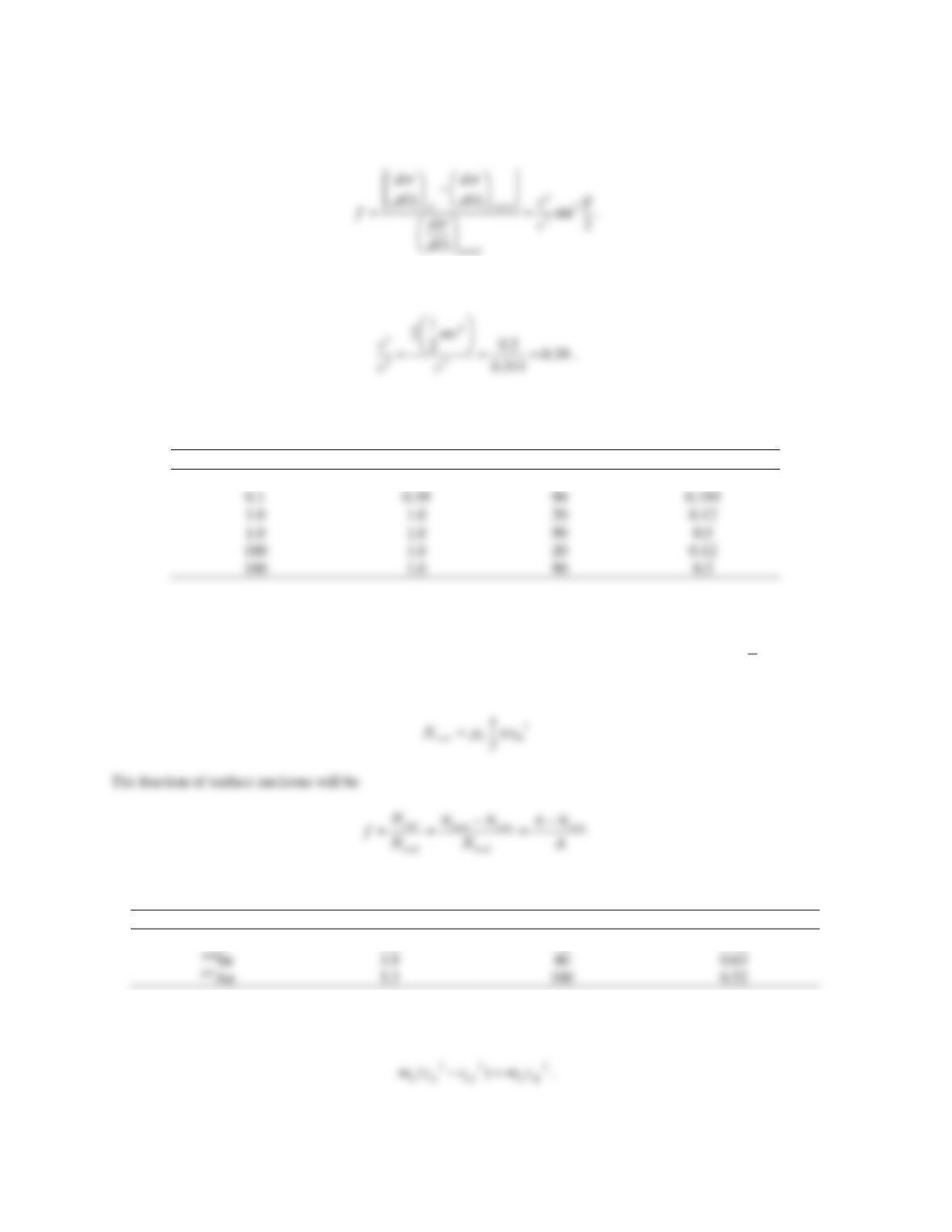
3.8. The relativistic scattering cross section is given as
5
We define the relative size of the relativistic correction as
For E = 0.1 MeV then mv2/2<<mc2 and we calculate
For E = 1 MeV or 100 MeV the E > mc2 so v c giving v2/c2 = 1. Using these values in the above expression gives
the results in the table.
E (MeV)
v2/c2
(°)
f
0.1
0.39
20
0.011
0.1
0.39
90
0.195
1.0
20
0.12
1.0
90
20
0.12
90
3.9. We define the central part of the nucleus as r < r90. The volume of the central region is therefore
3
90
4
3r
and
the number of nucleons in this volume is
Reading values from the appropriate graphs gives the values in the table.
nucleus
r90 (fm)
Ncore
f
16O
1.2
1.2
0.92
3.9
0.63
5.3
0.52
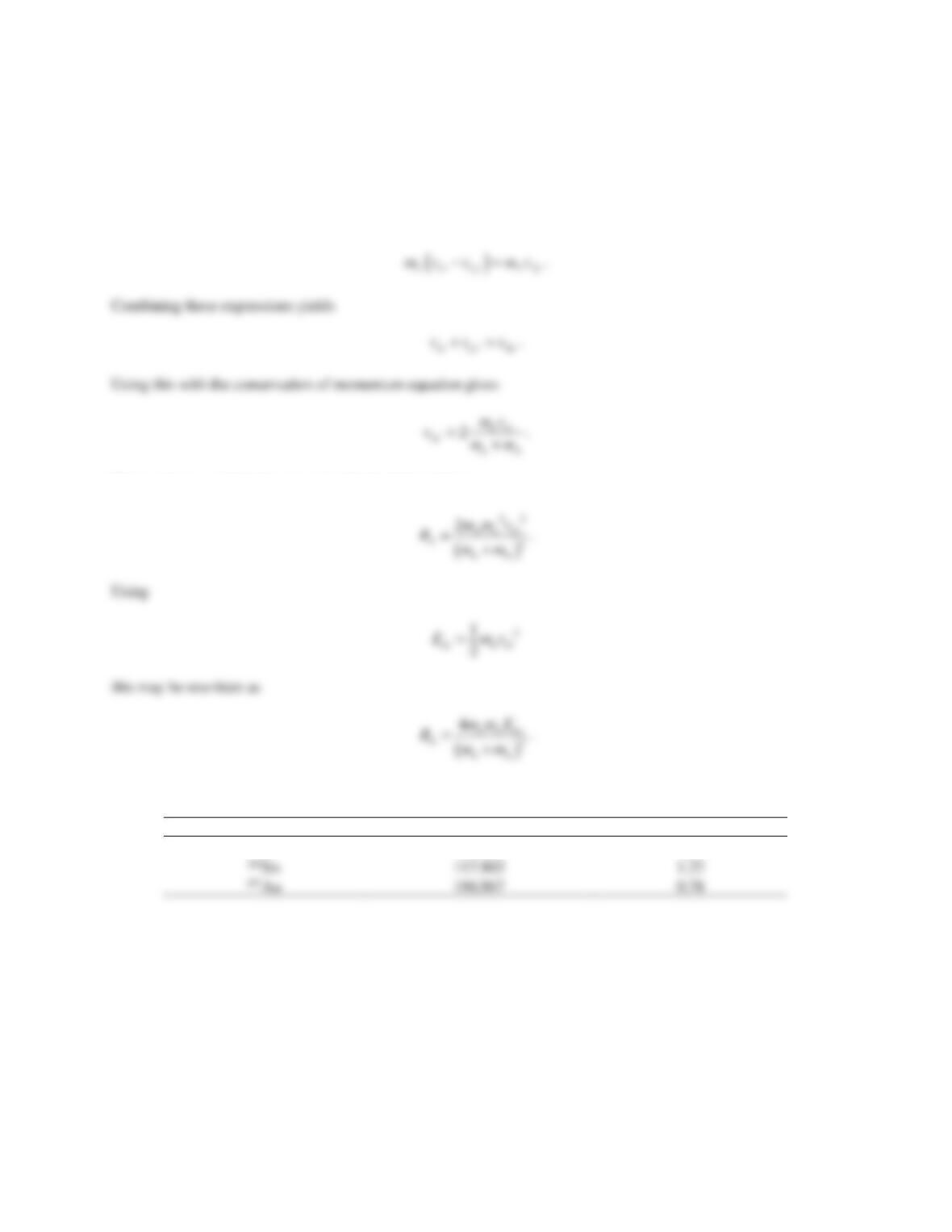
3.10. (a) Conservation of energy gives
6
This may be rearranged to give
( )( )
2
AAi f i f f
m v v v v m v
− + =
.
Conservation of momentum gives
The recoil energy (kinetic energy) is obtained from this as
(b) Using m = 4.0015 u and Ei = 10 MeV we obtain the following results:
nucleus
mA (u)
RA (MeV)
16O
15.995
6.4