B. Visualizing and understanding mineral properties.
a. General properties.
b. Cleavage
c. Silicate structures
d. Mineral structures
e. Mineral structures
48
C. Mineral Uses
a.
TEACHER RESOURCES
Web Resources
49
Photos, Animations, and Interactive Sites
Maps
ANSWERS TO QUESTIONS IN THE CHAPTER:
CONCEPT CHECKS
3.1 MINERALS: BUILDING BLOCKS OF ROCKS
1. To be considered a mineral, an Earth material must be (1) naturally occurring, (2) inorganic,
2. Water is not a mineral, because it is not a solid and therefore does not possess an orderly
3. A rock is any solid mass of mineral, or mineral-like, matter that occurs naturally on Earth.
50
3.2 ATOMS: BUILDING BLOCKS OF MINERALS
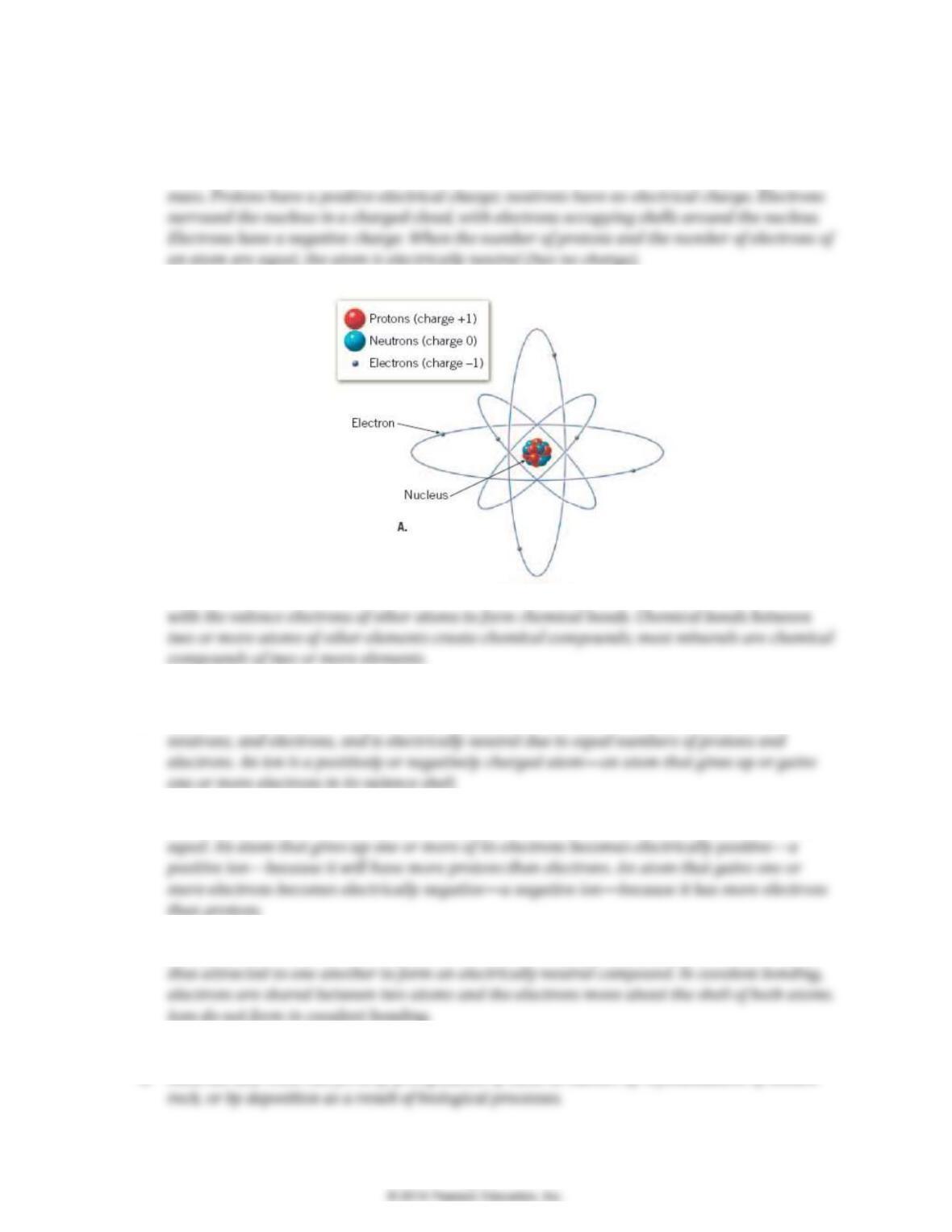
1. The three main particles of an atom are protons, neutrons, and electrons. Protons and
neutrons compose the nucleus of an atom. Both are fairly dense particles that give the atom its
2. Figure 3.4 in text:
3. Valence electrons are the electrons in the outermost shell of an atom. These electrons interact
3.3 WHY ATOMS BOND
1. An atom is a small particle of matter composed of a characteristic number of protons,
2. Electrons are negatively charged and protons are positively charged; an atom is electrically
neutral (equal positive and negative charges) when its number of electrons and protons are
3. In ionic bonding, one atom gives up one or more electrons to another atomelectrons are
transferred from one atom to another. This results in two oppositely charged atoms that are
3.4 HOW DO MINERALS FORM?
1. Minerals and rocks can form by precipitation of mineral matter, by crystallization of molten
51
3. Most mineral matter secreted by organisms is calcium carbonate formed as the organisms use
3.5 PHYSICAL PROPERTIES OF MINERALS
1. Luster is defined as how a mineral reflects light. This is the appearance or quality of light
2. Color can vary in the same mineral due to impurities in the minerals chemical composition. A
4. Cleavage is a description of minerals that break along characteristic smooth, flat surfaces due
5. Calcite can be identified by reacting the mineral with a weak acid. When a weak acid, such as
3.6 MINERAL STRUCTURES AND COMPOSITIONS
2. Looking at Figure 3.34, we see that several minerals contain two elements that can readily
3. Polymorphs are minerals that have the same chemical composition but different external
forms. An example is graphite and diamond; both have the chemical composition C, they are
52
3.7 HOW MINERALS ARE CLASSIFIED
1. Rock-forming minerals comprise the most abundant minerals on Earth and they make up most
2. The eight most common elements in Earths crust include oxygen (O), silicon (Si), aluminum
3. A mineral species is a collection of minerals that have similar internal structures and chemical
3.8 THE SILICATES
1. Silicon is the name for the element with atomic number 14; the chemical symbol is Si. Silicate
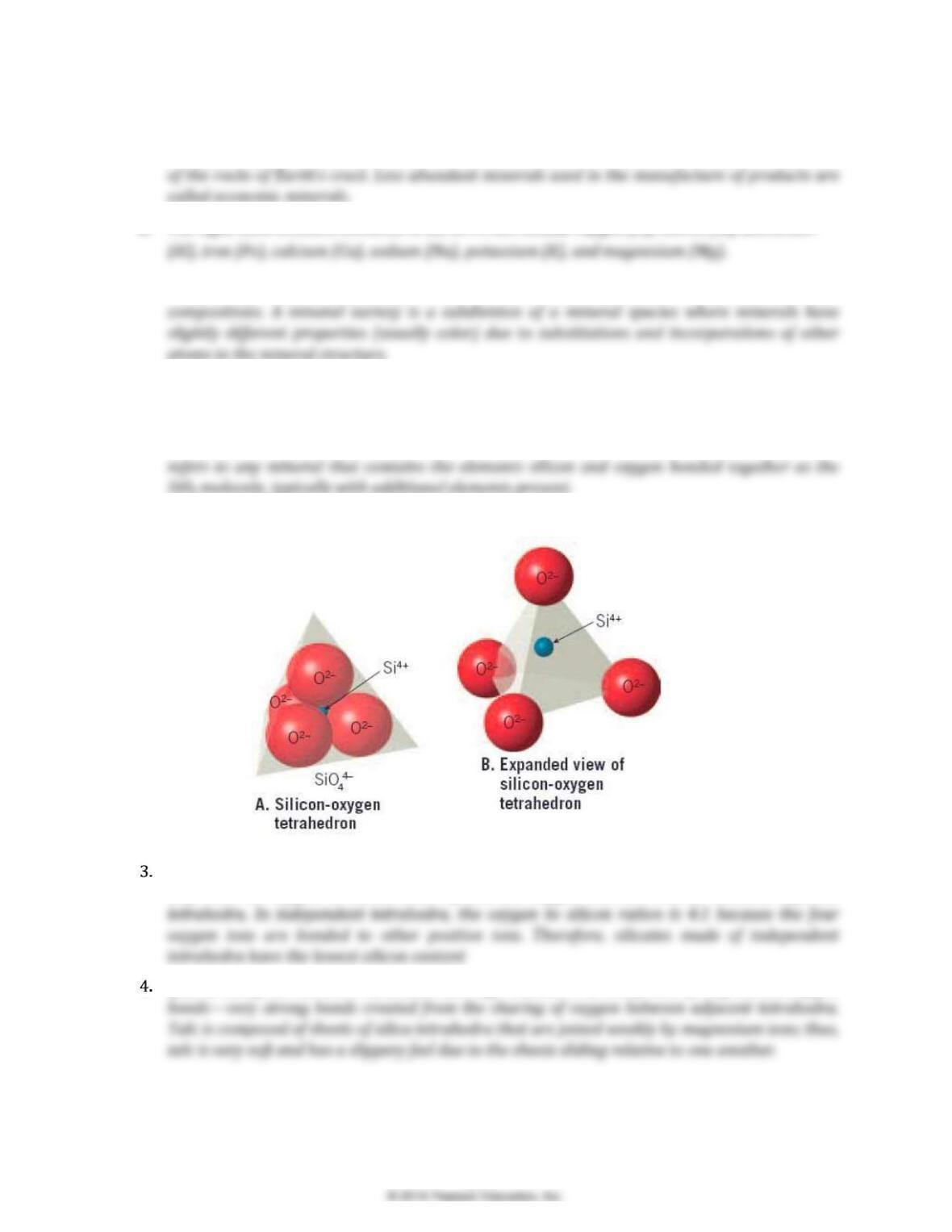
2. The silicon-oxygen tetrahedron (Figure 3.31):
Silicate minerals with three-dimensional structures have the highest silicon content because
they have an oxygen to silicon ratio of 2:1; the oxygen ions are shared between adjacent
Quartz has great hardness and lacks cleavage because it is composed of only silicon-oxygen
53
3.9 COMMON SILICATE MINERALS
1. Most silicates form as minerals crystallized from a cooling molten rock, either at/near the
2. Light and dark silicates differ in their primary chemical makeup. Dark-colored silicates have
ions of iron and/or magnesium in their structure, making them darker in color and giving
3. Muscovite and biotite mica are similar in that they both have a sheet structure of silica
4. Color is not a good diagnostic property of the different feldspars because color can be similar
3.10 IMPORTANT NONSILICATE MINERALS
2. Calcite and dolomite are very similar minerals with similar properties. Their primary
difference is compositionalcalcite is calcium carbonate while dolomite is calcium-
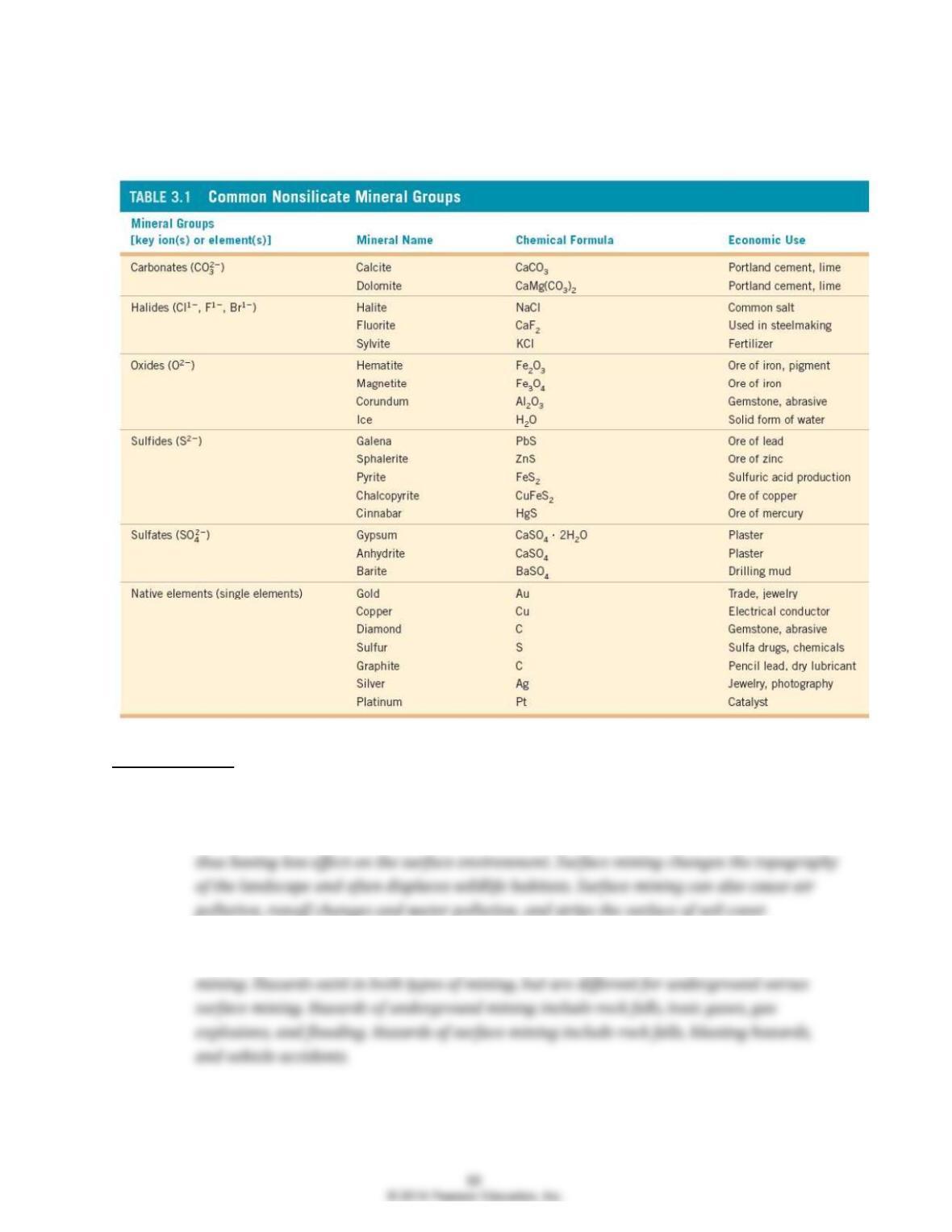
3. See Table 3.1 for possible answers:
EYE ON EARTH
EOE #1 SUPER PIT, KALGOORLIE, AUSTRALIA
1. Underground mining does not disrupt the landscape as dramatically as open pit mining,
2. Working conditions would have changed from working deep underground, to working on
the surface. Likely, different methods of extraction and transportation occur in surface
EOE #2 GLASS
1. Quartz belongs to the silicate mineral group because it is composed of silicon and oxygen
atoms.
GIVE IT SOME THOUGHT
1.
a. A gold nugget would be a mineral.
b. Seawater is not a mineral because it is not a solid.
2.
a. The element with 92 protons and a mass number of 238 is uranium.
3. Sodium (Na) is most likely to form chemical bonds. Sodium is in the Group I elements of the
periodic table and this tells us that sodium has one electron in its outer shell. The octet rule
tells us that atoms tend to gain, lose, or share electrons until they are surrounded by eight
5. Specific gravity is a number representing the ratio of a minerals weight to the weight of an
equal volume of water. Gold has a specific gravity of 20; the specific gravity of water is 1, by
6.
a. This sample has 6 flat surfaces.
56
7.
a. Hornblende.
b. Muscovite Mica.
8. Because continents sit above sea level, they are likely less dense than ocean basins, which sit
below sea level. Two low-density silicates are quartz and feldspars; these are likely abundant
10.
a. Stainless steel is made with iron and chromium. Magnetite, nickel, and chromite are
11. These sites should help students find minerals of their states:
57