GLOBAL CLIMATE CHANGE 21
INTRODUCTION
Global Climate Change
CHAPTER OUTLINE
1.
2.
335
3.
336
4.
337
5.
6.
338
7.
339
8.
9.
340
10.
341
LEARNING OBJECTIVES/FOCUS ON CONCEPTS
21.2 Explain discuss
21.4 Outline
21.6 Summarize
Describe
21.8 Discuss
TEACHING STRATEGIES
Clicker Questions:
Global Climate Change Quizzes from NASA
342
Muddiest Point:
A. How do we know what will happen?
B. How do we know humans are causing warming?
C. Climate Change Data.
343
TEACHER RESOURCES
Web Resources:
Climate Literacy Resources
o CLEAN Climate Literacy & Energy Awareness Network
Climate Change Websites
NASA Earth Observatory
oPaleoclimatology: The Ice Core Record
344

Imagery, Animations, and Videos:
Images
Animations
345

Video
ANSWERS TO QUESTIONS IN THE CHAPTER:
CONCEPT CHECKS
21.1 CLIMATE AND GEOLOGY
1. The five major parts of the climate system are the atmosphere, hydrosphere, geosphere,
biosphere, and cryosphere.
21.2 HOW IS CLIMATE CHANGE DETECTED?
1. Proxy data refers to indirect evidence of past climate changes. Examples of proxy data include
2. Seafloor sediments act as continuous recorders of climate change because the number, types,
3. More 18O is evaporated from the oceans when temperatures are high, and less is evaporated
4. Sources of proxy data aside from seafloor sediments include ice cores, tree rings, fossil pollen,
and corals.
21.3 SOME ATMOSPHERIC BASICS
1. Clean, dry air is composed of 78 percent nitrogen and 21 percent oxygen. The remaining 1
2. As altitude increases, air pressure decreases. The pressure does not decrease at a steady rate;
it thins rapidly as you travel away from Earths surface.
3. The troposphere is the layer nearest Earth, and temperature decreases with an increase in
altitude. In the next layer, the stratosphere, the temperature remains constant to an altitude of
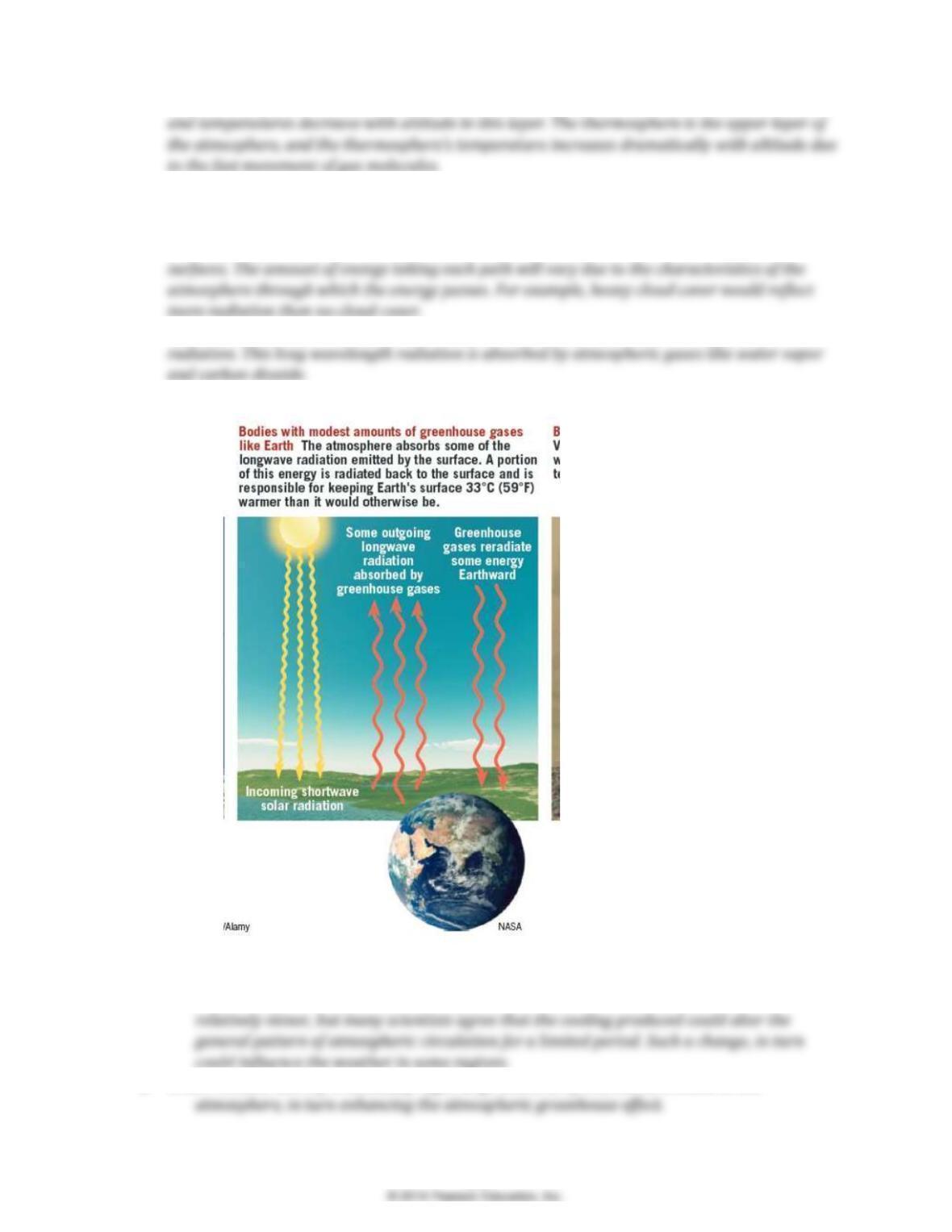
21.4 HEATING THE ATMOSPHERE
1. Incoming solar radiation may be absorbed at the Earths surface, absorbed by clouds and
atmospheric gases, or reflected back to space by the atmosphere, clouds, and reflective
2. Radiation emitted from Earths surface is of a longer wavelength than incoming solar
3. Sketch should be similar to Figure 21.18:
21.5 NATURAL CAUSES OF CLIMATE CHANGE
1. The impact on global temperature of eruptions such as El Chichón and Mount Pinatubo is
2. When volcanic activity is unusually high, large amounts of CO2 can be emitted to the
347
3. Sunspots are huge magnetic storms that extend from the Suns surface deep into the interior.
During periods of maximum sunspot activity, the Sun emits slightly more energy than
21.6 HUMAN IMPACT ON GLOBAL CLIMATE
2. The atmosphere has been warming in response to increased CO2 concentrations because CO2 is
a greenhouse gas.
4. Methane, nitrous oxide, and chlorofluorocarbons are also greenhouse gases in trace amounts
that contribute to global temperature change.
21.7 CLIMATE-FEEDBACK MECHANISMS
1. Feedback mechanisms are outcomes of changes in the climate system. Positive-feedback
2. A positive-feedback mechanism is caused by the increase in evaporation rates when surface
temperatures increases. This increase in evaporation increases water vapor, a strong
3. Mathematical models are simplified versions of the real Earth and cannot capture its full
complexity. When computer models are used to simulate future climate change, many
21.8 HOW AEROSOLS INFLUENCE CLIMATE
2. Black carbon warms the atmosphere because it is an effective absorber of incoming solar
radiation.
4. Aerosols released into the troposphere remain there for only a few days or, at most, a few
weeks before they are washed out by precipitation.
21.9 SOME POSSIBLE CONSEQUENCES OF GLOBAL WARMING
2. Global warming is greater near the poles because a reduction of sea ice greatly changes the
albedo of the Earths surface, replacing reflective sea ice with much lower albedo (more heat
348
3. Climate changes other than temperature change include changes in the frequency of
precipitation events, changes in the amount of precipitation (more or less) received by an area,
and increases in intense tropical cyclone activity.
EYE ON EARTH
EOE #1 WEATHER BALLOON
1. The package carried aloft by the weather balloon is a radiosonde.
3. Using the environmental lapse rate of 6.5°C per km, and the surface temperature given
(17°C), the temperature at 1km altitude should be 10.5°C.
EOE #2 ERUPTION OF MOUNT KIRISHIMA
2. However, the ash will quickly fall out of the atmosphere because of its relatively high
density, so the impact on regional climate will be short.
3. Sulfuric acid is also released by volcanic eruptions and could have a greater effect on
EOE #3 AMUNDSENSCOTT SOUTH POLE STATION
1. The lighter line has much greater variations in CO2 with relatively large increases and
3. The lighter blue line is recording seasonal variations in CO2 due to photosynthesis of
plants; this larger variation is common in Northern Hemisphere recording stations due to
EOE #4 AMAZON BASIN SATELLITE IMAGE
1. Deforestation adds CO2 to the atmosphere directly through the burning and decomposition
of vegetation, and indirectly by destroying an important absorber of CO2, trees.
GIVE IT SOME THOUGHT
1. The five major spheres on Earth include the atmosphere, hydrosphere, geosphere, biosphere,
and cryosphere. In Figure 21.1, the atmosphere is the air above the landscape, the hydrosphere
349
2. Answers will vary depending on which of the many components is chosen and more than one
type of interaction is possible with various components. For example, changes in atmospheric
3. Deforestation is a change in the biosphere that can cause changes in the climate system. As
vegetation is removed from the Earths surface, carbon dioxide increases in the atmosphere due
4. Albedo is the reflectivity of a surface; reflection of solar radiation has a cooling effect because it
5. The massive lava outpourings of the Cretaceous released huge amounts of CO2 to the
6. This glacier, and most glaciers on Earth, is retreating due to atmospheric warming. The melting
8. Electricity is generated by the burning of coal in many areas; coal is a fossil fuel whose
9. Climate is a long-term average of atmospheric conditions for a given area. Short-term changes,
over a few years, are not indicative of a global climate change. Climate variability brings about
350