Microscopy
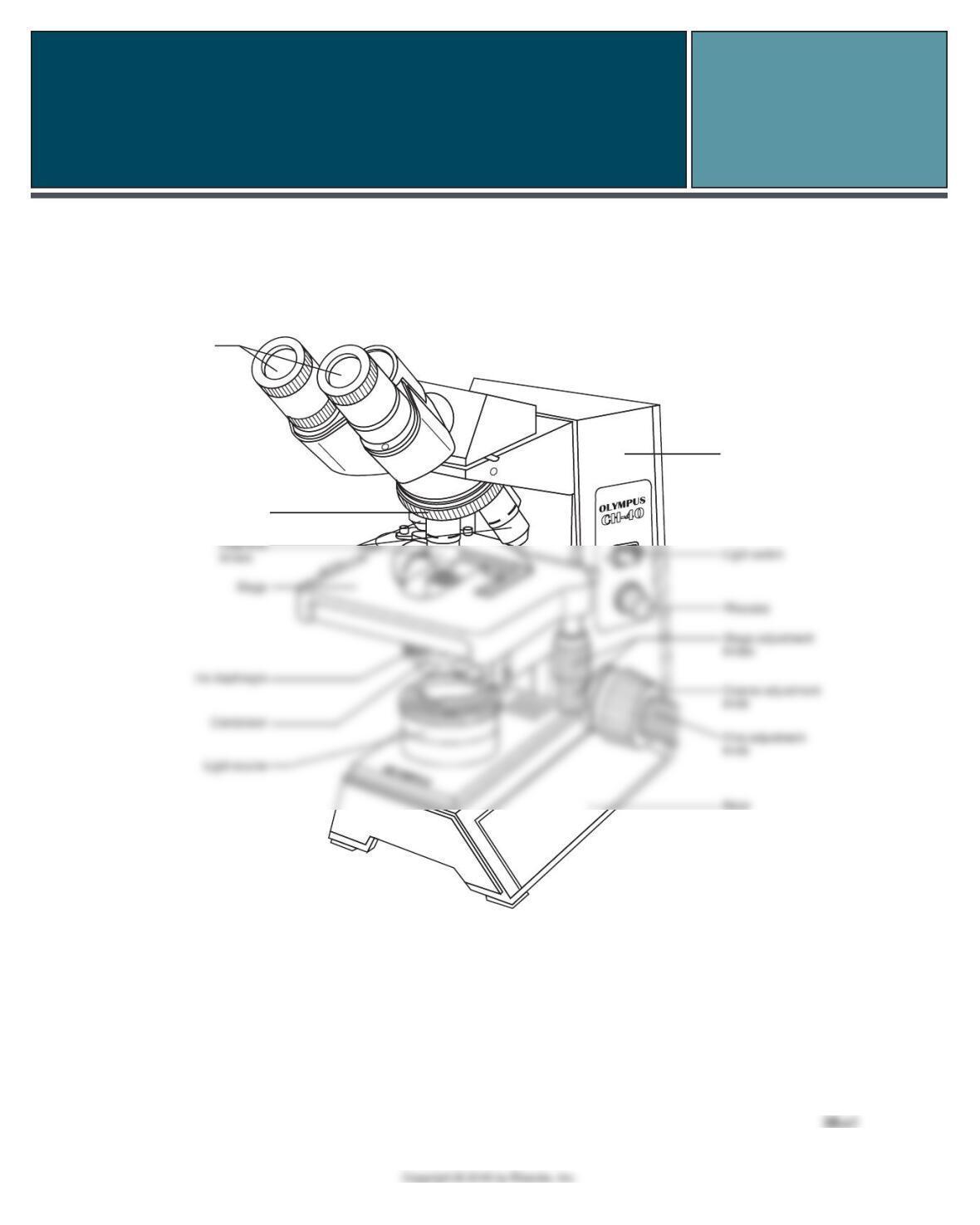
EXERCISE 1. LABEL THE PARTS OF THE MICROSCOPE
CHAPTER
2
Oculars
Nosepiece
Arm
CHAPTER 2 Microscopy
38.e2
EXERCISE 2. MATCH THE PARTS OF THE
MICROSCOPE WITH THE CORRESPONDING
DEFINITION
i. Oculars
EXERCISE 3. PROCEDURE: MEASURE
AND CALCULATE MAGNIFICATION
Students should complete the procedure as instructed.
EXERCISE 6. CLINICAL THINKING CHALLENGE
1. Over time, oil will damage the seal that attaches the lens
to the objective tube and will leak behind the lens.
2. Only the oil immersion lens has a special protective seal
that reduces the chance of oil leakage.
10. Bulbs are expensive and have a limited life.
11. Size can differentiate one specimen from another when
they appear otherwise very similar.
12. The elements nitrogen, oxygen, hydrogen, and carbon
make up 96% of the matter found in all living
organisms.
13. Healthy animals have only 9 to 22 mg of iron in their
reduces the level of iron stored in the body. Without
adequate levels of iron, the body is unable to make
hemoglobin and adequate numbers of red blood cells. In
this way, ongoing blood loss results in a condition called
with each other and with other polar molecules. The
polarity of the water molecule allows it to fulfi ll the
following important roles within the living organism.
16. Water molecules surround molecules of solute; the neg-
extracellular fl uids.
17. When they ionize in water, they can transmit electricity.
18. Acidity and alkalinity are measured on a pH scale. The
scale ranges from 1 (the most acidic) to 14 (the most
alkaline or basic). A pH of 7 is the middle of the scale
and is neutral.
bonds between and within molecules start to break. The
hydrogen bonds holding proteins in their tertiary and
quaternary structures are especially sensitive to this
stress. When these bonds break, proteins are released
from their complex structures and stretch into a straight
chain of amino acids. Because they no longer have
their unique shape these proteins lose their function.