GROUNDWATER 17
INTRODUCTION
Groundwater
CHAPTER OUTLINE
1.
2.
272
3.
273
4.
5.
274
6.
7.
275
8.
9.
276
10.
277
LEARNING OBJECTIVES/FOCUS ON CONCEPTS
17.1 Describe
17.3 Discuss describe
17.5 Sketch explain Discuss
17.7 Sketch and label
17.9 List and discuss
17.10 Explain
TEACHING STRATEGIES
Clicker Questions:
Muddiest Point:
278
A. Examples of Groundwater Flow.
B. Measuring and Calculating Groundwater Flow.
TEACHER RESOURCES
Web Resources:
USGS Resources:
279

EPA Resources:
Groundwater:
Karst
280
Locations that exhibit groundwater/karst issues and features:
Imagery, Animations, and Videos:
Images
281

Animations
Video
282
ANSWERS TO QUESTIONS IN THE CHAPTER:
CONCEPT CHECKS
17.1 THE IMPORTANCE OF GROUNDWATER
1. Groundwater is 14.6 percent of Earths total freshwater supply.
3. Groundwater is an erosional agent because it actively dissolves soluble rock, such as limestone,
17.2 THE DISTRIBUTION OF GROUNDWATER
1. The amount of water that soaks into the ground when rain falls on land is influenced by the:
2. Groundwater is the water that exists in the cracks, crevices, and pore spaces of rock and soil.
The water table is the upper limit of the zone of saturation of groundwater. This zone of
17.3 THE WATER TABLE
1. Mapping of the water table reveals that it is rarely level; its shape is usually a subdued replica
of the surface topography. The water table is highest beneath hills and lowest beneath valleys.
2. A gaining stream is one that receives water from the groundwater system because the water
17.4 FACTORS INFLUENCING THE STORAGE AND MOVEMENT OF GROUNDWATER
1. Porosity is the percentage of the total volume of rock or sediment that consists of pore spaces.
2. An aquifer is permeable rock strata or sediment that transmits groundwater freely; examples
17.5 HOW GROUNDWATER MOVES
1. In Figure 17.9, the path of groundwater flow is influenced by the downward pull of gravity and
the tendency of groundwater to move toward areas of reduced pressure. Groundwater in this
2. Hydraulic gradient is the slope of the water table, and hydraulic conductivity is coefficient that
3. In the near-surface local system, groundwater moves in upper water table aquifers.
17.6 WELLS
2. Heavy pumping of groundwater by a well can create a very large, steep cone of depression and
may lower the water table significantly, such that nearby shallow wells may become dry.
3. In Figure 17.14, the well on the right encountered a perched water table, formed where an
17.7 ARTESIAN SYSTEMS
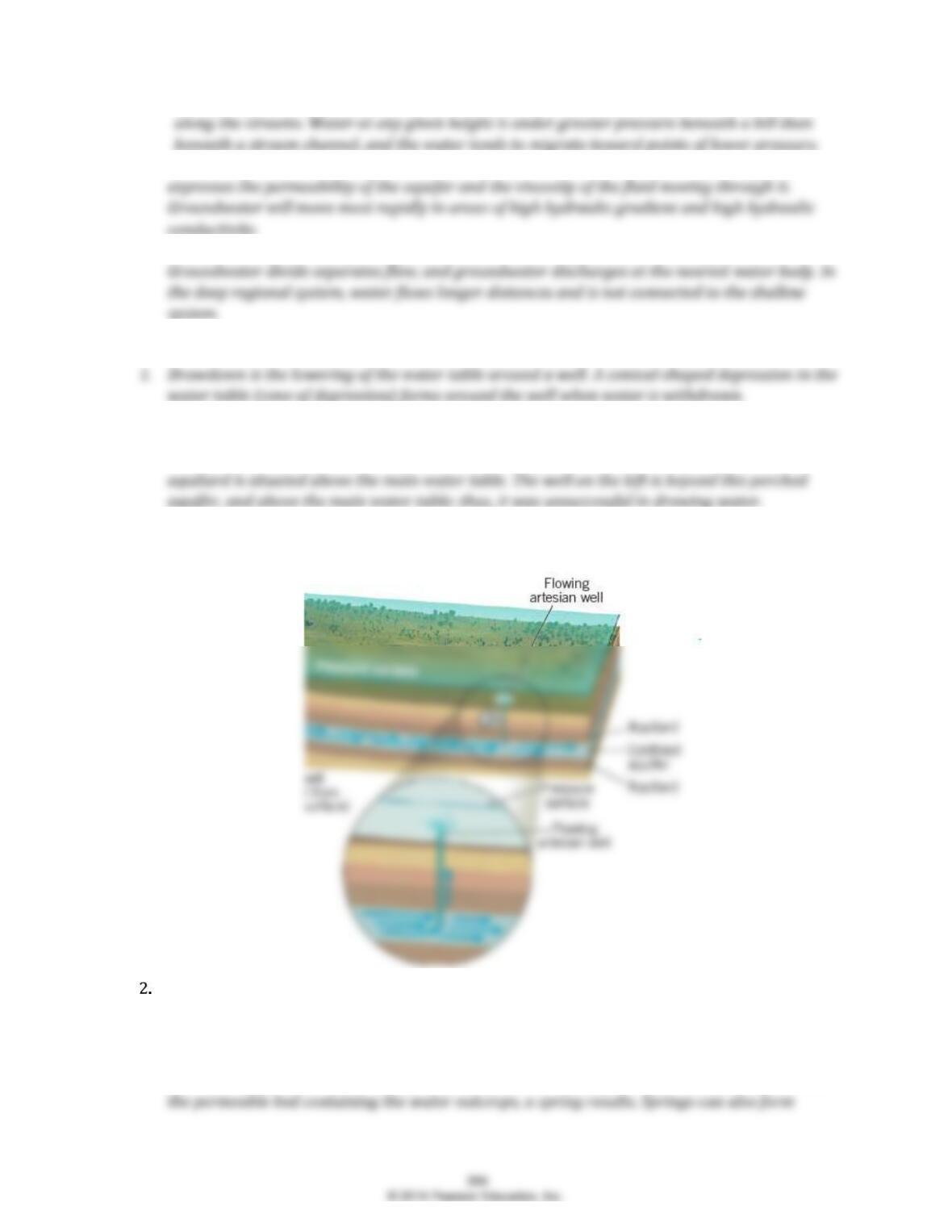
1. Sketch should be similar to this portion of Figure 17.15:
An artesian system will not flow if its pressure surface is below ground level.
17.8 SPRINGS, HOT SPRINGS, AND GEYSERS
1. Springs are natural outflows of groundwater at Earths surface. Springs form where aquitards
block the downward movement of groundwater, and water is forced to move laterally. Where
2. The water of springs of Warm Spring, Georgia, and Hot Springs National Park, Arkansas, are
3. Most hot springs and geysers are heated by magma bodies and hot igneous rocks beneath the
4. Cool groundwater enters underground chambers and is heated by surrounding rock. The great
pressure in these chambers raises the boiling point of water, allowing water to attain high
17.9 ENVIRONMENTAL PROBLEMS
1. In the southern High Plains, water is being extensively pumped from the High Plains aquifer to
irrigate crops. Here, evaporation rates are also high relative to precipitation, and the recharge
2. Subsidence may occur in areas underlain by thick layers of unconsolidated sediments where
3. An aquifer composed of sand or permeable sandstone would be best for purifying polluted
groundwater. The openings between the sand grains are large enough to allow groundwater
4. Heavy pumping of groundwater in coastal areas can cause saltwater to encroach into the
aquifer. Freshwater is less dense than saltwater, so it floats atop saltwater in the groundwater
17.10 THE GEOLOGIC WORK OF GROUNDWATER
1. Groundwater creates caves through dissolution of limestone. Groundwater is slightly acidic
due to incorporation of carbon dioxide from the air and from decaying plants. When this
2. Stalactites are icicle-like pendants that hang from the ceiling of caverns; these form when
water reaches the air of a cave, carbon dioxide escapes from the water, and calcite
285
3. Sinkholes form in two ways. Over time, limestone beneath soil is dissolved by downward
seeping acidic rainwater. As fractures formed from this dissolving action grow, the surface soil
EYE ON EARTH
EOE #1 WETLAND SOUTHWEST OF FORT MCMURRAY, ALBERTA, CANADA
1. The position of the water table is the surface of the water in this marshy area. In wetlands,
the water table is right at the surface.
EOE #2 REPUBLICAN RIVER OF COLORADO, NEBRASKA, AND KANSAS
1. It is likely that the Republican River and its tributaries are gaining streams, and therefore
2. Heavy irrigation will deplete the groundwater system faster than it can recharge. If the
EOE #3 WELL NEAR WOONSOCKET, SOUTH DAKOTA
1. In this area, an upturned permeable sandstone layer is sandwiched between impermeable
3. It is likely that water was overdrawn from this system at a rate faster than the aquifer is
EOE #4 SAUDI ARABIA DESERT
1. Agricultural activity in this region is not sustainable indefinitely. The groundwater used
2. This is a desert region, meaning it has an arid climate. The water is likely lost to
evaporation into the atmosphere.
3. A similar situation is occurring in the Great Plains of the United States, where water is
being extensively pumped from the High Plains aquifer to irrigate crops. Here, evaporation
286
GIVE IT SOME THOUGHT
1. Answers will vary by student, but generally may include:
a) Water pumped from the ground to irrigate a farm field may be uptaken by plants and
transpired to the atmosphere, it may directly evaporate to the atmosphere, it may run off
2. Gaining streams will occur where the elevation of the water table is higher than the level of the
surface of the stream; these streams receive water from the groundwater system. In the United
3.
a) India uses about 13 percent of the total water extracted worldwide; this equates to about
b) The population of each of the top three countries in 2010 was as follows: China, 1.4 billion;
India, 1.2 billion; United States, 309 million. To determine the per capita use of
groundwater for each nation, we divide the amount of water used for each nation by its
4. The land upon which New Orleans sits is currently subsiding due to groundwater pumping.
5. Sedimentary rocks have the greatest likelihood of being good aquifers because they generally
6. Neither artesian nor spring water is betterthese terms describe how groundwater arrives
at Earths surface, not the quality of that water. Springs occur where the water table intersects
7. The difference between an intermittent stream and a stream that flows all the time is likely due
to that streams interaction with groundwater. An intermittent stream is likely a losing stream;
8.
a) Groundwater moves perpendicular to the contours and down the slope of the water table.
Looking at the elevation of the water table in this area, we see that groundwater flows
9. I would consult Figure 17.24 to determine if my friends purchase falls within the area of over-
10. This sinkhole appears to have formed abruptly, due to the debris in the depression, and the
288