Solutions to Problems in
Chapter 16: Reactions and Decays Involving Particles
16.1. The Feynman diagrams are constructed from an analysis of the quark content of the mesons.
(a)
0
BD
++
→ + +
(b)
0
BD
++
→+
ub uc ud→+
(c)
BD
+ − + +
→ + +
69
(d)
0
+
+s
B D +K→
16.2. For the first decay we write the quark relations as
and the Feynman diagram is as shown.
and the Feynman diagram is as follows
70
16.3. We must consider conservation of mass/energy, charge, lepton number and lepton generation. Since all of the
light and strange mesons have masses less than the – lepton, these are all possible decay products. The most
common mode is to the – meson as shown in the diagram below.
−−
→+
71
As well, fragmentation can create additional pairs of charged mesons, e.g.;
KK
− − + −
→ + + +
16.4. The branching ratios for the decays of the W+ as shown in Table 16.1 add up to 100%. We, therefore, expect
any other decays to be either nonexistent or very unlikely. We consider the decay modes as suggested in the
problem as these all conserve charge. These may be classified into three categories as follows:
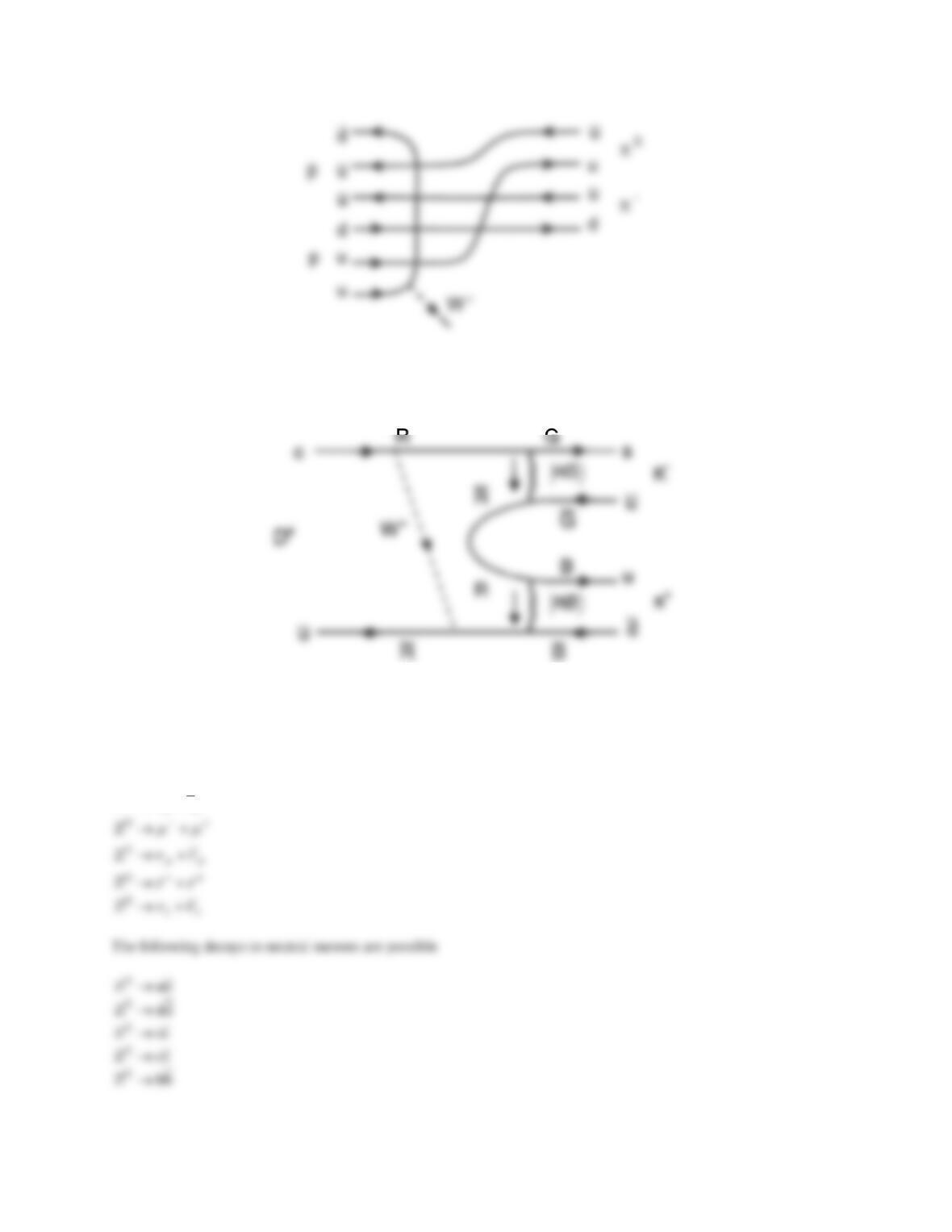
16.5. The Feynman diagram for the process
+− ++→+ Wpp 0
is shown below.
72
16.6. One possible combinations of colors is shown below
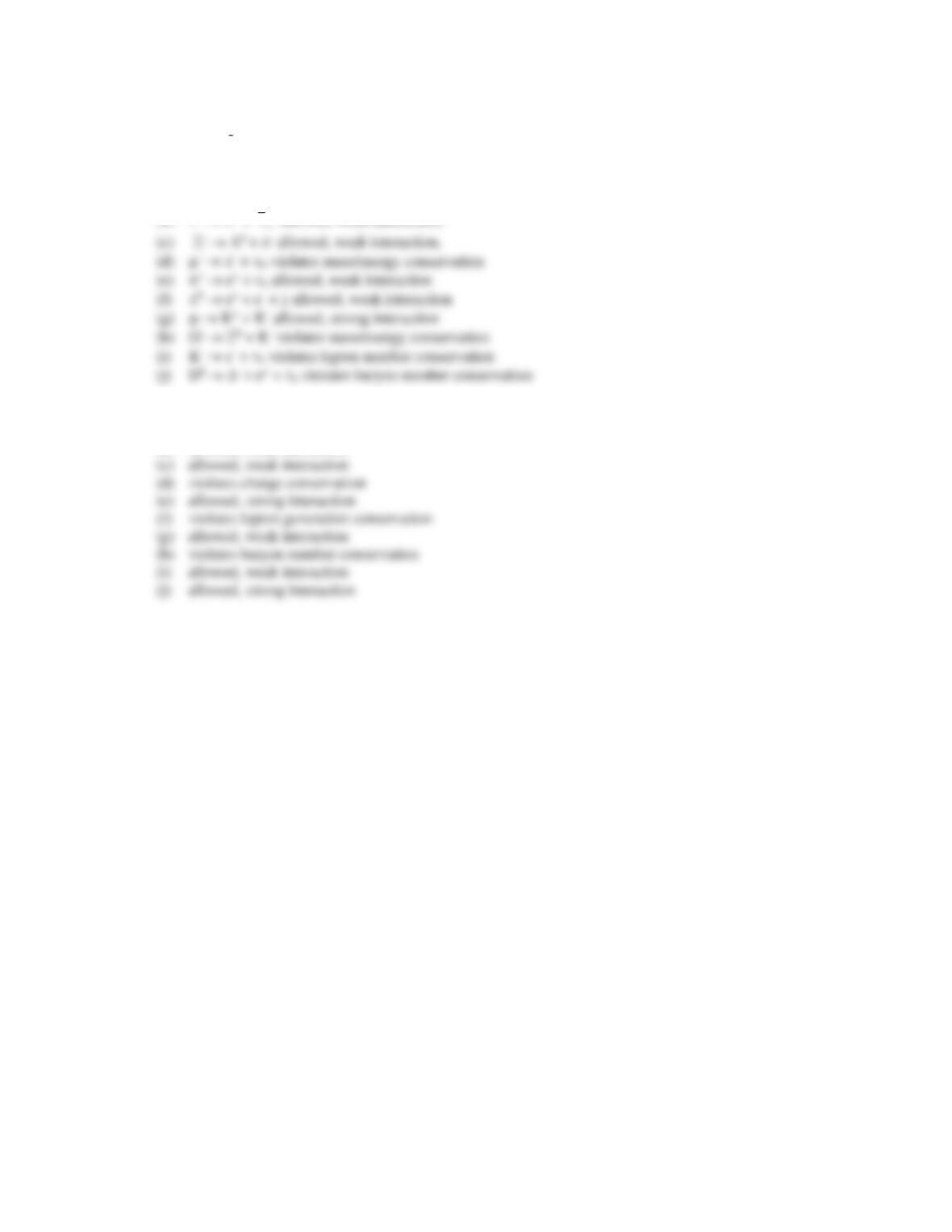
16.7. Following the vertex rules as specified in Figure 16.14, the Z0 must decay to lepton-antilepton pairs or quark–
antiquark pairs where the flavors of the two particles must be the same. Conservation of mass/energy allows for all
flavors of lepton-antilepton pairs to be produced. These deacys are
+− +→ eeZ0
ee
0
Z
+→
73
The decay
ttZ0→
is not allowed as it violates conservation of mass/energy.
16.8. (a) + → 0 + e+ + e allowed, weak interaction
(b) + → + +
ν
allowed, weak interaction,
16.9. (a) allowed, electromagnetic interaction
(b) allowed, weak interaction