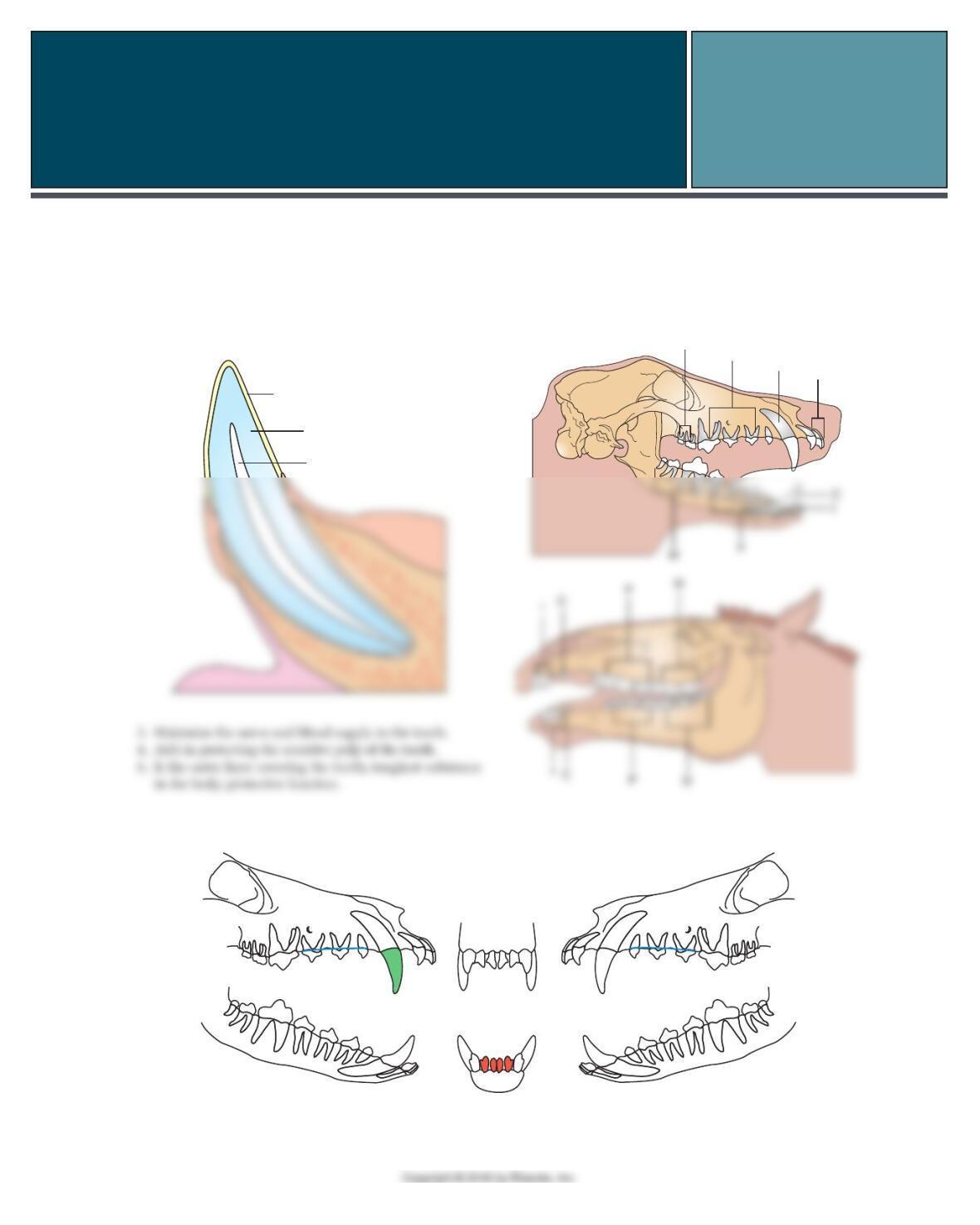
EXERCISE 2. LABEL THE DENTITION IN THE
DOG AND HORSE
397e.1
The Digestive System
THE ORAL CAVITY
EXERCISE 1. IDENTIFY TOOTH STRUCTURE
1 . , 3 . , 5 .
CHAPTER
14
Enamel
Dentin
Pulp
M
PCI
EXERCISE 3. DENTAL CHARTING
CHAPTER 14 The Digestive System
397.e2
DENTAL FORMULAS
EXERCISE 4. DENTAL FORMULA: FELINE
(ADULT)
I 3/3 C1/1 P3/2 M1/1 30 teeth
THE ESOPHAGUS AND STOMACH
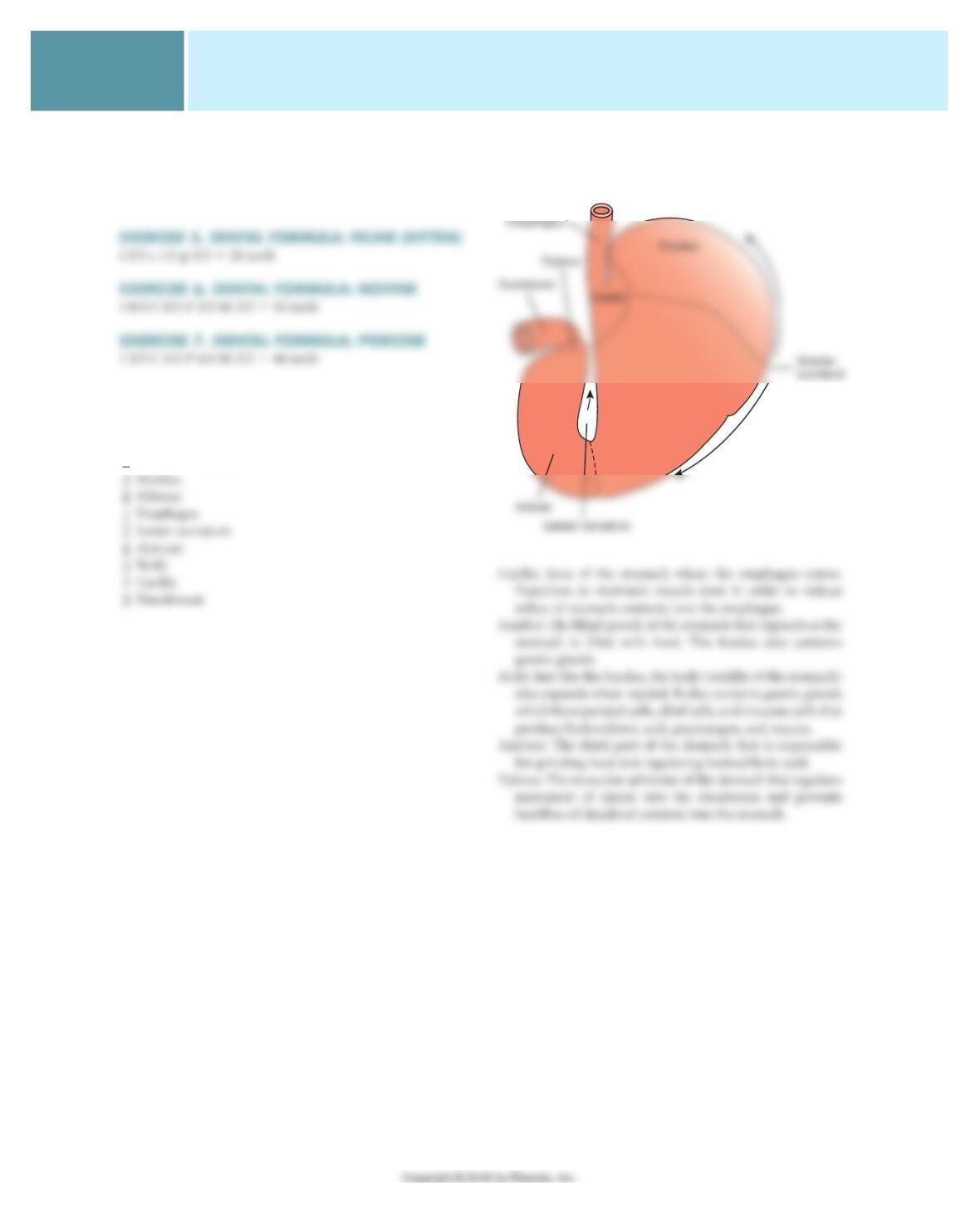
EXERCISE 8. IDENTIFY STRUCTURES
ON A HORSE STOMACH
4 Greater curvature
Body
EXERCISE 9. LABEL AND DEFINE ANATOMIC
AND PHYSIOLOGIC FUNCTIONS OF EACH
STOMACH PART
397.e3
CHAPTER 14 The Digestive System
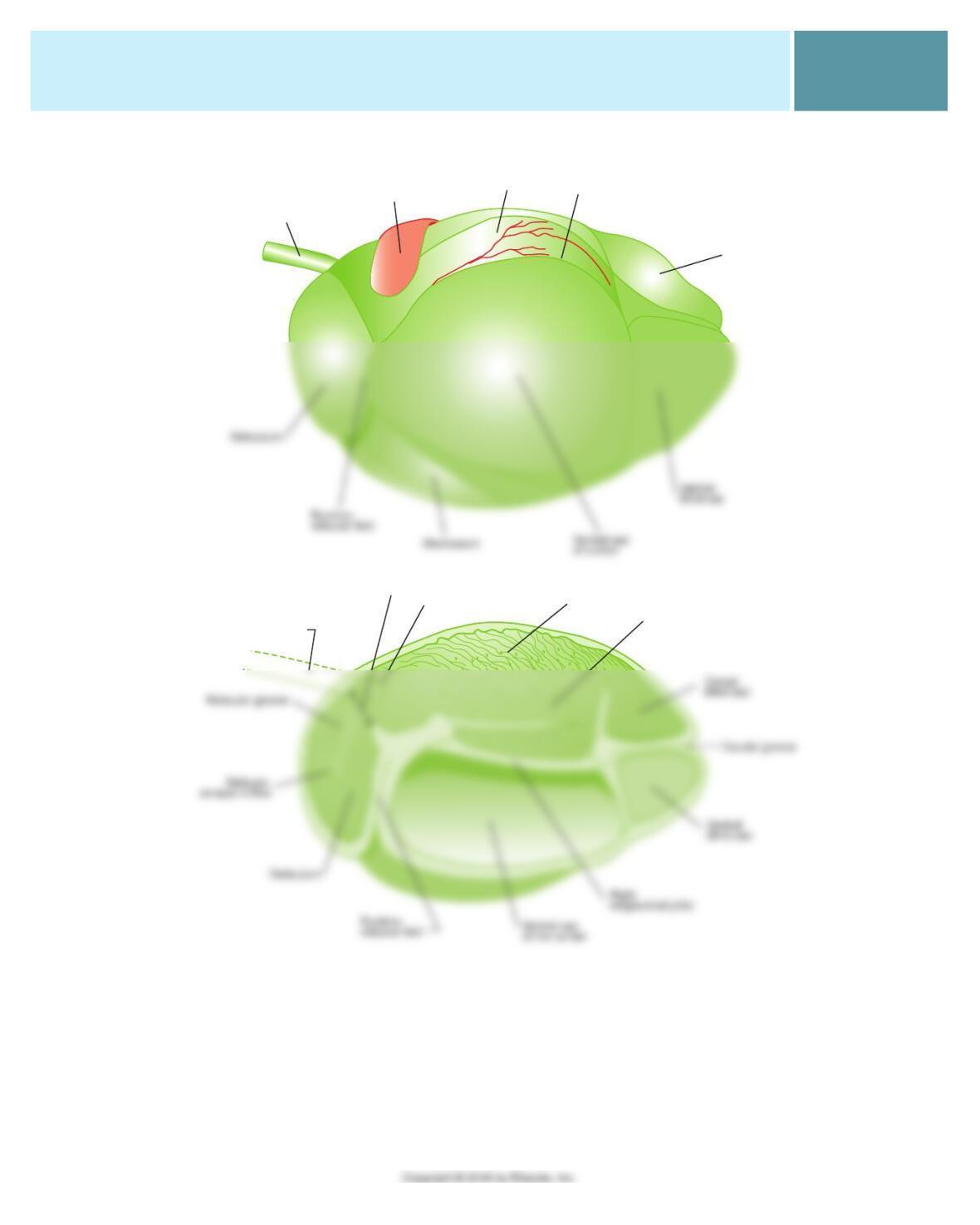
EXERCISE 10. STUDENT LECTURE PRESENTATION ON DIGESTIVE ANATOMY AND PHYSIOLOGY
Dorsal
blind sac
Spleen
Dorsal sac
of rumen Left longitudinal
groove
Esophagus
Rumino-
reticular orifice Esophageal
sphincter
Dorsal sac
of the rumen
Ruminal papillae of
the ruminal wall
Esophagus
CHAPTER 14 The Digestive System
397.e4
EXERCISE 11. COMPARE AND CONTRAST
THE RETICULUM, RUMEN, OMASUM, AND
ABSOMASUM FOR STUDENT LECTURE
Reticulum: The reticulum has a honeycomb appearance
inside that increases the surface area, resulting in an
the remainder of the volatile fatty acids, remove bicar–
bonate ions from ingesta, and absorb water from ingesta.
Abomasum: Secretes acids, mixes and contracts ingesta, and
moves liquid chyme into the small intestine.
EXERCISE 13. IDENTIFY PANCREATIC
PROTEASES
a. Trypsin
b. Chymotrypsin
c. Elastase
intestine to prevent them from reforming fat globules.
EXERCISE 16. IDENTIFY STRUCTURES IN THE
INTESTINAL TRACT AND TRACE INGESTA
FROM DUODENUM TO RECTUM
10 Transverse colon
1 Body of the cecum
3 Right ventral colon
11 Small colon
7 Left dorsal colon
8 Diaphragmatic fl exure
DIGESTION-RELATED ORGANS
EXERCISE 17. IDENTIFY DIGESTION-RELATED
ORGANS
1 Gallbladder
6 Left lateral lobe
EXERCISE 18. DETAIL LIVER FUNCTION
The hepatic portal system is a group of blood vessels that
carries blood from the capillaries of the intestines directly to
the sinusoids of the liver. Once in the liver, phagocytic cells
EXERCISE 19. IDENTIFY STRUCTURES ON THE
FELINE STOMACH, DUODENUM, AND
PANCREAS
1 Esophagus
1 3 J e j u n u m
8 P y l o r u s
EXERCISE 20. DESCRIBE EXOCRINE AND
ENDOCRINE FUNCTIONS OF THE PANCREAS
Exocrine: The exocrine function is responsible for secreting
substances such as pancreatic amylase, proteases, lipase,
and bicarbonate.
EXERCISE 21. CLINICAL APPLICATION #1:
LABEL THE DIGESTIVE TRACT OF THE RABBIT
AND TRACE HINDGUT FERMENTATION
1 Esophagus
397.e5
CHAPTER 14 The Digestive System
EXERCISE 25. IDENTIFY DIGESTION-RELATED
FELINE ORGANS: VENTRAL ASPECT JEJUNUM
REMOVED
11 Spleen
REVIEW
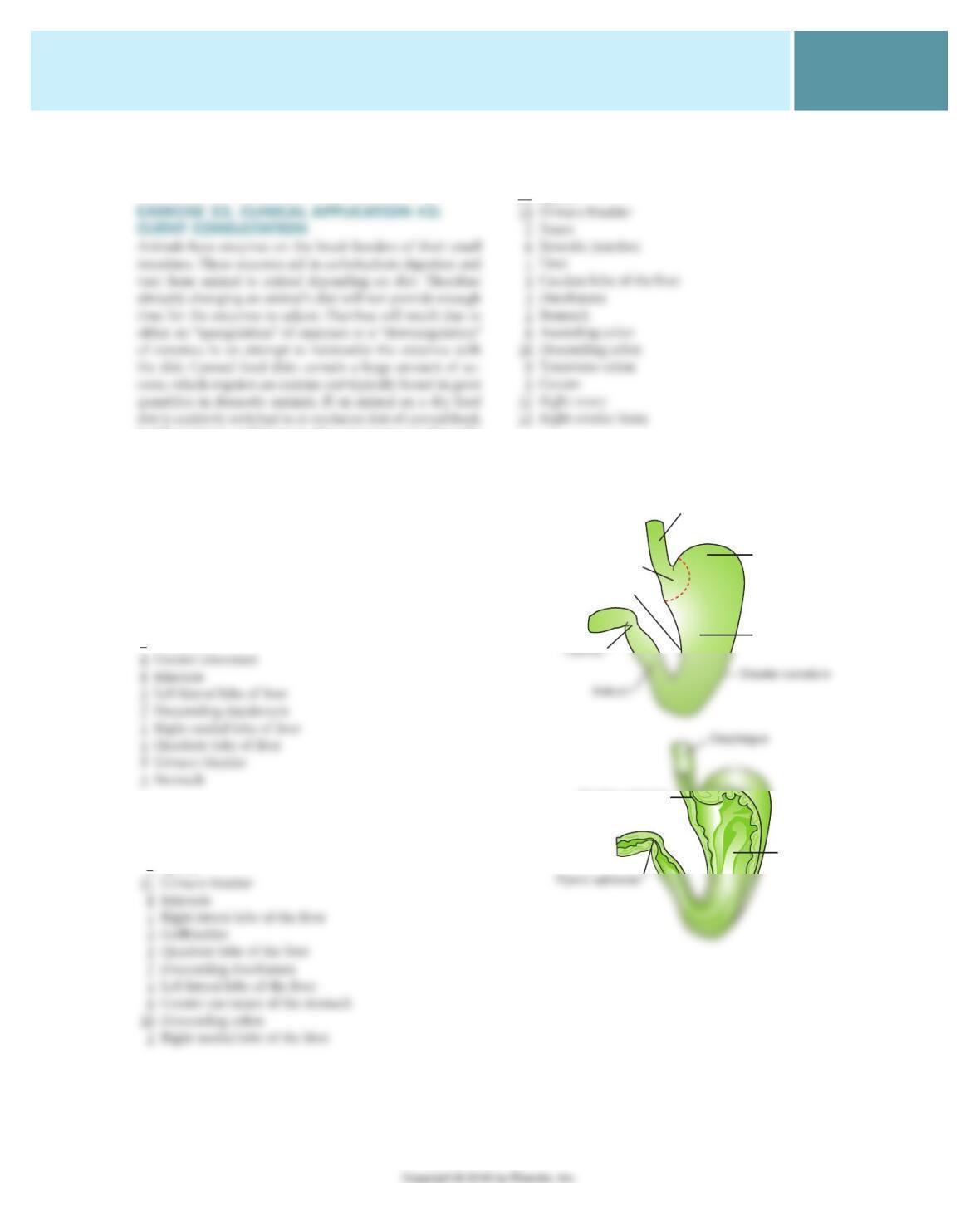
EXERCISE 26. LABEL STOMACH STRUCTURES
9 R e c t u m
4 D u o d e n u m
2 S t o m a c h
it will not have a suffi cient number of enzymes to digest the
large amount of sucrose. The result will be the development
of diarrhea. The best way to avoid this problem is to intro-
duce a new diet to an animal gradually over a period of 5 to
7 days. This can be accomplished by mixing a small amount
of the new food with the regular diet and gradually increas-
ing the amount of new food every day (with a reduction in
the amount of the old food) until the animal is completely
switched over.
EXERCISE 23. IDENTIFY DIGESTION-RELATED
FELINE ORGANS: VENTRAL ASPECT
3 Gallbladder
EXERCISE 24. IDENTIFY DIGESTION-RELATED
FELINE ORGANS: VENTRAL ASPECT,
OMENTUM REMOVED
9 Spleen
Esophagus
Fundus
Lesser curvature
Cardia
Body
Rugae
Cardiac sphincter
CHAPTER 14 The Digestive System
397.e6
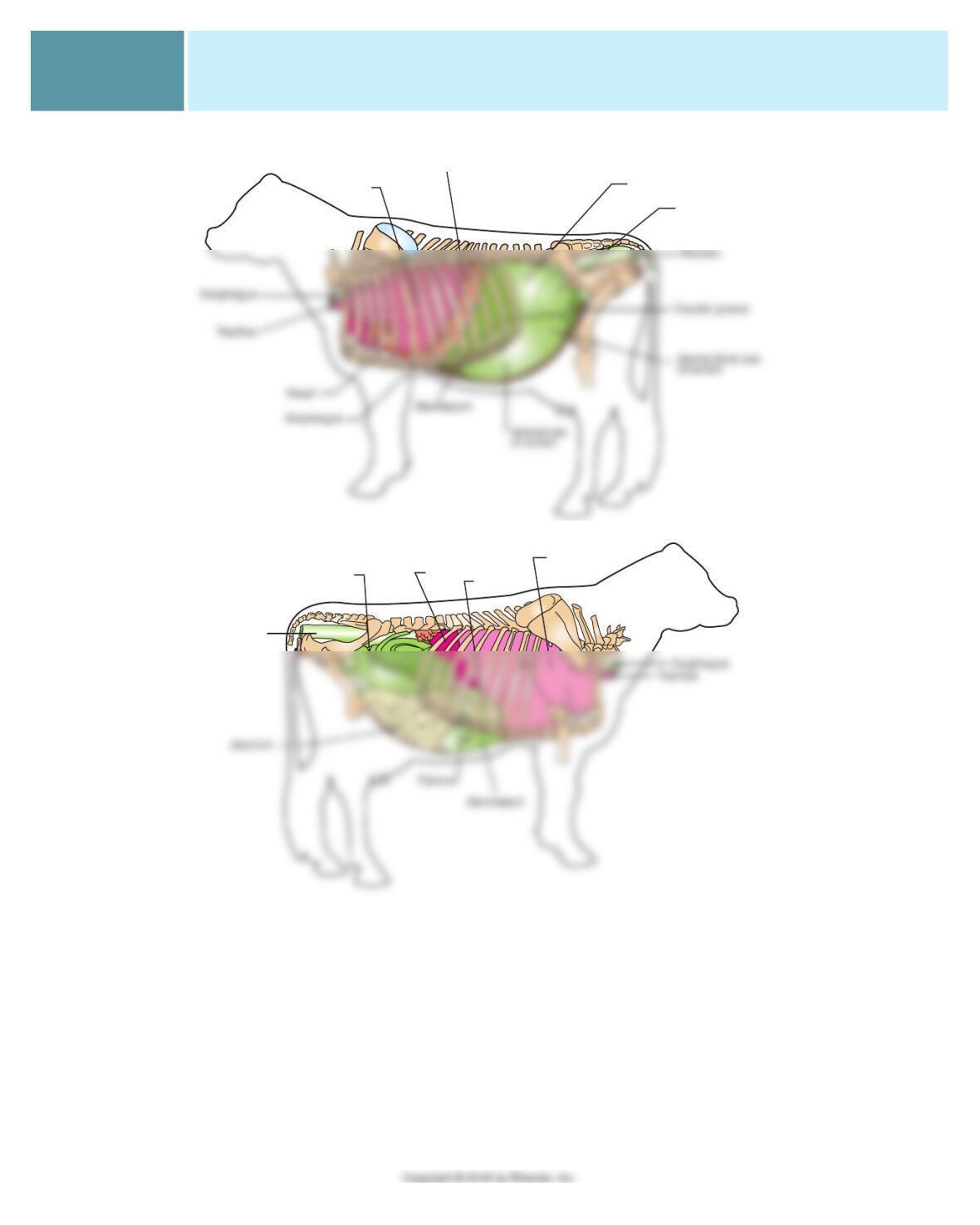
EXERCISE 27. LABEL ANATOMIC BOVINE DIGESTIVE STRUCTURES
Dorsal sac
of rumen
Dorsal blind sac
of rumen
Lungs
Reticulum
Cecum Liver Omasum
Rectum
Lungs
397.e7
CHAPTER 14 The Digestive System
CRITICAL AND CLINICAL THINKING
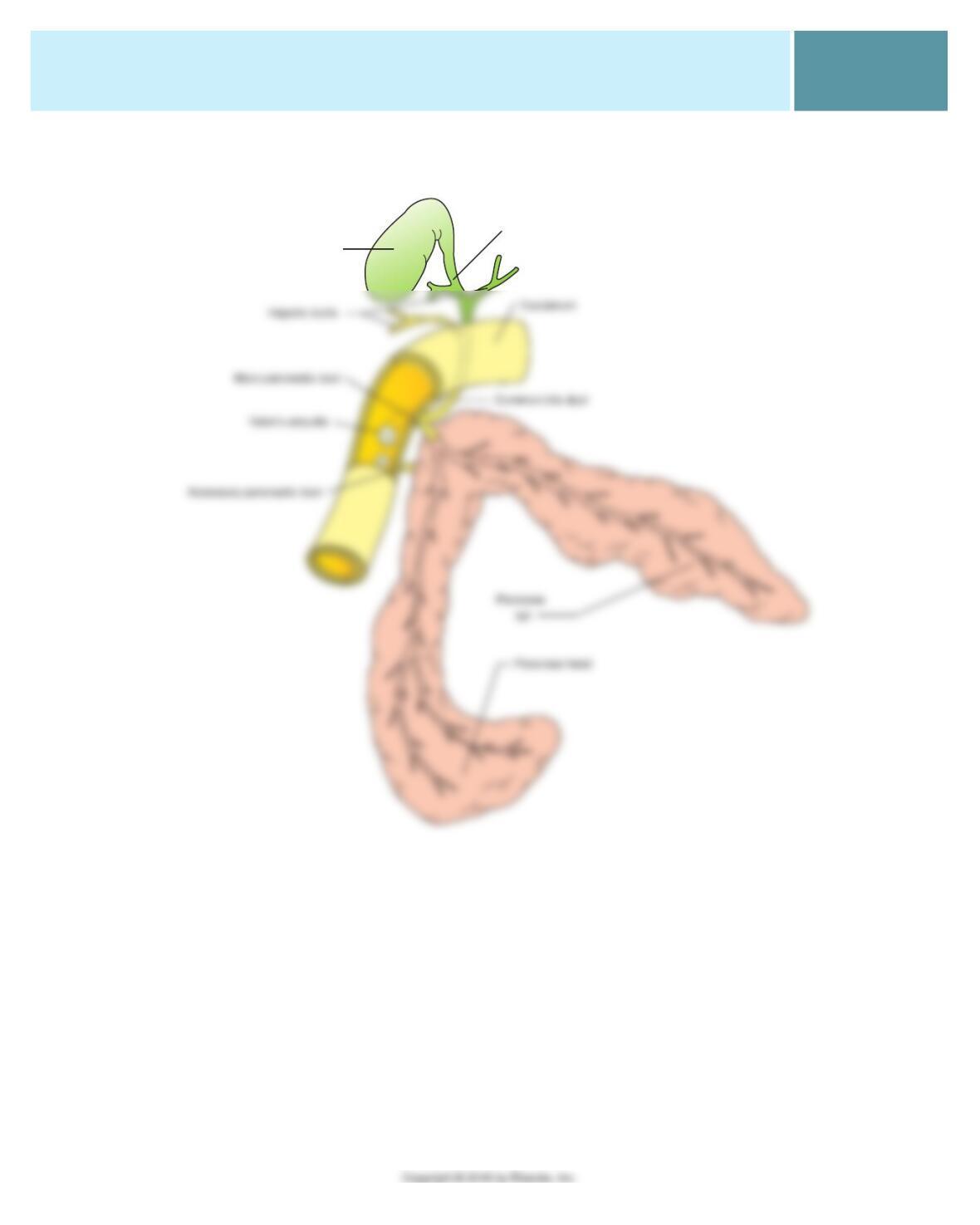
EXERCISE 28. CRITICAL THINKING: LABEL, MATCH, FILL IN
Cystic duct
Gallbladder
CHAPTER 14 The Digestive System
397.e8
FILL-IN THE BLANK
1. A herbivore is an animal whose diet is primarily plants.
A carnivore is an animal whose diet is primarily meat.
An omnivore is an animal whose diet is a mixture of
plants and meat.
MATCHING
1 . D
EXERCISE 29. CLINICAL THINKING CHALLENGE
1. In herbivores, such as horses and cattle, the process of
converting consumed plant material into usable nutri-
ents and energy is heavily dependent on microbial
4 . T h e fi rst system involves a combination of the central
nervous system and the endocrine system. The second
system is unique to the gastrointestinal tract and con-
sists of an enteric or intrinsic nervous system with an
intrinsic endocrine/paracrine component.
across the pharynx, pushing the food bolus into the
esophagus.
12. The cardia, fundus, and pylorus.
complex, but a ruminant is not born with this ecosystem
already established. When a ruminant is born, its gastro-
intestinal tract is usually sterile. The microorganisms
that will one day be so crucial to its survival must be
acquired. The young ruminant attains these different
397.e9
CHAPTER 14 The Digestive System
17. Enzymes derived from the exocrine pancreas are vital to
the digestion of proteins, carbohydrates, lipids, and nu-
cleic acids. Lipases break down lipids into two free fatty
acids and a monoglyceride. Pancreatic amylase breaks
activated to chymotrypsin, proelastase is activated to
elastase, and procarboxypeptidases A and B are activated
to carboxypeptidases A and B. Trypsin can also activate
additional trypsinogen to trypsin.