59
Solutions to Problems in
Chapter 13: Fusion Reactions
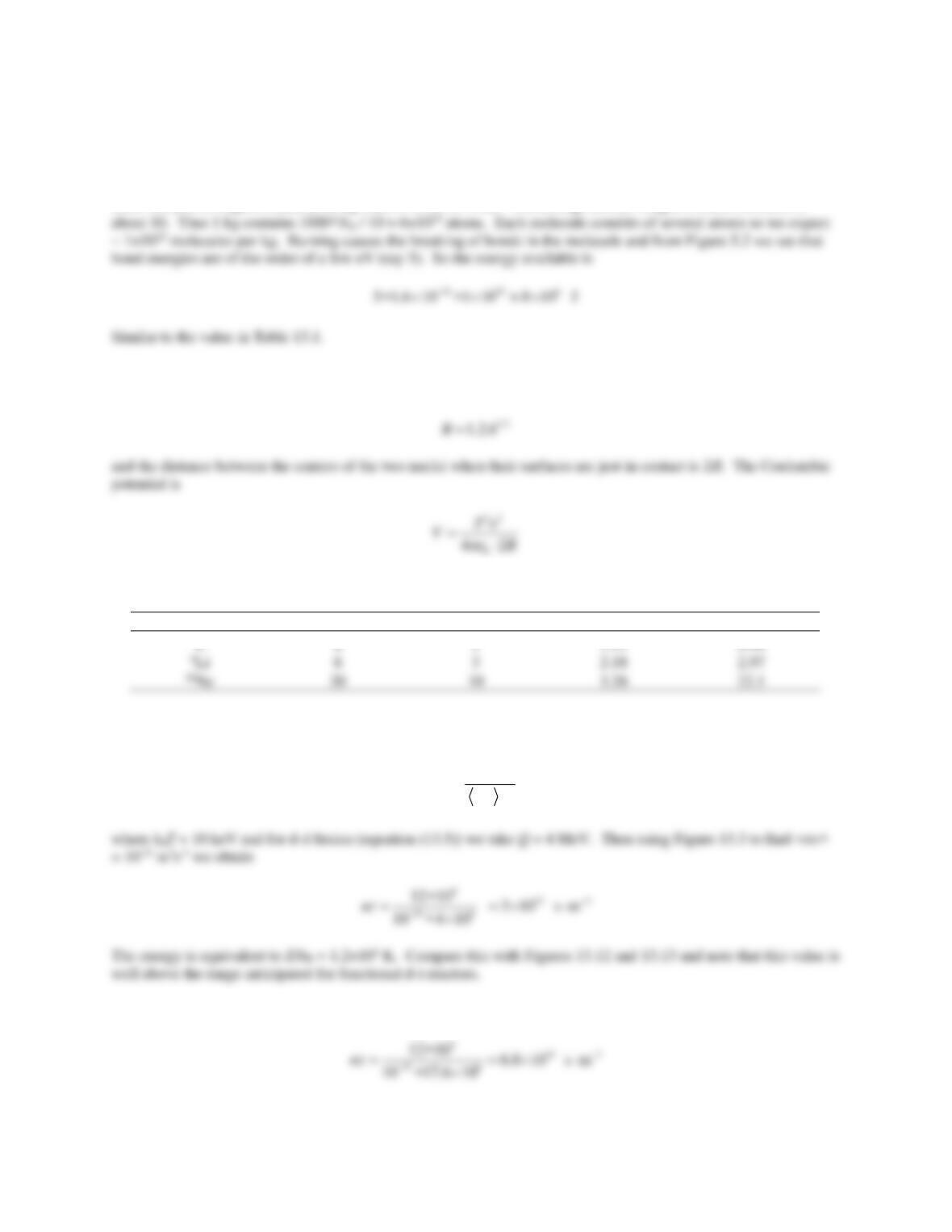
13.1. Assume an organic material comprised of H, C, O, N etc. The average atomic weight of these elements is
13.2. The nuclear radii are given (in fm) by
The following results are obtained.
nucleus
A
Z
R (fm)
V (MeV)
d
2
1
1.51
0.48
6
3
2.18
2.97
3.26
22.1
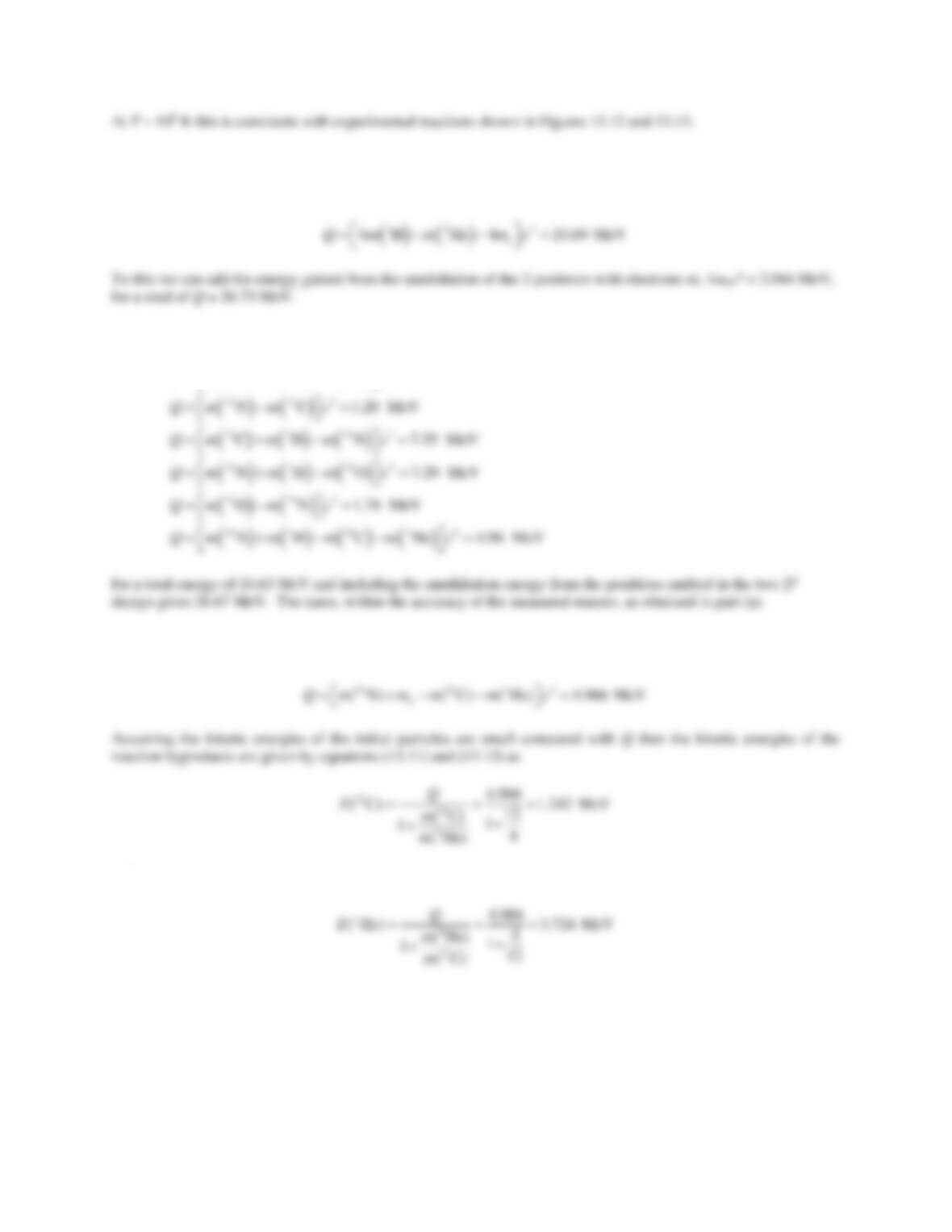
13.3. (a) From equation (13.37) we have
12 B
kT
nQ
=
(b) Repeating for d-t fusion we use Q = 17.6 MeV (equation 13.7) and <v> = 10-22 m3s-1 (Figure 13.3) to get
60
13.4. (a) The process of fusing 4 protons into a 4He nucleus must be considered in the context of atomic masses. We
add 4 me to each side of equation (13.25) to obtain
(b) The energy in each case is calculated from atomic masses – being careful with electron masses – as
( ) ( ) ( )
12 1 13 2
C H N 1.94 MeVQ m m m c
= + − =
13.5. The Q for this reaction is
and
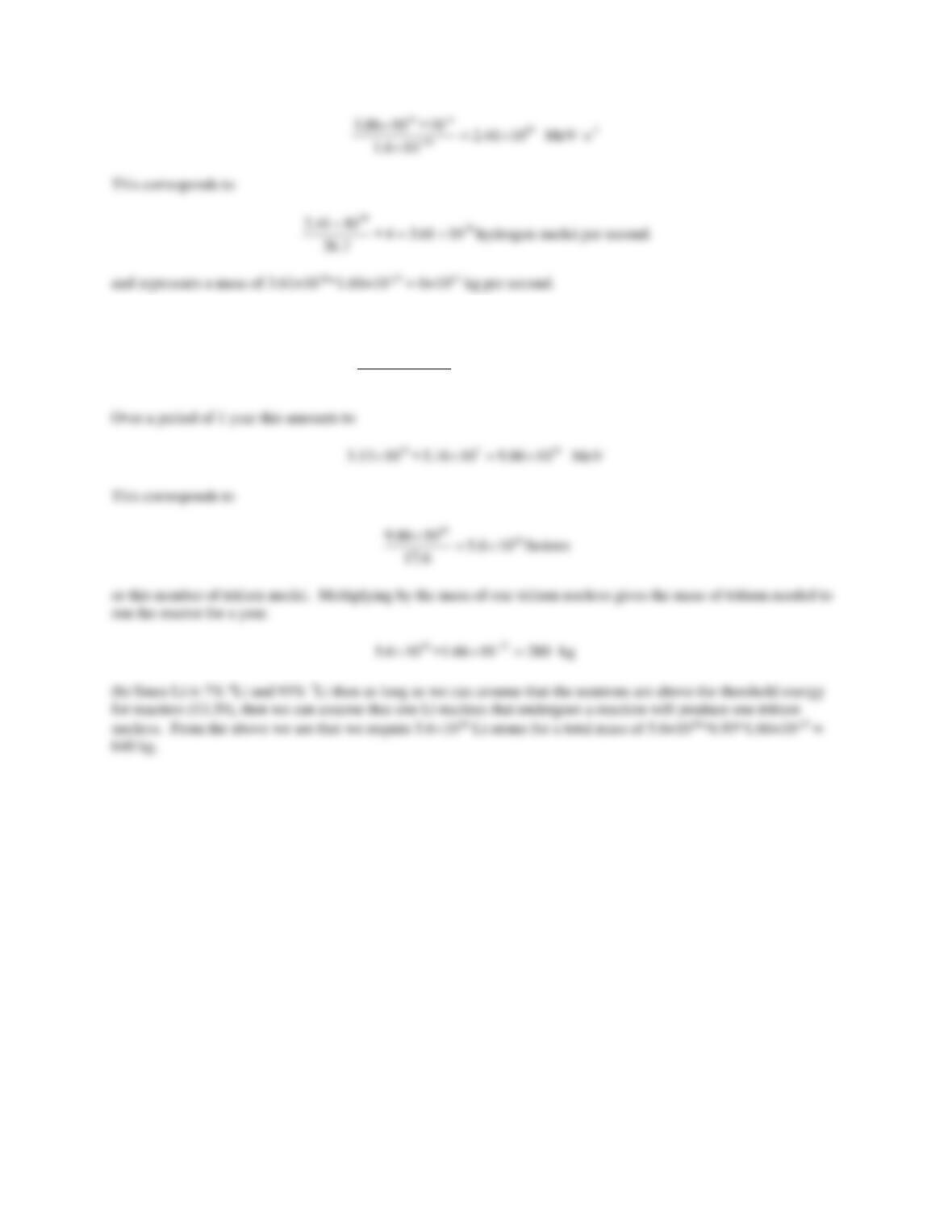
13.6. Each p-p cycle produces 26.7 MeV of which 0.52 MeV is lost as neutrino energy giving a net energy which
can be observed as 26.18 MeV per p-p cycle. This represents the fission of 4 hydrogen nuclei. The observable
energy from the sun is 3.86×1026 W or
61
13.7. (a) One d-t fusion produces 17.6 MeV of energy. To produce 5 GW requires
922 –1
19 6
5 10 3.13 10 MeV s
1.6 10 10
−
=