The Cardiovascular System
EXERCISE 1. IDENTIFY THE EXTERNAL
STRUCTURES OF THE HEART
1. Base of the heart
EXERCISE 2. IDENTIFY THE STRUCTURES OF
THE HEART
1 . A o r t i c a r c h
9. Caudal vena cava
10. Right atrium
11. Pulmonary valve
1 . A o r t a
2 . A o r t i c v a l v e
3. Right ventricle
4 . M i t r a l v a l v e
CHAPTER
12
EXERCISE 4. CHART THE SEQUENCE OF BLOOD FLOW
Vena cava
Right atrium
Pulmonary vein
Left atrium
CHAPTER 12 The Cardiovascular System
333.e2
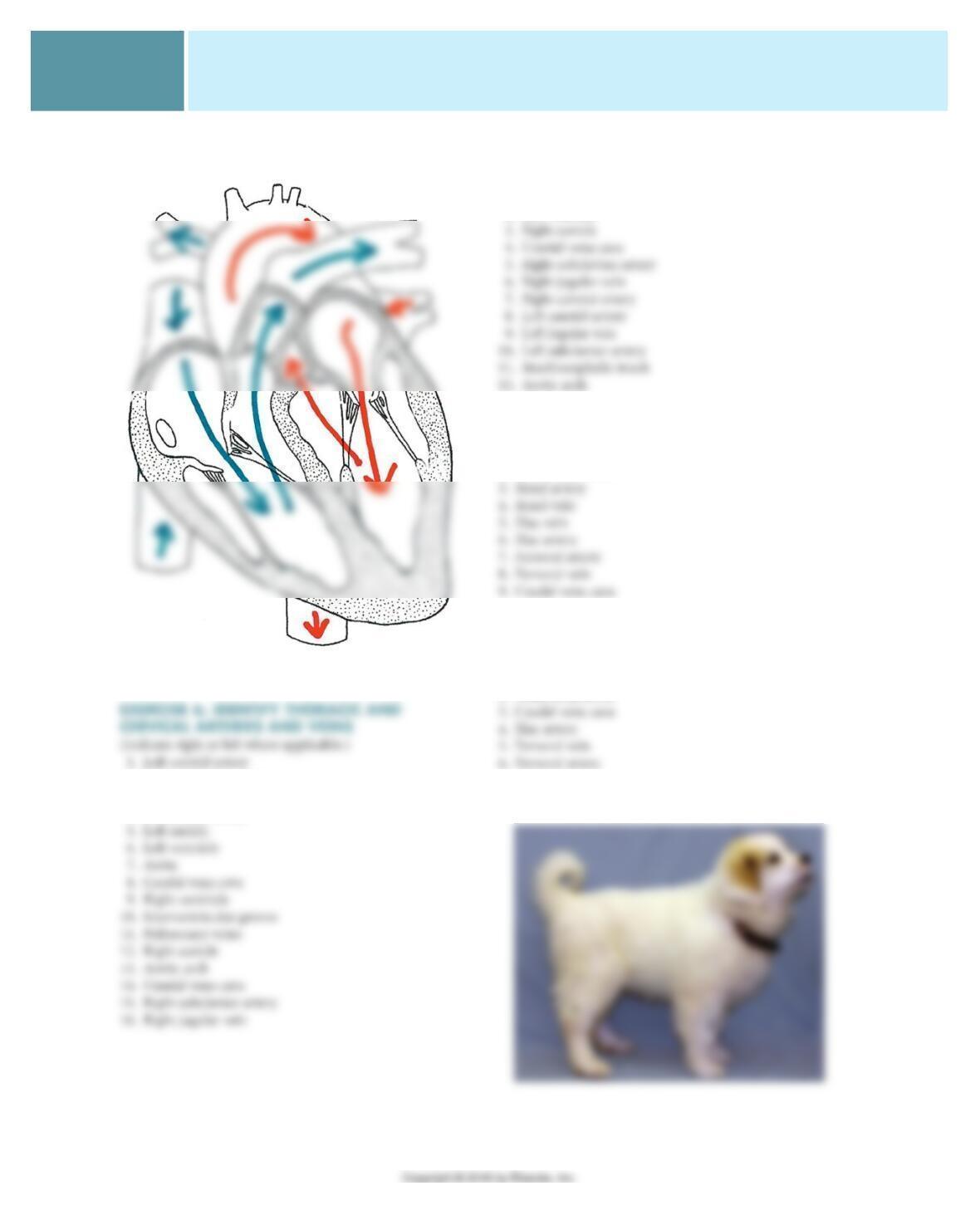
EXERCISE 5. TRACE THE FLOW OF BLOOD
THROUGH THE HEART EXERCISE 7. IDENTIFY THORACIC AND
CERVICAL ARTERIES AND VEINS
(Indicate right or left where applicable.)
1. Apex of the heart
2. Left ventricle
EXERCISE 8. IDENTIFY CARDIAC AND
ABDOMINAL STRUCTURES
1 . H e a r t
2. Abdominal aorta
EXERCISE 9. IDENTIFY FELINE CAUDAL
ABDOMINAL AND PROXIMAL HINDLIMB
ARTERIES AND VEINS
1. Renal vein
2. Abdominal aorta
EXERCISE 10. LOCATE VEINS
2. Left subclavian artery
3. Brachiocephalic trunk
4. Pulmonary artery
333.e3
CHAPTER 12 The Cardiovascular System
EXERCISE 11. DEFINE KEY TERMS
1. Aorta: The major artery of the systemic circulation, it
receives blood from the left ventricle.
2. Aortic arch: After leaving the heart in a cranial direction,
the point at which the aorta turns caudally to go to the
abdominal cavity.
7. Auricle: The externally visible part of an atrium.
8. Capillary: The smallest blood vessels composed of
rolled-up tubes of simple squamous epithelium (endo-
thelium) that form extensive networks all over the body.
Nutrients, gases, wastes, and so on are exchanged be-
tween the blood and the cells at the capillary level.
15. Heart: The muscular pump that pumps blood to the
cells and tissues of the body.
16. Interatrial septum: The “wall” of myocardium that sepa-
rates the left and right atria of the heart.
22. Myocardium: The thick muscular layer of the heart wall.
23. Pericardial sac: The outermost layer of the pericardium
that surrounds the heart.
24. Pericardium: The protective outer covering of the heart.
25. Pulmonary circulation: The blood circulation to the
lungs.
26. Pulmonary valve: The valve between the right ventricle
and the pulmonary artery, also known as the pulmonic
chamber.
33. Tricuspid valve: The valve between the right atrium and
the right ventricle.
34. Vein: A blood vessel that carries blood toward the heart.
35. Ventricle: The heart chamber that pumps blood out
through the large arteries. The left ventricle pumps
CHAPTER 12 The Cardiovascular System
333.e4
8. Aortic and pulmonary
9. Pulmonary valve
10. Base of the heart
1 9 . A f f e r e n t
2 0 . E f f e r e n t
2 1 . O x y g e n r i c h
2 2 . O x y g e n p o o r
2 3 . O x y g e n p o o r
24. Carotid artery
25. Pulmonary vein
26. Vena cava
27. Femoral artery and femoral vein
EXERCISE 13. CLINICAL THINKING
CHALLENGE: IDENTIFY THE CARDIOVASCULAR
COMPONENT
1. Plasma
2. Erythrocytes
13. Parietal layer
14. Pericardial fl uid
15. Myocardium
24. Tricuspid valve
25. Chordae tendineae
26. Bicuspid/mitral valve
27. Semilunar valves
28. Skeleton of the heart
29. Coronary sinus
3 0 . N e r v e s u p p l y
31. Septic pericarditis
32. Pericardial effusion
46. Arterioles
47. Vena cava
48. Umbilical vein
49. Foramen ovale/ductus arteriosus
50. Pulse
51. Systolic blood pressure