EARTHS INTERIOR 12
INTRODUCTION
Earths Interior
CHAPTER OUTLINE
1.
2.
196
3.
197
4.
198
°
199
5.
200
201
LEARNING OBJECTIVES/FOCUS ON CONCEPTS
12.1 Explain
12.3 List and describe
TEACHING STRATEGIES
Clicker Questions:
Muddiest Point:
A. How do we know about the layers of the Earth?
202
TEACHER RESOURCES
Web Resources:
Formation of Earth
o Origin of the Earth and Moon
Earth Layers
203
Magnetic Fields
Heat Flow
Images, Videos, and Animations:
Images
204
Videos
Animations
ANSWERS TO QUESTIONS IN THE CHAPTER:
CONCEPT CHECKS
12.1 EARTHS INTERNAL STRUCTURE
2. Earths layers formed from molten nebular debris that segregated by gravity as the Earth
3. Compression of mineral structures at high pressures causes mineral phase changes. Mineral
phase changes occur when atoms rearrange into more stable and denser structure. At high
12.2 PROBING EARTHS INTERIOR
1. Seismic waves from large earthquakes travel all the way through the Earth and can be
3. Seismic waves travel along curved paths through the mantle because their velocities generally
increase with depth due to changes in the density of materials.
12.3 EARTHS LAYERS
1. Oceanic crust is composed of basalt and is formed at mid-ocean ridges. Oceanic crust has a
2. The Moho is the boundary between the crust and the mantle. Seismic waves travel at 6 km/sec
3. The asthenosphere is weaker than the lithosphere because it is hotter.
4. The upper mantle is composed of peridotite and is denser than the crust above it. The
transition zone between the upper and lower mantle is composed of spinel (top half) and
5. The outer core is liquid while the inner core is solid. Both are composed of iron with smaller
12.4 EARTHS TEMPERATURE
1. Earth is 0°C at its surface, and about 5500 °C at its center. Within the crust, temperature
increases rapidly at 30°C per kilometer of depth. At the base of the lithosphere through the
2. Earths internal heat comes from its formation and radiogenic heat from short-lived
radioactive isotopes, and from radiogenic heat from long-lived radioactive isotopes.
3. Within Earth, heat transfer occurs through convection and conduction. Conduction and
12.5 EARTHS THREE-DIMENSIONAL STRUCTURE
1. The force of gravity is not the same over the entire Earth. Gravity is less at the equator than
2. Seismic tomography is the collection of signals from many different seismograph stations to
obtain a picture of the inside of Earth. Seismic tomography reveals seismic wave velocity
3. The Earths magnetic field is thought to be created by convection of liquid iron in the outer
core. Iron-rich fluid in the outer core rises through convection and its path is twisted by Earths
4. Through time, Earths magnetic north and south pole vary in their declination with Earths
GIVE IT SOME THOUGHT
2.
Ray 3. When the velocity of seismic waves increases as they pass from one layer into
Ray 2. When the velocity of seismic waves decreases as they pass from one layer into
another, the waves refract (bend) away from the boundary separating them.
3. Density increases with depth in the Earths mantle due to mineral phase changes of olivine and
pyroxene in the ultramafic rock peridotite. These mineral phase changes result in more
5. The Earth is likely the most dense because it has a large metallic core and a large, fairly dense
mantle. Metallic cores are more dense than
rocky mantles. Mars would have moderate
6. The inner core grows as Earth continues to
7. Convection is a method of heat transfer in a
fluid-like mannerhot materials rise and
8.
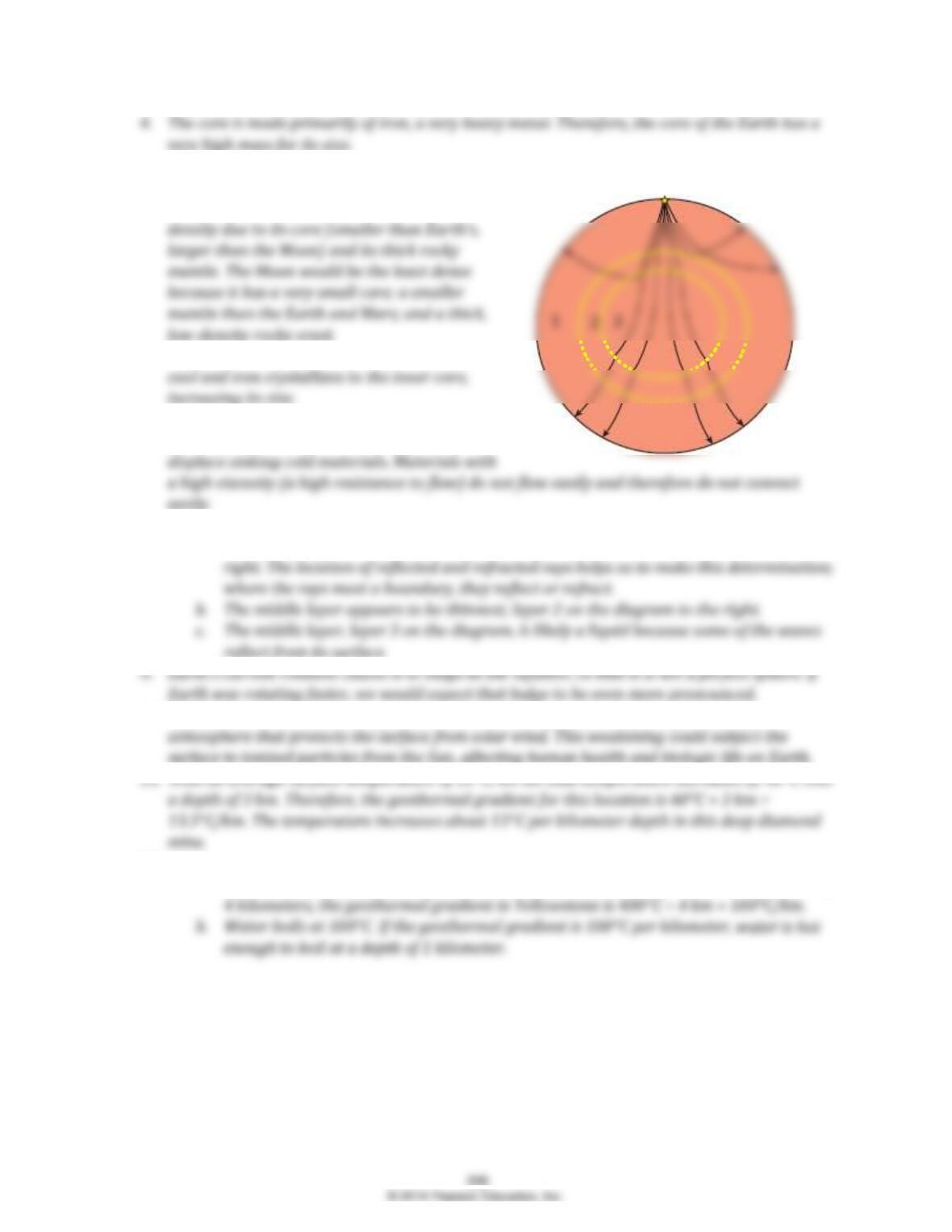
a. This planet appears to have at least three layers as indicated by the yellow lines to the
10. Magnetic reversals are accompanied with a weakening of the magnetosphere, a layer in the
12.
a. With an average surface temperature of 0°C and a temperature of 400°C at a depth of