49
Solutions to Problems in
Chapter 11: Nuclear Reactions
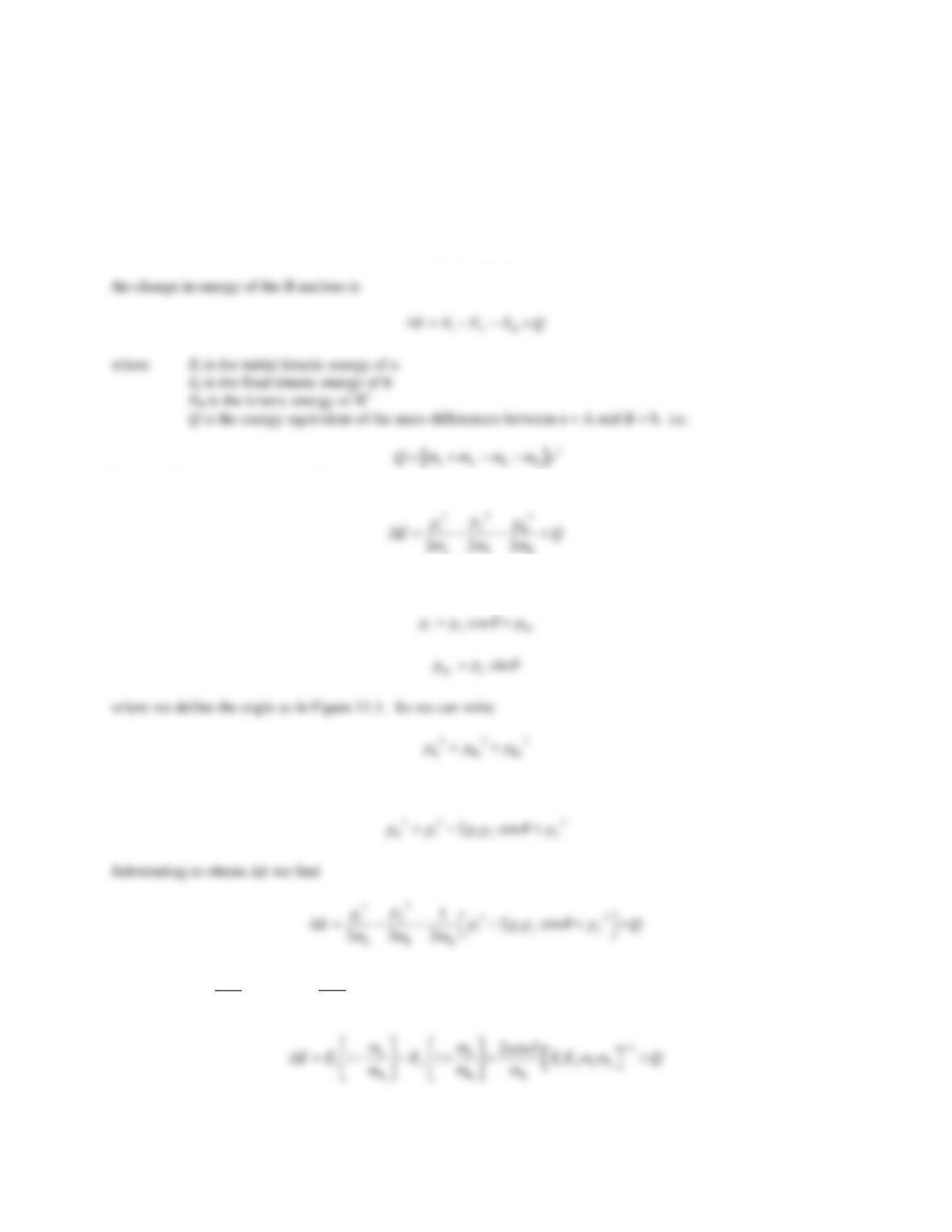
11.1. For the process
*
a+A B +b→
In terms of momenta we may write
Conservation of the various components of momenta gives
Combining with the above we obtain
and using
2
a
2
i
i
E
pm
=
and
2
b
2
f
f
E
pm
=
we find
50
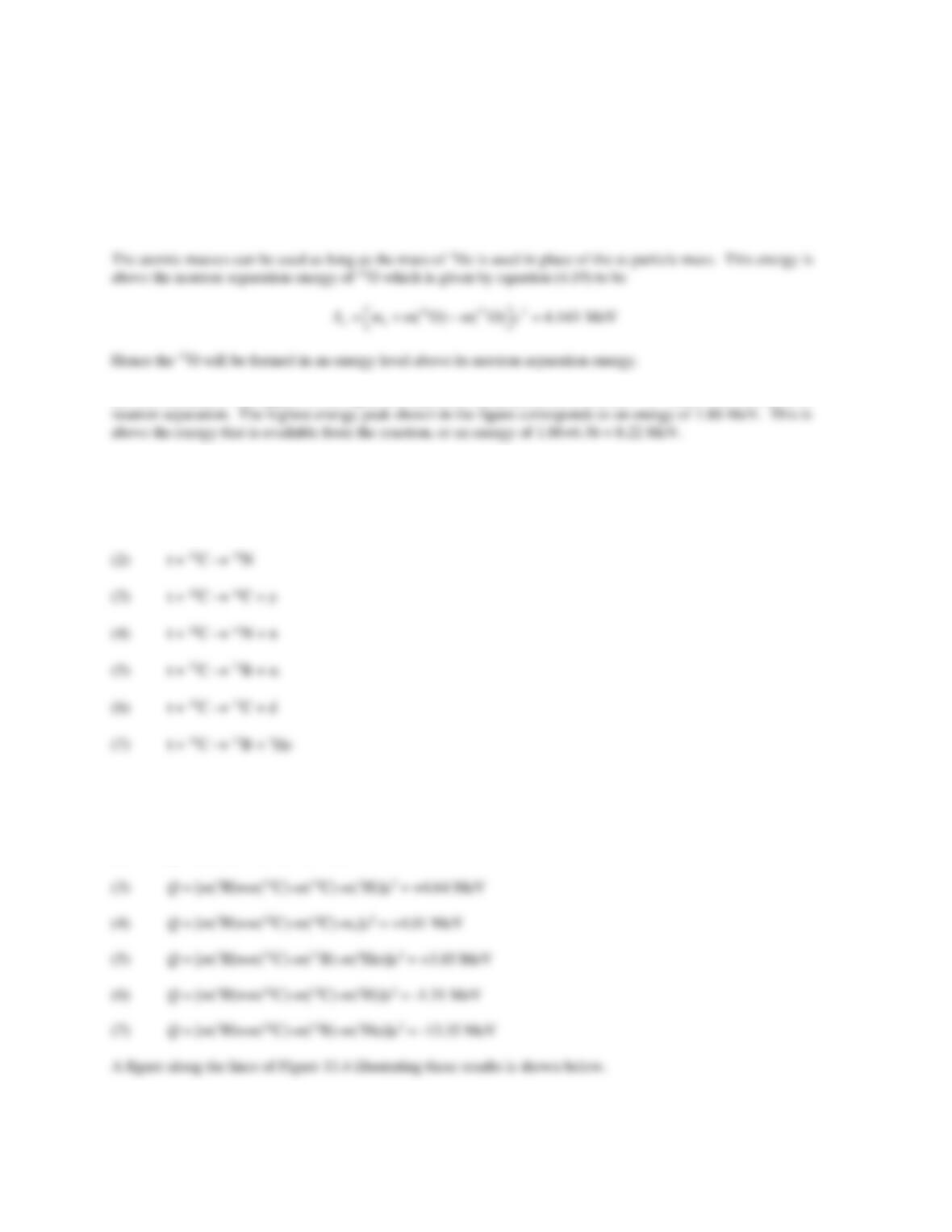
11.2. (a) The excess energy available is
13 4 17 2
( C)+ ( He)– ( O) 6.359 MeVQ m m m c
= = +
(b) The resonances that appear in the figure correspond to the population of excited 17O* states that form prior to
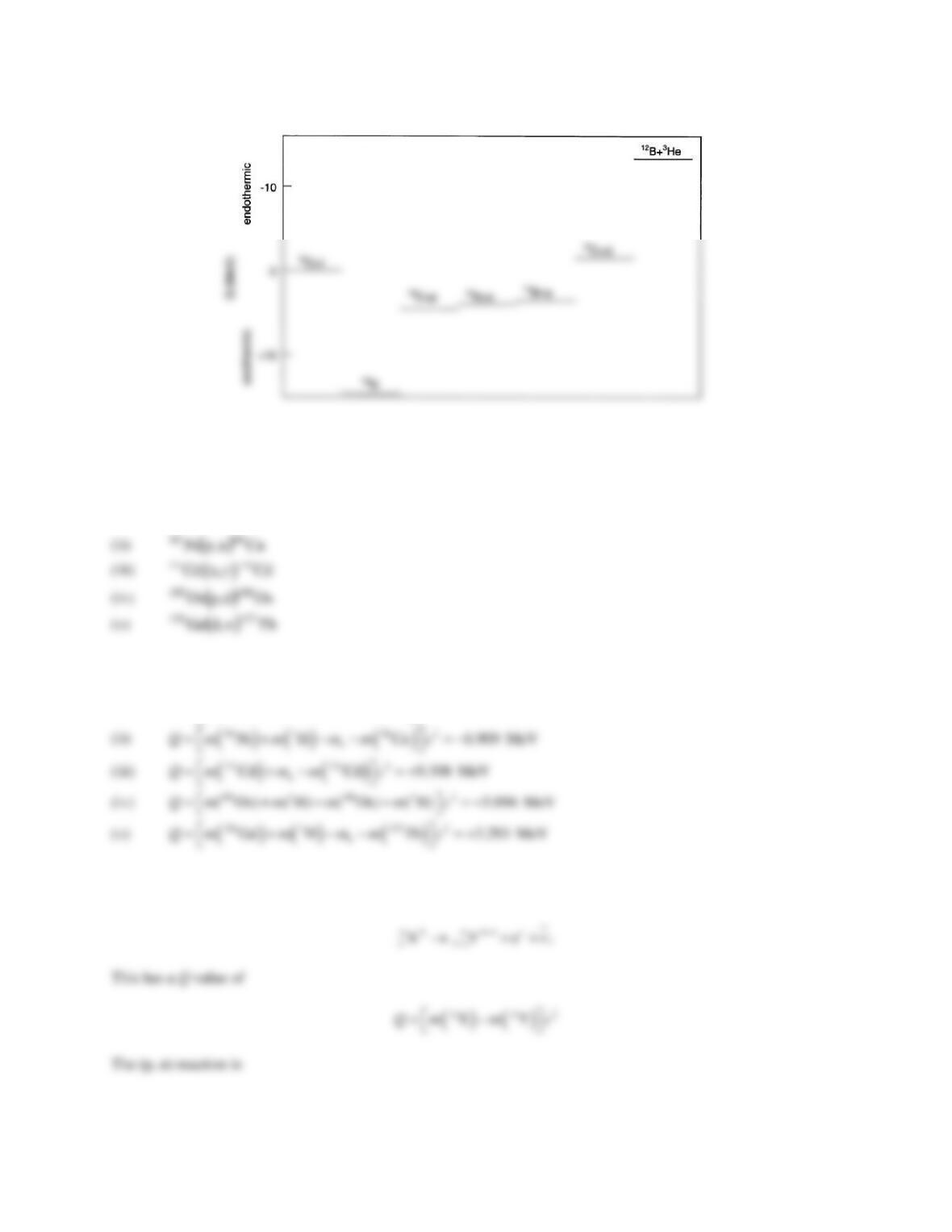
11.3. The reactions we need to consider are as follows.
(1) t + 12C → 12C + t
The energy for each process is written in terms of the relevant atomic masses as follows.
(1) Q = [m(3H)+m(12C)–m(12C)–m(3H)]c2 = 0 MeV
(2) Q = [m(3H)+m(12C)–m(15N)]c2 = +14.85 MeV
51
11.4. (a) The missing particle/nucleus can be determined by equating neutrons and protons on the two sides of the
reaction.
(i)
( )
29 32
Si ,n S
(b) The reactions involve nuclei, so when using atomic masses it is important to properly account for all electrons.
(i)
( ) ( ) ( )
29 4 32 2
n
Si He S 1.525 MeVQ m m m m c
= + − − = −
11.5. The conventional – decay is
52
11.6. (a) Conservation of the number of neutrons and protons requires that the reaction is
(b) The Q for this process is
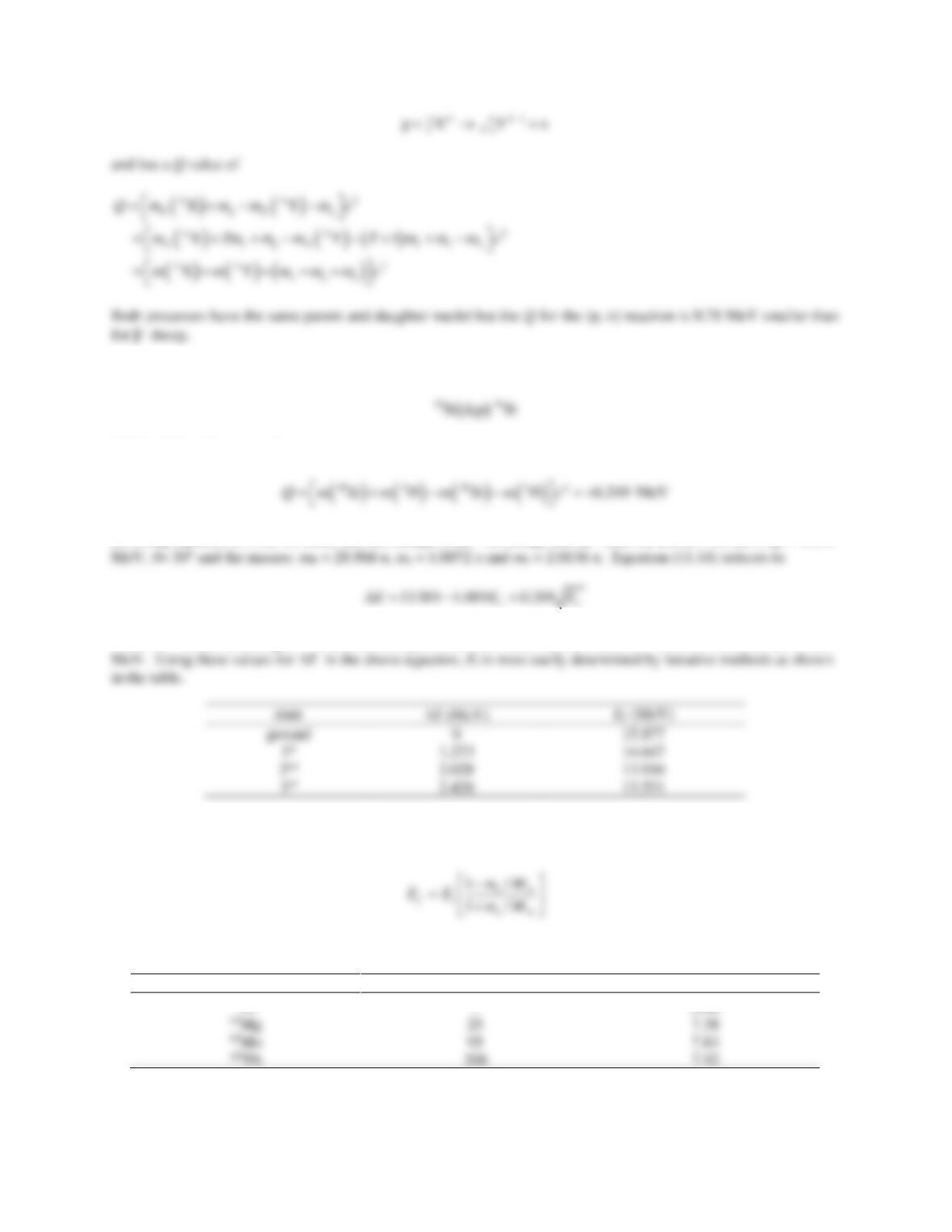
(c) Using equation (11.14) we relate E, the change in the 29Si energy and Ef. Here we use Ei = 10 MeV, Q = 6.249
From the “Table of Isotopes” we find the energies of the first three excited states of 29Si as 1.273, 2.028 and 2.426
10.7. Equation (11.10) may be used by setting =90 and E=0 (for elastic scattering). Thus Ef may be found to be
Using ma = 1 u and the given values of MA we find the following Ef for Ei = 8 MeV.
nuclide
MA (u)
Ef (MeV)
7Li
53
11.8. The reaction
where m = mn, mA = m(16O) and kBT = 0.04 eV at room temperature.
Thus