44
Solutions to Problems in
Chapter 10: Gamma Decay
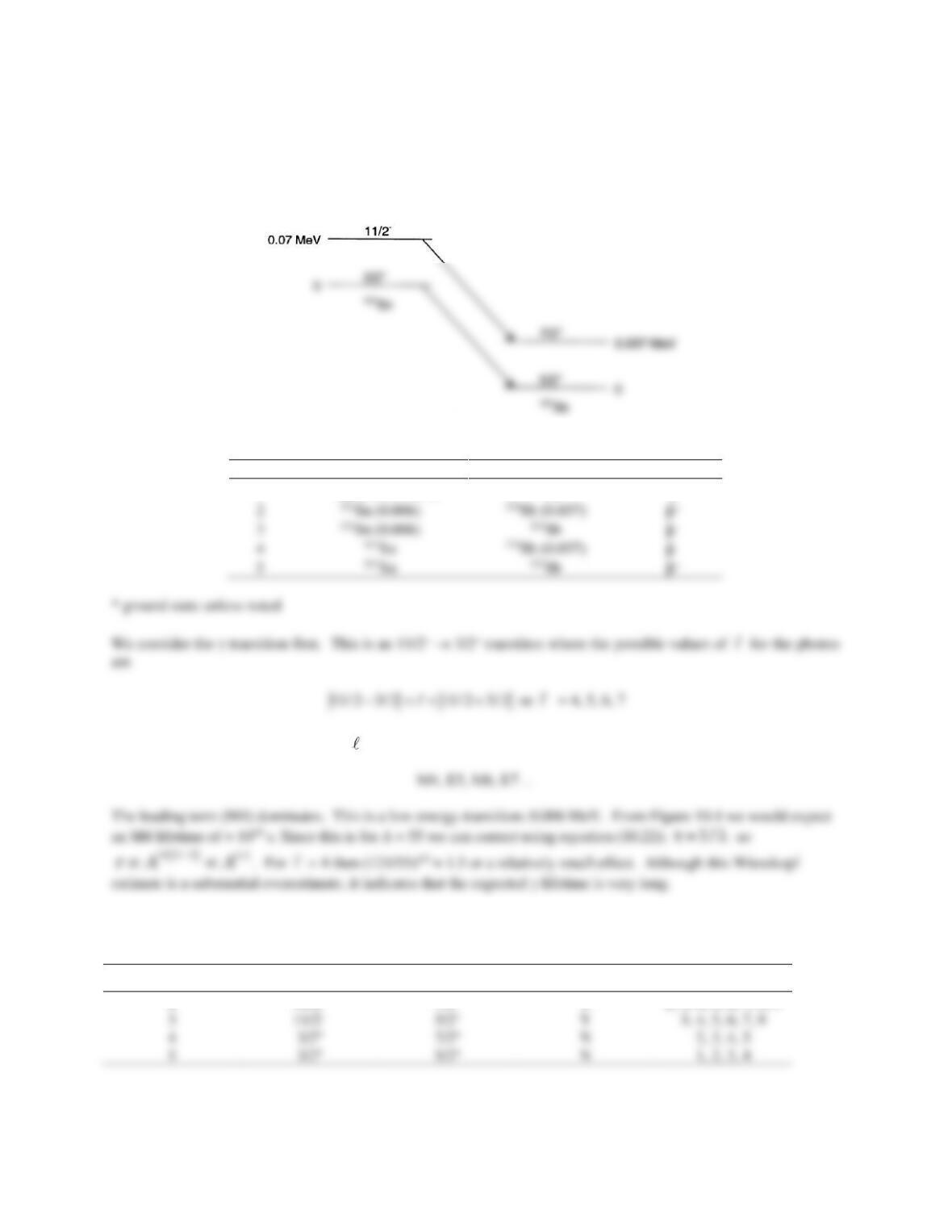
10.1. The decay from the “Table of Isotopes” is shown below.
We need to consider the following possible decays.
#
initial state*
final state*
decay
1
121Sn (0.006 MeV)
121Sn
There is a change of nuclear parity so for the must be odd. The possible transitions are therefore
For the – decays we consider the degree to which the transition is forbidden. The spin and parity considerations are
shown in the table.
decay #
i
J
f
J
parity change
J
2
11/2–
7/2+
Y
2, 3, 4, 5, 6, 7, 8, 9
3
11/2–
5/2+
Y
4
3/2+
7/2+
N
5
3/2+
5/2+
N
2
45
These results give the degree of forbiddeness as shown below.
decay
mode (principal)
2
1st forbidden
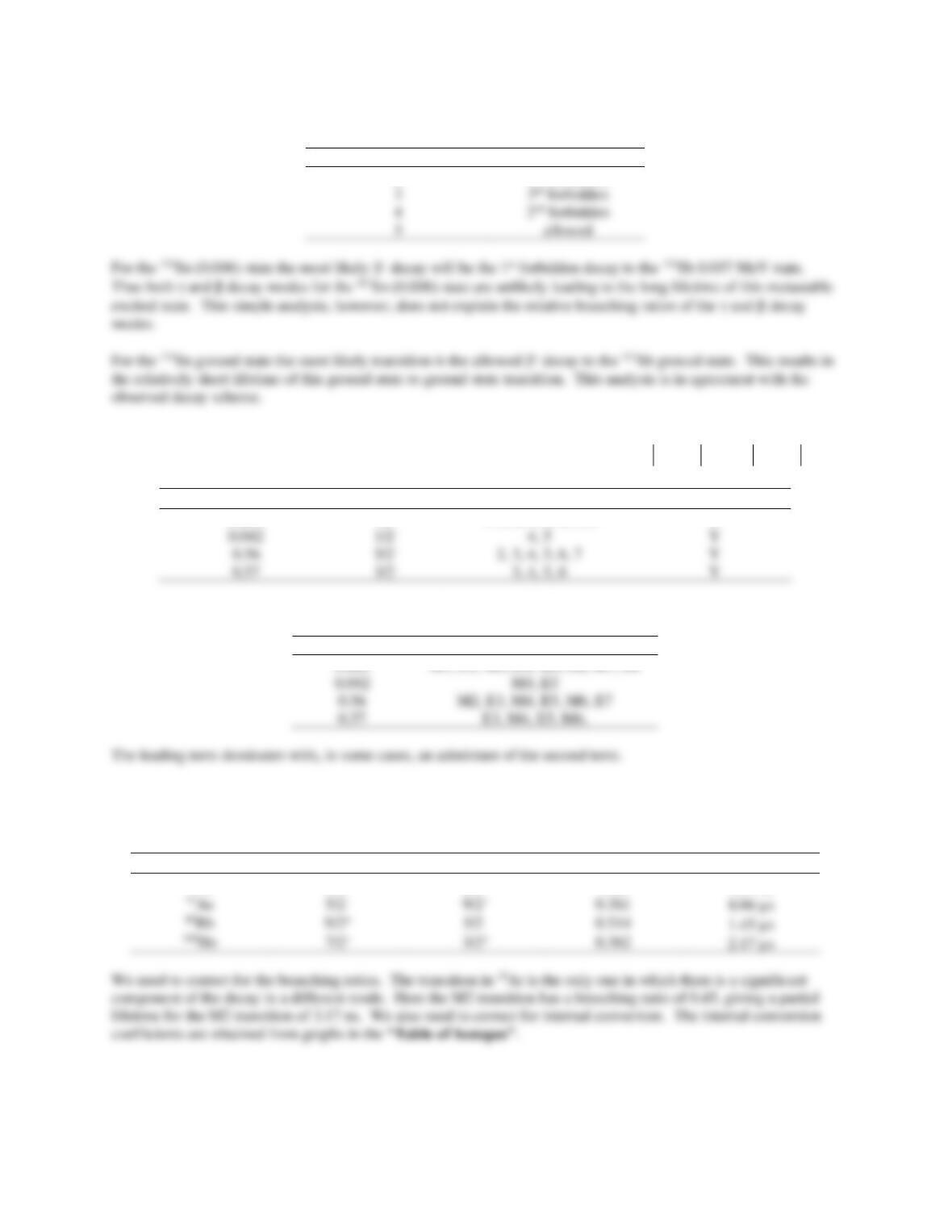
10.2. The four transitions to the 9/2+ ground state have the following properties where
i f i f
J J J J J− +
.
E (MeV)
J
J (allowed)
change
0.009
7/2+
1, 2, 3, 4, 5, 6, 7, 8
N
0.042
Y
Y
3, 4, 5, 6
Y
Based on the allowed J and the parity change the allowed multiplicities are
E (MeV)
multiplicities
0.009
M1, E2, M3, E4, M5, E6, M7, E8
0.042
10.3. We consider the transition to the ground state of the following.
nuclide
J (ground)
J (excited)
E (MeV)
mean
39Ar
7/2–
3/2+
1.52
1.37 ns
3
3rd forbidden
4
5
46
nuclide
Z
E (MeV)
K
L1
L2
L3
total
39Ar
18
1.52
8×10⁻⁵
~ 0
~ 0
~ 0
8×10⁻⁵
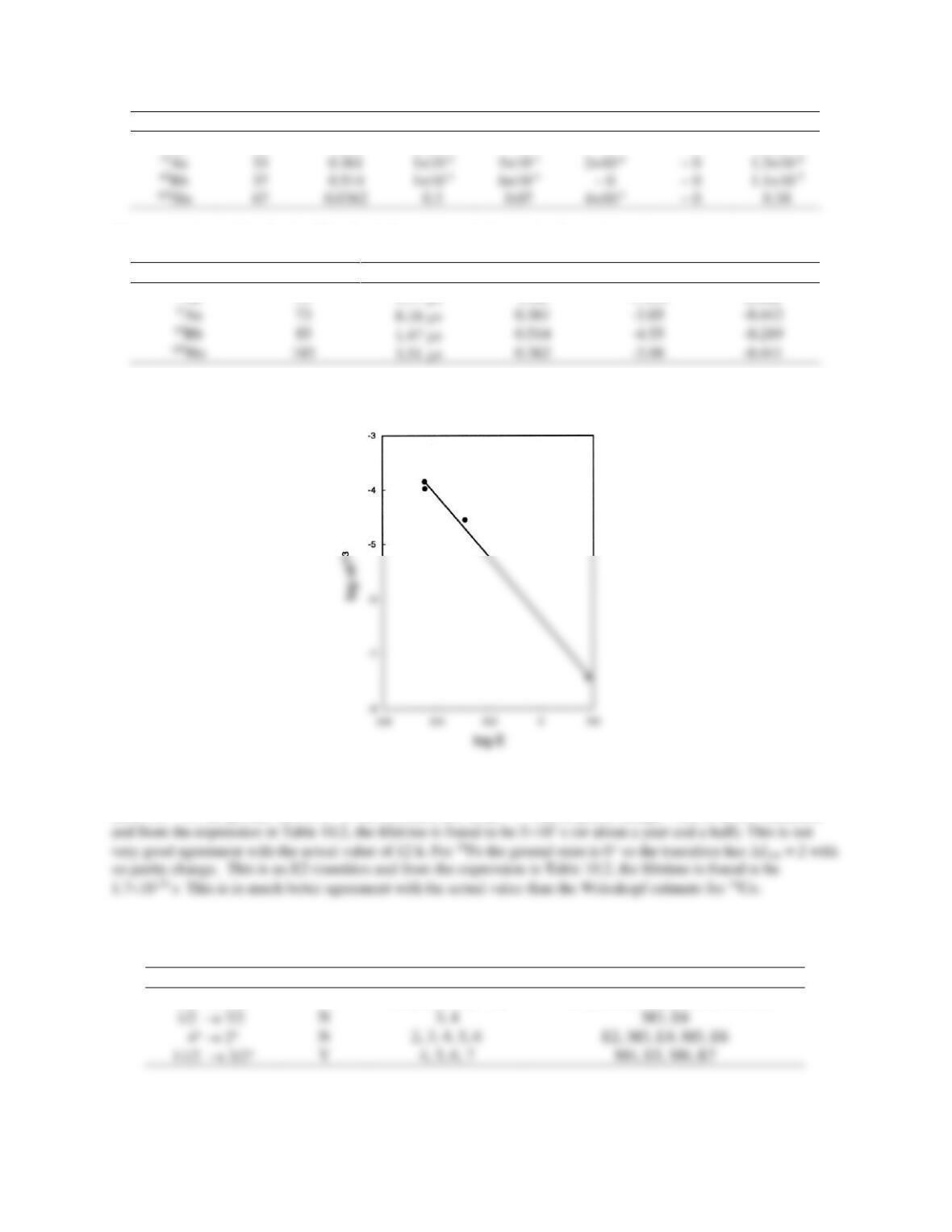
The corrected and data for the Weisskopf plot are given below and a plot is shown.
nuclide
A
corr
E (MeV)
log A2/3
log E
39Ar
39
3.17 s
1.52
-7.439
0.182
-3.85
-0.442
1.47 s
-4.55
-0.289
3.51 s
-3.98
-0.441
A least squares fit gives a slope of –5.4, consistent with the Weisskopf estimate of –5.0.
10.4. For 58Co the ground state is 2+ so the transition has Jmin = 3 with no parity change. This is an M3 transition
10.5. We may summarize the results for these transitions.
transition
change
allowed L
multipolarities
9/2– → 7/2+
Y
1, 2, 3, 4, 5, 6, 7, 8
E1, M2, E3, M4, E5, M6, E7, M8
N
N
Y
47
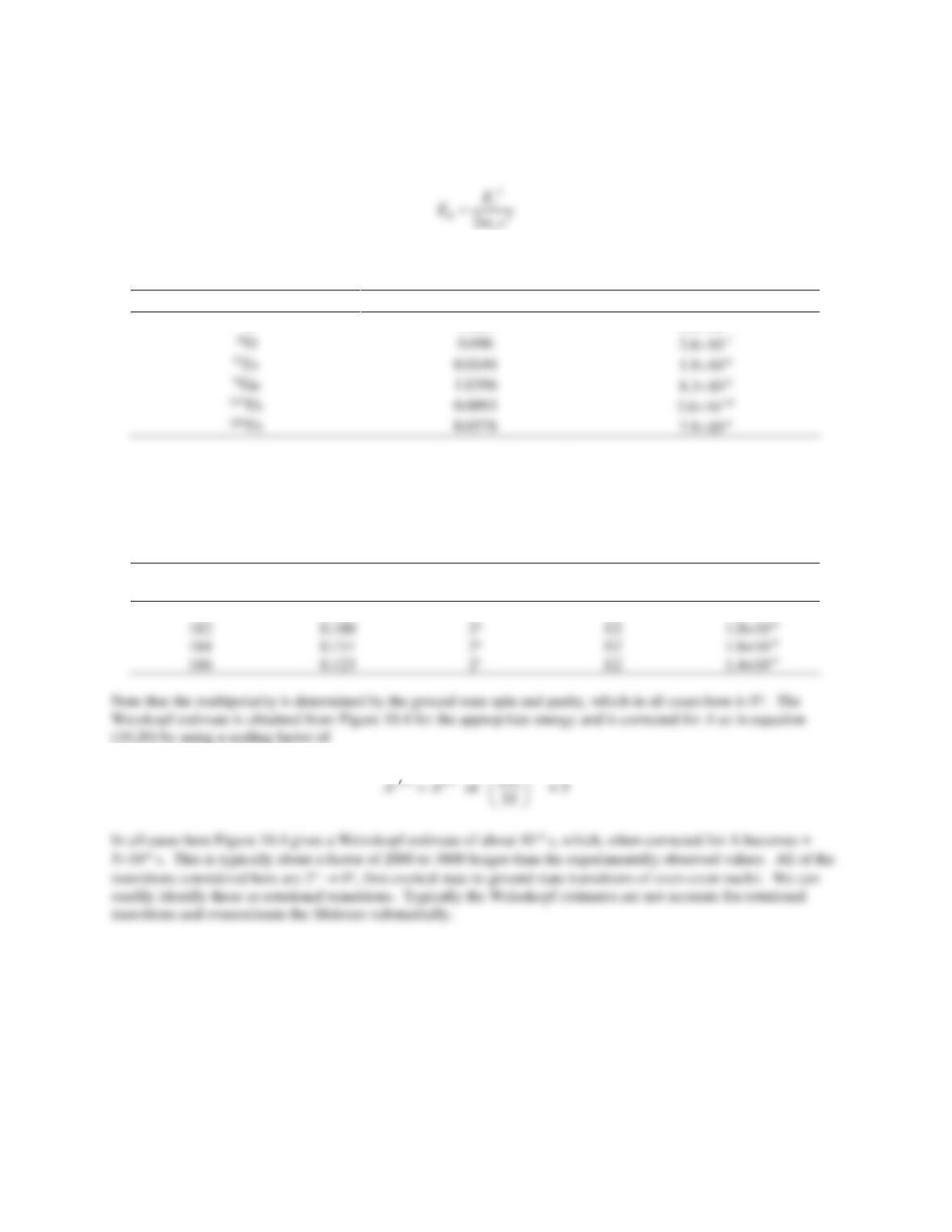
10.6. (a) The recoil energy is given by equation (10.3) as
f
Using mf as the ground state mass, results are tabulated below.
nuclide
E (MeV)
ER (MeV)
15O
5.183
9.610-4
1.910-9
7.910-9
ER decreases as either E decreases or mf increases. Heavier nuclei typically have more closely spaced energy levels.
Both these factors lead to a decrease in the importance of the recoil energy for heavier nuclei.
10.7. From the “Table of Isotopes” we locate the following information about the transition.
A
1st excited state
transition
multiplicity
exp (s)
E (MeV)
J
180
0.103
2+
E2
1.7×10⁻⁹
182
0.100
2+
E2
1.9×10⁻⁹
184
0.111
2+
E2
1.8×10⁻⁹
186
0.123
2+
E2
1.4×10⁻⁹
4/ 3
48
10.8. The expected transitions are shown below. These transitions shown have properties given in the table.
[Transition “1” has an energy E1].
transition
~E
change
J
multiplicity
1
E1
N
2, 3
E2, M3
2
N
1, 2
M1, E2
3
Y
3, 4
E3, M4
4
Y
2, 3
M2, E3
We make the following assumptions and consider the relevant Weisskopf estimates for the leading term in the
transition
(s-1)
1
5108
2
8102
2107
5/2+
7/2+
3/2–
5/2–
1/2–