CRUSTAL DEFORMATION 10
INTRODUCTION
Crustal Deformation
CHAPTER OUTLINE
1.
2.
167
168
3.
4.
169
170
5.
LEARNING OBJECTIVES/FOCUS ON CONCEPTS
10.1 Describe contrast
10.3 List and describe
TEACHING STRATEGIES
Clicker Questions:
171
Muddiest Point:
A.
B.
172
C.
D.
TEACHER RESOURCES
Web Resources:
173

Introduction to Earth Movements and Structure
174
Imagery and Animations:
Images
Animations
175
ANSWERS TO QUESTIONS IN THE CHAPTER:
CONCEPT CHECKS
10.1 WHAT CAUSES ROCK TO DEFORM?
1. Rock deformation is the changes in shape or position of a rock body in response to differential
2. Compressional stress is a stress applied unequally in different directions that tends to squeeze
a rock body. Shortening occurs in the direction parallel to the direction of the compressional
stress and elongation or stretching occurs in the direction perpendicular to the compressional
3. Compressional stresses are common at convergent plate boundaries where collision of plates
shorten and thicken crust.
10.2 HOW DO ROCKS DEFORM?
1. Elastic deformation occurs when stress is applied gradually and minerals in a rock are
2. Brittle deformation causes rocks to break into smaller pieces and occurs when the stress
3. Temperature, confining pressure, rock type, and time all influence the strength of a rock. At
high temperatures, rock is more likely to deform through ductile deformation, and at cooler
176
4. At shallow depths, rocks have less confining pressure and tend to exhibit brittle behavior by
10.3 FOLDS: ROCK STRUCTURES FORMED BY DUCTILE DEFORMATION
1. Anticlines are folds with two limbs dipping in opposite directions from the fold axis. After
erosion, older strata are exposed along the axial portion of the fold. Synclines are folds with
two limbs dipping inward at the fold axis; after erosion, younger strata are exposed at the fold
axis.
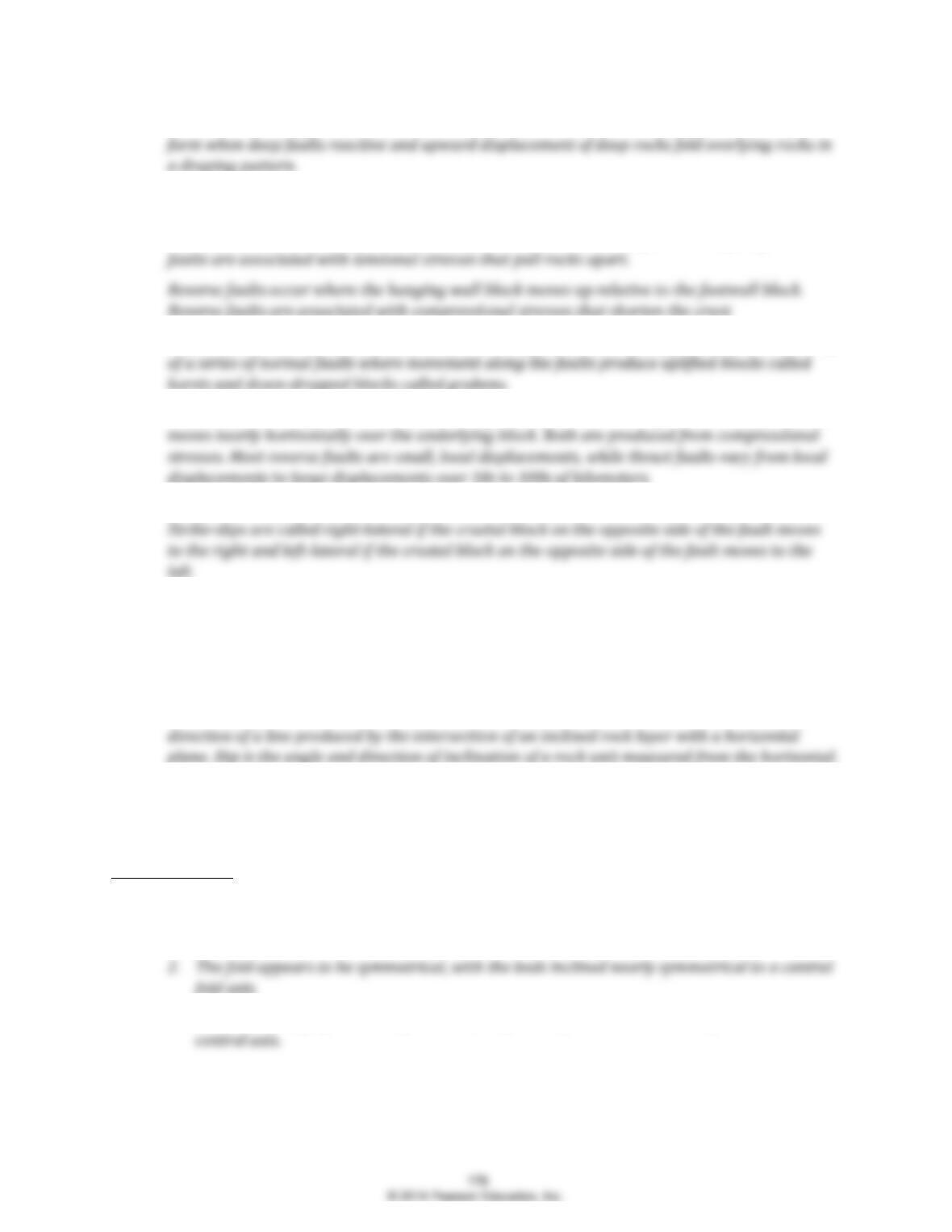
2. Symmetrical anticline drawing should be similar to this portion of Figure 10.11:
3. The Black Hills of South Dakota are an example of a structural dome. Here, the core of the
4. In an eroded basin, the youngest rocks will outcrop near the center of the structure.
177
5. Monoclines are large, step-like folds in otherwise horizontal sedimentary strata. These often
10.4 FAULTS AND JOINTS: ROCK STRUCTURES FORMED BY BRITTLE DEFORMATION
1. Normal faults occur when the hanging wall block (rock surface immediately above the fault)
moves down relative to the footwall block (rock surface immediately below the fault). Normal
2. Fault-block mountains are associated with normal faults. These are large structures consisting
3. Thrust faults are a type of reverse fault having dips of less than 45 degrees; the overlying block
4. Along strike-slip faults displacement is horizontal and parallel to the direction of the fault.
5. Joints are fractures in rocks upon which no appreciable movement occurs. Faults are fractures
in rocks and crust where movement occurs.
10.5 MAPPING GEOLOGIC STRUCTURES
1. Strike and dip are used to establish the orientation of deformed strata. Strike is the compass
2. Geologists make many strike-and-dip measurements of strata on the surface and plot these
measurements on a topographic map or aerial photo. Considered together, these data can
allow geoscientists to infer the sub-surface orientation and shape of rock units.
EYE ON EARTH
EOE #1 DEATH VALLEY NATIONAL PARK, CALIFORNIA
1. This structure is likely a syncline.
3. These rocks display ductile deformation; they are deformed into bends or folds about a
EOE #2 NEEDLESS DISTRICT OF CANYONLANDS NATIONAL PARK, UTAH
1. These down-faulted linear valleys are called grabens.
3. The faults that border the collapsed structures are normal faults because the footwall
moves down relative to the hanging wall.
GIVE IT SOME THOUGHT
1. Ductile deformation describes material deformation by flowing and bending. Ductile
deformation would be expected deep inside the crust because it is enhanced both by elevated
2. Granite is more likely to fracture because it is a rigid, strong rock with few planes of weakness.
3.
a. Diagram 1 shows a reverse fault. The dominant pressures were compressional.
4.
5. Normal faulting predominates in divergent plate boundaries. Thrust faulting is common in
6. Photo A depicts a dip-slip normal fault where the hanging wall to the right moved down
7.
a. This is ductile deformation.
8.
a. This fold is an anticline.

9. The dips indicate the limbs are dipping toward the axial plane of this structure and the strikes
180