Exercise 11
NOTE: If you are having any issues seeing logic symbols in this Word document, select “Read”
mode under the View menu in MS Word. PDF versions of the Instructor Manual are also
available on the Instructor Companion Site.
Chapter 11
Exercise 11
Part I
1. 1/6
Part II
1. P(6 or 1) = P(6) + P(1) = 1/6 + 1/6 = 2/6 = 1/3
2. P(H1 and H2 and H3) = P(H1) P(H2) P(H3)
Exercise 11
5. P(A1 or A2) = P(A1) + P(A2) − P(A1 and A2)
6. First compute the probability of getting no heads:
P(no heads) = P(T1 and T2 and T3)
7. First compute the probability of getting no sixes:
Exercise 11
9a. P(R1 and R2) = P(R1) P(R2)
9b. P(G1 or G2) = P(G1) + P(G2) − P(G1 and G2)
9e. P(same color) = P(R1 and R2) + P(G1 and G2) + P(Y1 and Y2)
10a. P(R1 and R2) = P(R1) P(R2 given R1)
d. P(G1 or G2) = 1 − P(not-G)
Exercise 11
11. First compute the probability of drawing neither an ace nor a king:
12. First compute the probability of the event not happening; i.e., the probability of drawing
either not an ace or not a king:
13a. P(M or W) = P(M) + P(W) − P(M and W)
13b. P(M and W and S) = P(M) P(W) P(S)
14. P(WS) = P(I) P(C)
Exercise 11
15. P(two on same day) = 1 − P(separate days)
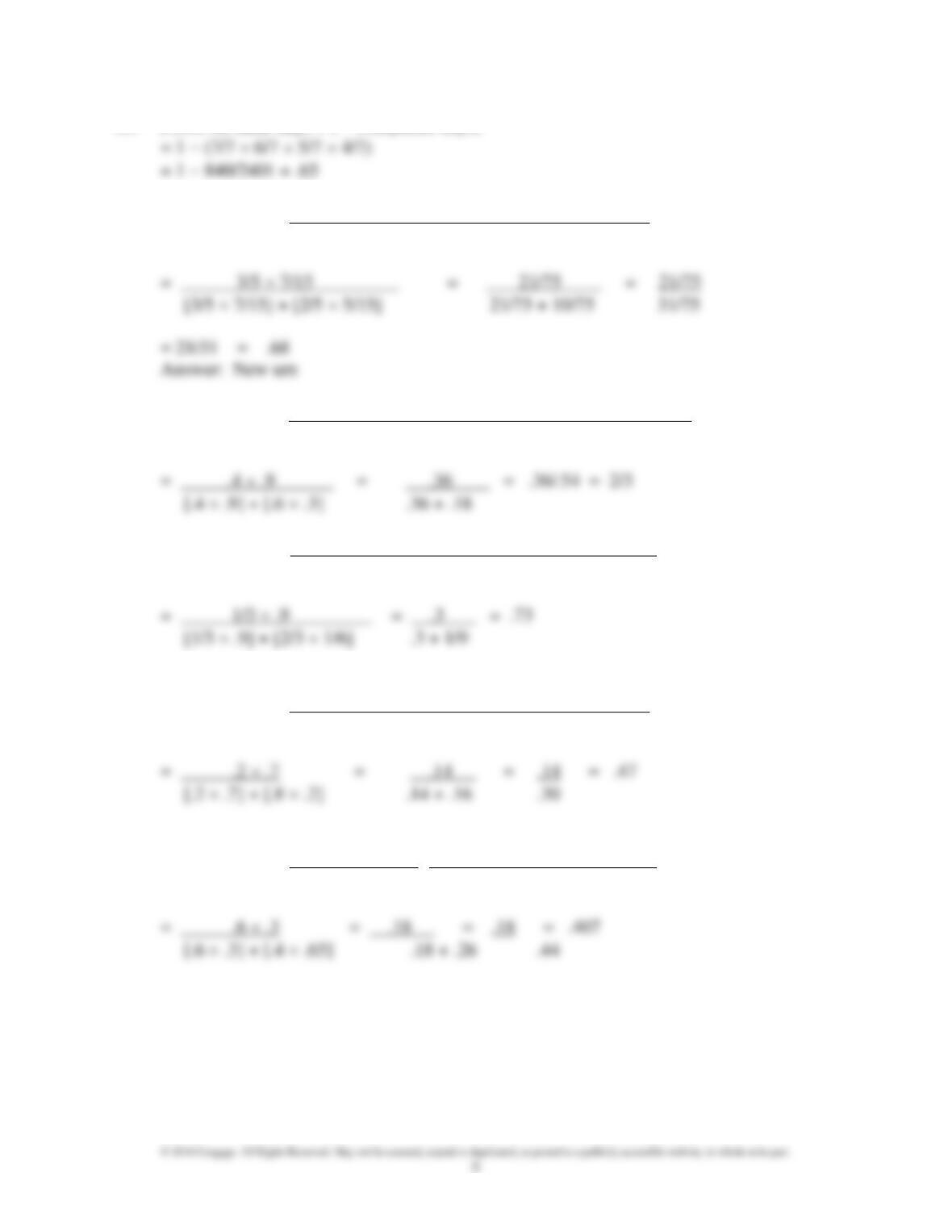
16. P(N given R) = P(N) P(R given N)
[P(N P(R given N)] + [P(O) P(R given O)]
17. P(S given P) = P(S) P(P given S)
[P(S) P(P given S)] + [P(not-S) P(P given not-S]
18. P(L given T) = P(L) P(T given L)
[P(L) P(T given L)] + [P(H) P(T given H)]
19. P(R given N) = P(R) P(N given R)
[P(R) P(N given R)] + [P(T) P(N given T)]
20. P(N given C) = P(N) P(C given N)
[P(N) P(C given N)] + [P(S) P(C given S)]