B. Spelling I and V | 105
NAME:
A. QUESTIONS FOR REVIEW
1. In voice leading between I and V, how should you handle the upper voices?
2. When is it typical for the upper voices to move by leap?
3. What note is preferable to double in the I triad? What note is best to double in V?
What note may never be doubled in V?
B. SPELLING I AND V
1. For each of the following major keys, write the key signature and the I and V
chords. You need not worry about voice leading between the chords.
2. For each of the following minor keys, write the key signature and the i and V
chords. Remember to raise ˆ
7 to form a leading tone. You need not worry about
voice leading between the chords.
chapter
9I and V
3. On the blank lines below the staff, write the names of the notes in each chord as
indicated by the figured bass. Remember to include an accidental when necessary.
• No figures = 5
3.
C. REALIZING ROMAN NUMERALS
1. SATB format. For the chords below, square brackets indicate octaves; curved
brackets indicate fifths.
• On the lines below the staff, write the note names of the chords.
• Then complete the Roman numeral realization, using good voice leading and
adding brackets as needed.
NAME:
Remember to add an accidental for the leading tone in minor keys.
In both (g) and (h), revoice (use different notes in different voices and octaves) at
least one of the chords that repeats.
108 | CHAPTER 9 | I and V
2. Keyboard format. On the lines below the staff, write the note names of the chords.
Then complete the Roman numeral realization, using good voice leading.
Remember: since the chords are in root position, their roots should be in the bass!
Circle the leading tones throughout.
In both (d) and (e), revoice chords that repeat.
D. REALIZING FIGURED BASS
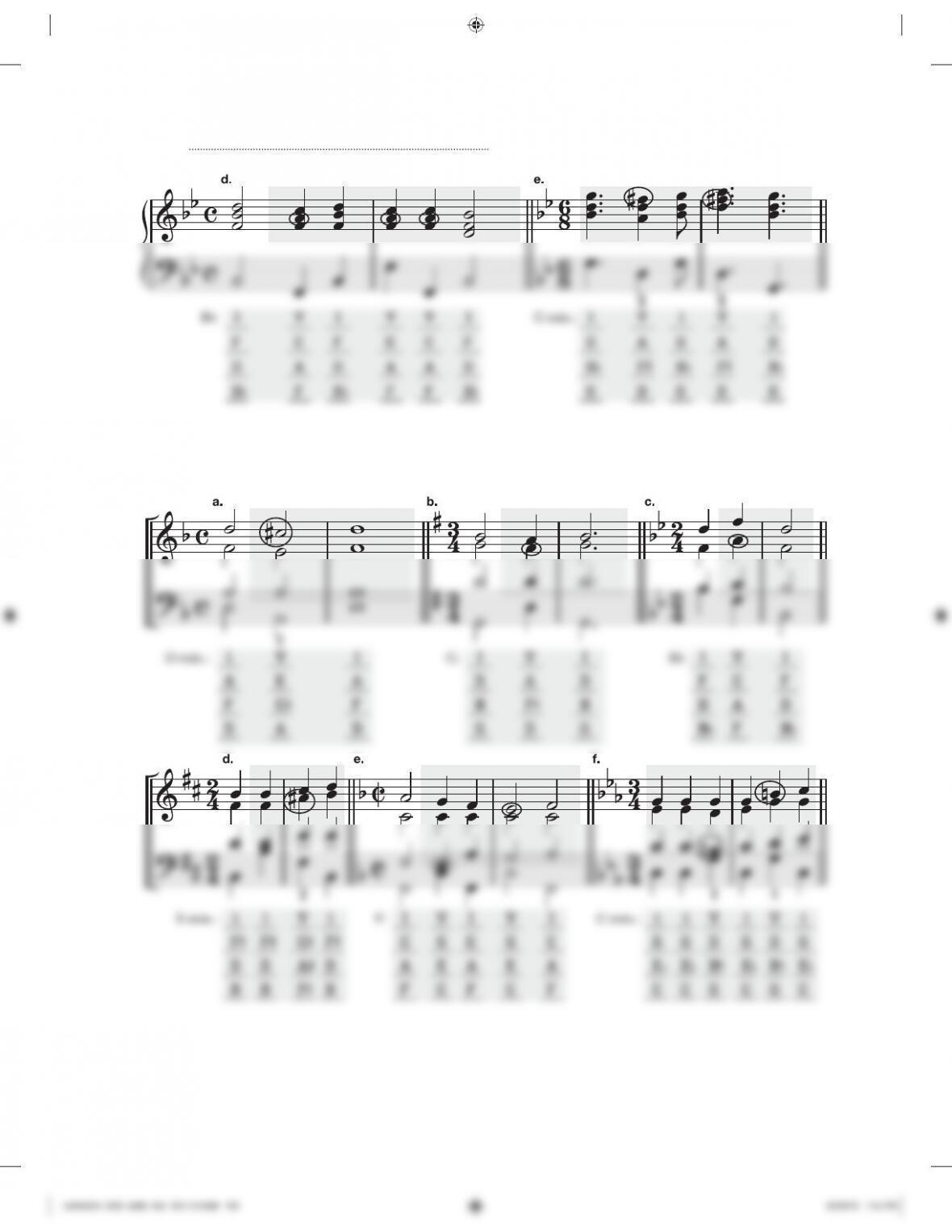
1. Keyboard format. On the blank lines below the staff, write the note names of the
chords indicated by each figured bass symbol. Then complete the figured bass
realizations, label the Roman numerals, and circle the leading tones.
D. Realizing Figured Bass | 109
NAME:
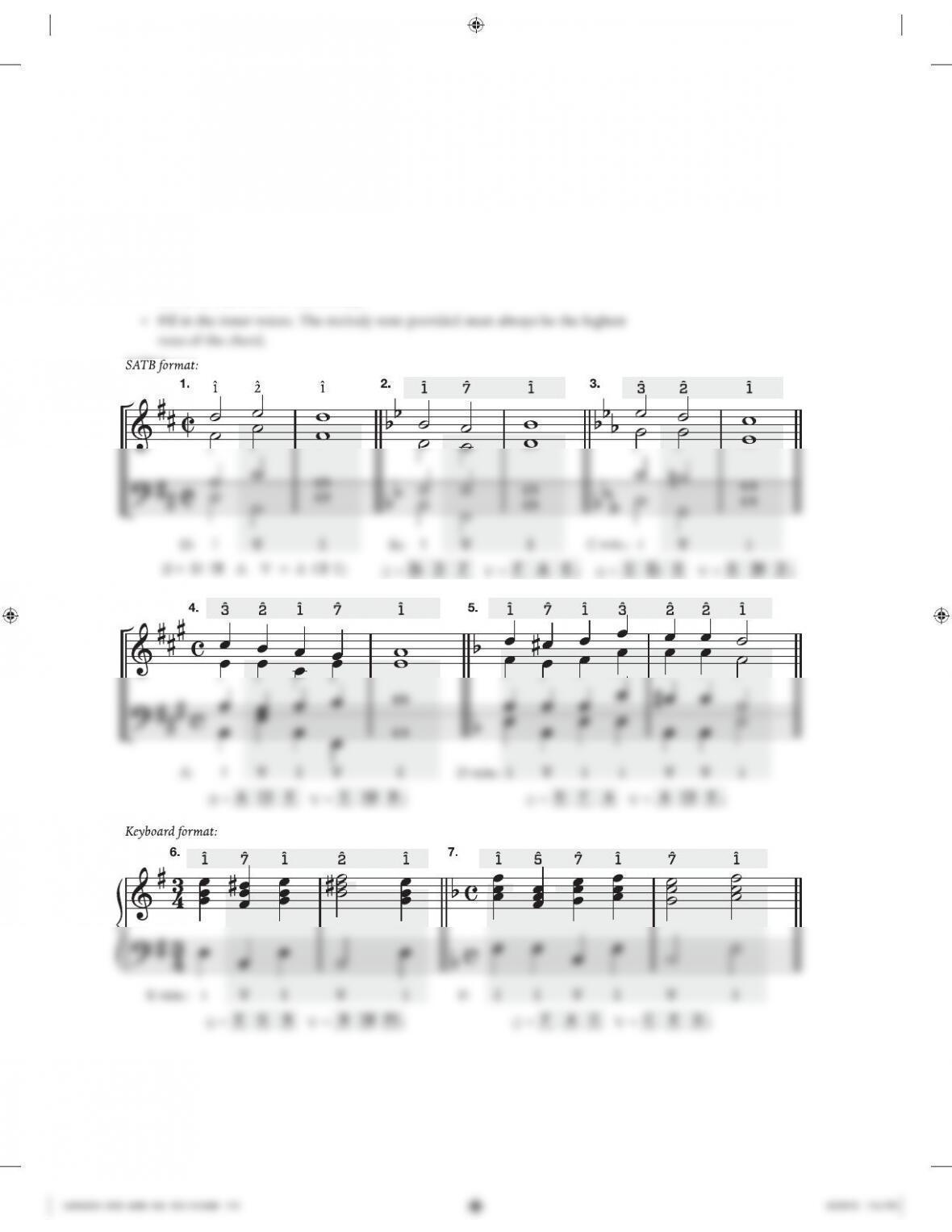
2. SATB format. On the blank lines below the staff, write the note names of the chords
indicated by each figured bass symbol. Then complete the figured bass realiza-
tions, label the Roman numerals, and circle the leading tones.
E. HARMONIZING MELODIES
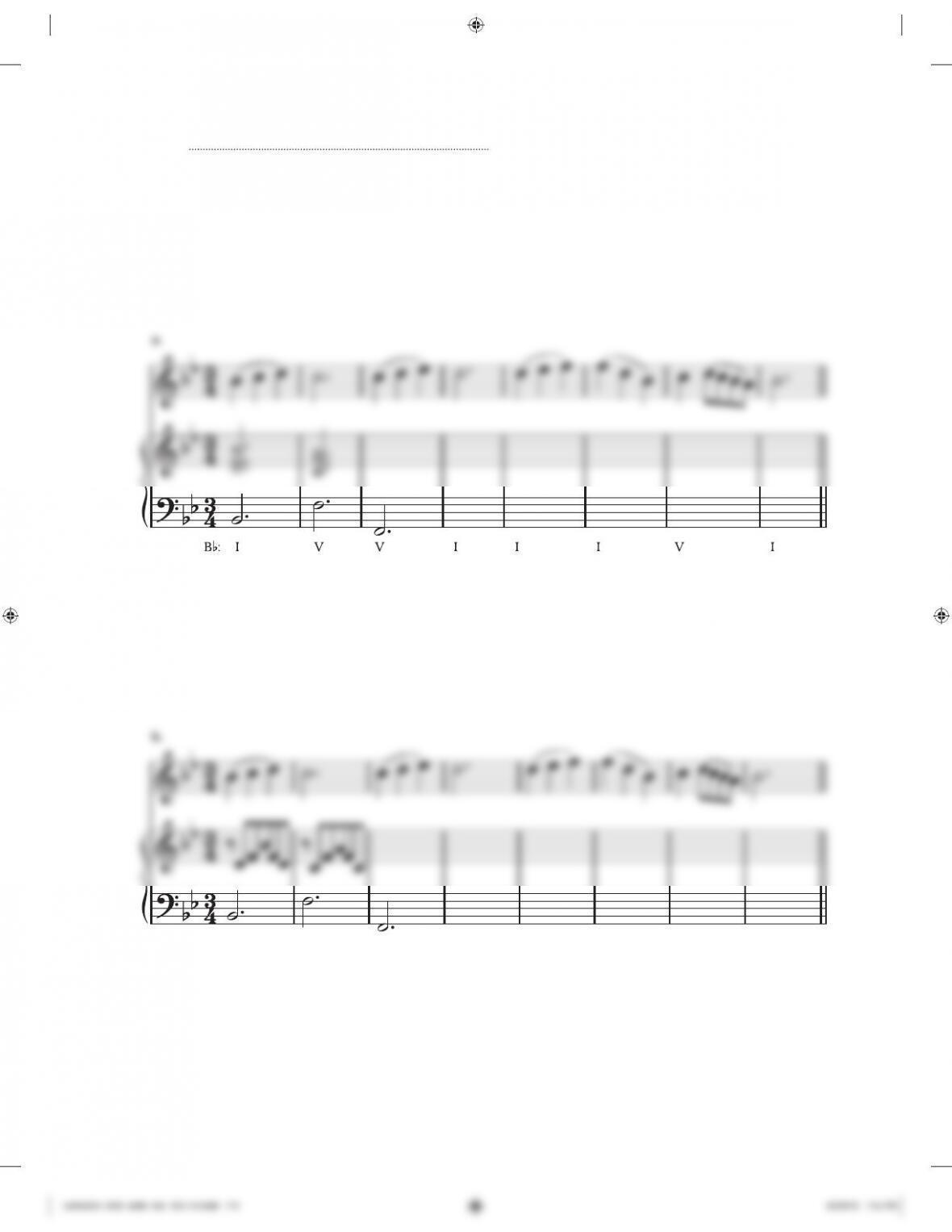
For each of the following short melodies:
• In the blanks beneath the staff, list the note names of the I and V triads.
• Write the scale degrees of each melody note above the staff.
• Using only root-position I and V triads, harmonize the melody by writing
Roman numerals beneath the staff and completing the bass line. Choose one
chord for each note of the melody.
F. Composition | 111
NAME:
F. COMPOSITION
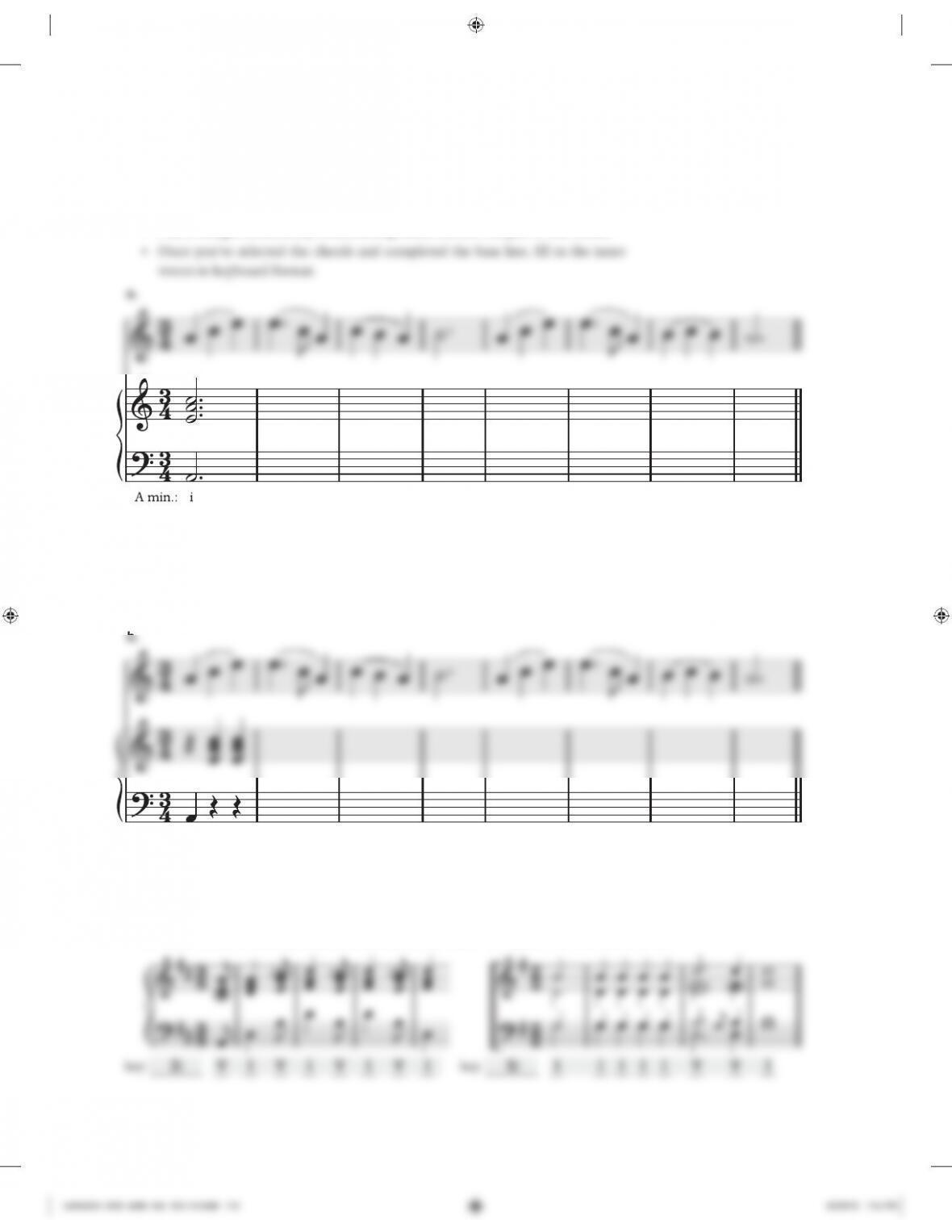
1. Provide a keyboard accompaniment for this melody by realizing the Roman
numerals provided. The voice leading of the keyboard part should be good; do not
worry if there are parallel octaves or unisons between the melody and the upper
notes of the piano part.
Next, elaborate on the accompaniment that you wrote above using the arpeggiated
pattern begun in measures 1
–
2 below. Conclude the accompaniment pattern on
the third beat of measure 8. The elaborated accompaniment should use the same
pitches as in the harmonization above, although set in a different texture.
112 | CHAPTER 9 | I and V
2. Using one chord per measure, provide an accompaniment for this melody using
only root-position i and V chords.
• The notes of the melody should either be members of the chord you choose, or
embellishing tones such as passing tones or neighbor tones.
• Place triangles around any embellishing tones that are not part of the chord.
Next, elaborate on the accompaniment that you wrote above by continuing the
oom-pah-pah pattern begun in measure 1; conclude the pattern with a half note in
the right hand on the second beat of measure 8. The elaborated accompaniment
should use the same pitches as in the harmonization above, although set in a
different texture.
G. ANALYSIS
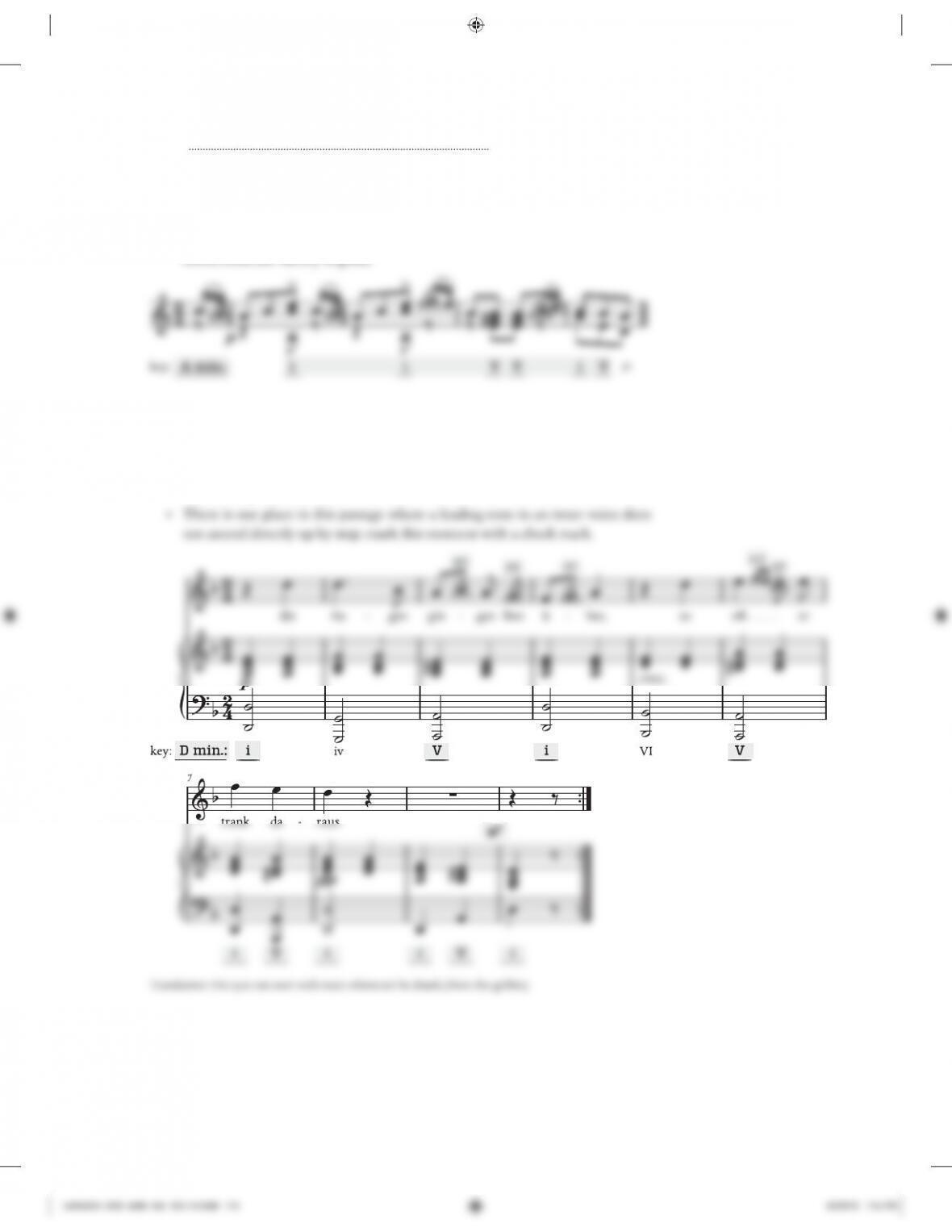
1. Identify the key and label the chords of the following excerpts with Roman
numerals. Circle every leading tone.
a. André da Silva Gomes, Missa da Conversão de São Paulo b. Hymn from Harmonia Unio
NAME:
c. Ferdinando Carulli, Grand recueil de morceaux progressifs for guitar, Op. 333, No. 7
Note that some embellishing tones (indicated by triangles) decorate the basic
harmonies and that in the harmonies that appear in the final measure, some
chord tones are merely implied.
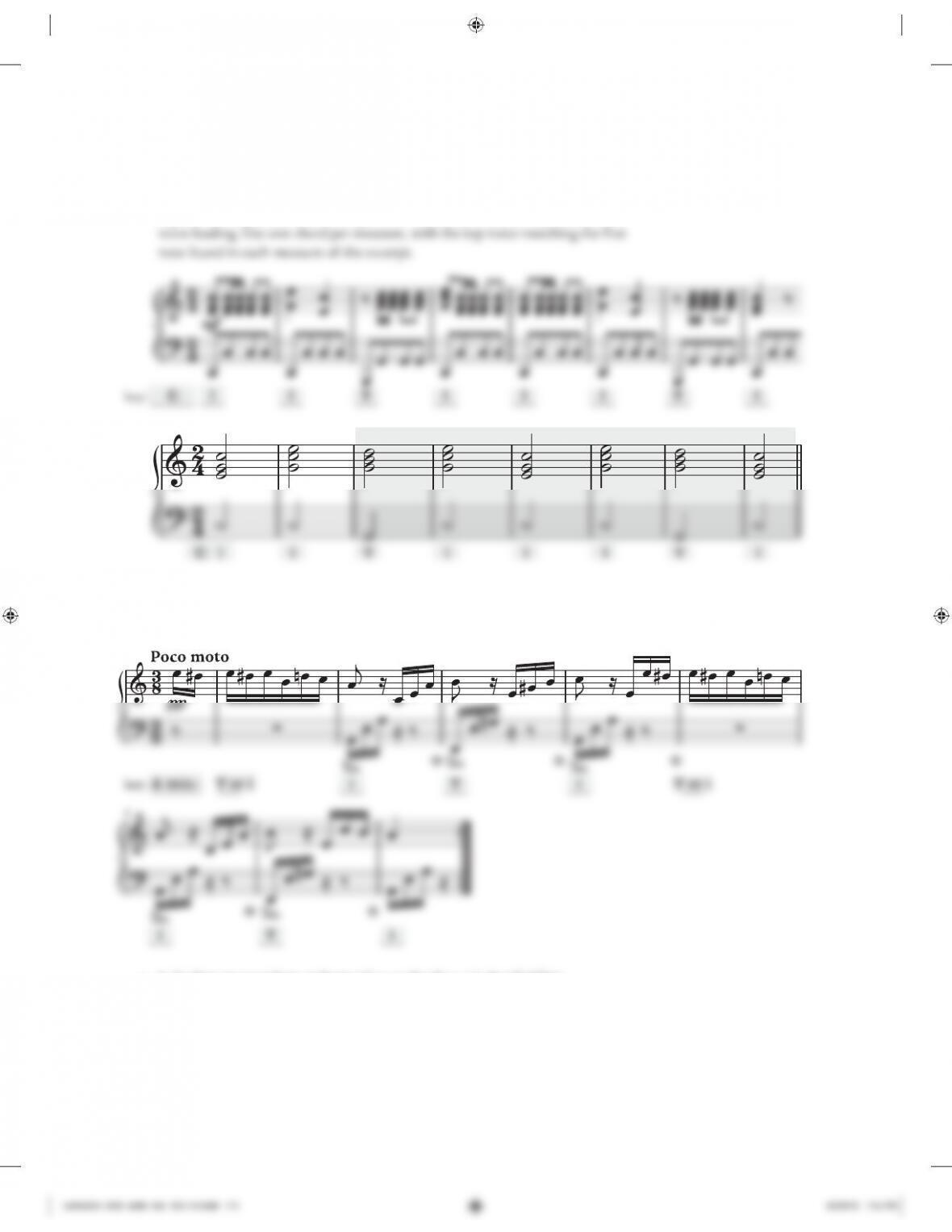
2. Franz Schubert, “Der König in Thule”
• Identify the key and label the chords with Roman numerals.
• Place a triangle around every embellishing tone and label it as a passing tone
(PT) or neighbor tone (NT).
114 | CHAPTER 9 | I and V
3. Frances Arkwright, “Xarifa”
• Label the key and Roman numerals, one chord per measure.
• On the blank staves below, continue the simplified harmonic model of this pas-
sage by writing its chords in four-part harmony, keyboard format, with proper
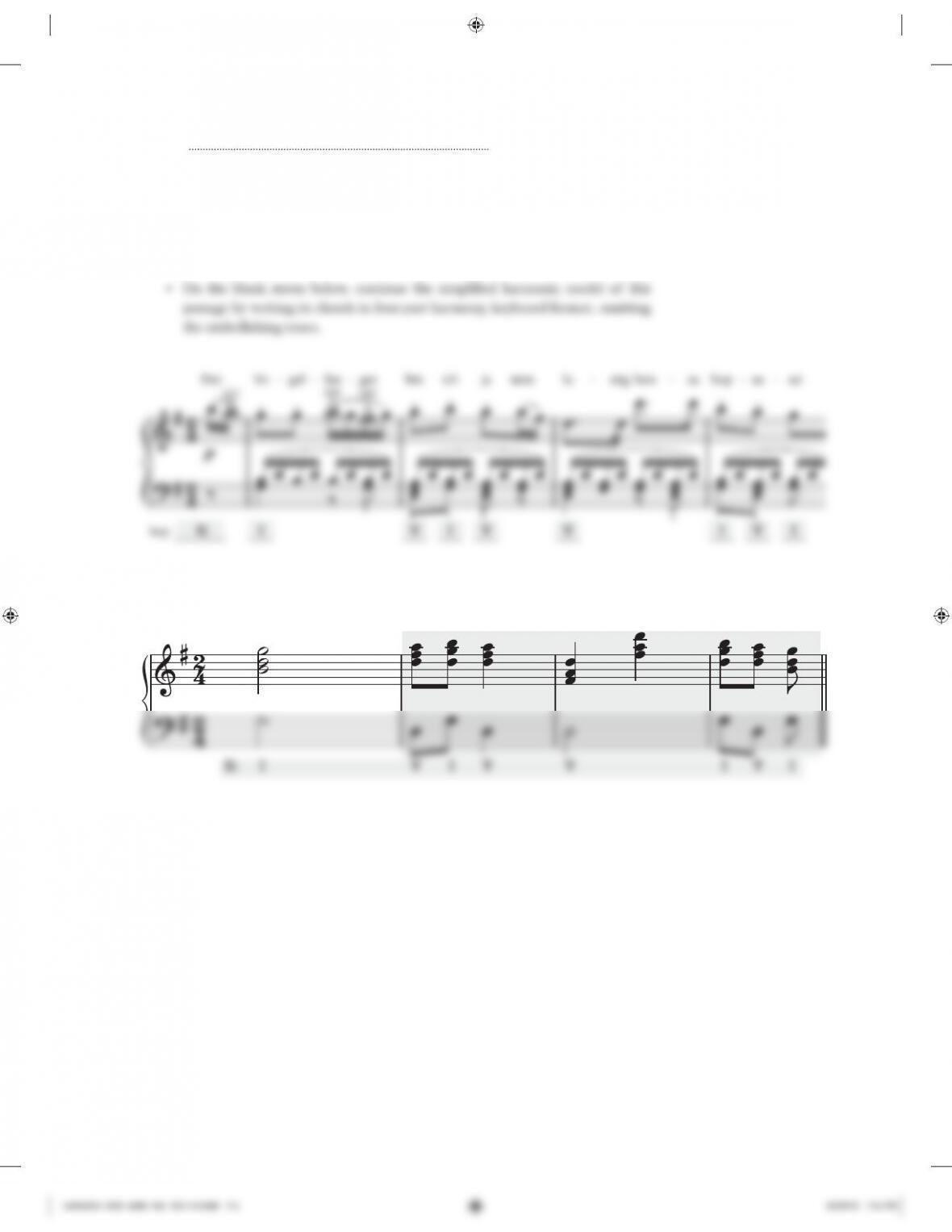
4. Ludwig van Beethoven, Bagatelle No. 25 in A minor (WoO 59), “Für Elise”
Label the key and Roman numerals (one chord per measure).
• Is the first measure best understood as a i chord or a V chord? Why?
• How do mm. 1
–
4 and 5
–
8 compare? What do they have in common, and how
do they differ? Which of these two phrases sounds more complete, and why?
G. Analysis | 115
NAME:
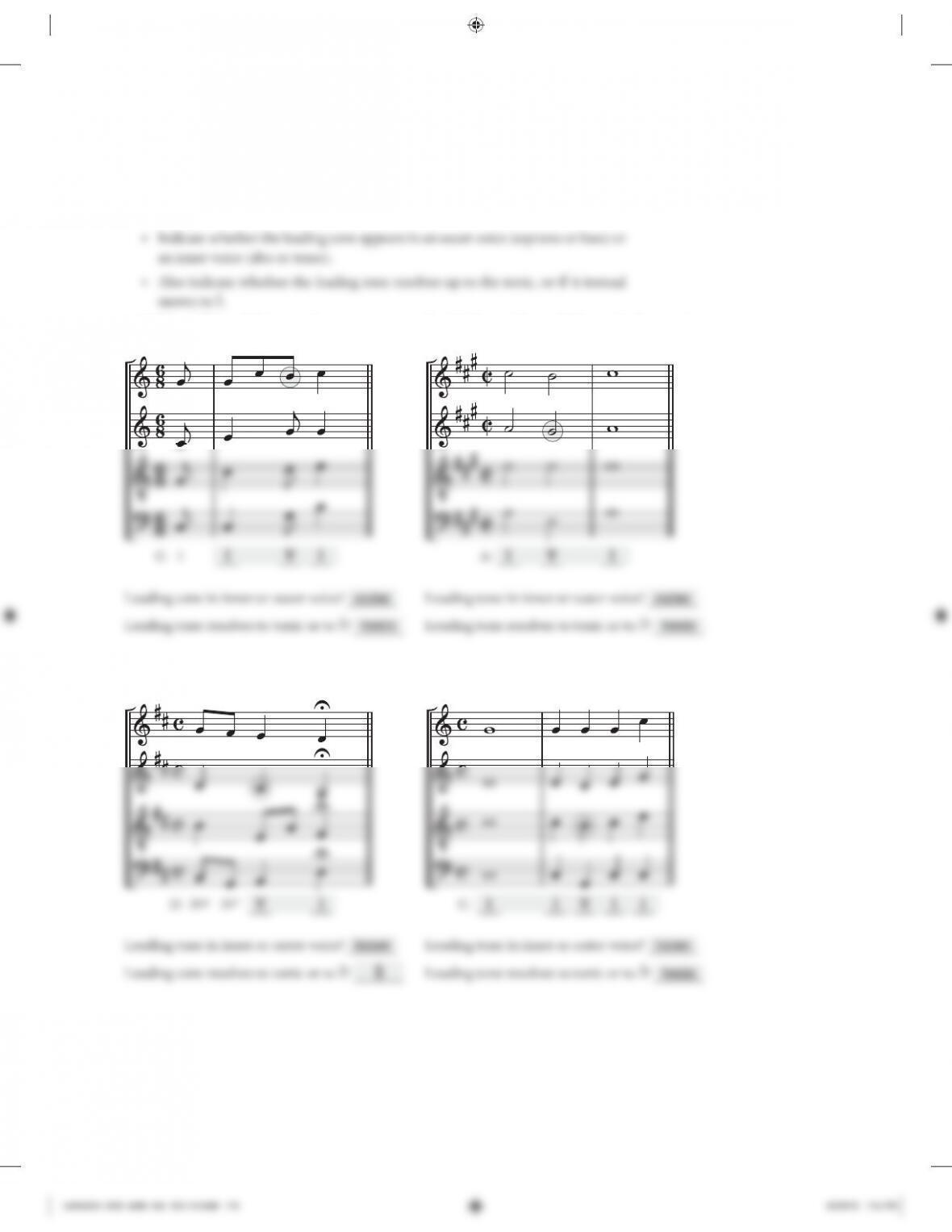
5. W. A. Mozart, “Der Vogelfanger bin ich ja” from The Magic Flute (arr. Metzdorff )
• Label the key and Roman numerals in this passage.
• Place a triangle around every embellishing tone and label it as a passing tone
(PT) or neighbor tone (NT).
Translation: A bird catcher I am indeed, always cheerful, hey-yo hopsasa!
This excerpt is from an aria sung by Papageno, a character in Mozart’s opera with
a simple and carefree personality. What features of the music express Papageno’s
nature?
6. The following excerpts are notated in open-score choral format, with each voice
on a separate line and the tenor sounding an octave lower than written.
• Label the Roman numerals.
• Circle the leading tone in each.
a. William Billings, “Clarimont” b. J.M. Nunes Garcia, “Cântico de Zacarias”
c. J. S. Bach, Chorale 250 d. William Billings, “Egypt”