
B. Series Forms | 659
NAME:
A. QUESTIONS FOR REVIEW
1. What is a twelve-tone series? What is twelve-tone music?
2. What are the four orderings of a twelve-tone series? How do they compare to each
other in pitch? in interval?
3. How many different row forms are there, counting all possible transpositions?
4. What is a 12×12 matrix and how is it constructed?
5. What is a “twelve-count”?
6. What is a subset? What is a two-note subset called? What is a three-note subset
called? What happens to the subset-types when the series is transformed by
transposition or inversion or their retrogrades?
7. What is invariance?
B. SERIES FORMS
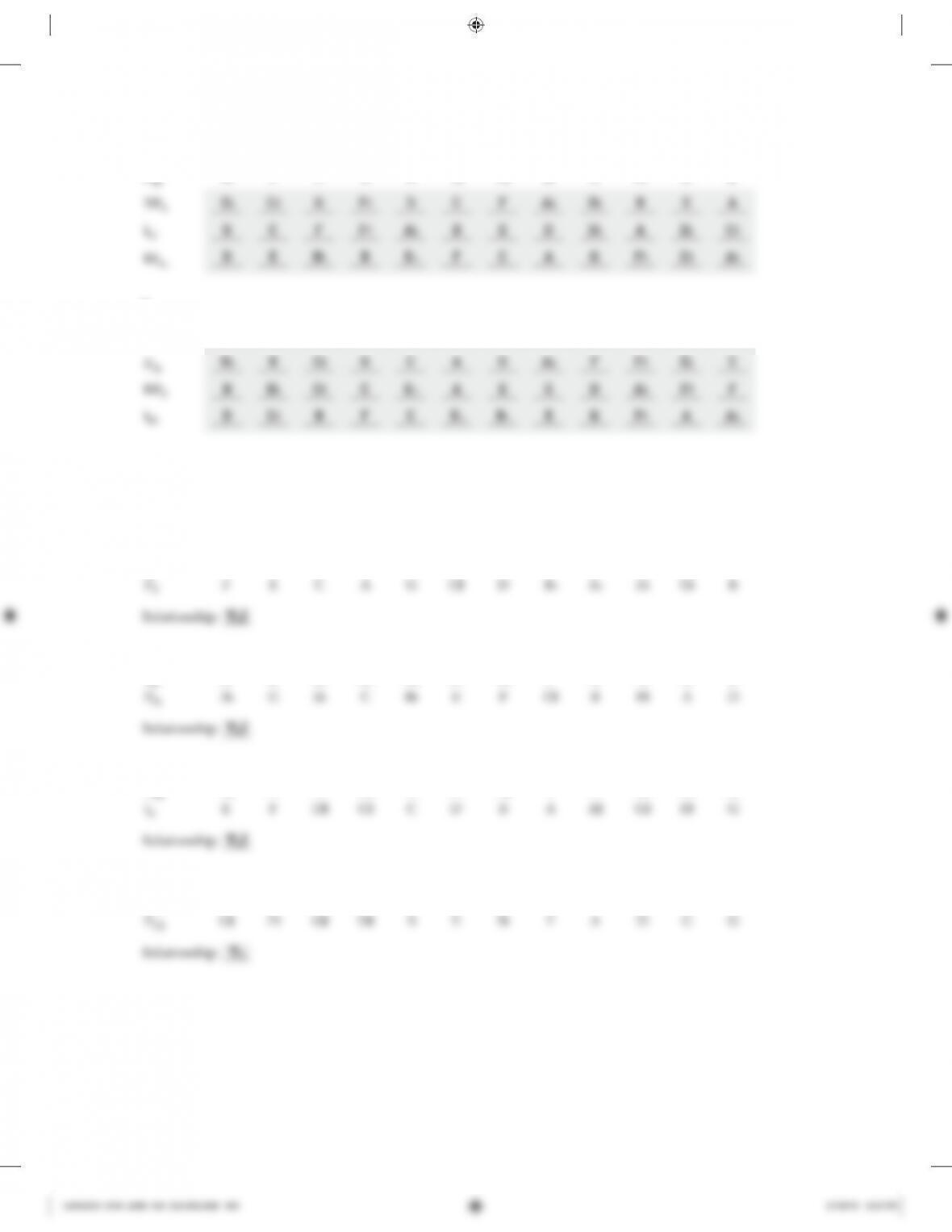
1. Write series forms as indicated.
a.
PBbBbACBE
bEC
#DF
#FA
bG
chapter
46 Twelve-Tone Serialism
b.
PBbBbFCBAF
#C#EbGA
bDE
c.
PEEFGD
bGbEbAbDBCAB
b
2. Identify the relationship (transposition or inversion) between the following series
forms, expressed as Tn or TnI.
a.
IG G Ab C Eb F B Bb D E A Gb C
#
b.
IBb B
b B Eb G
b A
b D C# F G C A E
c.
PA# A
# A B C# D C D# F E F# G
# G
# C D B A A# G
# F
# G
d.
PG# G
# C
# D
# A
# F
# B F C E A G D
# F
# G
# D
# B E Bb F A D C G
NAME:
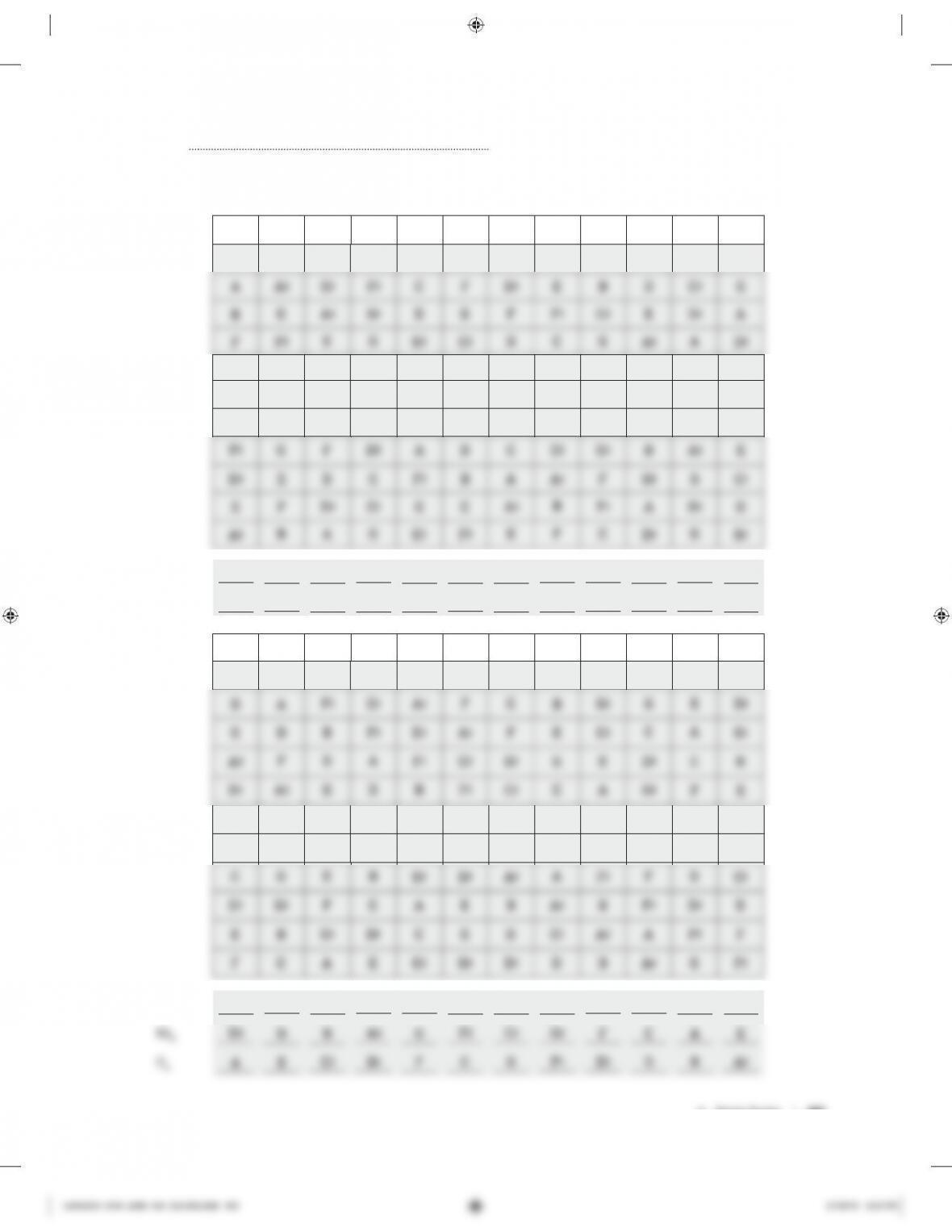
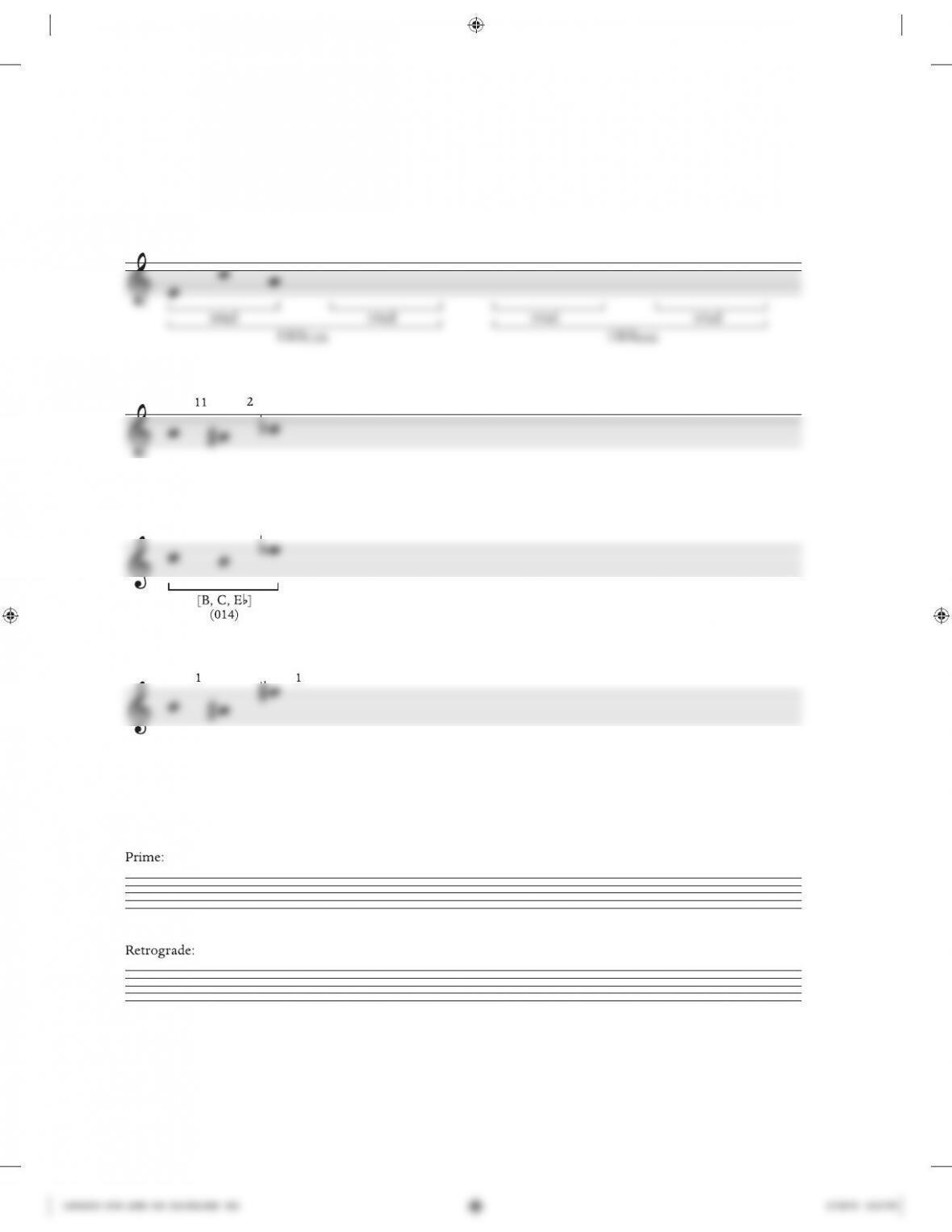
3. Complete 12=12 matrices. Then write out the indicated series forms.
a. G#AGF BED
D#A#C#CF#
GG#F#EA#D#C#DACBF
CC#BA
D#G#F#GDFE
A#
DD#C#BF
A#G#AEGF#C
C#DC
A#EAG
G#D#F#FB
PF#F#G F D#A D C C#G#BA#E
RIGAD#D F C C#B E A#G#F#G
b. F#C#A#FDAE
D#CB
G#G
BF#D#A#GDA
G#FE
C#C
G#D#CGEB
F#FD
C#A#A
AEC#G#FCG
F#D#DB
A#
RPEFF#AA#C#D G C D#G#B E
662 | CHAPTER 46 | Twelve-Tone Serialism
C. COMPOSITION
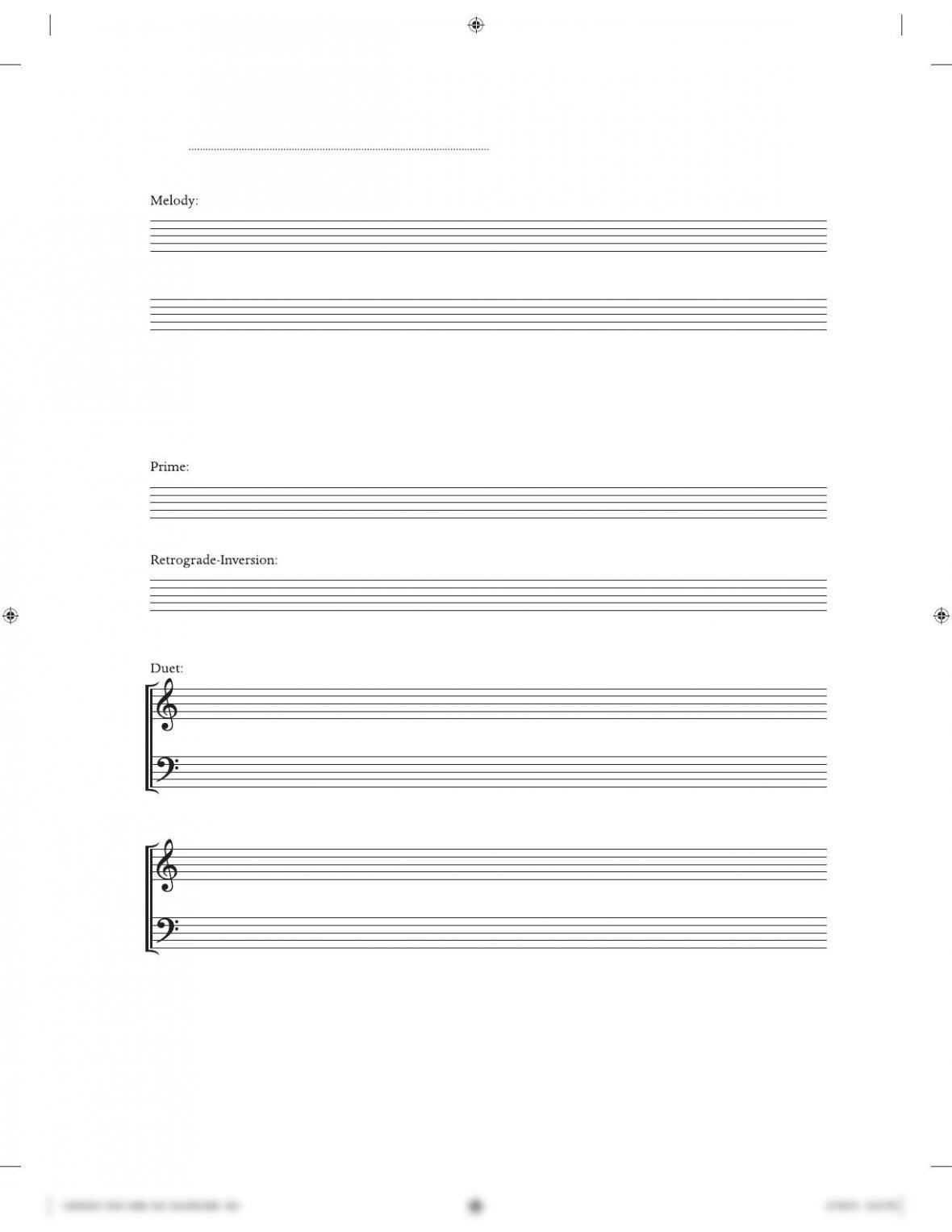
1. Complete these twelve-tone series as instructed.
a. The first six notes and the last six are complementary hexatonic collections. The
four trichords are all consonant triads (two minor and two major).
b. Each of the eleven ordered pitch-class intervals (1–11) occurs once.
c. As many trichordal subsets as possible are members of set-class (014). Trichords
may overlap (share one or two notes in common).
d. Every other interval is a member of interval-class 1.
2. Using one of the series you composed in the previous exercise, or one discussed
in Chapter 46 of the textbook, write a melody using a Prime followed by its
Retrograde. Before you compose your melody, write out the two series forms. In
your melody, feel free to repeat notes or groups of notes.
C. COMPOSITION | 663
NAME:
3. Using one of the series you composed in the previous exercise, or one discussed
in Chapter 46 of the textbook, write a duet for violin and cello that has a Prime in
one instrument and a Retrograde-Inversion in the other. Before you compose your
duet, write out the two series forms. Within each part, feel free to repeat notes or
groups of notes.
664 |CHAPTER 46 |Twelve-Tone Serialism
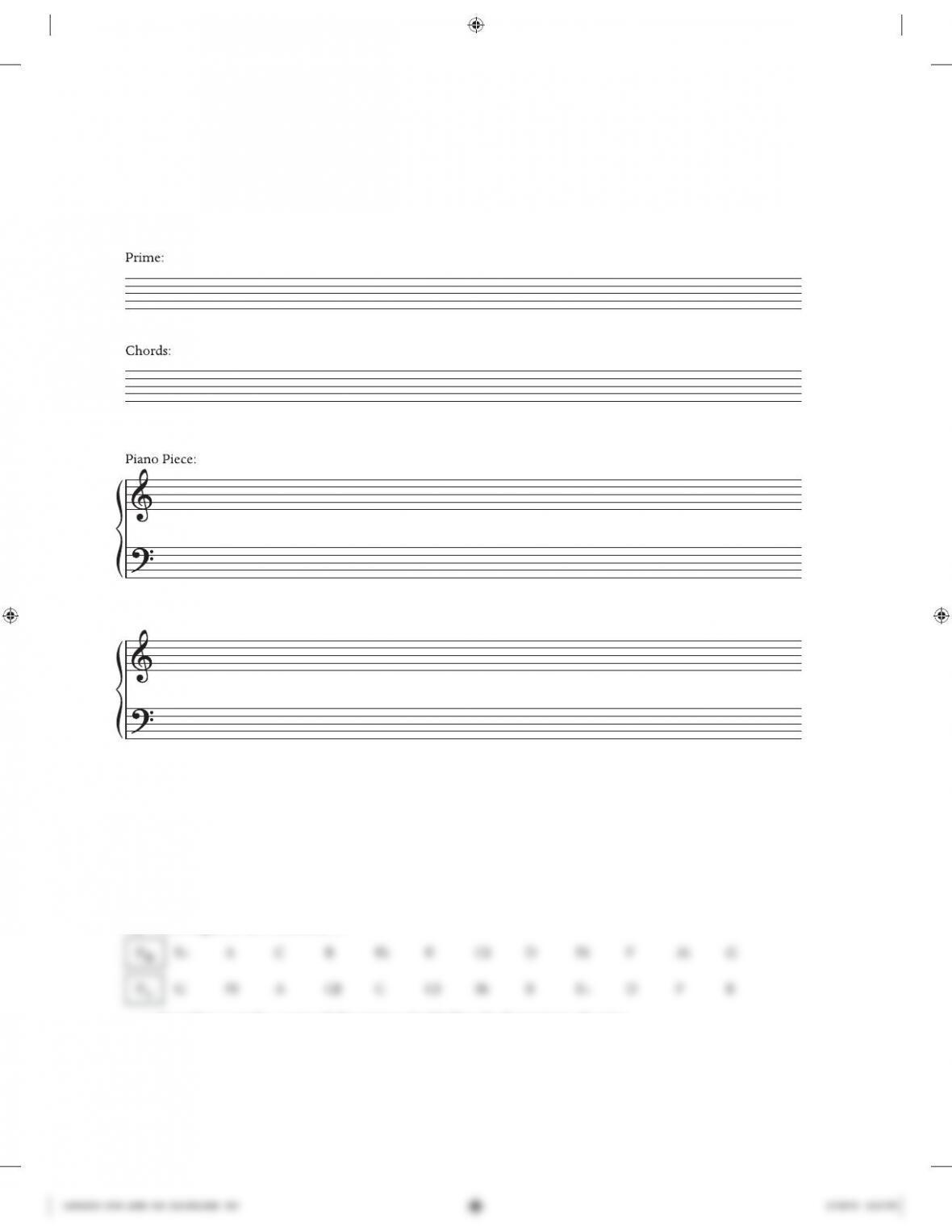
4. Using one of the series you composed in the previous exercise, or one discussed
in Chapter 46 of the textbook, write a short piano piece where the melody is the
Prime ordering and the accompanying chords are subsets of the Prime. Before you
compose your piece, write out the series form and, in close position, the chords
you plan to use.
D. ANALYSIS
For each of the following passages, the series is provided. Answer questions about the
structure of the series and its use in the music.
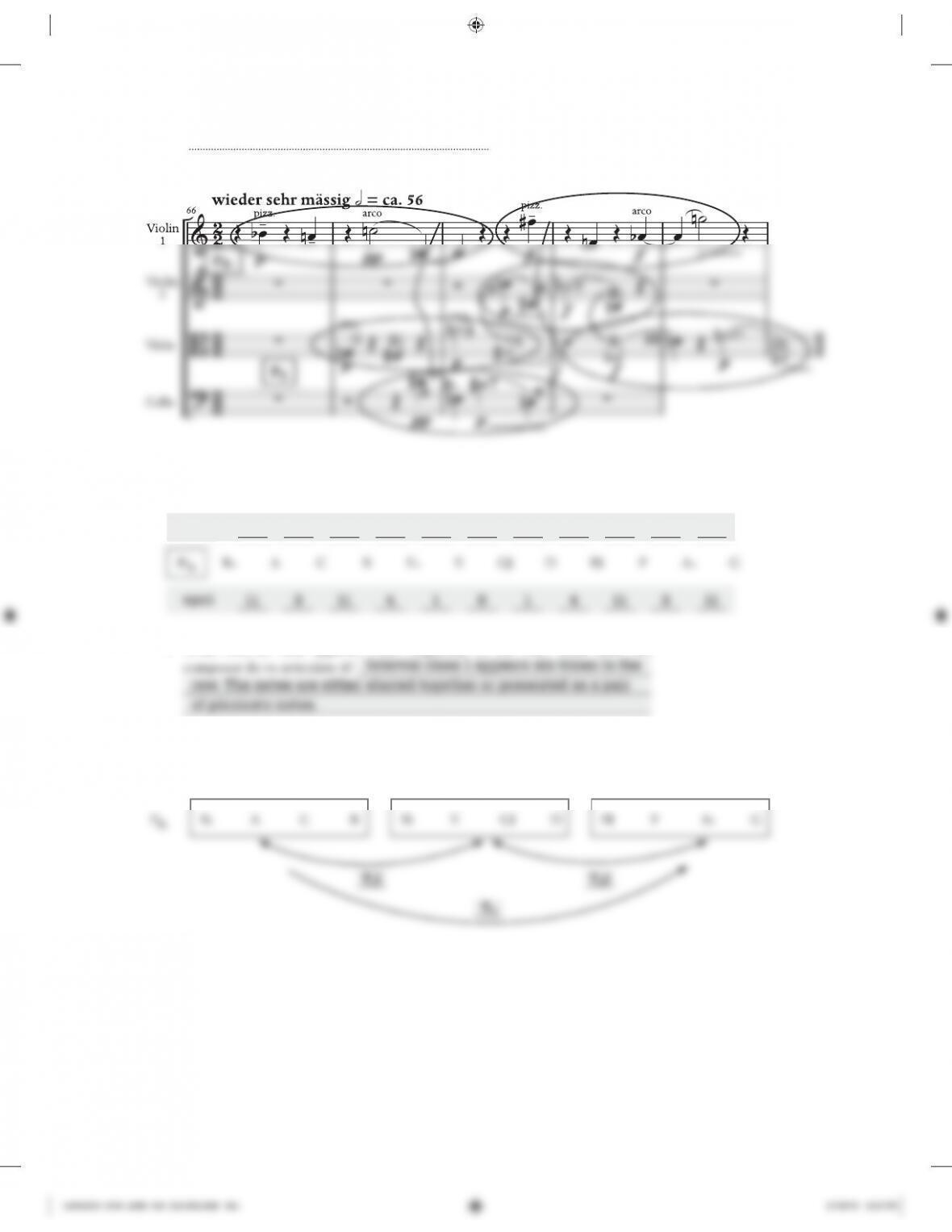
1. Anton Webern, String Quartet, Op. 28, i
There are two series forms in this passage: PBb, which begins in violin 1 in m. 1, and
PG, which begins in the viola in m. 2.
P
G
,
whic
• Complete a twelve count of the passage by labeling the beginnings of series
forms and numbering the pitches. Use lines connecting pitch numbers to show
how the series moves from one instrument to the next.
D. Analysis |665
NAME:
1
2
3
4
5
6
7
8
9
10
11
12
• Below, write the ordered and unordered pitch class intervals. Are there any
patterns?
upci 1 3 1 4 1 3 1 4 1 3 1
• What interval class appears most frequently in the row? what does the
• The first four notes of the series, Bb–A–C–B, spell Bach’s name (in German, B is
called Bb, and H is called Bn). Fill in the chart below showing how the other four–
note groups are related to Bb–A–C–B by transposition and inversion.
• There are three forms of this four-note motive in PBb and three more in PG.
Circle them on the score. What has the composer done to articulate them?
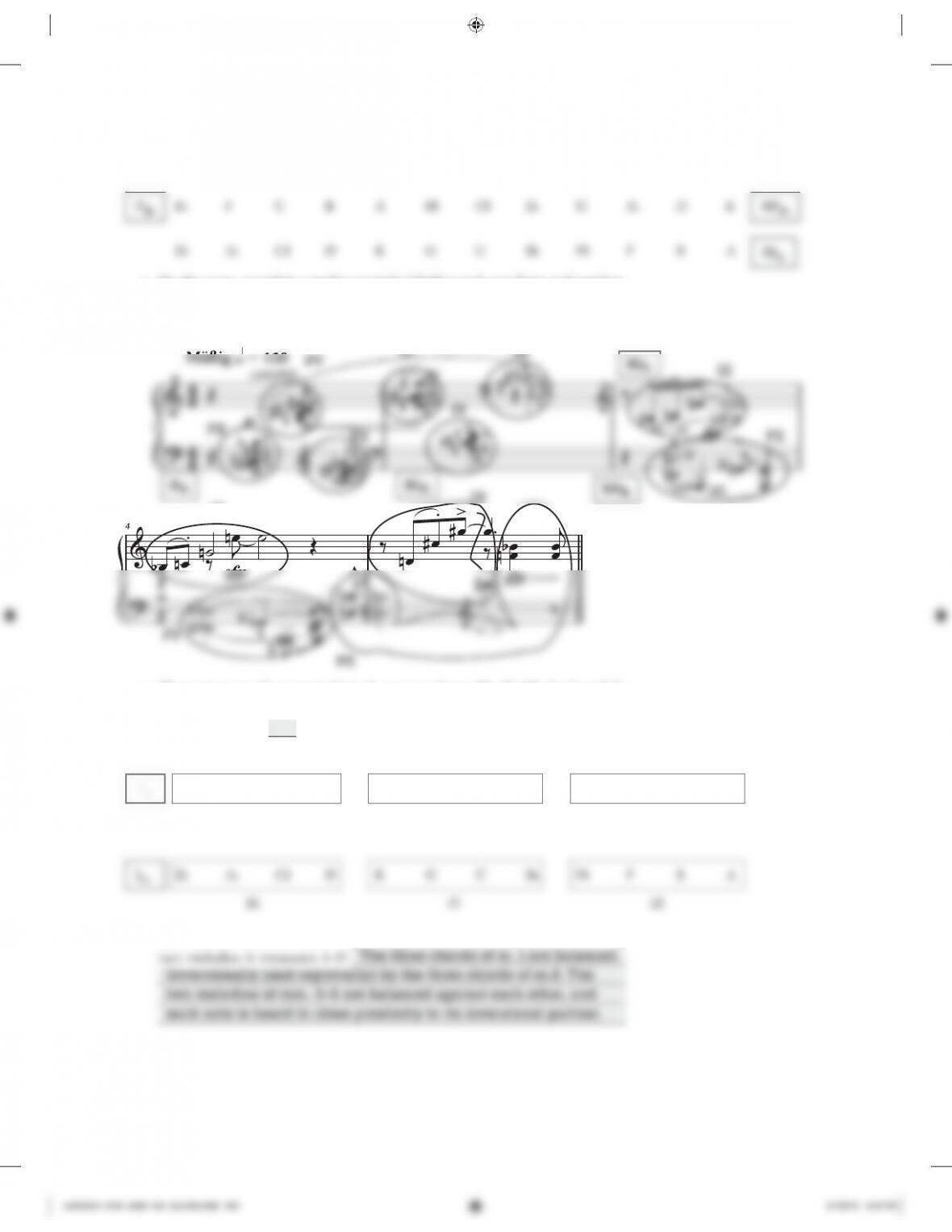
2. Arnold Schoenberg, Piano Piece, Op. 33a
There are three series forms in this passage: PBb, RPBb, and RIEb.
# E
• On the score, complete a twelve count by labeling each row form and number-
ing the pitches. Remember that within chords, the order of notes from lowest
to highest does not necessarily follow the order within the series.
PY
IZ
IX
PX
4
3
10
10
11
12
5
7
8
8
6
6
1
2
3
4
• The music is mostly organized into four-note subsets, PX, PY, PZ, IX, IY, and IZ.
Circle and label these subsets on the score. What TnI connects corresponding
four-note subsets? T1I
PX PY PZ
PBb B
b F C B A F# C
# E
b G Ab D E
• How does inversional balance help to shape the six chords in measures 1–2? The
NAME:
• There is little or no invariance of dyads or trichords between these two series
forms. But there is a special sort of invariance that affects the six-note groups
(hexachords). How do the two hexachords of PBb relate to the two hexachords
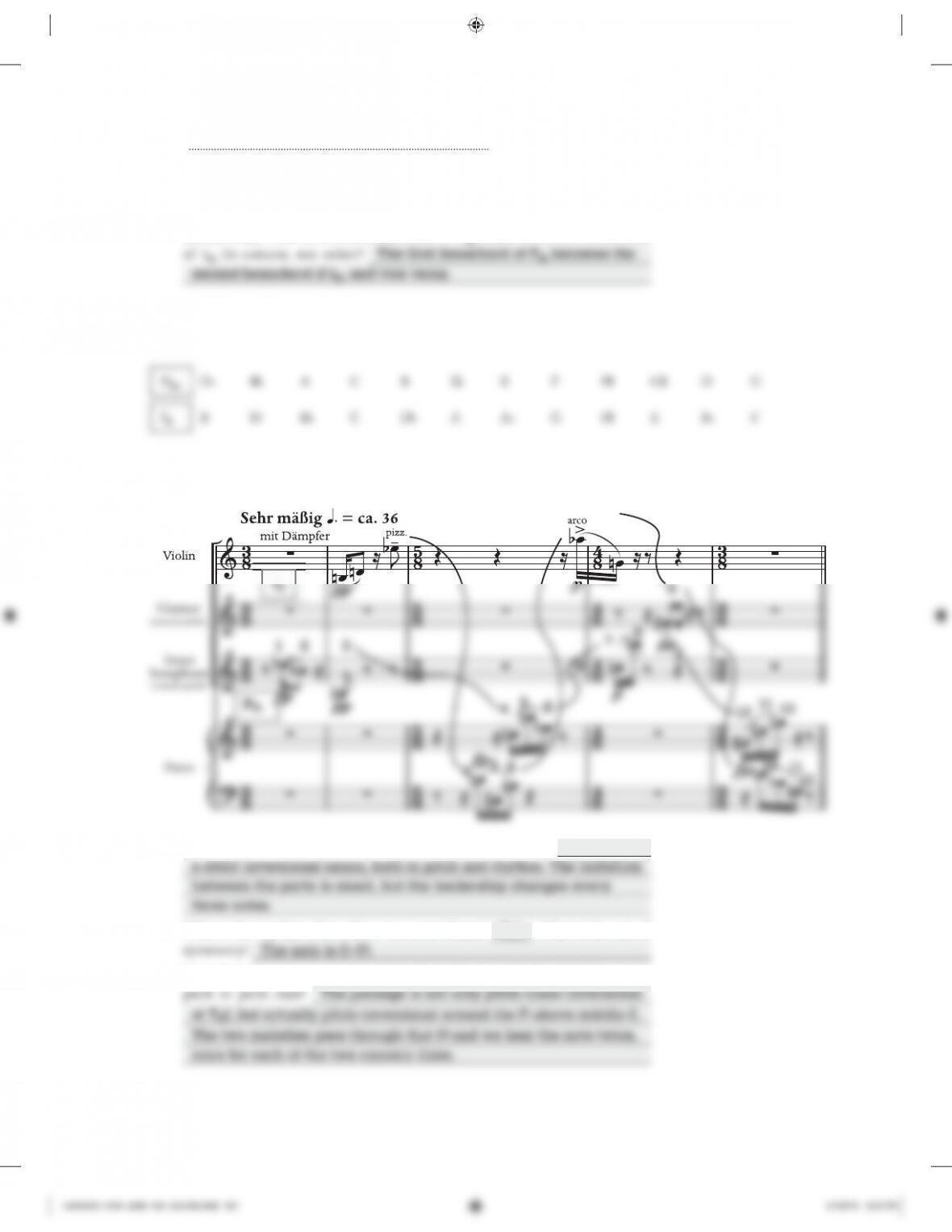
3. Anton Webern, Quartet, Op. 22, i
Provide a twelve-count of the passage. The music is based on row forms PDb and IB:
# D G
• Label the beginning of each form and number the pitches within each row
form. Note that the series move among instrumental parts.
IB
1
2
3
7
8
9
• Describe the role of imitation between the two serial melodies. It is almost
• What is the TnI that relates these two series forms? T0I. What is the axis of
• How does this inversional relationship shape the music? Is the inversion one of
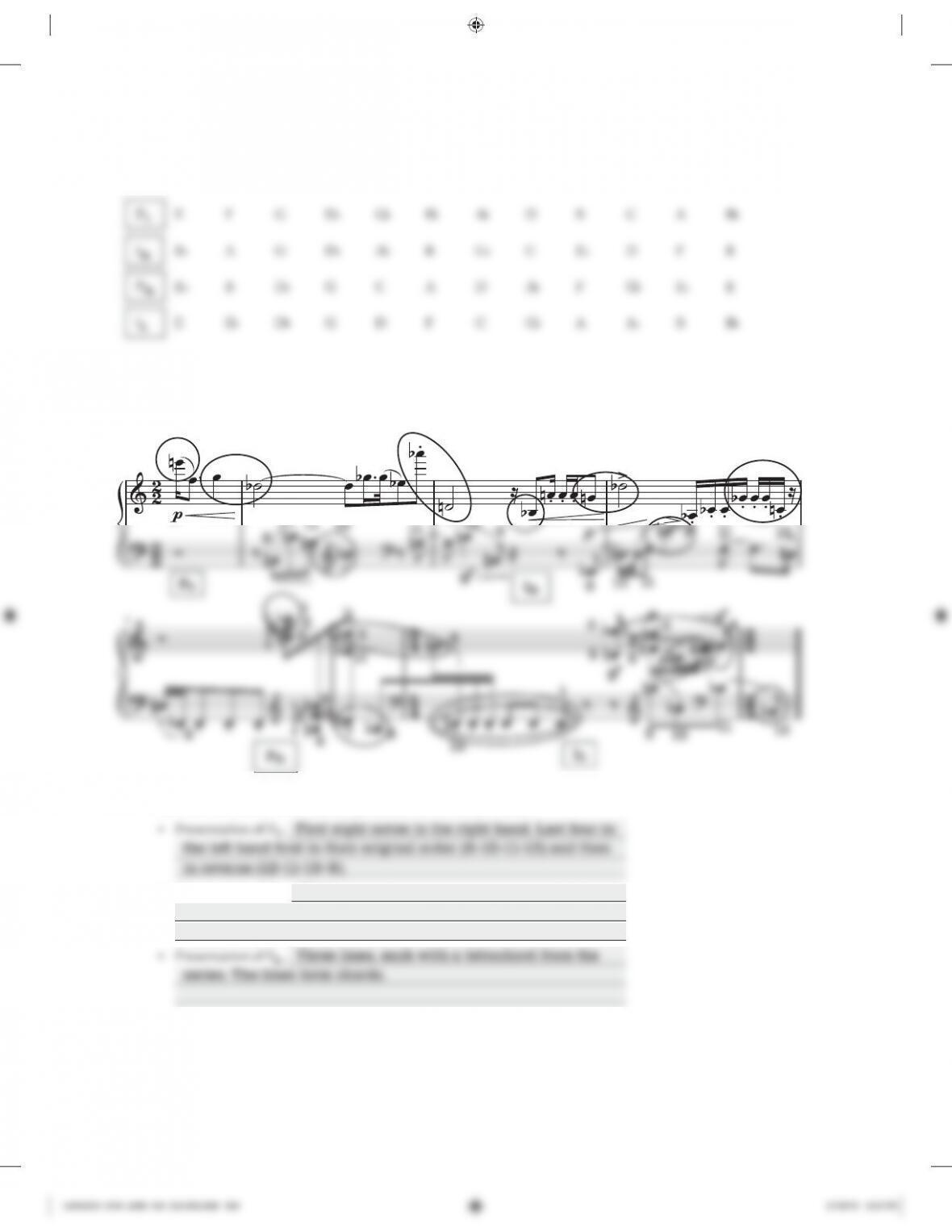
4. Arnold Schoenberg, Suite for Piano, Op. 25, Gavotte
• Provide a twelve count of the passage, which is based on these series forms:
• On the score, label the beginning of each form and number the pitches within
each row form. Note that a single note may be both the end of one series and
the beginning of another.
1
13
3
4
4
5
5
6
6
7
7
8
8
9
10
10
11
11
12 12
11
10
22
• How are the notes of the series distributed between the voices?
• Presentation of IBb. Same.
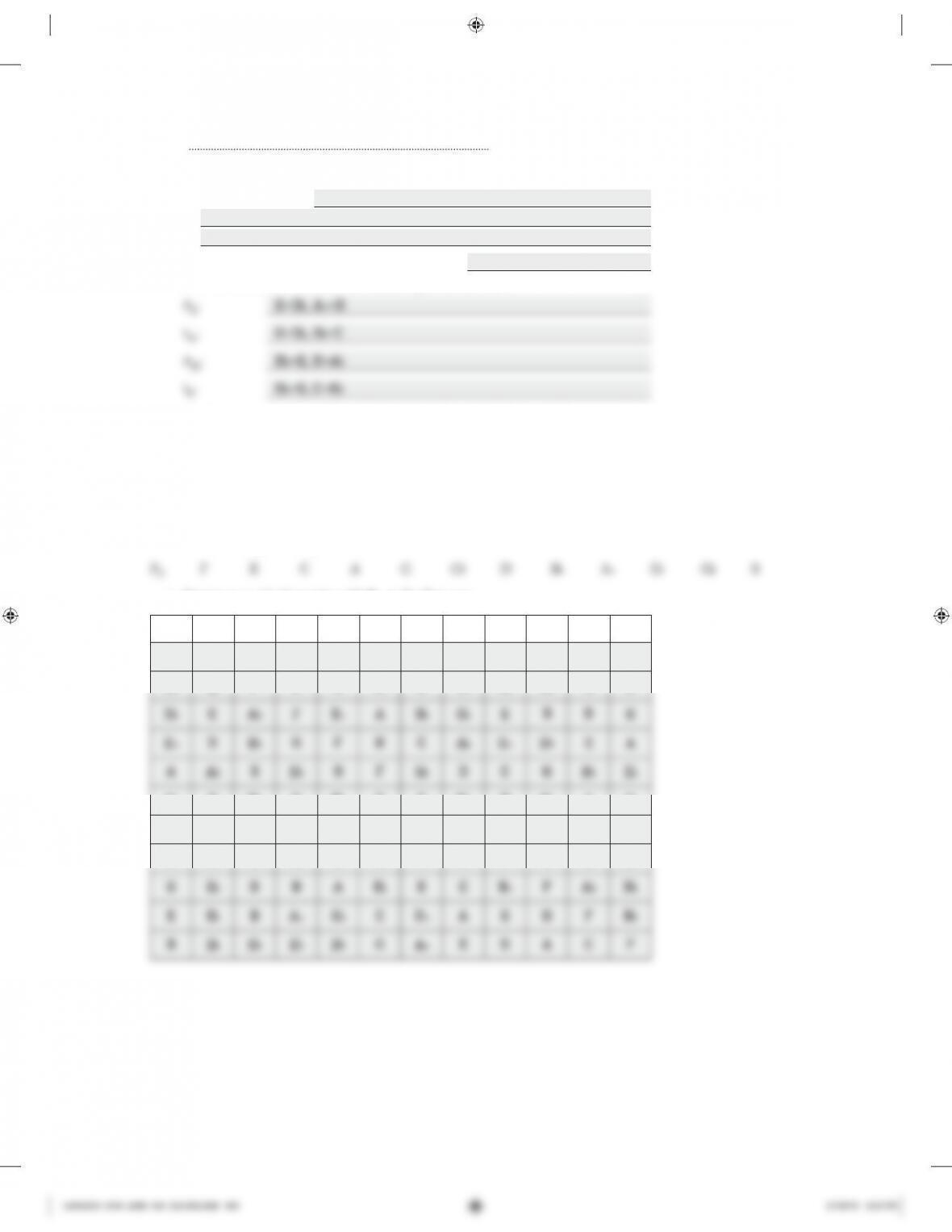
NAME:
• Presentation of IE. Same.
• How many tritones are there within the series? Two in each series form.
List the tritones in each of the following series forms:
• Circle these tritones on the score. How do they shape the music?
• All four series forms begin and end on E and Bb, another tritone at this higher
level. Circle those two notes on the score. How do they shape the music?
5. Luigi Dallapiccola, Quaderno musicale di Annalibera, Contrapunctus secundus
(canon contrario motu)
The series for the piece is PF
.
• Construct a 12×12 matrix with PF as the first row.
FECAG
DbDBbAbEbGbB
GbFDbBbAbDEbBAEGC
BbAFDC
GbGEbDbAbBE
AbGEbCBbEF
DbBGbAD
CBGED
AbAFEbBbDbGb
DDbAGb EBbBGFC
EbAb
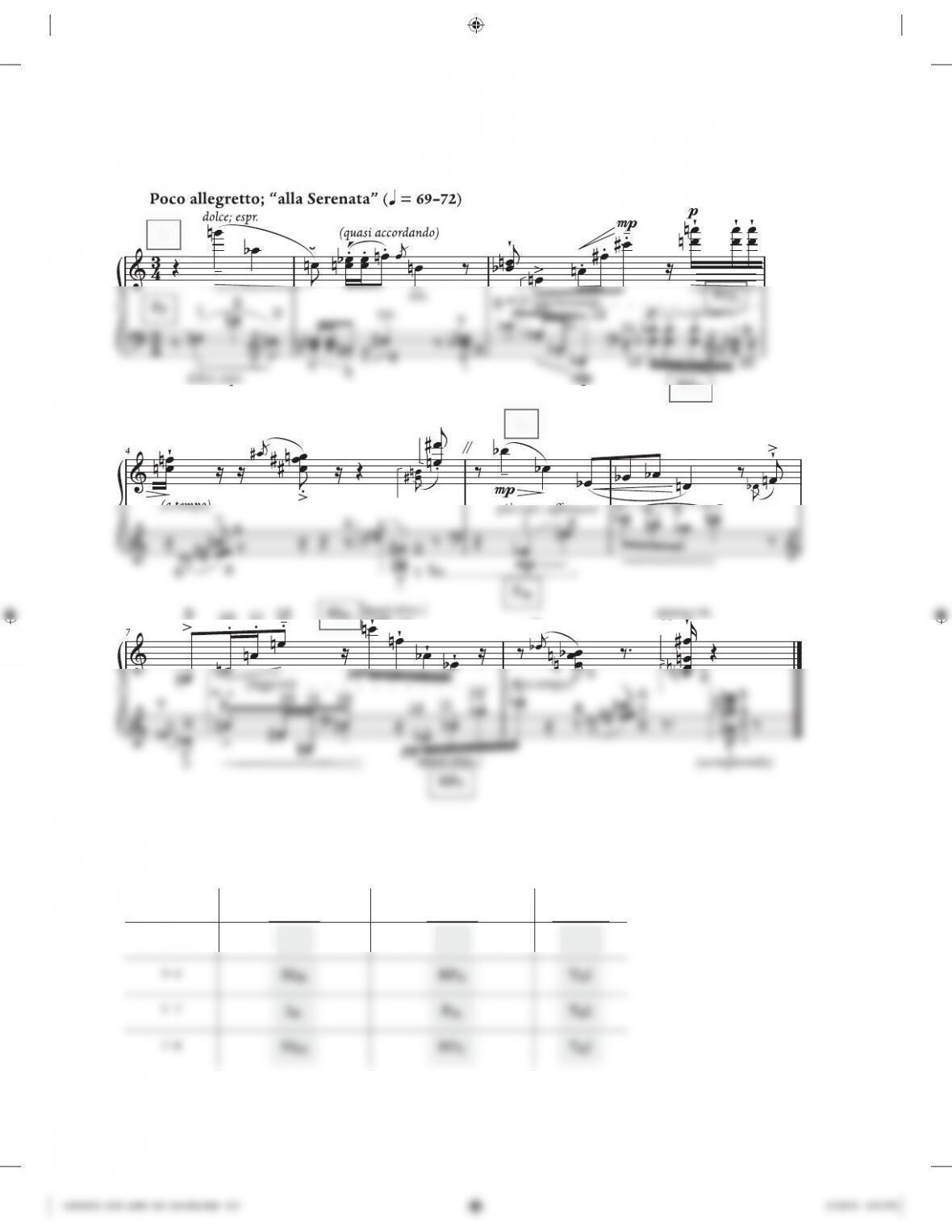
• On the score, label the beginning of each series form and give a complete
12-count.
1
2
3
4
5
6
7
8
9
10
11
12
12
11
IG
RIEb
RPA
1
1
2
2
3
3
4
4
5
5
6
6
7
7
8
8
9
10
1
2
IBb
• The piece uses four pairs of simultaneously sounding series forms. Each pair
consists of two forms related by inversion. What are the pairs? What are the
TnI that connect them?
Measures Row in top voice Row in bottom voice TnI
1–3 IGPFT0I