B. Identifying Intervals | 615
NAME:
A. QUESTIONS FOR REVIEW
1. What is enharmonic equivalence?
2. What is a pitch? How many different pitches are represented on the piano
keyboard?
3. What is an ordered pitch interval? An unordered pitch interval?
4. What is octave equivalence?
5. What is a pitch class? How many pitch classes are there?
6. What is an ordered pitch-class interval? An unordered pitch-class interval?
7. What is an interval class?
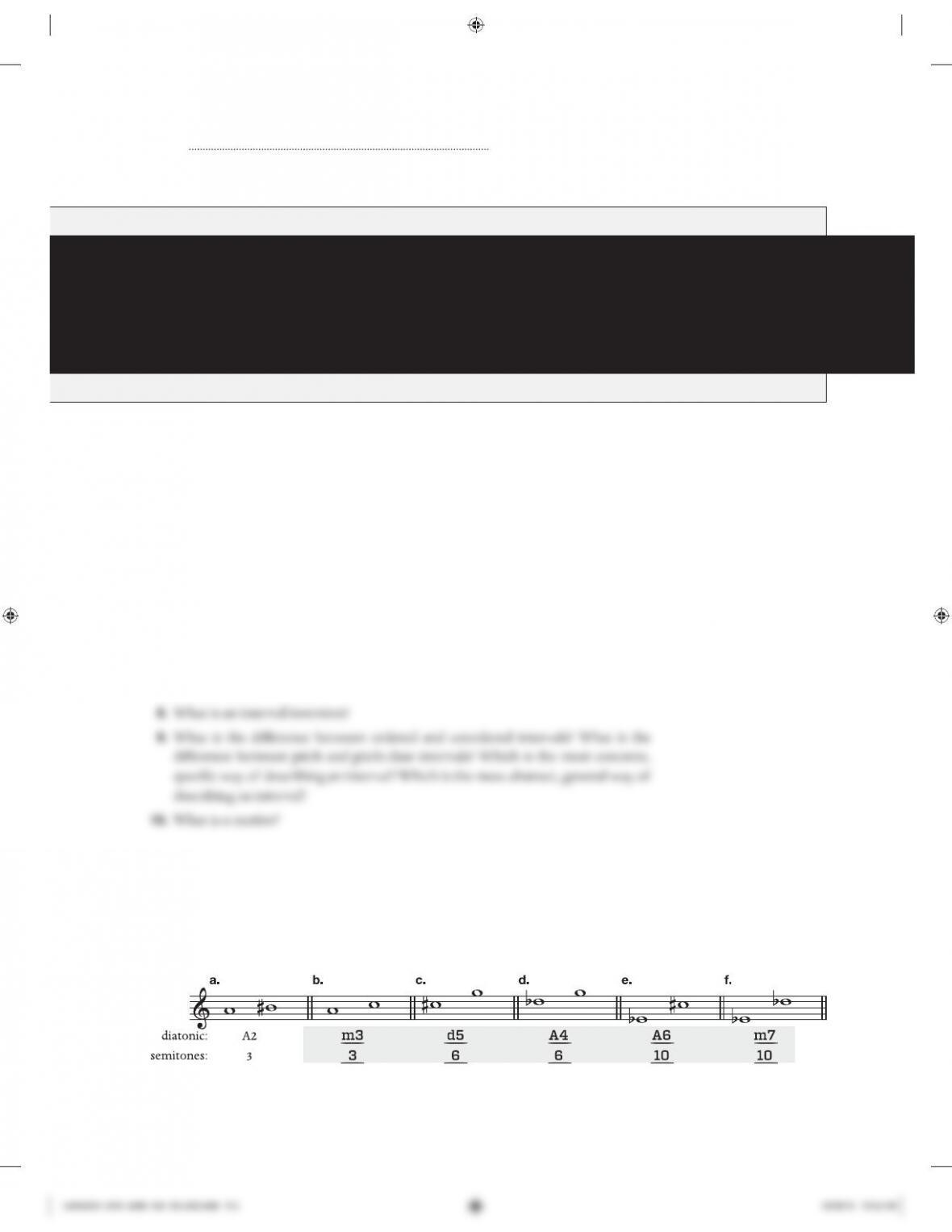
B. IDENTIFYING INTERVALS
1. For each of these intervals, give the diatonic name (e.g., M3) and the number of
semitones (i.e., the unordered pitch interval).
chapter
43 Intervals
616 | CHAPTER 43 | Intervals
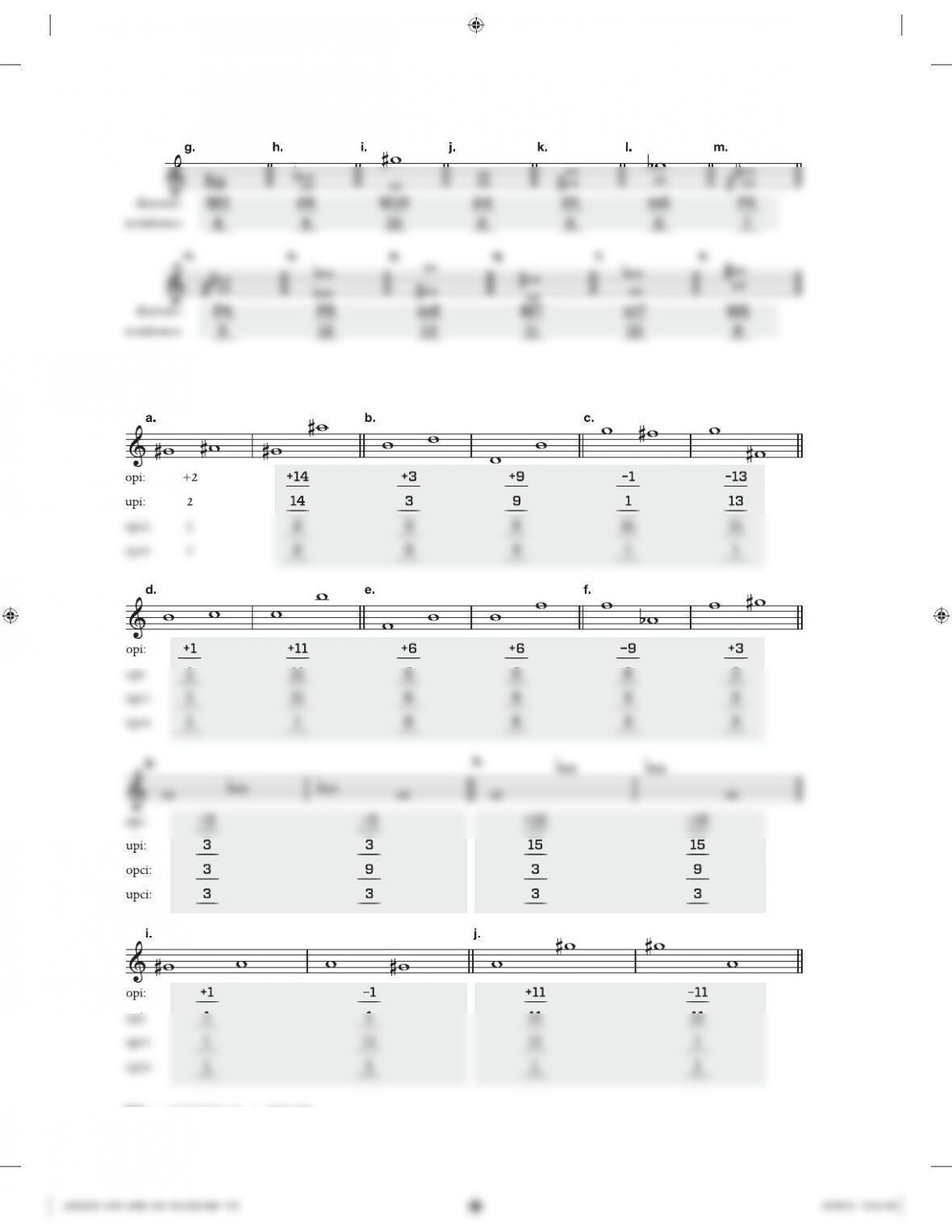
2. Identify each interval as an ordered pitch interval (opi), unordered pitch interval
(upi), ordered pitch-class interval (opci), and unordered pitch-class interval (upci).
C. Writing Intervals | 617
NAME:
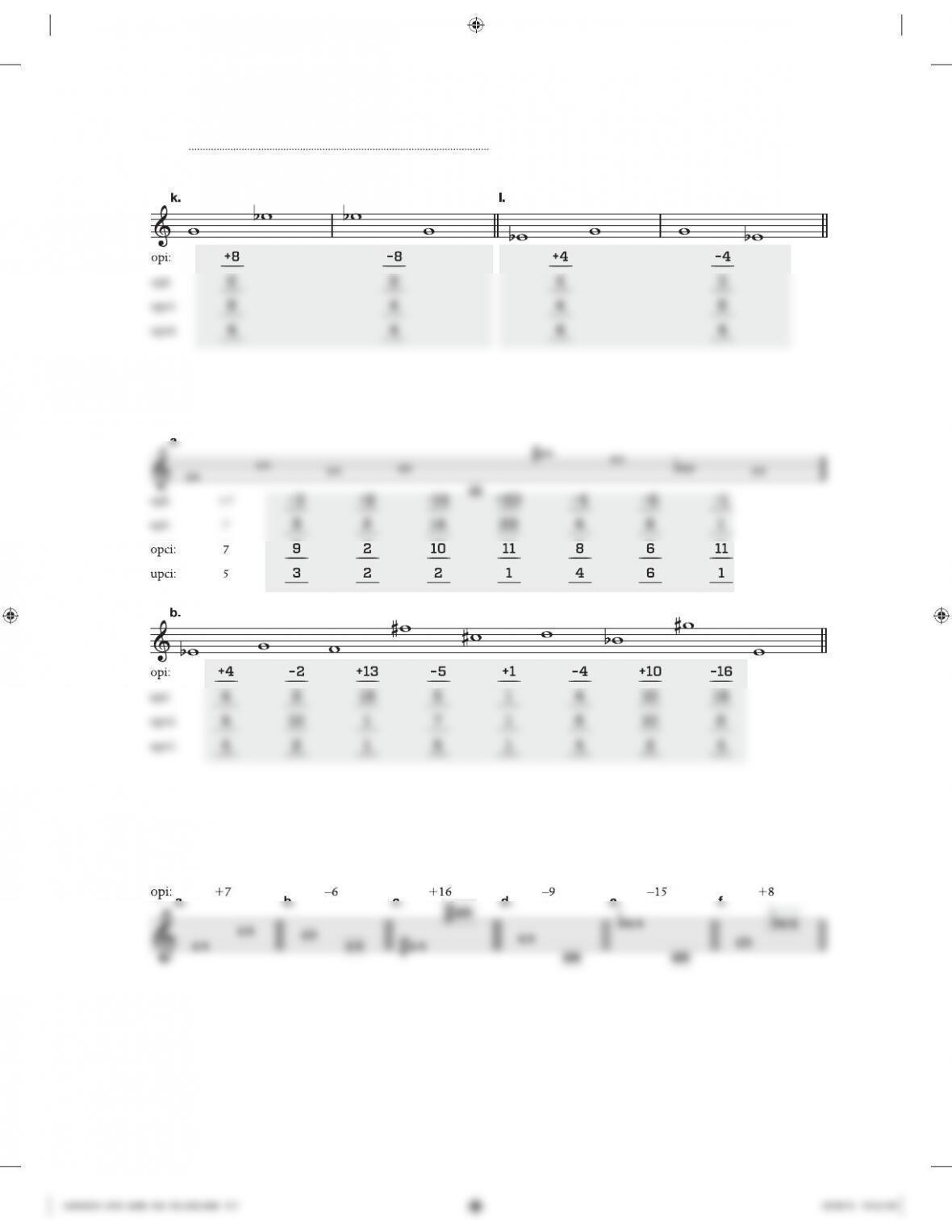
3. Identify each of the melodic intervals as an ordered pitch interval (opi), unordered
pitch interval (upi), ordered pitch-class interval (opci), and unordered pitch-class
interval (upci)
C. WRITING INTERVALS
1. Write each ordered pitch interval on the staff as indicated.
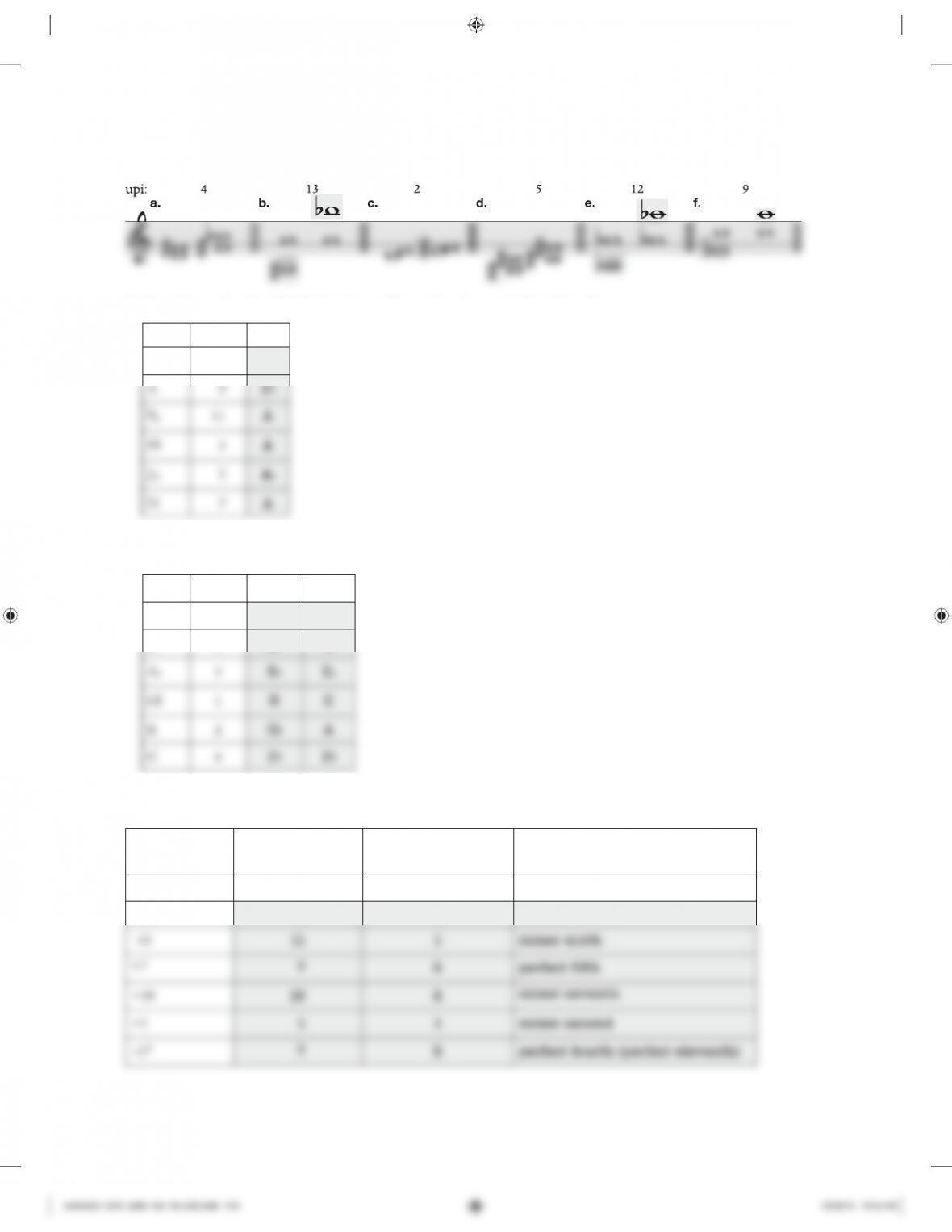
2. For each of the notes given, write two unordered pitch intervals: one below the
note and one above it.
3. Complete each ordered pitch-class interval by writing the note in the right column.
opci
G 4
B
4. Complete each unordered pitch-class interval with two notes, above and below
the given note.
upci above below
F4
ADb
G3
BbE
5. For each given ordered pitch interval, fill in the chart by supplying the associated
ordered and unordered pitch-class intervals, as well as the diatonic name.
Ordered pitch
interval (opi)
Ordered pitch-class
interval (opci)
Unordered pitch-class
interval (upci)
Diatonic name
–3 9 3 minor third
–11 1 1 major seventh
NAME:
D. COMPOSITION
1. Compose a short piece (6–8 measures) for a melody instrument of your choice in
which every pitch interval is either a 1 or a 4 (or the octave equivalents of these).
• Provide clef and time signature.
• Add tempo and articulations.
2. Compose a short piece (6–8 measures) for a melody instrument of your choice in
which every interval is either a 2 or a 6 (or the octave equivalents of these).
• Provide clef and time signature.
620 | CHAPTER 43 | Intervals
E. ANALYSIS
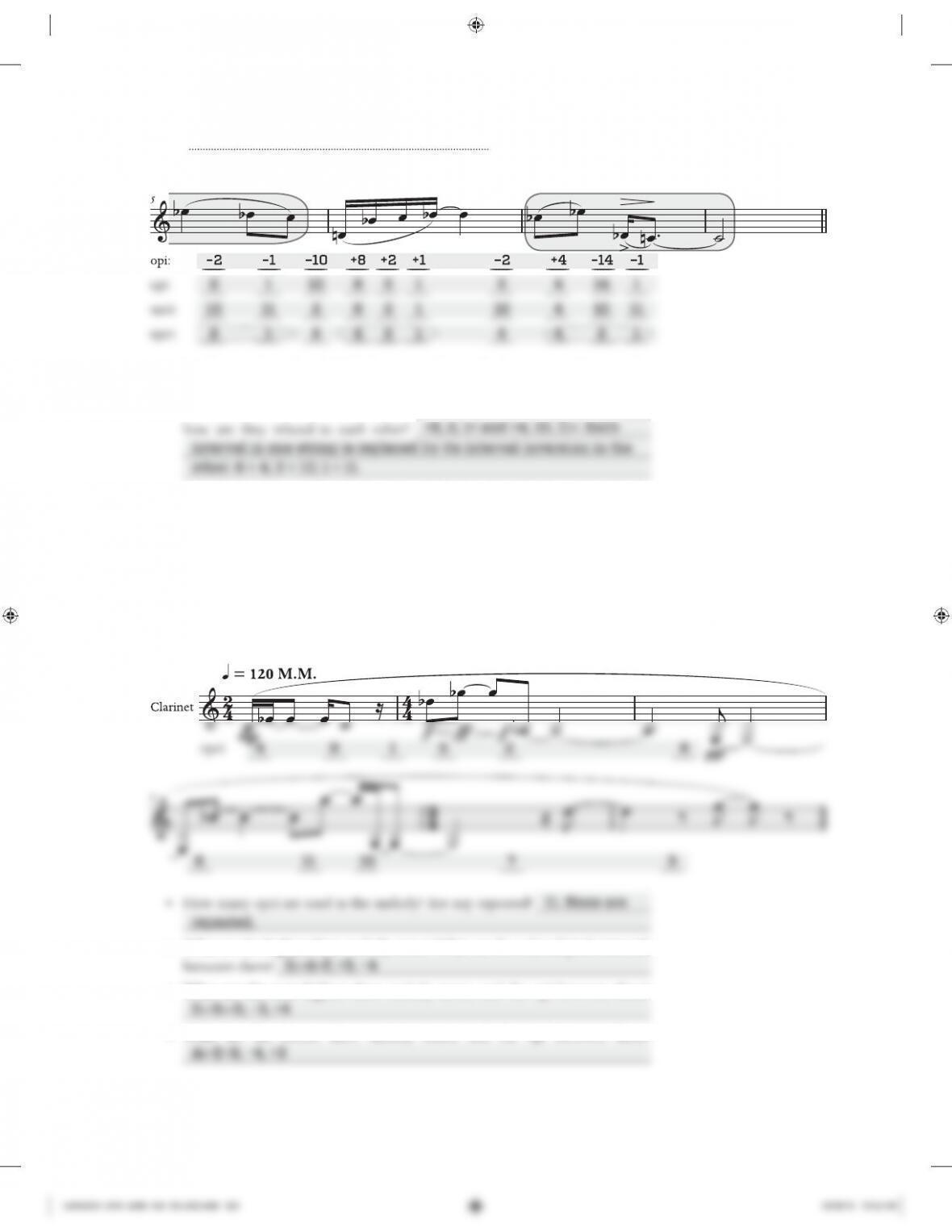
1. Béla Bartók, String Quartet No. 3:
• Identify all the ordered pitch intervals below the score using numbers with
+or− signs.
• Circle adjacent combinations of pitch intervals 2 and 3 (some of your circles
will overlap).
• The combination of pitch intervals 2 and 3 (moving in the same or opposite
direction) acts as a unifying motive. Write one or two sentences in which you
2. Ruth Crawford Seeger, Diaphonic Suite No. 1, i
• Identify all occurrences of pitch intervals 1, 2, and 11 below the score, with
+and − signs for direction.
• An important motive features pitch intervals 1 and 2 moving in opposite direc-
• Looking more closely at the first three measures, what are the notes on the
• What are the lowest three notes in the first three measures, and what are the opi
• Write one or two sentences describing how the motive that you identified is
used in this passage.
• How is pitch-interval 11 used in this excerpt? How does it relate to phrase begin-
nings or endings? How does it relate to the frequently heard pitch-interval 1?
E. Analysis | 621
NAME:
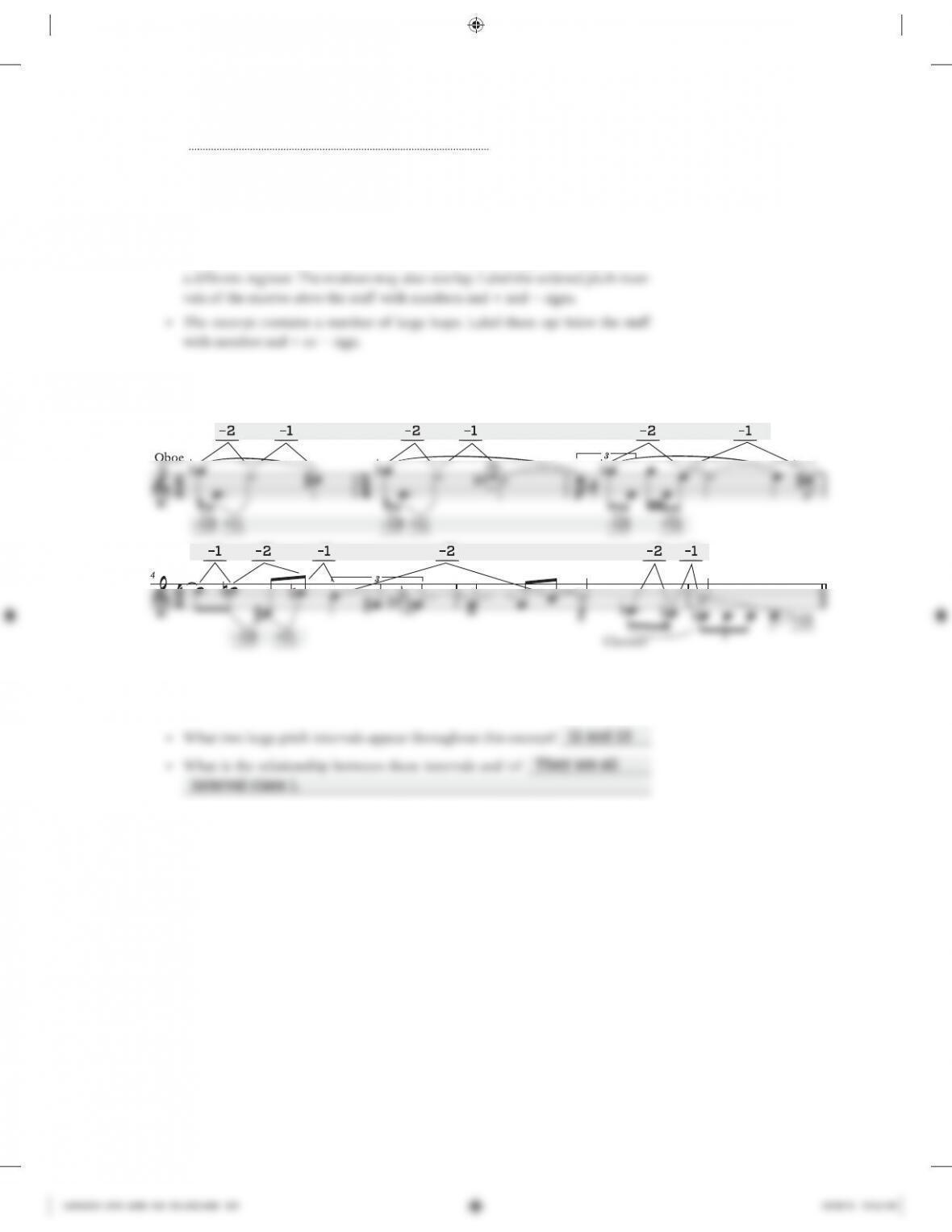
3. Edgard Varèse, Octandre
• This excerpt contains a motive that consists of pitch intervals 1 and 2, moving
in the same direction (<+1, +2>, <−1, −2>, <+2, +1>, and <−2, −1>). Some
instances of the motive may involve nonadjacent notes separated by pitches in
• Write a sentence or two tracing the statements of the three-note motive
throughout the passage. What story do they tell, and how do the large pitch
intervals contribute to the story?
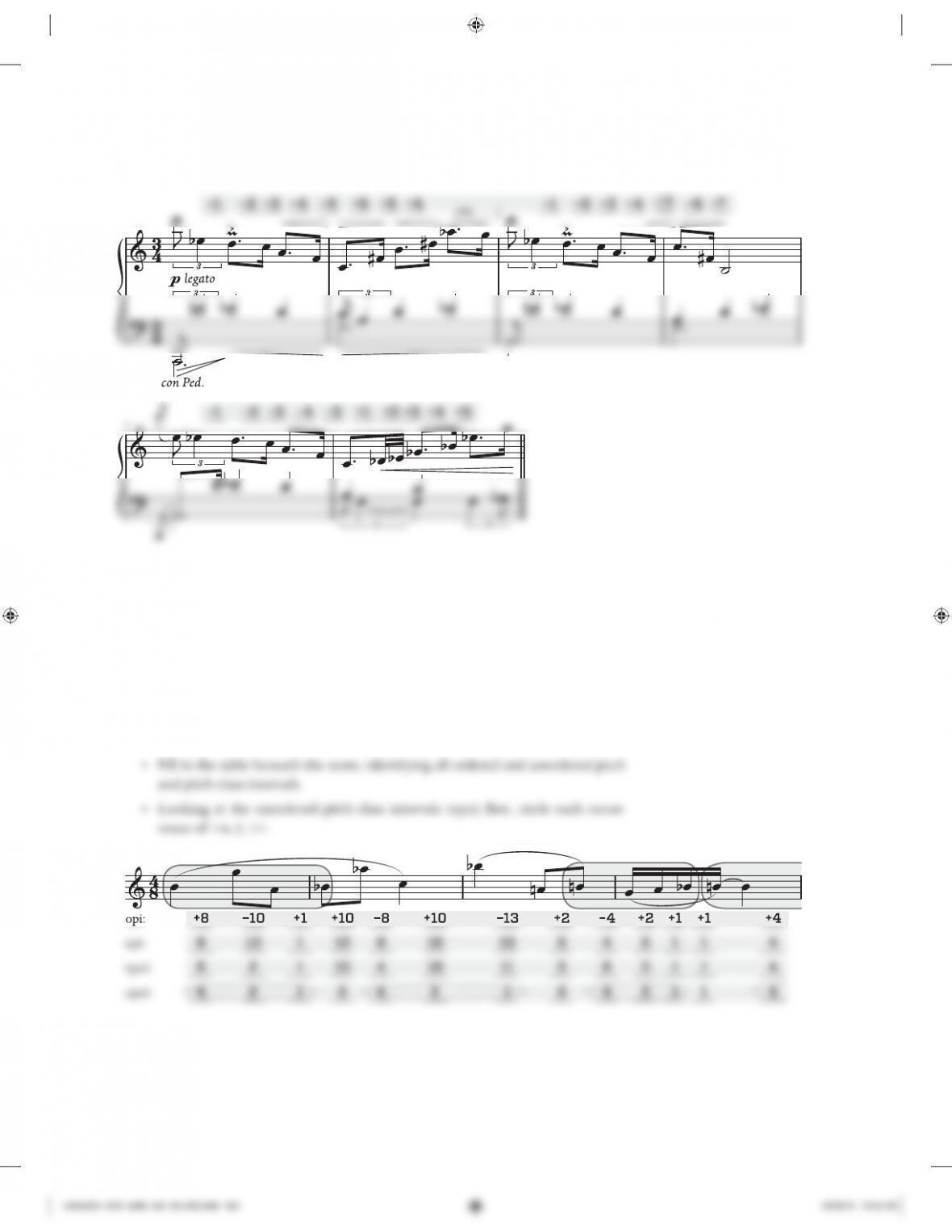
4. Thomas Adès, First Mazurka
• Label the melodic (ordered) pitch intervals above the staff.
• Do you see any patterns in the series of labeled intervals? Is there a particular
note on which patterns start or end? One interval does not quite conform to the
pattern; circle it. How can you account for this interval?
5. Igor Stravinsky, “Music to hear” from Three Shakespeare Songs
Note: This passage was discussed several times in the textbook for this chapter.
• Considering the pitch classes used in this 24-note melody, circle any successions
of four pitch classes that occur more than once in the same order.
NAME:
• Looking at the ordered pitch-class intervals (opci), the upci <4, 2, 1> in the
lowest row of the chart are represented by two different strings of opci in
the second-lowest row of the chart. What are those two strings of opci, and
• How do the patterns of pitch-class intervals (both ordered and unordered) work
in this melody? Are the patterns clarified or concealed by the pitch intervals? If
concealed, in what way and for what artistic purpose?
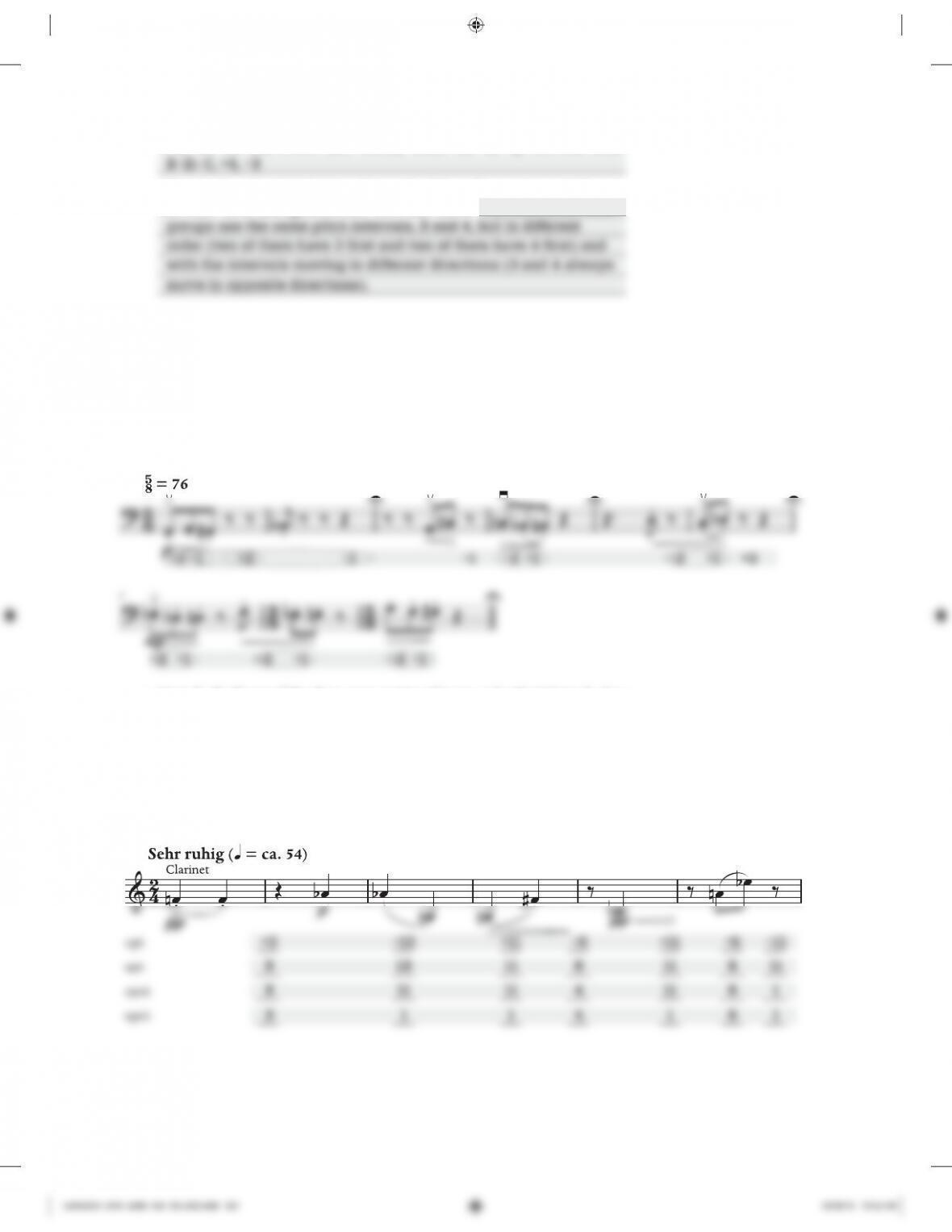
6. Milton Babbitt, Composition for Four Instruments.
Note: Clarinet sounds as written.
• Under the score, write the ordered pitch-class intervals formed by the adjacent
notes of this twelve-note melody.
• What are the highest three melody notes? What are the ordered pitch intervals
• What are the next highest three melody notes, and the opi between them?
• What are the lowest three melody notes, and the opi between them?
624 | CHAPTER 43 | Intervals
• What are the next lowest three melody notes, and the opi between them?
• What do the ordered pitch intervals in each of these three-note groups have in
common? What distinguishes them from each other? All four three-note
7. Sofia Gubaidulina, Ten Preludes for Solo Cello, No. 1 (Staccato—Legato)
• Identify all instances of pitch intervals 1 or 2, and label them below the staff
using + and − signs to show direction.
• Circle every three-note motive that contains pitch intervals 1 and 2 moving in
opposite directions. The four possibilities are <+1, −2>, <−1, +2>, <+2, −1>,
and <−2, +1>. Note that the groups may overlap, and they may span across
rests.
• How do the forms of the three-note motive relate to each other? How do they
participate in the overall ascent of the line?
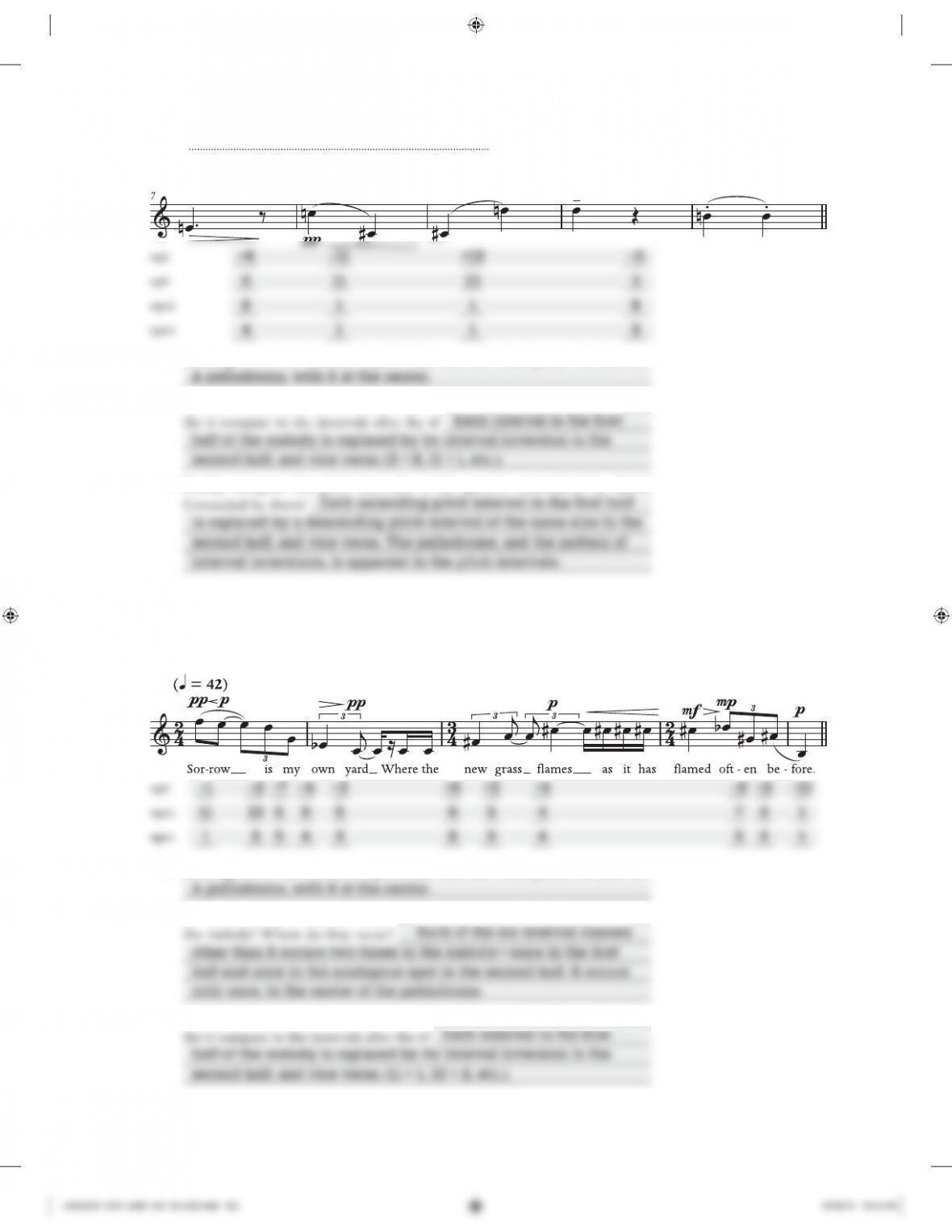
8. Anton Webern, Symphony, Op. 21, ii
• This melody contains twelve notes. Ignoring the immediate repetition of a
note, identify the ordered and unordered pitch and pitch-class intervals in this
melody and write them in the table beneath the staff.
NAME:
• Looking first at the unordered pitch-class intervals, what pattern do you see?
• Now also consider the ordered pitch-class intervals: how do the intervals before
• Finally, compare the pitch intervals: is the pattern maintained by them?
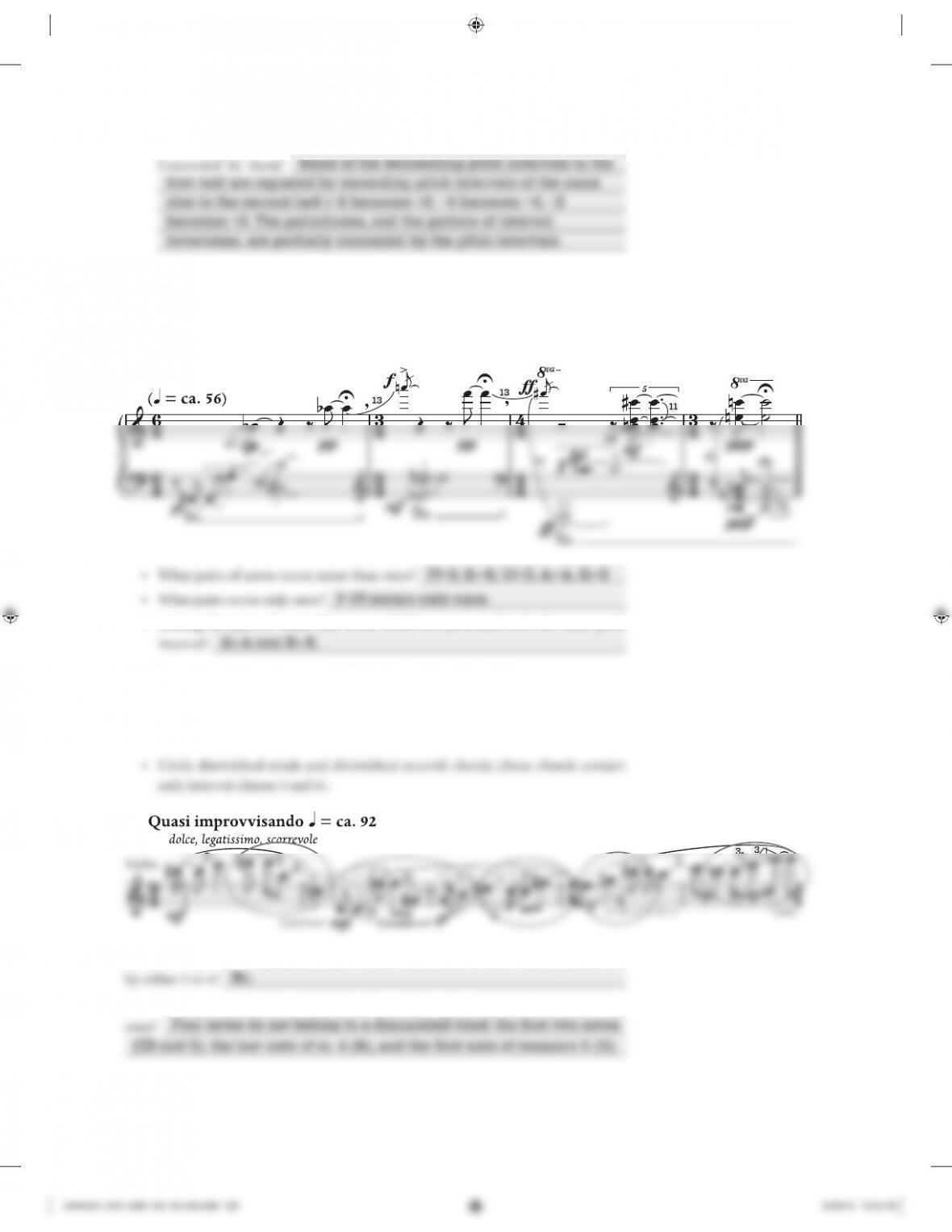
9. Milton Babbitt, “The Widow’s Lament in Springtime”
• This melody contains twelve notes. Ignoring the immediate repetition of a
note, identify the ordered pitch intervals as well as the ordered and unordered
pitch-class intervals and write them in the table beneath the staff.
• Looking first at the unordered pitch-class intervals, what pattern do you see?
• Of the six different interval classes, how many times does each one occur in
• Now also consider the ordered pitch-class intervals: how do the intervals before
• Finally, compare the pitch intervals: is the pattern maintained by them?
10. Elisabeth Lutyens, Bagatelle, Op. 48, No. 1
• Draw a line between any pair of adjacent or simultaneous notes related by
interval class 1.
• Identify the unordered pitch interval for each and write it next to the interval.
• Among the pairs of notes that recur, which are presented with the same pitch
11. Elliott Carter, Riconoscenza per Goffredo Petrassi (for solo violin)
• On the score, draw a line between every pair of adjacent pitches related by
interval classes 3 or 6 and then write the unordered pitch interval next to the
line.
Are there any notes in the melody that are not connected to at least one adjacent note
Are there any notes in the melody that do not belong to a diminished triad? Which