A. Questions for Review | 51
NAME:
A. QUESTIONS FOR REVIEW
1. In SATB format, which voices are written in treble clef ? Which voices are in bass
clef ? Which voices are stemmed upward? Which voices are stemmed downward?
2. What is the proper range for each of the voices in SATB format?
3. Which pairs of voices should be within an octave of each other in SATB format?
4. When writing in keyboard format, which voices are in treble clef ? How are they
stemmed?
chapter
4Four-Part Harmony
52 | CHAPTER 4 | Four-Part Harmony
B. IDENTIFYING CHORDS AND DOUBLINGS
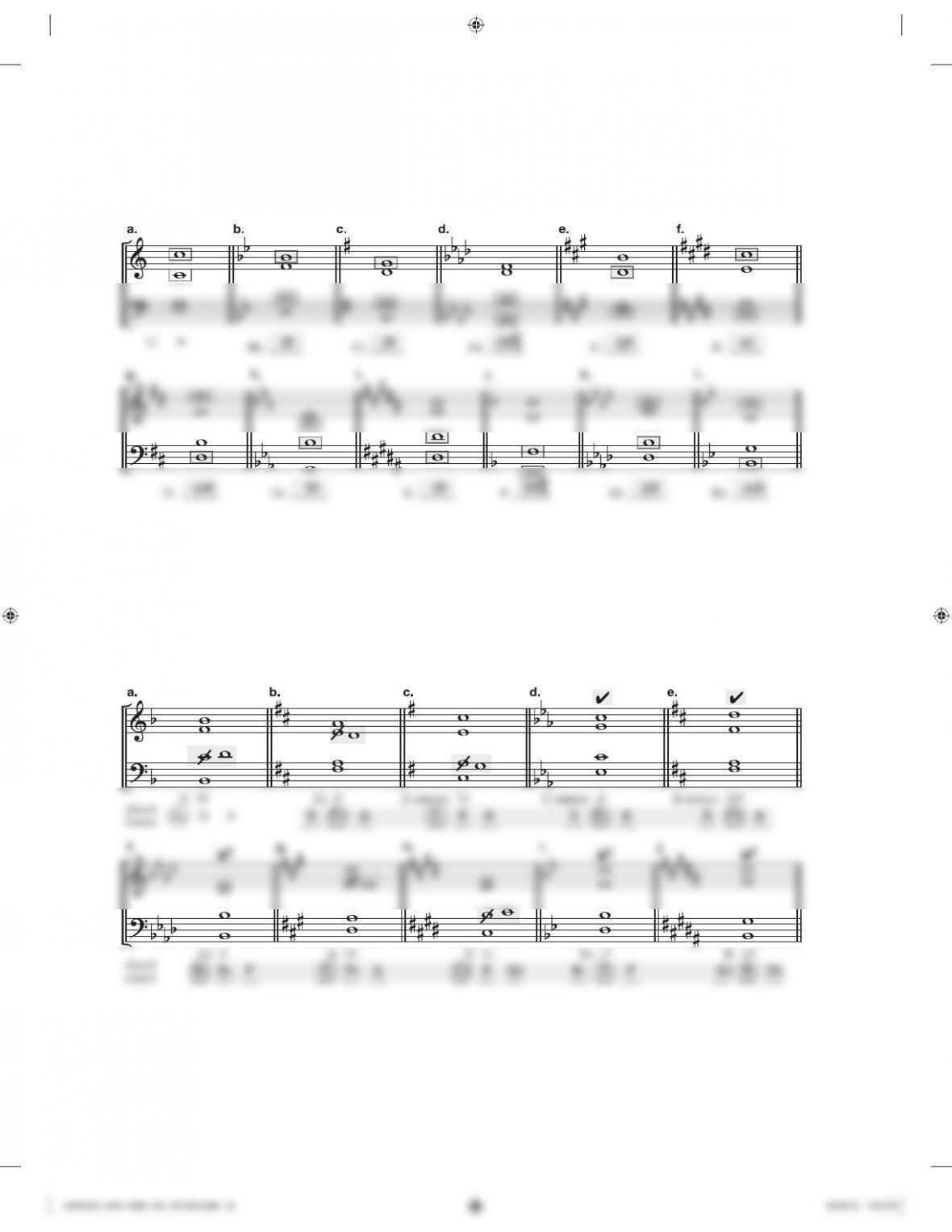
1. Give the Roman numeral of each chord in the given key, and add figures to indicate
inversions. Then place a square around the notes that are doubled.
2. For each of the following chords, follow the steps below to identify the errors:
• Look at the Roman numeral, and write the correct note names of the chords
in the blanks beneath the staff. Circle the letter name of the note that belongs
in the bass.
• Check the notation; if any note does not belong in the chord, write a slash
through it. Then write the correct note beside the incorrect note.
• If there are no problems with the chord, place a check above it.
B. Identifying Chords and Doublings | 53
NAME:
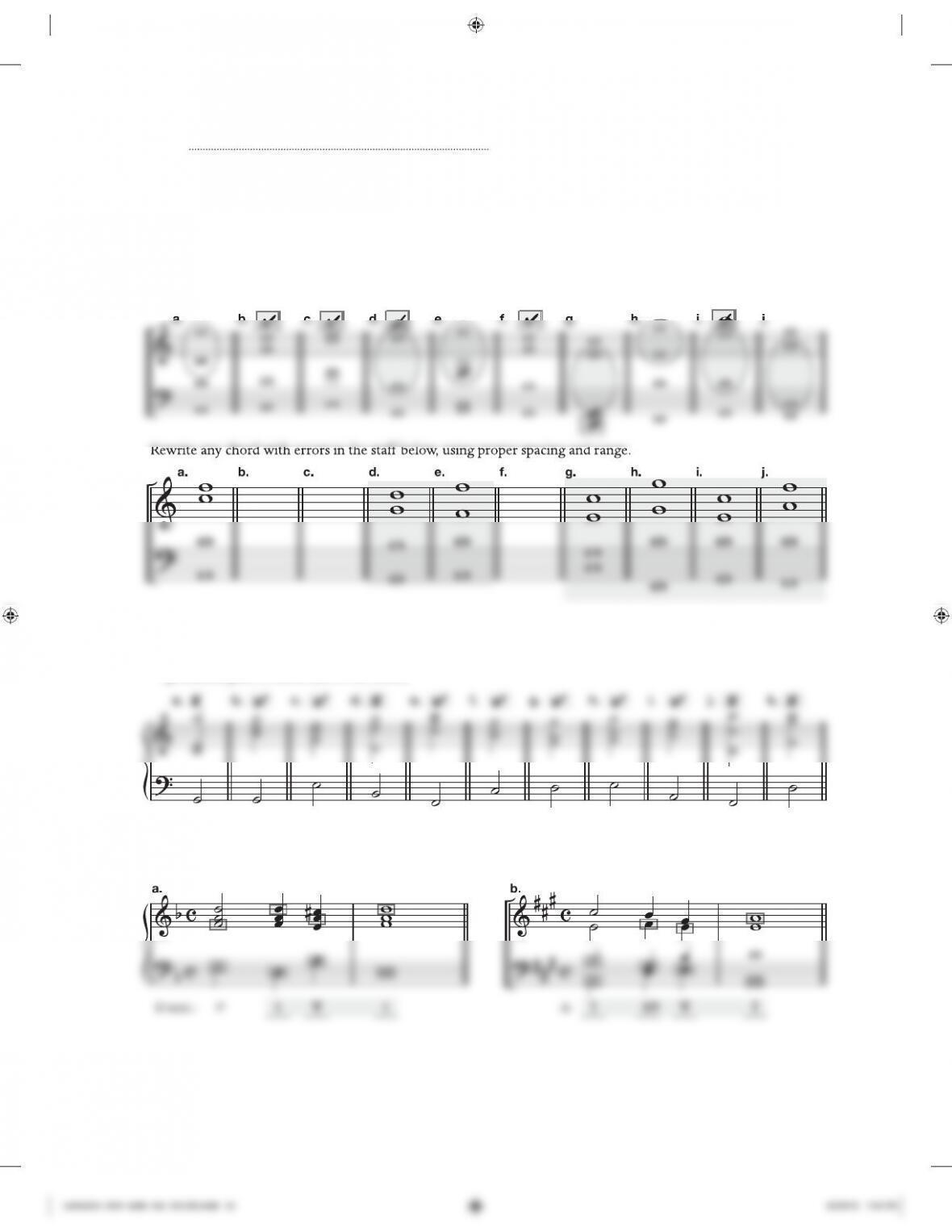
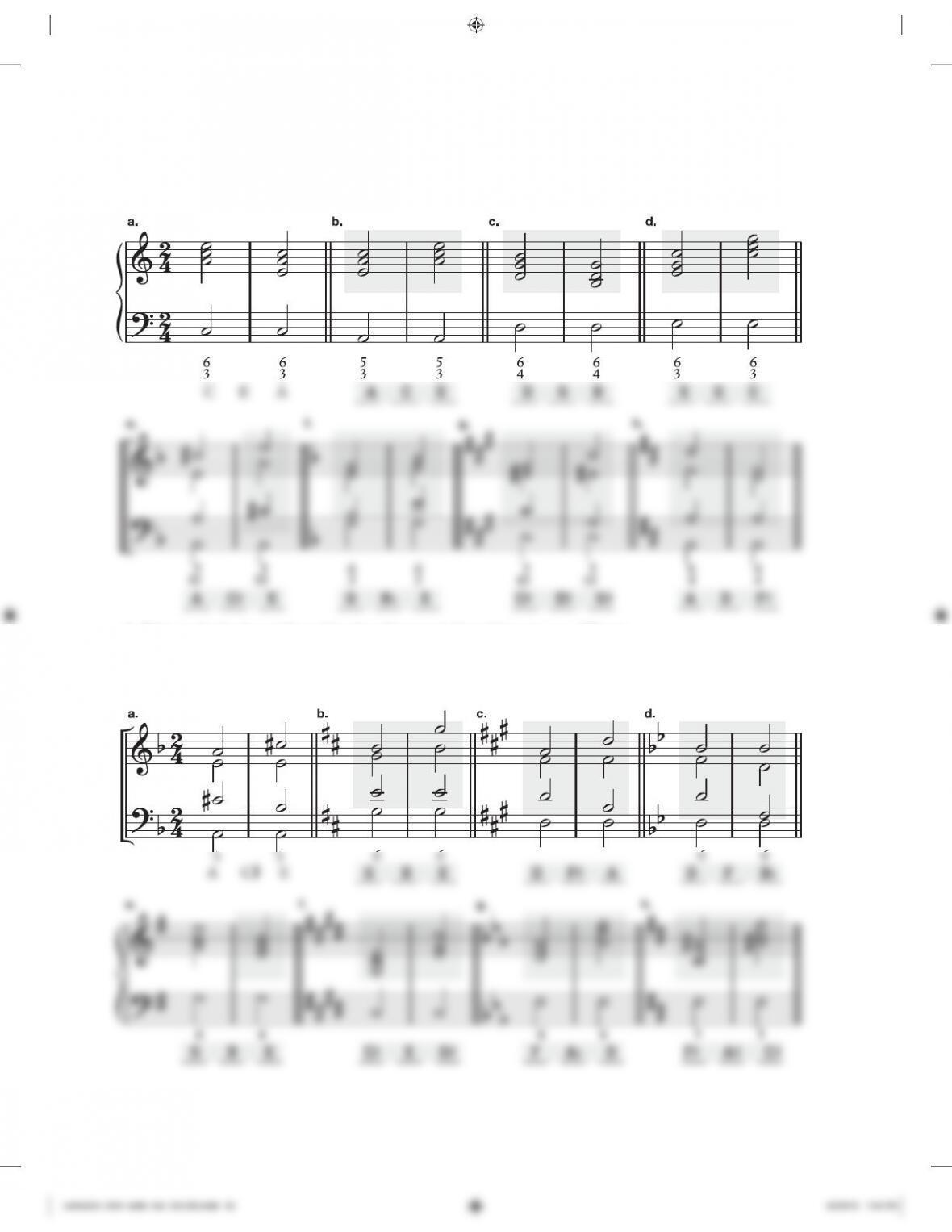
3. Look at the following chords in SATB format.
• Identify any notes that are too high or too low for the vocal range by writing a
slash through the note.
• Check the spacing and circle any pair of notes that are too far apart.
• If there are no problems, place a check above the chord.
4. Look at the following chords in keyboard format. If the spacing between the
top three notes is too wide, place an X above the chord. If there are no spacing
problems, place a check above the chord.
5. Label each chord and inversion below using Roman numerals; then place a box
around the notes that are doubled.
54 | CHAPTER 4 | Four-Part Harmony
C. LEADING TONES AND CHORDAL SEVENTHS
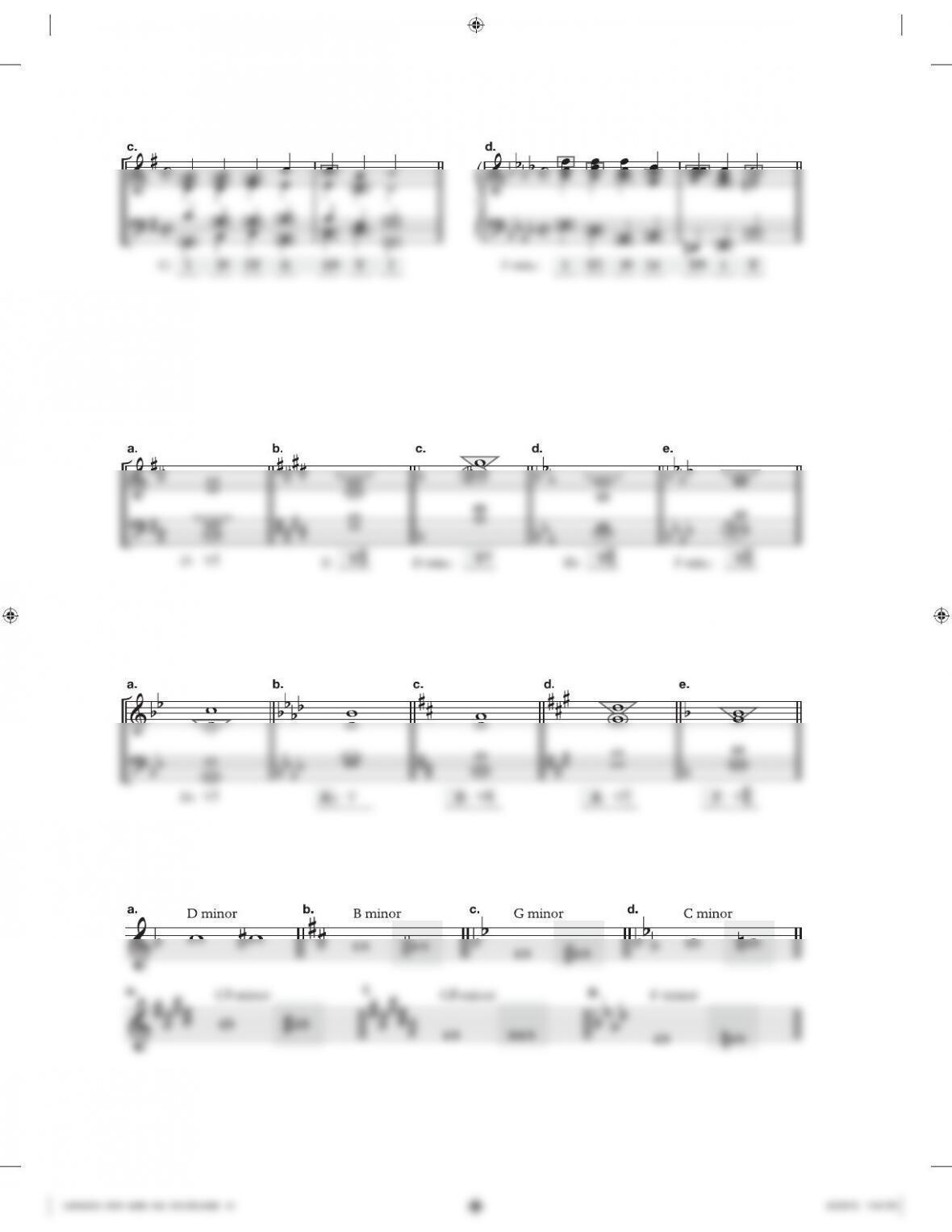
1. Each of the following is a V7 chord in root position or inversion; the key is indicated
for each. Provide the Roman numeral and figures for each (either V7, V6
5, V4
3, or
V4
2). Then circle each leading tone and place an inverted triangle around every
chordal seventh.
2. Each of the following exercises is in a major key and includes either a V or V7, in
root position or inversion. Label the major key, and add the necessary figures to
the Roman numeral for each. Also, circle each leading tone and place an inverted
triangle around every chordal seventh.
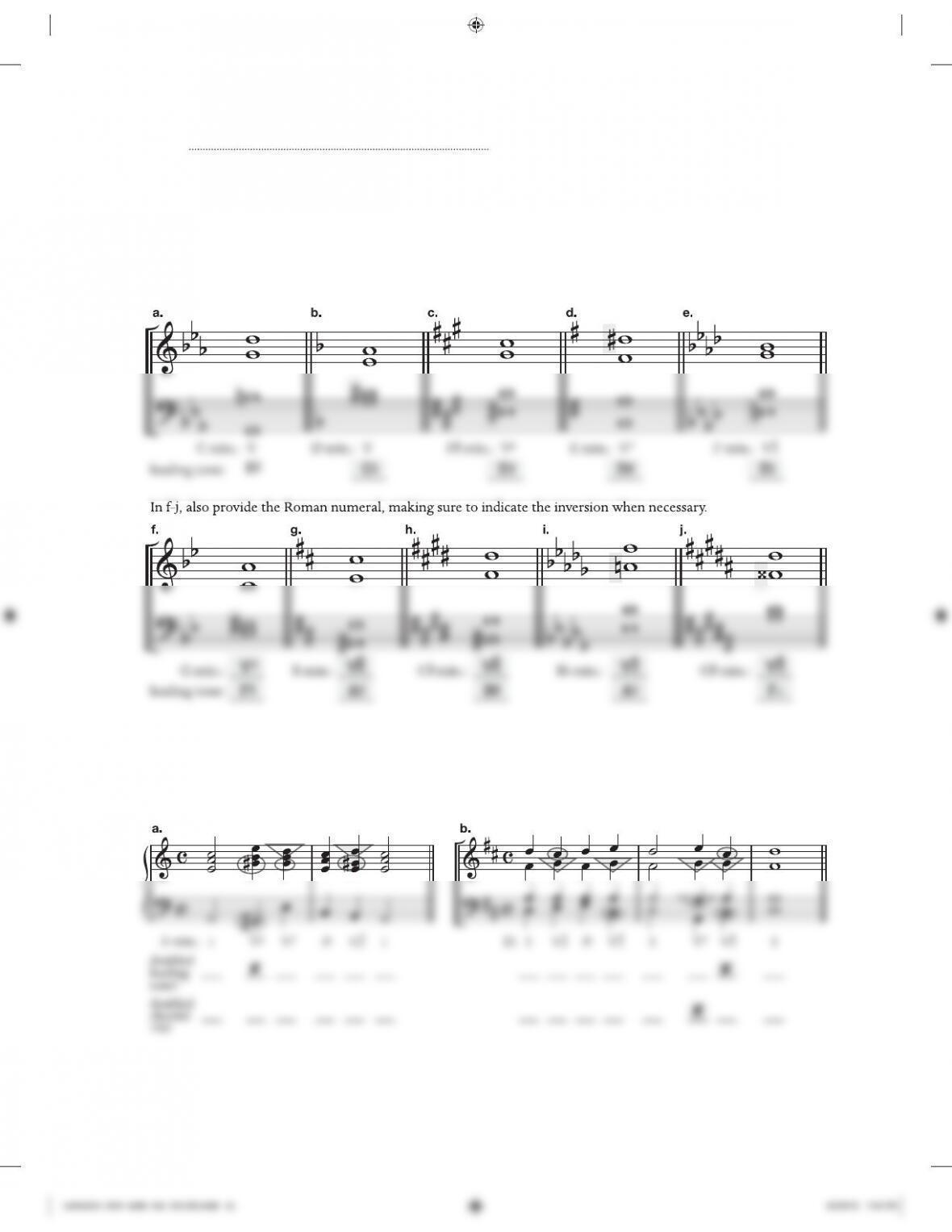
3. The following exercises each provide the seventh scale degree of a minor key. Turn
each into a leading tone by using a sharp, natural, or double sharp to raise the note
by a half step.
C. Leading Tones and Chordal Sevenths | 55
NAME:
4. In the following V chords in minor, the subtonic ˆ
7 should be raised to form the
leading tone.
• Write the note name of the leading tone for each minor key in the blank below
the staff.
• Add the correct accidental to the chord.
5. In the passages below:
• Use circles to mark leading tones and inverted triangles to mark chordal sevenths.
• If there is an incorrectly doubled leading tone or chordal seventh, place an X on
the blank line in the appropriate row under each chord.
D. NOTATION IN SATB AND KEYBOARD FORMATS
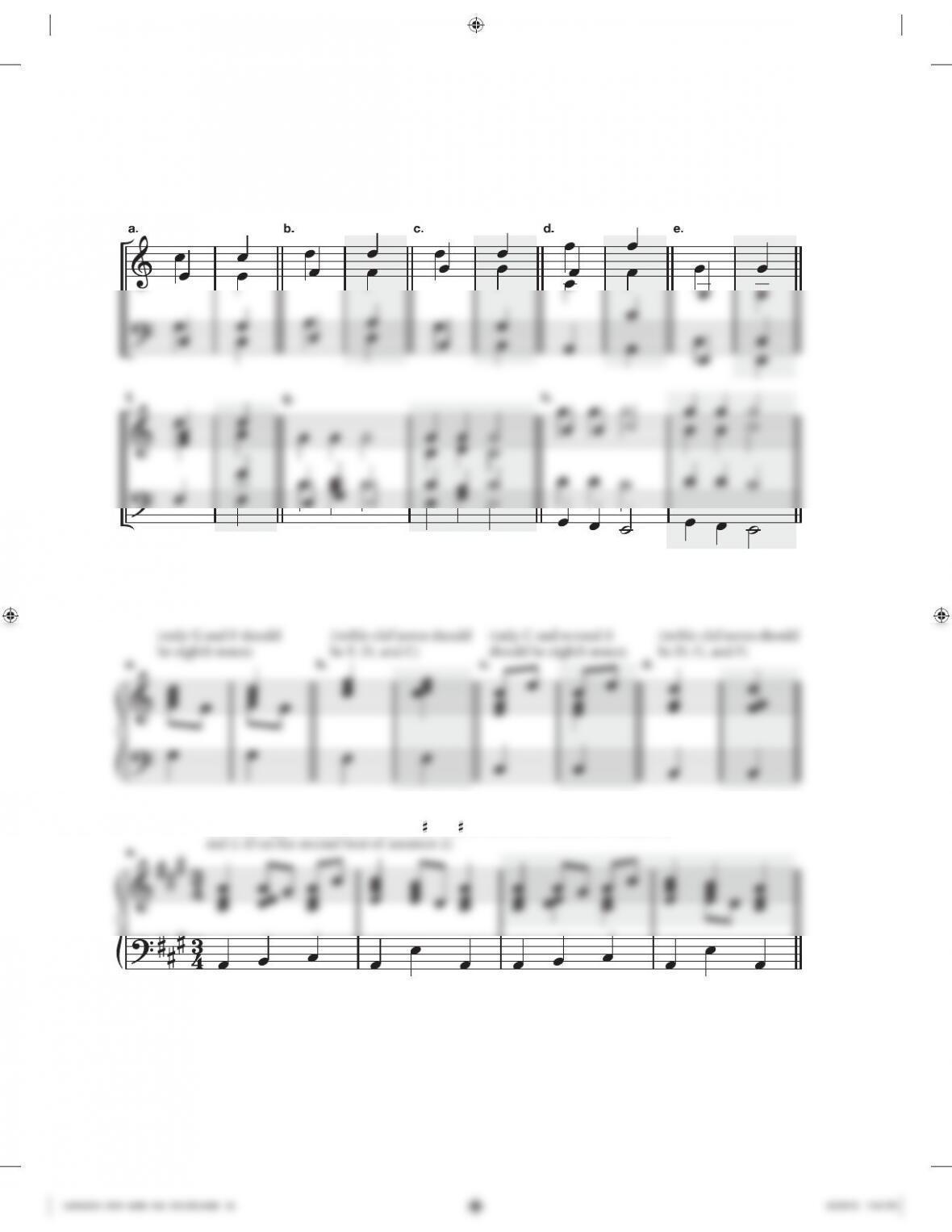
1. In the blank measure that follows each chord or passage, rewrite in SATB format
using proper notation.
2. In the blank measure (or measures) following each chord or passage below, rewrite
in keyboard format using proper notation.
(the only eighth notes should be A
–
G , A
–
C on the last two beats of measure 1,
E. Realizing Roman Numerals | 57
NAME:
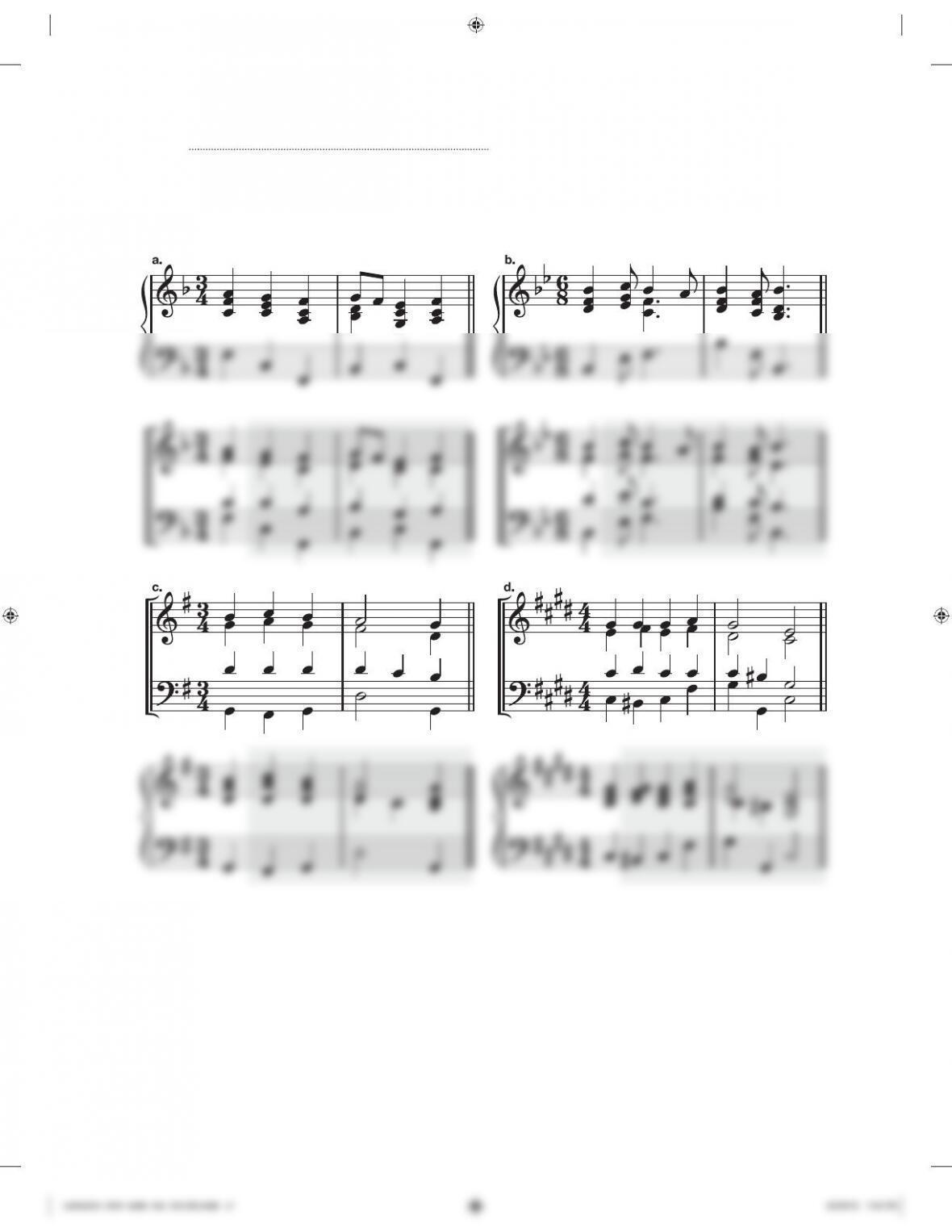
3. Rewriting keyboard and SATB notation: Exercises (a) and (b) are written in keyboard
format; rewrite them below as SATB. Exercise (c) and (d) are written in SATB
format; rewrite in keyboard format.
E. REALIZING ROMAN NUMERALS
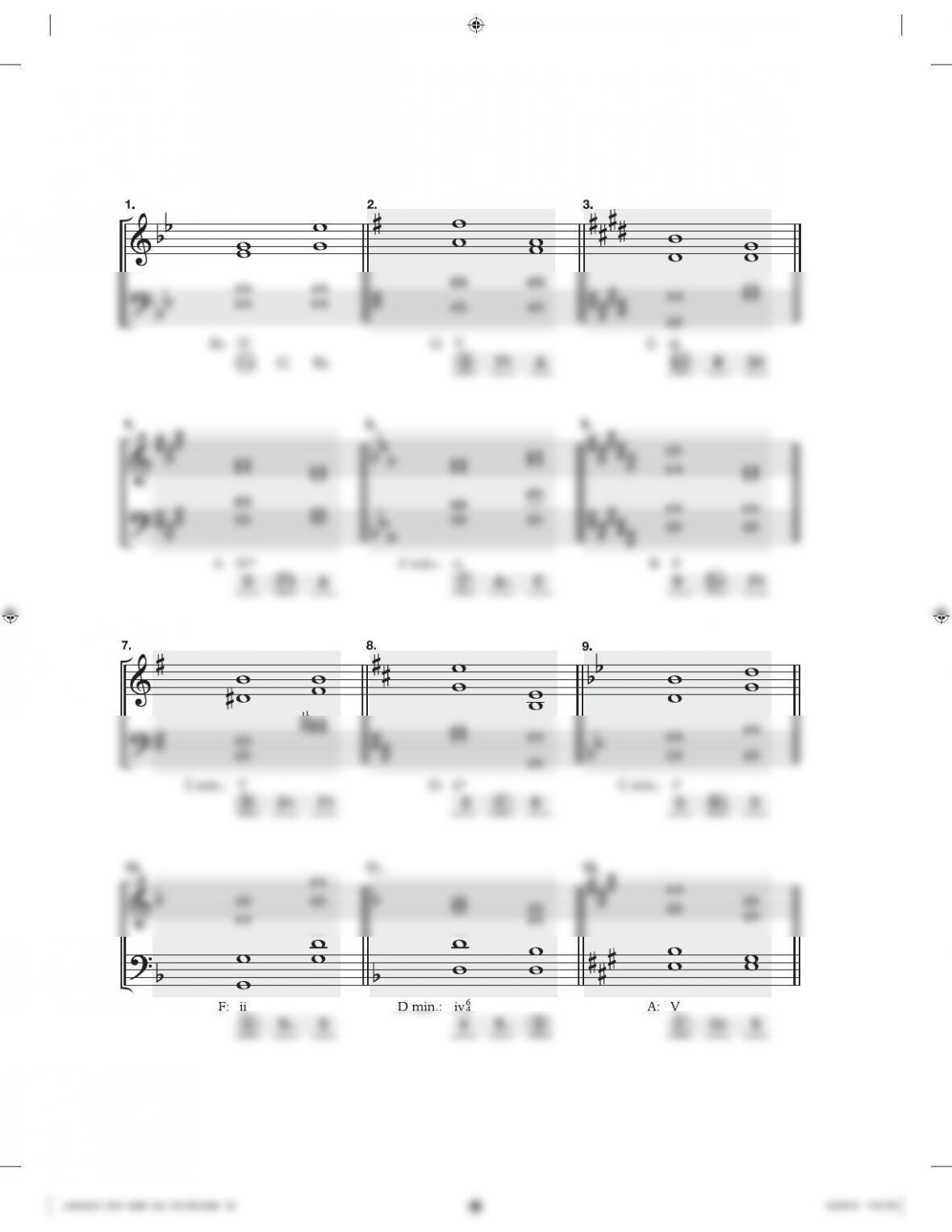
For each key and chord indicated below:
• Write the key signatures.
• Write the names of the notes of the chord in the blanks beneath the Roman
numeral and circle the note that should be in the bass.
58 | CHAPTER 4 | Four-Part Harmony
• On the staves, write the chord in SATB format in two different ways, using
proper range, spacing, and notation. Double the bass.
F. Realizing Figured Bass | 59
NAME:
F. REALIZING FIGURED BASS
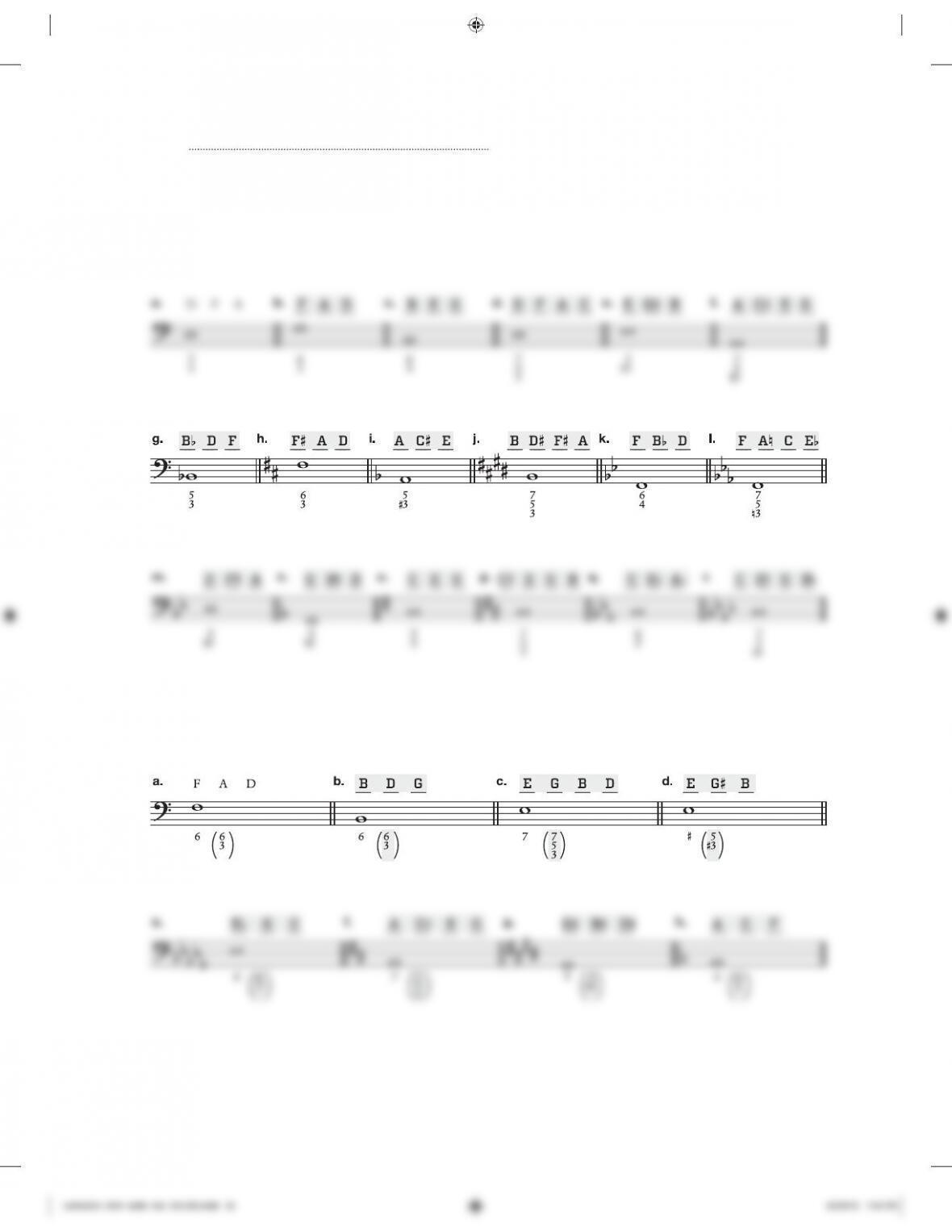
1. In the blanks above each chord, write the note names of the chord, as indicated by
the figured bass.
2. The following exercises provide abbreviated figured bass symbols. In the
parentheses next to each symbol, provide the unabbreviated form of the figured
bass. In the blanks above each chord, write the note names of the chord.
60 | CHAPTER 4 | Four-Part Harmony
3. Write each chord as indicated by the figured bass in two different ways, using
the correct notes with proper range, spacing, and notation. Exercises a
–
d are in
keyboard format, e
–
h are SATB.
4. Write each chord as indicated by the abbreviated figured bass in two different
ways, using the correct notes with proper range, spacing, and notation. In each
chord, double the bass. For a
–
d, use SATB format; for e
–
h, use keyboard format.