Chapter Three
International Cultures: Understanding Diversity
Overview
Yum, J. “The Impact of Confucianism on Interpersonal Relationships and Communication Patterns in
East Asia” (pp. 110-120).
In this essay, Yum first discusses the different emphases on social relationships and individualism
found in East Asia and the West and then describes some basic principles of Confucianism. She
Jain, N. “Some Basic Cultural Patterns of India” (pp. 121-126).
Jain provides an overview of Indian culture in this essay, specifically highlighting the Indian
Begley, P. “Communication with Egyptians” (pp. 126-133).
The focus of this essay is on understanding intercultural interactions involving Egyptians by
examining the worldview, religion, values, and language of Egypt. Following the introduction,
Bergelson, M. “Russian Cultural Values and Workplace Patterns” (pp. 133-140).
To demonstrate the importance of preventing the potentially damaging and destructive elements
of intercultural communication that result from misunderstanding in a globalized society, four
Skow, L. & Samovar, L. “Cultural Patterns of the Maasai” (pp. 141-149).
Skow and Samovar give the reader an overview of Maasai culture, beginning with the historical
accounts of Maasai creation, fierceness, and reaction to modernization that have influenced

– Chapter Three –
Outline
I. THE IMPACT OF CONFUCIANISM ON INTERPERSONAL RELATIONSHIPS AND
COMMUNICATION PATTERNS IN EAST ASIA (Yum)
a. Introduction
b. Social relationships versus individualism
c. Confucianism
i. History of Confucianism
ii. Principles of Confucianism
d. The impact of Confucianism on interpersonal relationship patterns
i. Particularistic versus universalistic relationships
1. The East Asian orientation applies particular rules and interaction
patterns depending on the relationship and the context
2. The North American orientation applies general and objective rules
across relationships and contexts
ii. Long-term asymmetrical reciprocity versus short-term symmetrical or contractual
reciprocity
iii. In-group/out-group distinction
2. The North American orientation has a less sharp distinction between in–
group and out-group members
iv. Informal intermediaries versus contractual intermediaries
1. In the East Asian orientation, intermediaries are usually personally
known and are used for diverse relationships
2. In the North American orientation, intermediaries are usually contractual
and professional and are used only for specific purposes
v. Overlap of personal and public relationships
2. In the North American orientation, personal and public relationships are
often separate
e. The impact of Confucianism on communication patterns
i. Process- versus outcome-oriented communication
ii. Differentiated versus less differentiated linguistic codes

1. In East Asia, linguistic codes are more differentiated, meaning that
2. In North America, linguistic codes are less differentiated
iii. Emphasis on indirect communication versus emphasis on direct communication
1. In East Asia, indirect communication is favored
2. In North America, direct communication is favored
iv. Receiver versus sender centeredness
1. In the East Asian orientation, communication is receiver-centered,
2. In the North American orientation, communication is sender-centered,
meaning is considered to be in the message, and formulating the best
messages, improving source credibility, and improving delivery skills are
emphasized
f. Discussion
II. SOME BASIC CULTURAL PATTERNS OF INDIA (Jain)
a. Worldview
i. Hindu conception of the universe, Atman and Brahman
b. Reincarnation
i. Reincarnation, Karma, and Nirvana
c. Dharma
i. Dharma
ii. The four stages of each person’s life
1. Brabmacharya (student)
3. Vanaprastha (retirement)
4. Final stage: the state of sannyas is reached
d. Caste system
i. Brahmins (priests)
ii. Kashtriyas (administrative or ruling classes)
iii. Vaisyas (traders, businesspeople, herders)
iv. Sudras (artisan specialists)
III. COMMUNICATION WITH EGYPTIANS (Begley)
a. Egyptian worldview and religion
i. Islamic history
ii. Islamic principles
2. God created the world
4. God will decide whether each Muslim will go to heaven or hell
iii. Islam and politics

2. Factions of religious fundamentalism have arisen, which urge more
adherence to religious laws
b. Egyptian values
i. Tradition
1. Tradition of rural farming
1. Egyptians fear loneliness and enjoy strong networks of friends and
family
2. Focus on family; kinship terms used metaphorically to emphasize
2. God is the ultimate authority
3. The oldest male of each family is the ruling patriarch
c. Egyptian language and culture
i. Arabic and unity
1. Classical Arabic as the language of the Koran
3. Linguistic style of Koranic writings is a model of linguistic excellence
iii. Writing as Art
d. Conclusion
IV. RUSSIAN CULTURAL VALUES AND WORKPLACE COMMUNICATION PATTERNS
(Bergelson)
a. Cultural sensitivity and cultural knowledge
“…in order to fully understand Russian communicative behaviors one must have
an appreciation of the basic cultural values which form the Russian worldview.” (p.
134)
1. Culturally loaded words (dusha – soul)
1. Inclination toward moral judgments
iv. Fatalism
1. The world is considered an irrational place
a. Behavioral attitudes which create difficulties when interacting
with Westerners

2. Problems arising from cultural differences
a. Traditional and Soviet co-cultures
i. A deep mistrust between the authorities and the people
ii. General pessimism
c. Culturally influenced communication patterns
i. Western (Anglo-American) and Russian politeness strategies and communication
patterns
1. Pure language mistakes can be easily recognized, but clumsy handling of
politeness strategies and speech acts can be taken as personality traits
ii. Politeness related problems
iii. Information processing related problems
2. Offering wrong or no answers to your questions, or “knowing better what
3. Addressee’s responsibility for information
a. A person interested in getting information has to ask for it
5. Parallel processing of information
a. Polychromic versus monochromic
iv. Culture and business: Applied communication patterns
1. Expectation gaps between Westerners and Russians in organizational
settings
a. Western: Russians don’t know how to work hard
i. Russian: Westerners have no appreciation of recent
societal changes

d. Application
i. Role-playing games
V. CULTURAL PATTERNS OF THE MAASAI (Skow & Samovar)
a. Background
i. The Maasai are not becoming Westernized as quickly as other cultures in Africa,
and they are proud of their cultural “purity”
b. Perception
i. History: Three episodes in the history of the Maasai have shaped their
perceptions of themselves, other people, and events
1. Creation of the culture
3. Reaction to modernization
ii. Values
1. Children
2. Cattle
3. Groups
5. Pride
6. Beauty
a. Both men and women adorn themselves with beautiful things
iii. Worldview
1. Nature
a. Nature is revered
3. Death
a. Corpses are left out in the open as part of a circular, mutually
beneficial relationship with nature
c. Verbal processes
i. Metaphors
1. Eloquent speakers use metaphor to show their mastery of language
ii. Proverbs

2. Examples of various proverbs and the cultural significance attached to
them
d. Nonverbal processes
i. Movement and posture
1. Posture and movement indicate strength, vigor, pride, and self-assurance
ii. Paralanguage
1. Male-female touching in public is very restricted, but same-sex touching
1. The Maasai never feel hurried or rushed, their time is not governed by a
1. Land is communal
2. Very little private space needed by Western standards
e. Conclusion– Chapter 3
Discussion Ideas
Concepts & Questions from “The Impact of Confucianism on Interpersonal Relationships and
Communication Patterns in East Asia” (Yum, pp. 110-120):
1. According to Yum, what is one reason Confucianism has endured?
3. What are the four Confucian principles of right conduct? How do they contribute to
communication behavior?
4. How do East Asian concepts of in-group and out-group differ from those of North Americans?
How might these differences affect intercultural communication?
5. How does Confucianism affect linguistic codes?
6. What are the major differences in the ways interpersonal bonding takes place in Eastern and
Western cultures?
9. What does Yum mean when she says that Confucianism is a philosophy of human nature?
10. Do you agree with Yum’s observation that it is not easy to change cultural values that have been
in place for several hundred years?
1. What does Jain mean when he writes that “Hinduism is an amorphous body of beliefs,
philosophies, worship practices, and codes of conduct”?
2. Why is knowing something about a culture’s worldview important for effective communication
with people of that culture?
3. How would you describe Jain’s explanation of a reality that is “undivided” and “unconditional”?
How does that reality differ from the Western view of reality?
4. What is meant by the phrase, “At the deepest level, existence is boundless”?

5. At the heart of the Hindu view of the world is the following: “Hindus believe that ordinary means
of acquiring knowledge—human senses, human reason, and empirical methods—cannot
penetrate the profound and undivided ultimate level of reality.” How would this notion influence
perception and the “defining” of reality?
6. What do you see as the link between dharma and ethics? Does your culture’s worldview have a
concept similar to dharma? What is it?
7. What is meant by “The Spirit of Tolerance” in the Hindu tradition?
8. Jain asserts that “An understanding of Indian worldview, and the influence of these cultural
patterns on communication behavior, will improve the quality of intercultural communication
between people of India and other cultures.” Do you agree? If so, why?
1. Why does Begley say it is hard to “think like an Egyptian”?
2. What aspects of Islamic history offer insights into Egyptian culture? What aspects of your own
culture would offer valuable insights for someone wanting to study your culture?
3. Why does Begley assert that “Islamic beliefs dominate every moment from birth to death and
beyond”?
4. Begley offers four tenets central to understanding Islam. What are they? Does your worldview
have similar or dissimilar tenets?
5. What does Begley mean when she writes, “Islam is a religion of action, not contemplation”? Is
your religion one of action or contemplation?
6. Why is the Arabic language so very important to Egyptians? What aspects of their language make
it unique?
7. What does Begley imply when she talks about Arabic as art?
8. What communication patterns within your culture might present problems when communicating
with someone of Egyptian culture?
Concepts & Questions from “Russian Cultural Values and Workplace Communication Patterns”
(Bergelson, pp. 133-140):
1. What idea is Bergelson trying to convey when she discusses Russian films?
2. What does Bergelson mean when she speaks of surface representations?
3. How would you explain the Russian values of emotionality, judgmental attitudes, fatalism, and
irrationality? Do you see the same four values being reflected in the United States?
4. How would you explain Bergelson’s observation that “Modern Russia is a huge conglomerate of
significantly contradictory cultural patterns”? Does the same generalization apply to the United
States?
5. Why do Russians “feel sensitive, vulnerable, and angry toward what they consider to be Western
cultural imperialism”? Should they feel this way?
6. What are some differences between politeness patterns in Russia and the United States?
7. What are some examples of normative Russian communicative behaviors that “become pitfalls in
a cross-cultural environment”?
8. Bergelson asserts that “It is evident that Russian–U.S. cross-cultural communication in a business
setting can be laden with challenging difficulties arising from culturally varied communicative
styles and behaviors.” What do you believe to be some of the difficulties?
9. Using Appendix I as a guide, compare and contrast the Western orientations with those of
traditional Russians on some of the following dimensions: (1) I/We orientation, (2) human

relationships, (3) activity orientation, (3) time orientation, (4) relation to nature, (5) progress, (6)
history, and (7) age.
Concepts & Questions from “Cultural Patterns of the Maasai” (Skow & Samovar, pp. 141-149):
1. What historical antecedents of Maasai culture contribute to their current worldview?
2. How does the Maasai’s orientation to children affect their worldview?
3. In what ways might the Maasai worldview affect intercultural communication?
4. How does the Maasai use of metaphor differ from the North American use? How could this
difference affect intercultural communication?
5. Skow and Samovar offer the following quotation by Edward T. Hall: “There is not one aspect of
human life that is not touched and altered by culture.” Do you agree with Hall? If so, why?
6. Why is it important to learn about the history of a culture? What aspects of the history of your
culture do you deem important? Why?
7. How would you compare the values of the Maasai culture with the values of your own culture?
Would a clash of these values present problems when you were communicating with a Maasai?
8. Compare three of the Maasai proverbs with three proverbs from your own culture.
9. Compare some of the Maasai’s nonverbal behaviors with some of the actions found in your
culture.
– Chapter Three –
Exercises
Exercise 3.1: Values that Conflict and Correspond
This exercise can be used in conjunction with the Begley article, “Communication with Egyptians,” and
the Skow and Samovar article “Cultural Patterns of the Maasai.” This activity asks the students to
1. What were the five top values of Egyptian or Maasai culture?
2. The top values that you ranked and the five top values of your friend?
3. What differences and similarities are there?
4. How do these rankings reflect the values of your cultures?
5. What are some examples of how the Egyptian or Maasai culture, as well as you and your friend’s
culture, have “taught” you to value certain things in life?
6. How might differences in cultural values influence interpersonal interactions?
7. How might such differences lead to interpersonal conflict?
8. How much do similarities and differences in values enhance intercultural communication?
9. What value differences might be insurmountable? Which would be incidental?

Exercise 3.1: Values that Conflict and Correspond
Value Inventory
Rank the following list of values from 1 (most valued) to 10 (least valued). Use Column A to record your
prediction of Egyptian or Maasai responses. Use Column B to record your responses to the values. Then
ask a person from another country or culture to rank the items and record them in Column C. The
definitions provided after each value are not meant to be definitive meanings. They are to allow you and
your friend to complete this inventory using the same definitions for each value.
Value
A
B
C
1. Happiness (contentedness)
2. Freedom (independence, free choice)
3. Salvation (being saved, eternal life)
4. Family security (taking care of loved ones)
5. Self-respect (self-esteem)
6. Equality (sisterhood/brotherhood, equal opportunity)
7. Sense of accomplishment (making a lasting
contribution)
8. A world at peace (free of war and international conflict)
9. Wisdom (a mature understanding of life)
10. A comfortable life (a prosperous life)
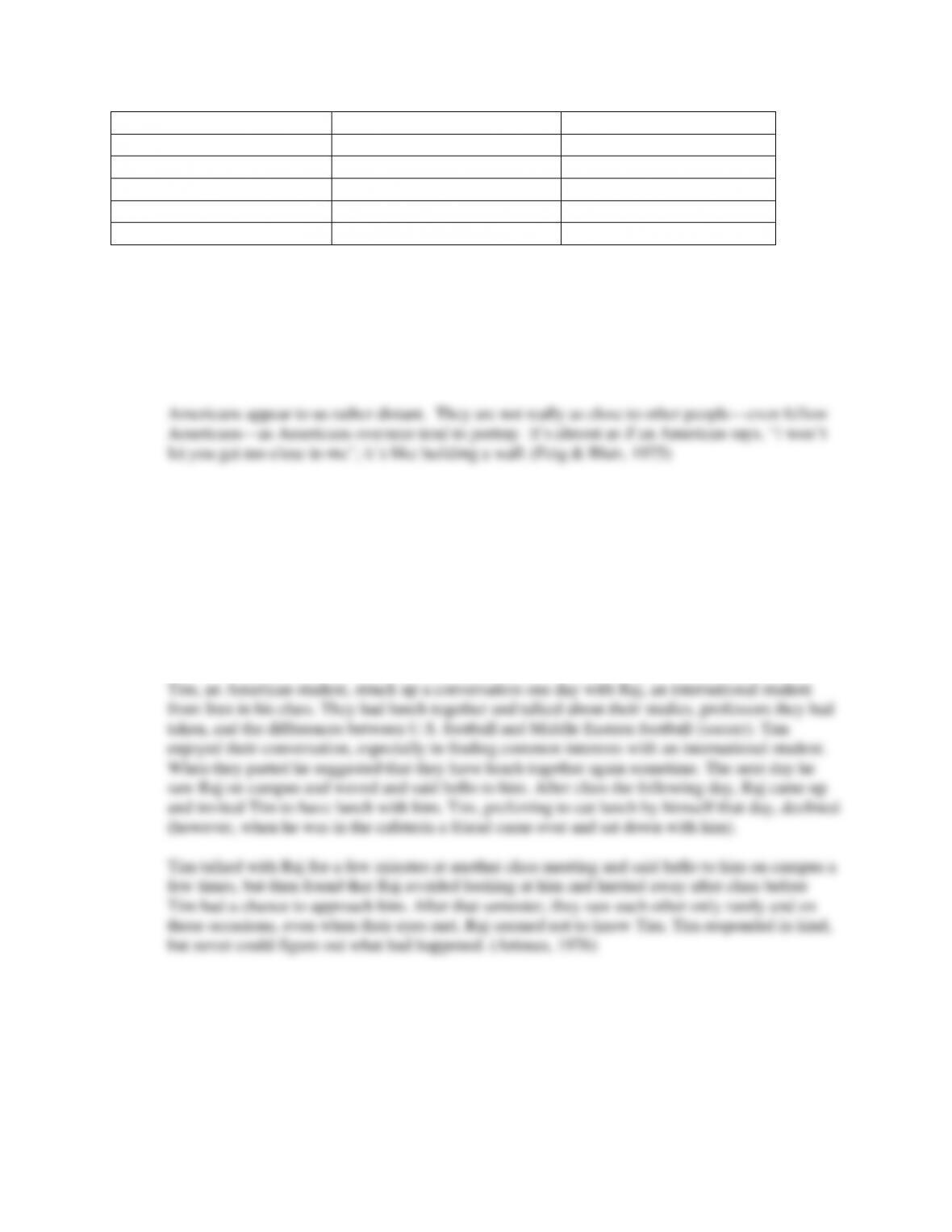
Value Comparison
Predicted Top Values of
Egypt/Maasai
My Top Values
My Friend’s Top Values
Exercise 3.2: Conflicting Messages
A common perception of people from the United States held by other cultures is that Americans tend to
be friendly yet distant and rather insincere. A Kenyan described people in the United States in the
following way:
While U.S. Americans may feel that by smiling and being informal they are communicating friendliness
and openness with people from other cultures, they may also be sending other messages that communicate
closed-mindedness and shallowness. How are these other messages sent and how might people from other
cultures respond to perceived insincerity?
The following case study of Raj and Tim from Artman (1976) includes some of these mixed messages
that we often don’t know we are sending. As students read the story, ask them to consider what messages
are being sent by both Raj and Tim, and how each is perceiving and responding to the messages. What
cultural factors are influencing these messages and responses?
After students have read the case study individually or in groups, discuss the scenario in groups using
some of the following questions:
1. How did Raj perceive his relationship with Tim after they had lunch together?
2. What messages did he receive from Tim that helped shape this perception?
3. How did Tim perceive his relationship with Raj after they had lunch together?
4. What messages might Tim have sent to Raj that led him to ignore Tim on campus?

5. How do you think Tim was perceiving his own behavior?
6. What might Raj have learned from his culture and from Tim from his about “appropriate”
friendly behavior among acquaintances?
7. What Iranian and U.S. American values and attitudes are evident from this scenario?
8. How might the miscommunication between Raj and Tim have been alleviated?
9. Think of what could have been done before, during, and after they met to prevent the breakdown
of their friendship.
Exercise 3.3: Showing Our Emotions
In some cultures, the expression of anger by yelling and cursing may be acceptable. In others, it would be
considered quite inappropriate. The extent to which we reveal ourselves through laughter, tears, anger,
anxiousness, and jealousy depends in large part on how our families and communities displayed emotions
and when we were chastised or rewarded as children for emoting inappropriately or appropriately. We
learned from culture how to show and not show our feelings.
After asking students to complete this list, ask them to consider the following questions.
1. Which emotions do you have the least/most difficulty expressing and why?
2. Which emotions do you have the least/most difficulty watching others express and why?
3. Which discrepancies, if any, are there between the extent to which you are willing to show certain
emotions and your feelings of comfort watching others express the same emotion?
4. How do you think your expression of emotions and your responses to others’ emotions have been
influenced by cultural beliefs and attitudes?
5. What differences and similarities are there in the displaying of emotions among your friends or
classmates who come from different cultural backgrounds?
6. How might intercultural communication be influenced by such differences?

Exercise 3.3: Showing Our Emotions Worksheet
Displaying Your Emotions Watching Others’ Emotions
1 very frequently 1 very comfortable
______________________ angry ______________________
______________________ loving ______________________
______________________ concerned ______________________
______________________ anxious ______________________
______________________ confident ______________________
______________________ sad ______________________
______________________ depressed ______________________
______________________ jealous ______________________
______________________ insecure ______________________
______________________ silly ______________________
______________________ violent ______________________
______________________ argumentative ______________________
______________________ arrogant ______________________
______________________ _________ ______________________

– Chapter Three –
Popular Film Suggestions
• Monsoon Wedding (New Delhi, 2001; writer/director: Mira Nair, with writer Sabrina Dhawan; 1
hr 54 min)
This film covers the concepts of class/caste, arranged marriage, collectivism, attitudes toward
• Fear and Trembling (Japan, 2003; director Alain Corneau; 107 min.)
This film, based on a true story, illustrates the kinds of misunderstandings that can occur in an
intercultural work environment. Amélie, a Belgian woman fluent in Japanese, takes on a job at a
Japanese corporation where it soon becomes clear that while she may speak the Japanese