B. Adding Embellishments | 257
NAME:
A. QUESTIONS FOR REVIEW
1. In what ways might embellishing tones create parallel fifths and octaves?
2. In what situations can adding an embellishing tone eliminate parallel fifths or
octaves? In what situations does adding an embellishing tone not eliminate parallel
octaves?
3. What is a pedal point? In what voice does it usually appear?
B. ADDING EMBELLISHMENTS
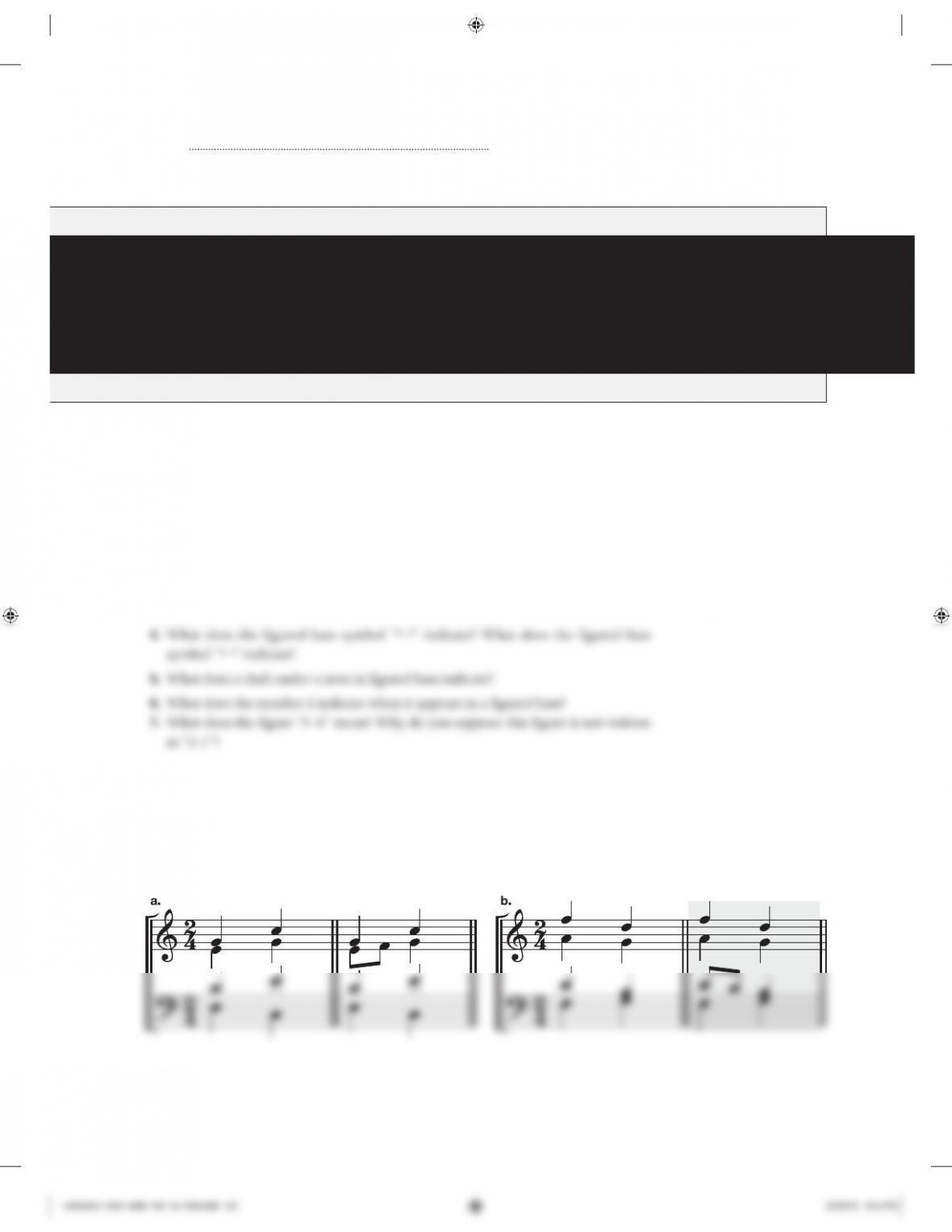
1. Rewrite each of the following chord pairs, adding one embellishing tone—either
a passing tone or neighbor tone—between the chords. The first example has been
completed for you.
chapter
20 Voice Leading with
Embellishing Tones
258 | CHAPTER 20 | Voice Leading with Embellishing Tones
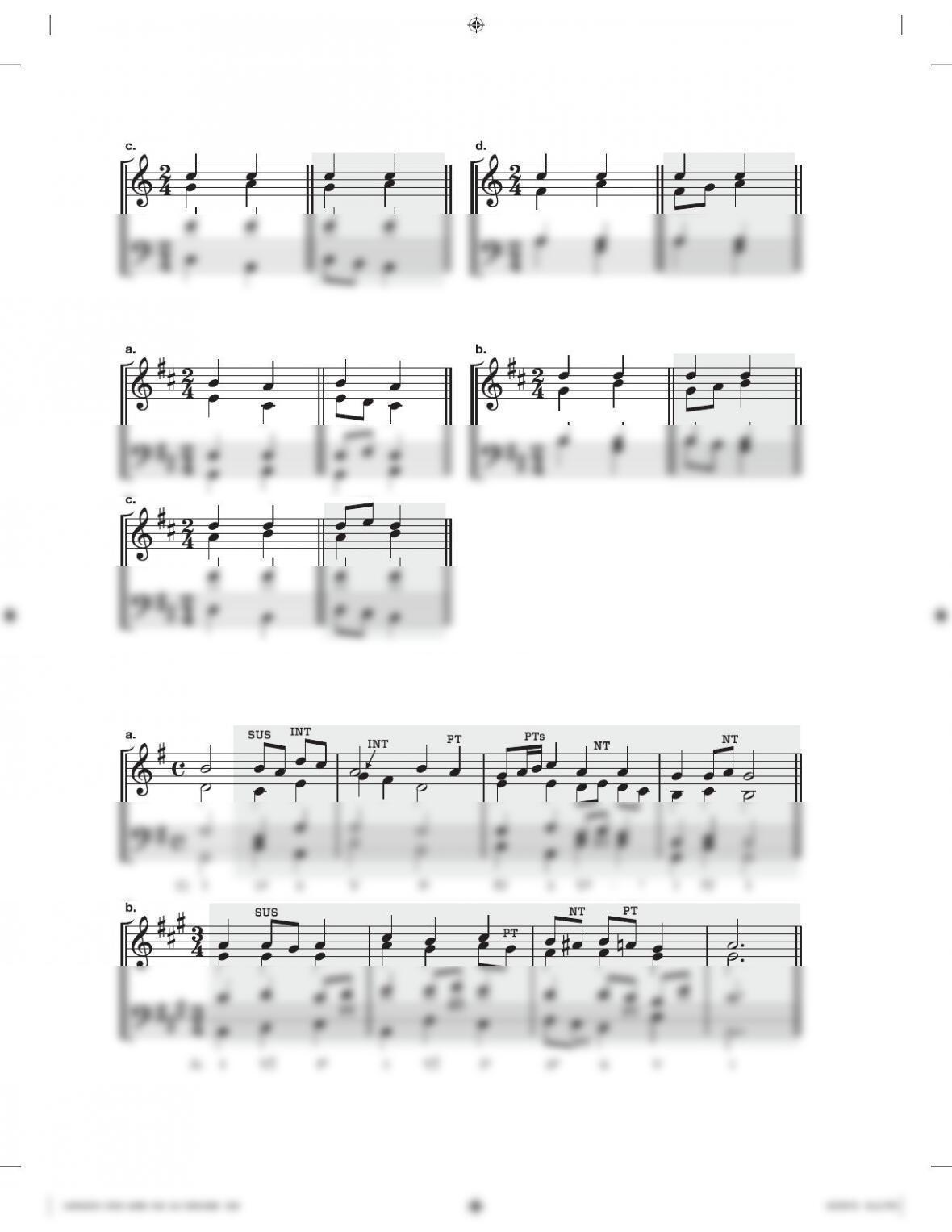
2. Rewrite each of the following chord pairs, adding two simultaneously sounding
embellishing tones between the chords. The first example has been completed for you.
3. Realize the following Roman numerals in SATB format, adding at least one
passing tone, one neighbor tone, and one suspension to each progression. Label
the embellishing tones.
C. Reading Figured Bass | 259
NAME:
C. READING FIGURED BASS
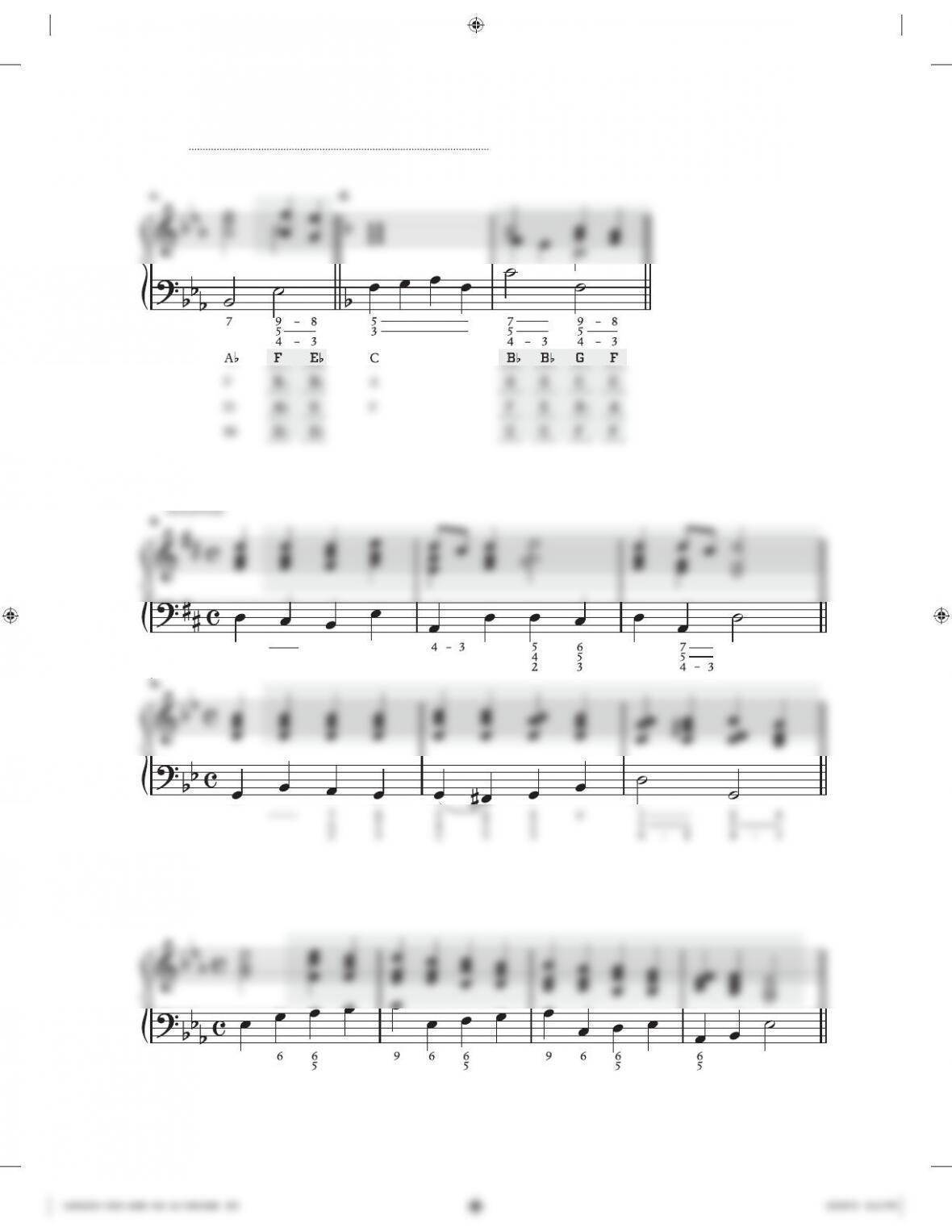
1. For each of the following sonorities:
• Above the staff, name the notes in the upper voices as indicated by the figured
bass.
• Note that none of these involves an inversion of a standard chord: in each case,
the notes in the chord must be determined by counting the intervals above the
bass.
2. For each of the following sonorities:
• Above the staff, name the notes in the three upper voices as indicated by the
figured bass.
• Note that some of the figures are standard abbreviations for chords that use
four different notes, while others are sonorities using only three different notes.
• If only three notes are indicated, decide which note you want doubled, write
that as the fourth note, and circle it.
3. For each of the following progressions or pairs of sonorities:
• Above the staff, name the notes in the upper voices, as indicated by the figured
bass.
• Use parentheses to indicate notes in the second chord that are held over from
the first.
• When the figured bass indicates a three-note sonority or chord, decide which
note you want doubled, write that as the fourth note, and circle it.
260 | CHAPTER 20 | Voice Leading with Embellishing Tones
D. REALIZING FIGURED BASS
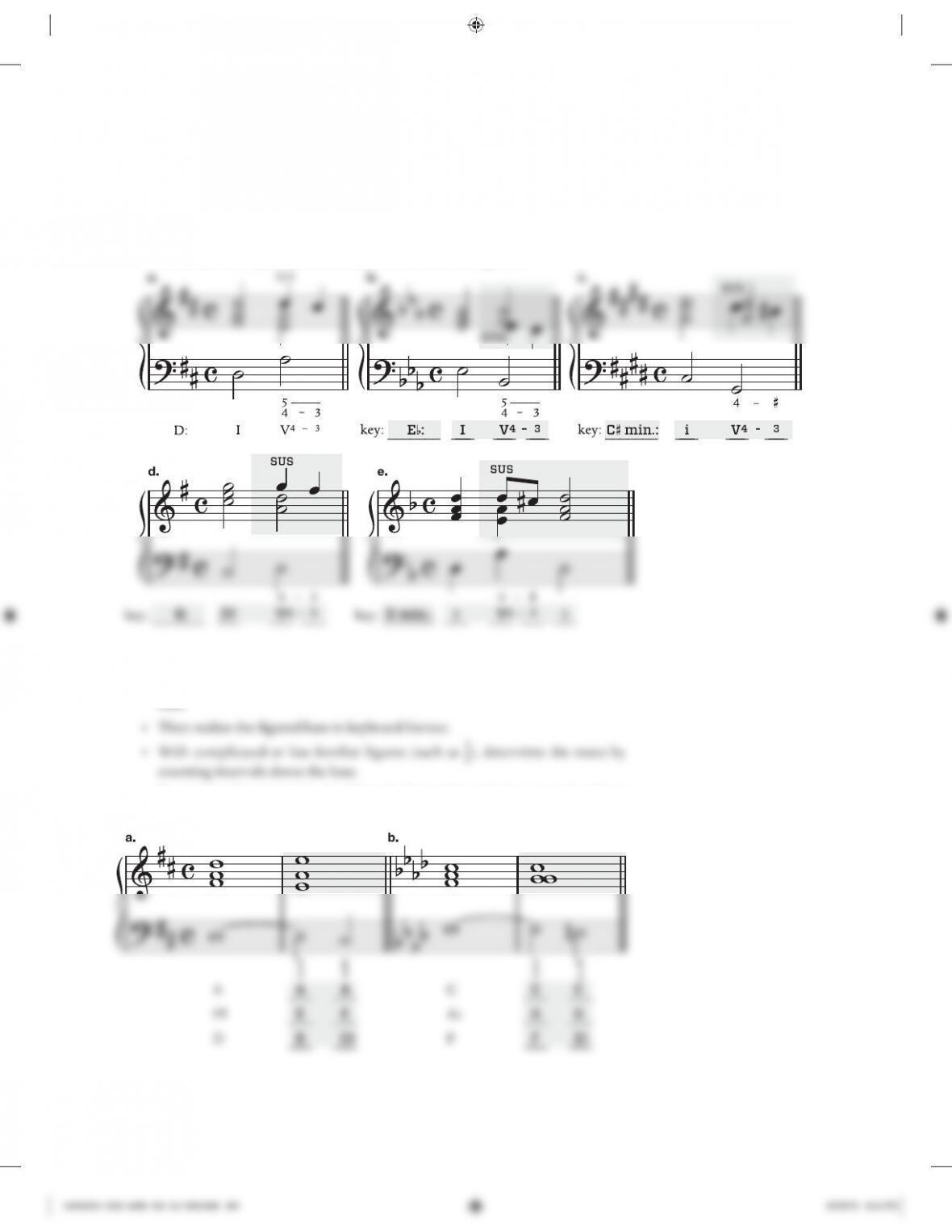
1. For each of the following:
• Realize the figured bass.
• Remember that “4–3” = “5––
4–3 = “5
4–
–5
3,” and “4–#” = “5
4–
–5
#3.”
• Then label the keys, Roman numerals, and embellishing tones.
2. For each of the following:
• Below each bass note, write the names of the notes as implied by the figured
bass.
• Remember that when there is a “2” in the figured bass, the bass note should not
be doubled.
NAME:
D. Realizing Figured Bass | 261
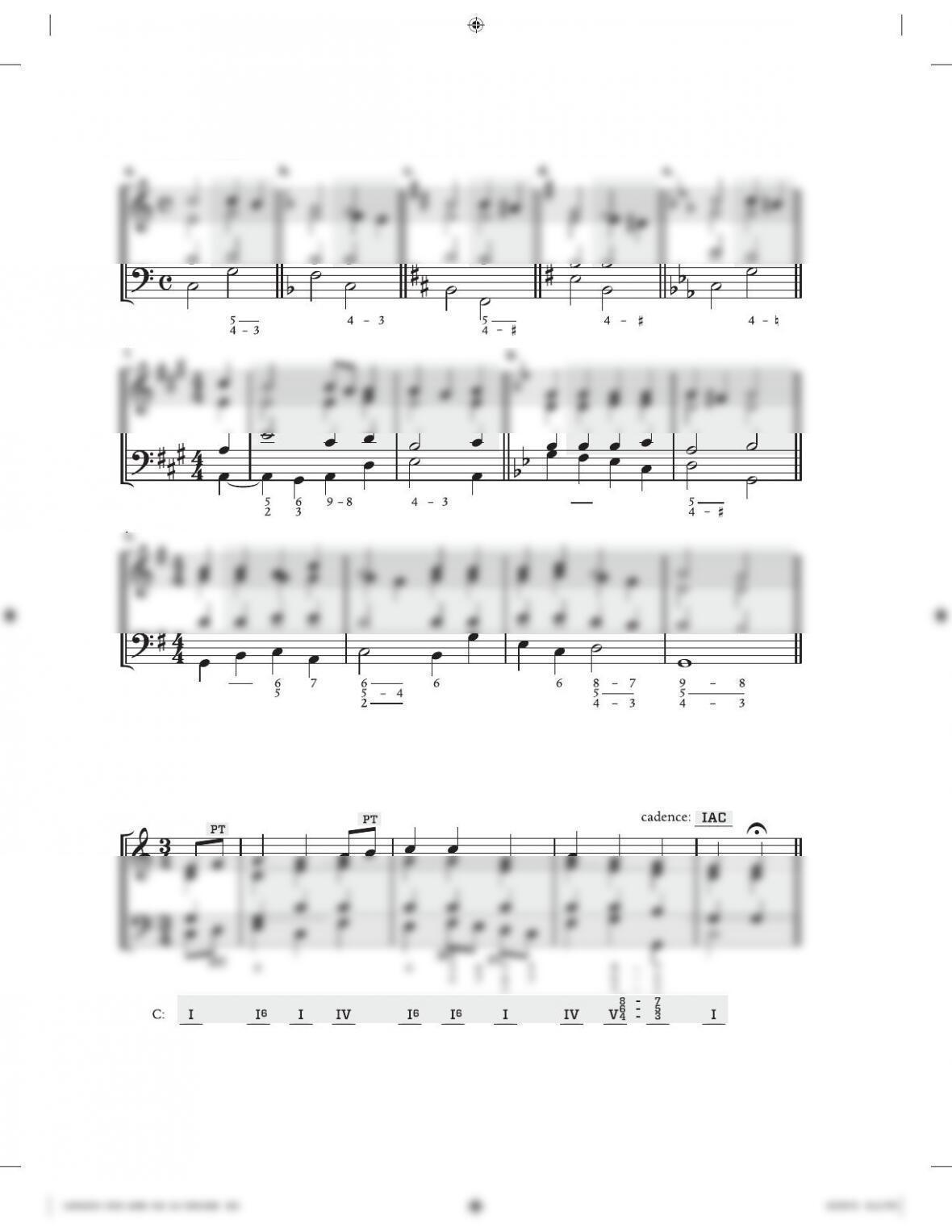
3. Realize each figured bass in keyboard format. Remember that the use of a dash
within the figures indicates that the notes in the upper voices should repeat or be
c. G. F. Handel, Exercise for Princess Anne
Remember, the figure 9 = 9
5
3.
262 | CHAPTER 20 | Voice Leading with Embellishing Tones
4. Realize each figured bass in SATB format.
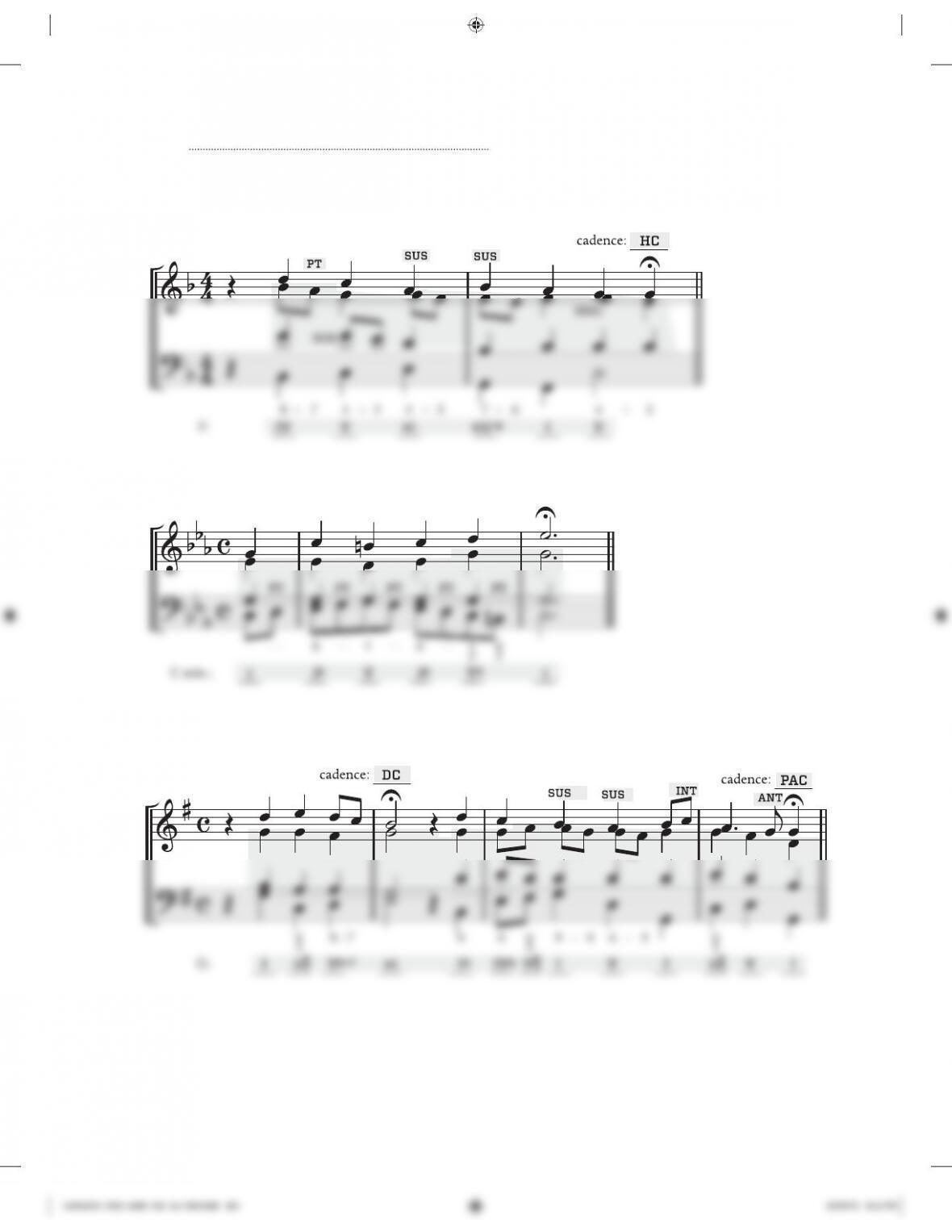
5. Complete the realizations of these chorale excerpts by J. S. Bach in SATB format.
Then label the Roman numerals, embellishing tones, and (where indicated) the
cadences.
a. “Eins ist Noth!” (“One thing’s needful”)
NAME:
D. Realizing Figured Bass | 263
b. “Ich lasse dich nicht” (“I won’t let you go”)
Hint: With the figure 7–6 in the second measure, omit the fifth above the bass.
c. “Ich freue mich in dir” (“I rejoice in you”)
d. “Kein Stündlein geht dahin” (“No hour goes by”)
Remember, 9–8 = 9
5
3
–
–
–
8
5
3.
264 | CHAPTER 20 | Voice Leading with Embellishing Tones
E. HARMONIZING MELODIES
For each of the following melodies:
• Provide a bass line and Roman numerals.
• Then fill in the inner voices in SATB format.
• Label the embellishing tones in the melody. (If you wish, you may add some
embellishing tones to the bass and inner voices as well.)
1.
2. Use one chord for the last half of the final measure.
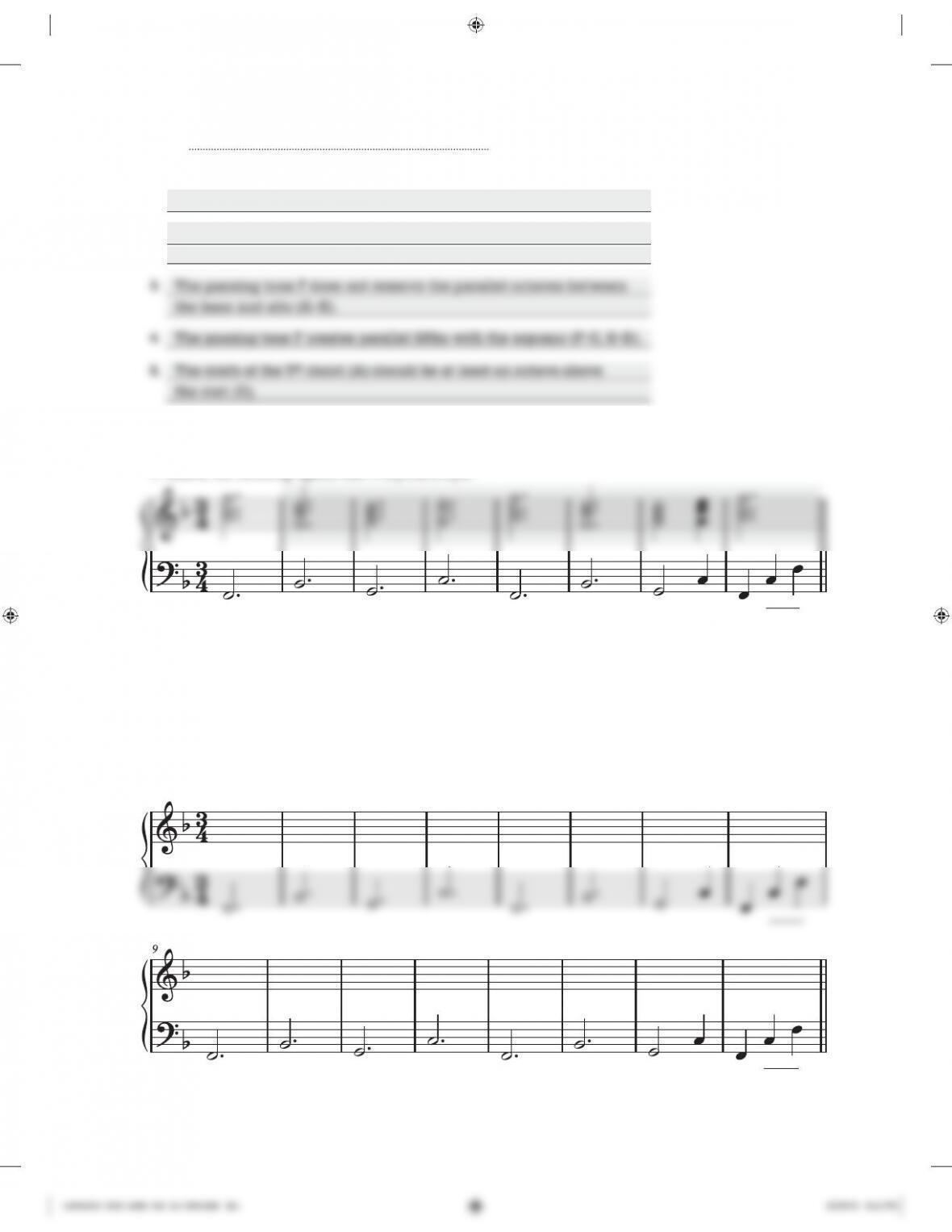
F. ERROR DETECTION
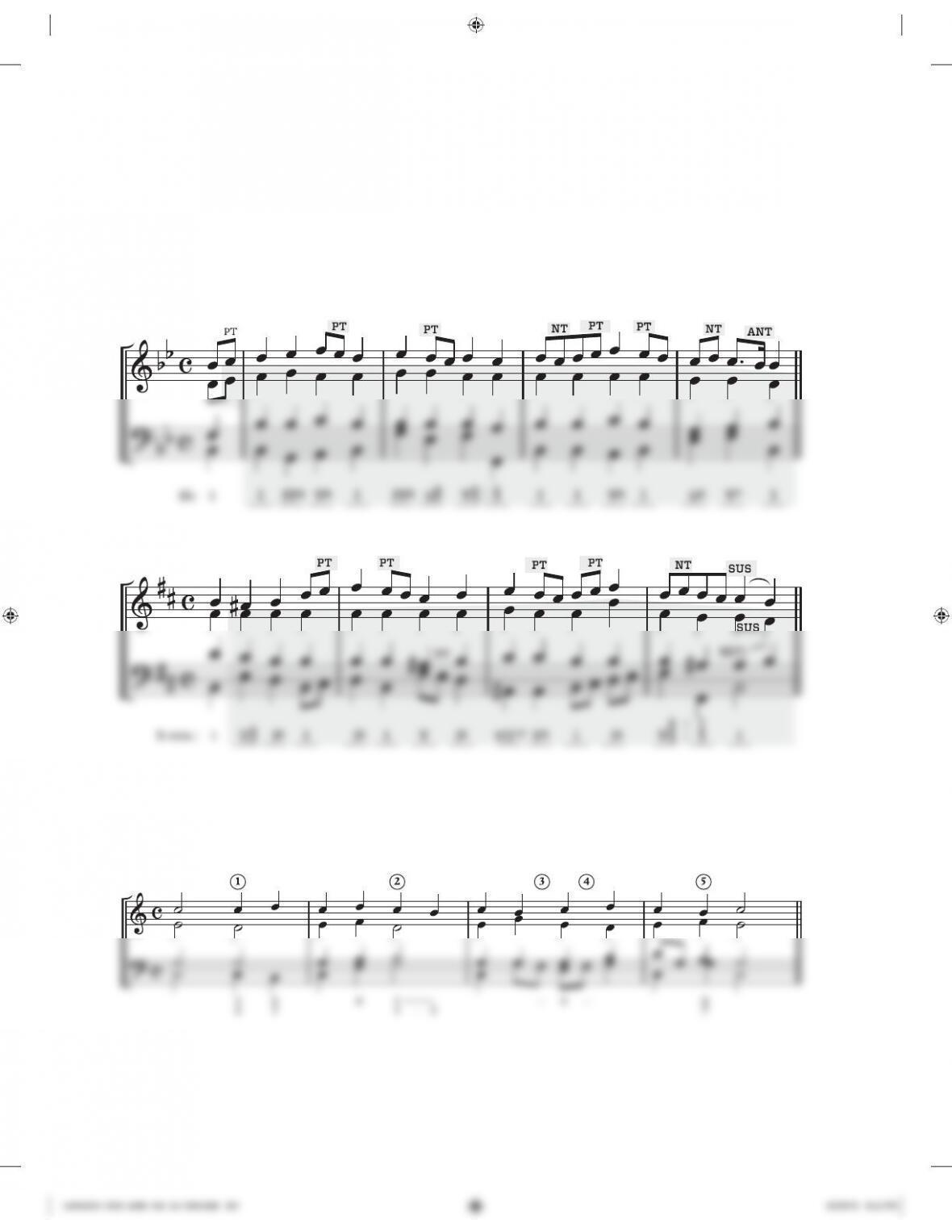
Below is a faulty realization of a figured bass, with numbers placed above each
mistake. On the blank lines following the score, describe each of these errors.
G. Composition | 265
NAME:
1. With the figure 5
2, the bass should not be doubled.
2. With the figure 5—
2–3, the third of the chord should not appear until 4
resolves to 3.
G. COMPOSITION
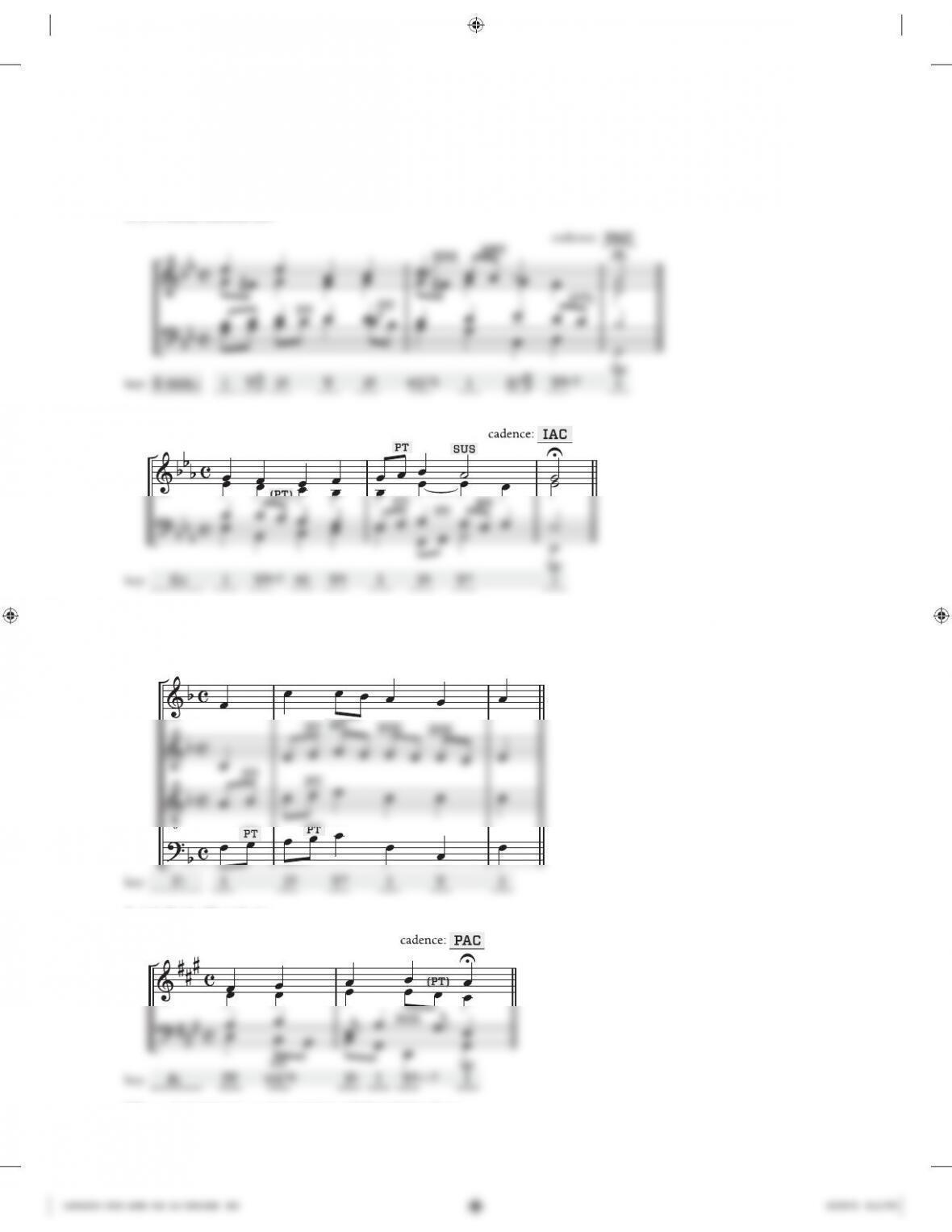
1. Realize the following figured bass in keyboard style.
2. Compose a melody above the following bass line.
• Use half notes, quarter notes, and eighth notes, with a dotted half note in measure 16.
• The notes should either be chord tones—that is, notes of the chord as seen in
(1) above—or embellishing tones. Label each embellishing tone.
• Octaves or fifths on the downbeat of a measure should be approached in
contrary motion.
• No two measures in a row should begin with a perfect octave or perfect fifth.
• The melody in measures 9–16 should be different than in measures 1–8.
266 | CHAPTER 20 | Voice Leading with Embellishing Tones
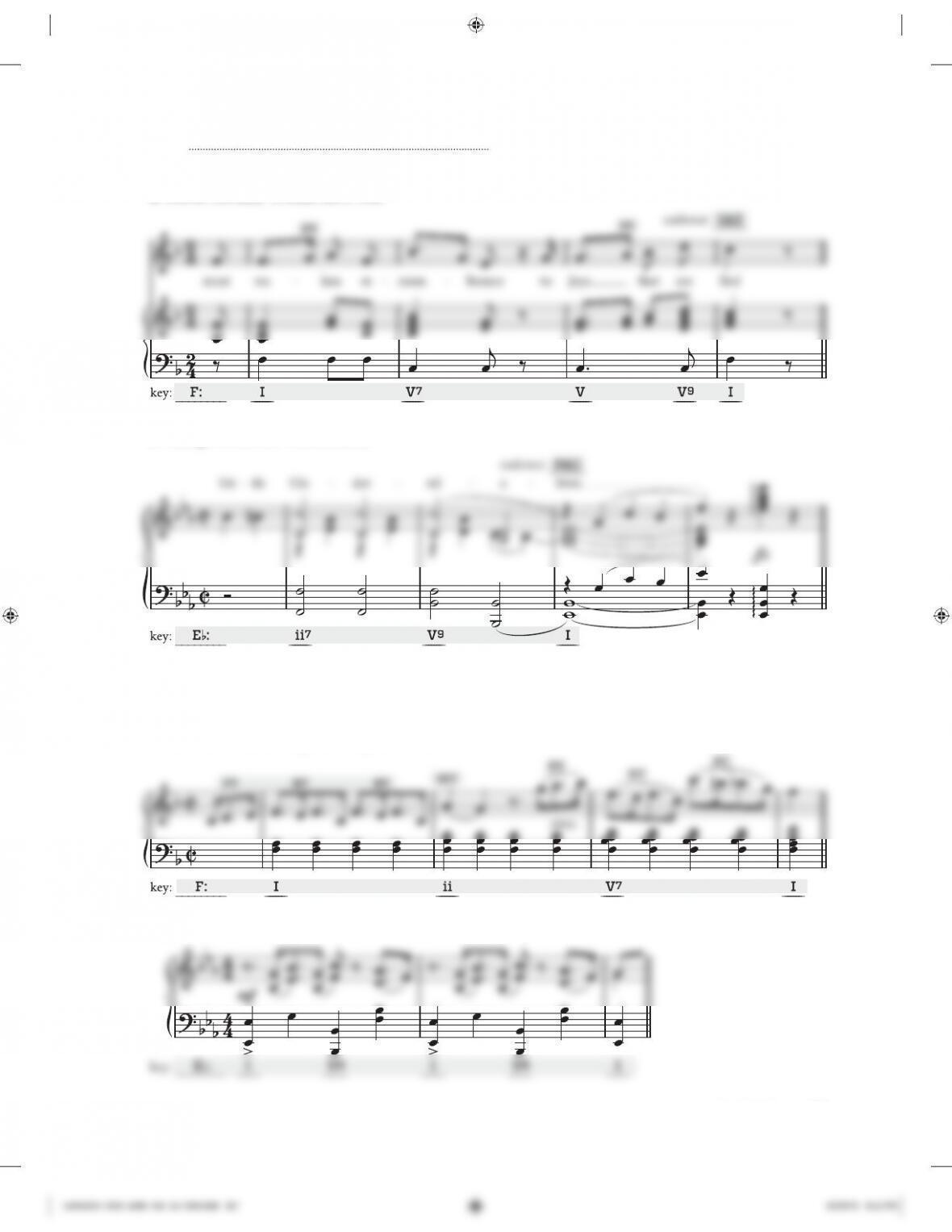
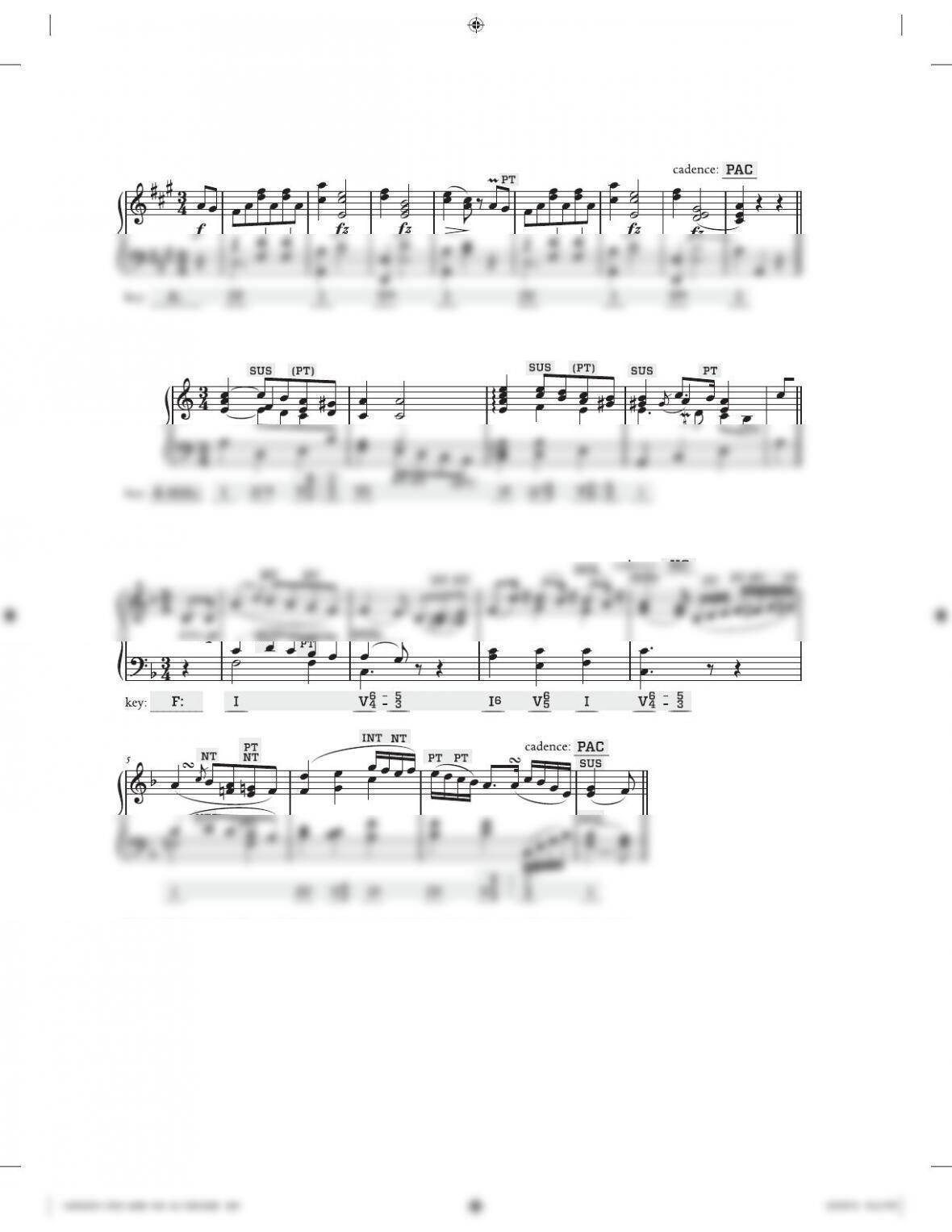
H. ANALYSIS
Label the key, Roman numerals, cadences (where indicated), and embellishing tones.
1. J. S. Bach, Chorale 269
2. J. S. Bach, Chorale 22
3. J. S. Bach, Chorale 154
Note: This is in open-score format; the tenor voice sounds an octave lower than
notated.
4. J. S. Bach, Chorale 36
H. Analysis | 267
NAME:
5. Harriet Abrams, “A Smile and a Tear”
6. George Gershwin, “Cinderelatives”
7. Léopoldine Goubau d’Hovorst, Piano Sonata, Op. 13, i
The following passage is built over a pedal tone in the bass. As always, when labeling
Roman numerals above a bass pedal tone, do not worry about indicating the chord
inversions. What scale degree is the pedal tone?
8. Jerome Kern, “You Found Me and I Found You”
268 | CHAPTER 20 | Voice Leading with Embellishing Tones
9. Franz Schubert, Dances, D. 365, No. 17
10. J. S. Bach, English Suite No. 2, Sarabande
11. Ludwig van Beethoven, Piano Sonata, Op. 2, No. 2, ii
How do the two halves of this passage compare? In what ways are they similar, and
in what ways do that differ?