B. Spelling Chords | 117
NAME:
A. QUESTIONS FOR REVIEW
1. What are the two tendency tones within V7? In which direction do they each lead?
2. In a V7–I progression in four-part harmony, which chord tone may be omitted
from V7? If a chord tone is omitted from V7, what note should be doubled?
3. In a V7–I progression in four-part harmony, which chord tone should be omitted
from I? If a chord tone is omitted from I, what note may be tripled?
4. Which is more common, V7–V or V–V7? Why?
5. What does “V8–7” stand for? How is this indicated with figured bass?
6. What are the options for the dominant harmony in an authentic cadence? In a half
cadence?
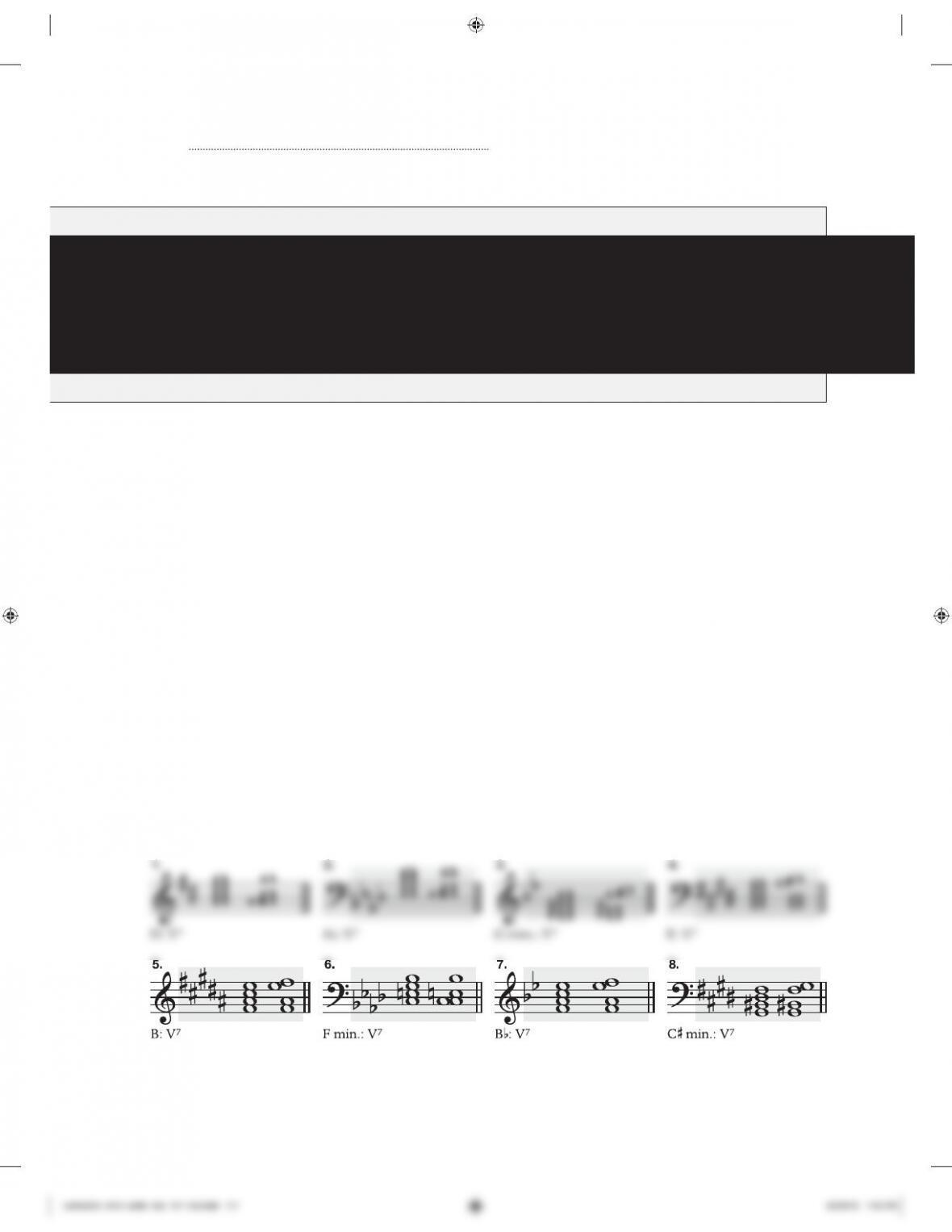
B. SPELLING CHORDS
Write the key signatures of the following keys. Then write the notes of the V7 chord
twice in each key: first with all the notes, and then with the fifth omitted and the root
doubled. Remember to raise ˆ
7 in the minor keys.
chapter
10 The Dominant Seventh
Chord: V7
118 | CHAPTER 10 | The Dominant Seventh Chord: V7
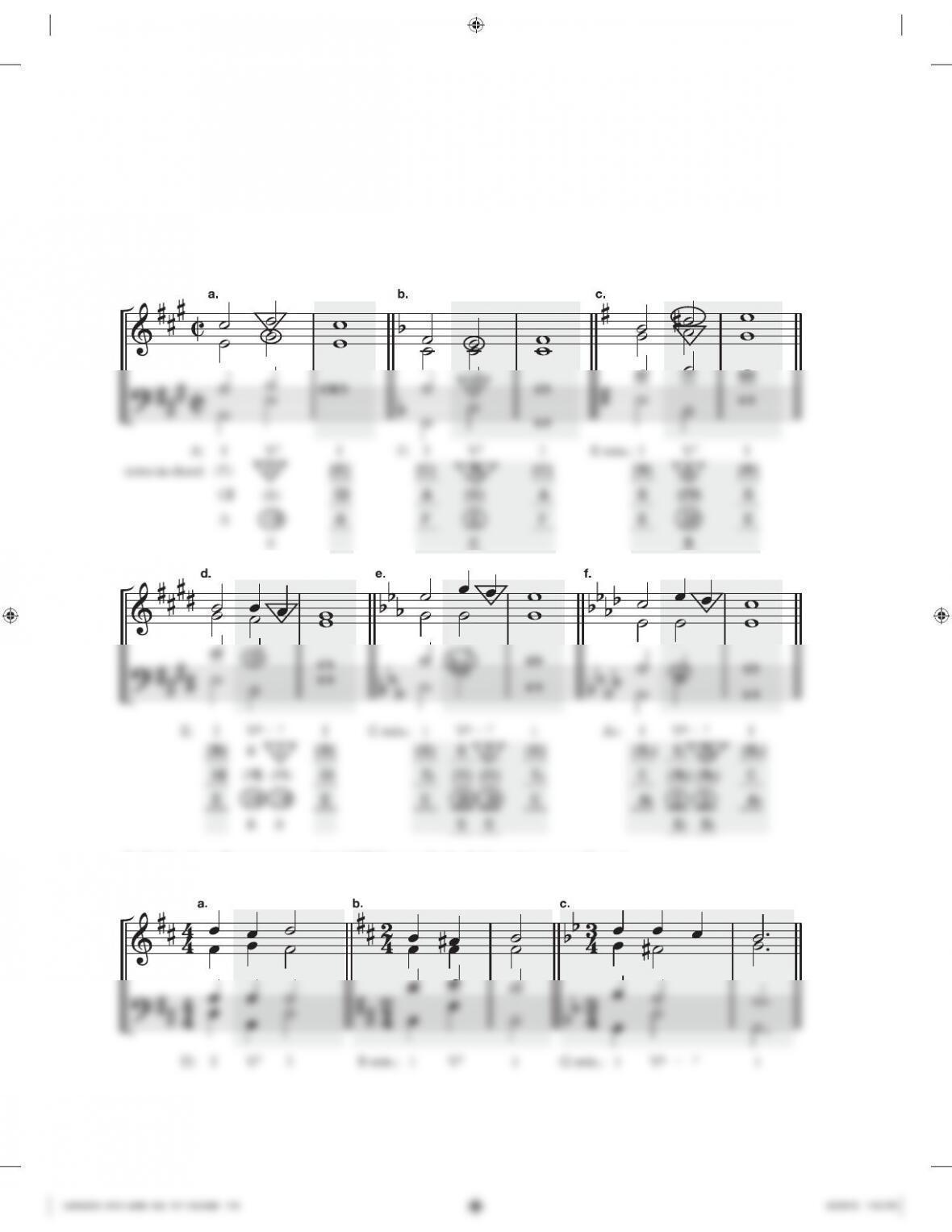
C. REALIZING ROMAN NUMERALS
1. • On the blank lines below the sta, write the note names of the given chords;
place parentheses around any note that may be omitted from the chord.
• Then complete the Roman numeral realization.
• Throughout, circle every leading tone and place an inverted triangle around
every chordal seventh.
2. Realize these Roman numerals in SATB format. For both (b) and (c), you will need
to provide the key signature as well.
C. Realizing Roman Numerals | 119
NAME:
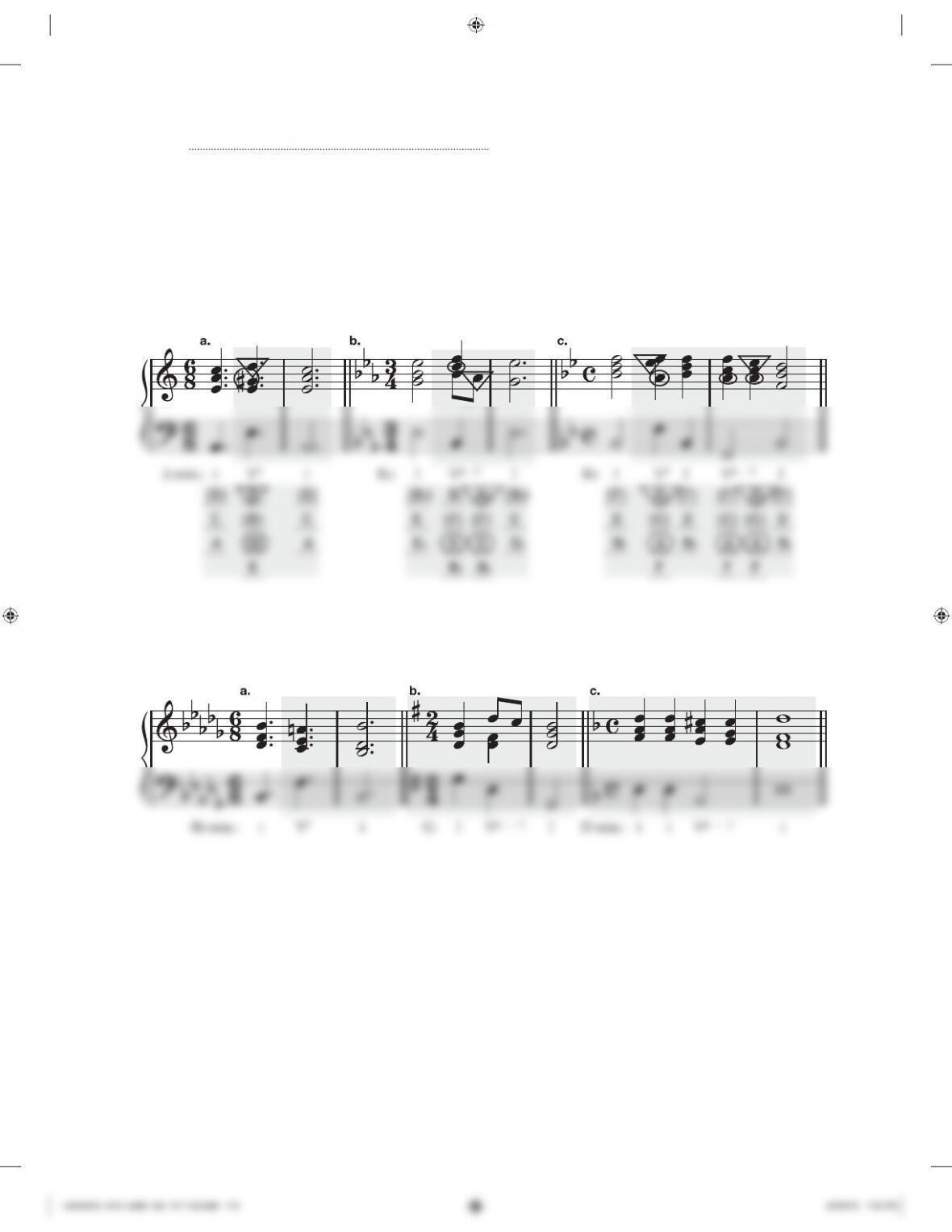
3. • On the blank lines below the sta, write the note names of the given chords;
place parentheses around any note that may be omitted.
• Then complete the Roman numeral realization in keyboard format.
• Throughout, on the sta and in the spelled chords, circle every leading tone and
place an inverted triangle around every chordal seventh.
4. Realize these Roman numerals in keyboard format. For both (b) and (c), you will
need to provide the key signature as well.
120 | CHAPTER 10 | The Dominant Seventh Chord: V7
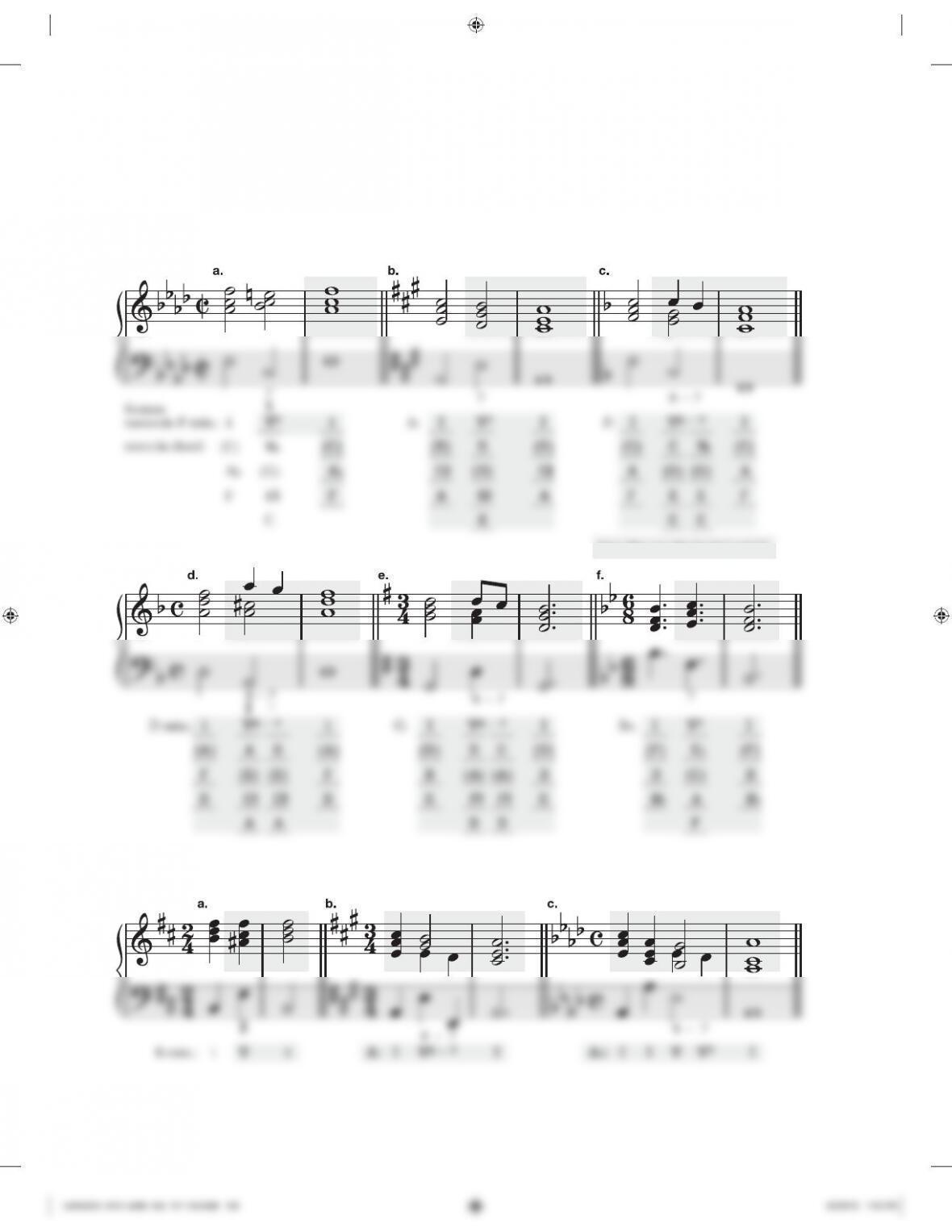
D. REALIZING FIGURED BASS
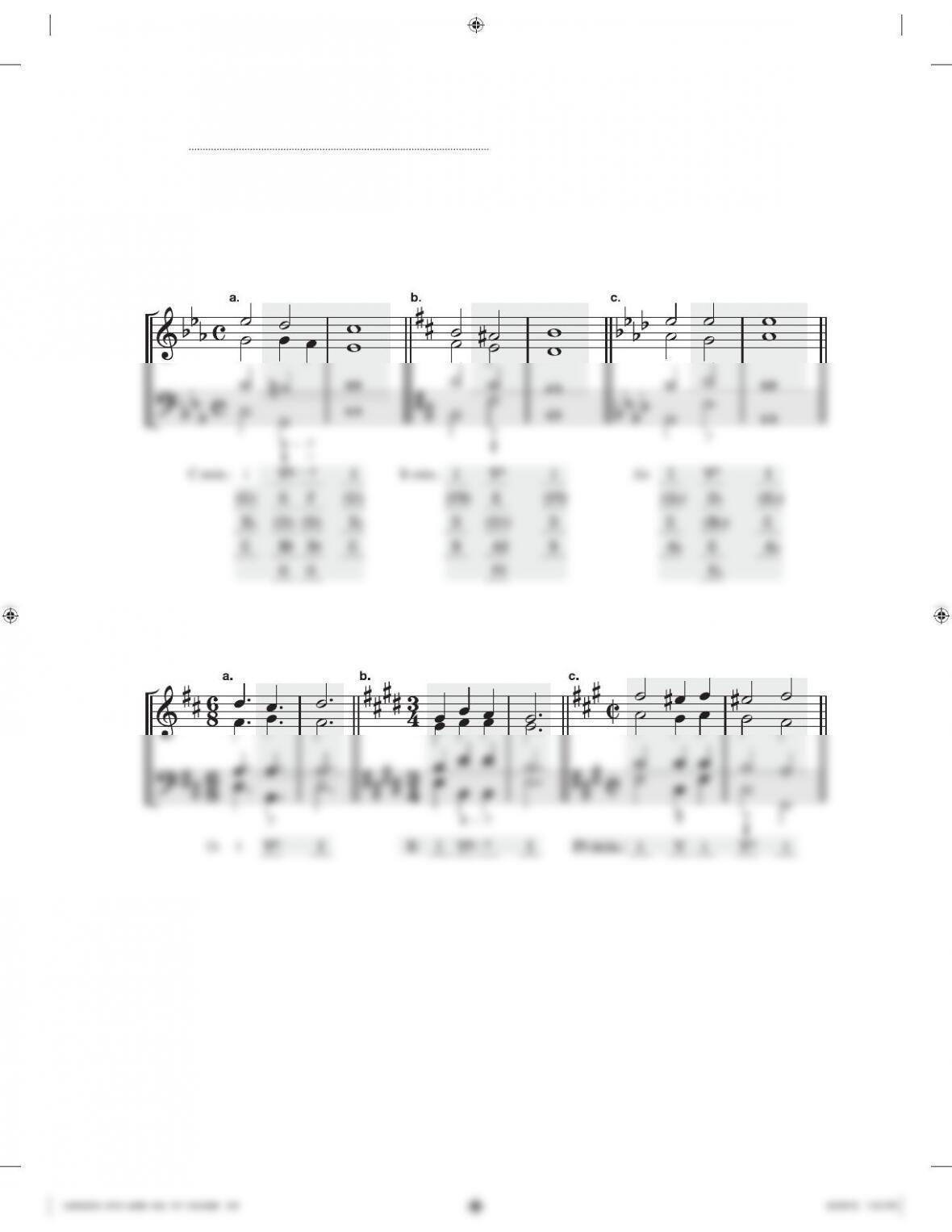
1. • On the blank lines below the sta, write the note names of the chords indicated
by the figured bass.
• Place parentheses around any note that may be omitted from the chord.
• Then complete the figured bass realization and label the Roman numerals.
Roman
2. Realize these figured basses in keyboard format, and label the key and Roman
numerals.
D. Realizing Figured Bass | 121
NAME:
3. • On the blank lines below the sta, write the note names of the chords indicated
by the figured bass.
• Place parentheses around any note that may be omitted from the chord.
• Then complete the figured bass realization and label it with Roman numerals.
(G) G F (G) (F ) E (F ) (E ) D (E )
___ ___ ___ ___ ___ ___ ___ ___ ___ ___
E (D) (D) E D (C ) D C (B ) C
___ ___ ___ ___ ___ ___ ___ ___ ___ ___
C B B C B A B A G A
___ ___ ___ ___ ___ ___ ___ ___ ___ ___
G G F E
___ ___ ___ ___
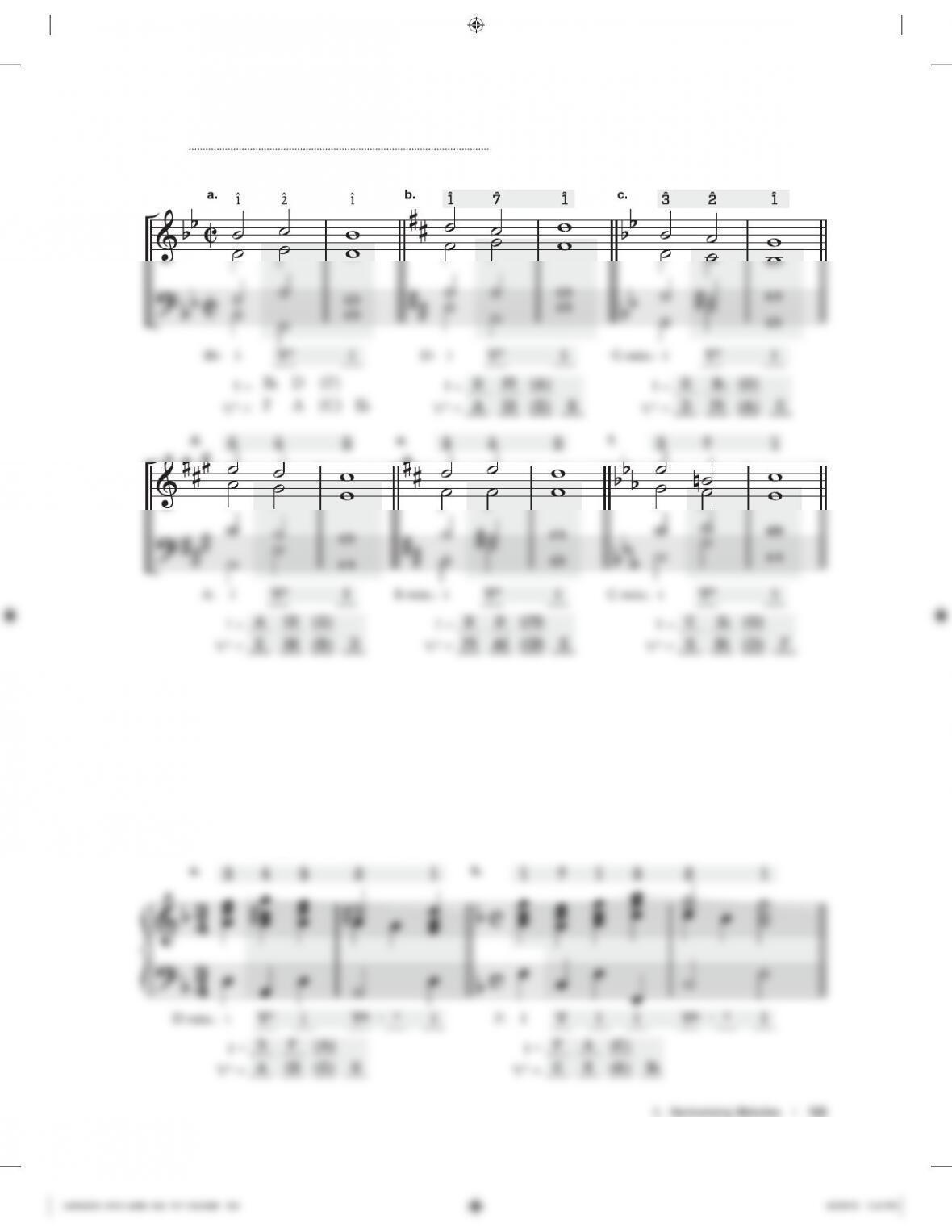
4. Realize these figured basses in SATB format, and label the key and Roman numerals.
5. Complete the realization of the figured bass accompaniment for these excerpts.
Do not worry about any parallel perfect intervals that may arise between your
figured realization and the given melody.
a. Pierre Gaviniès, Violin Sonata Op. 1, No. 5
b. Giovanni Battista Pergolesi (attrib.), “Medway”
E. HARMONIZING MELODIES
1. SATB format. For each of the following melodies:
• In the blanks beneath the sta, write the note names of the I and V7 chords.
Place parentheses around any notes that may be omitted.
NAME:
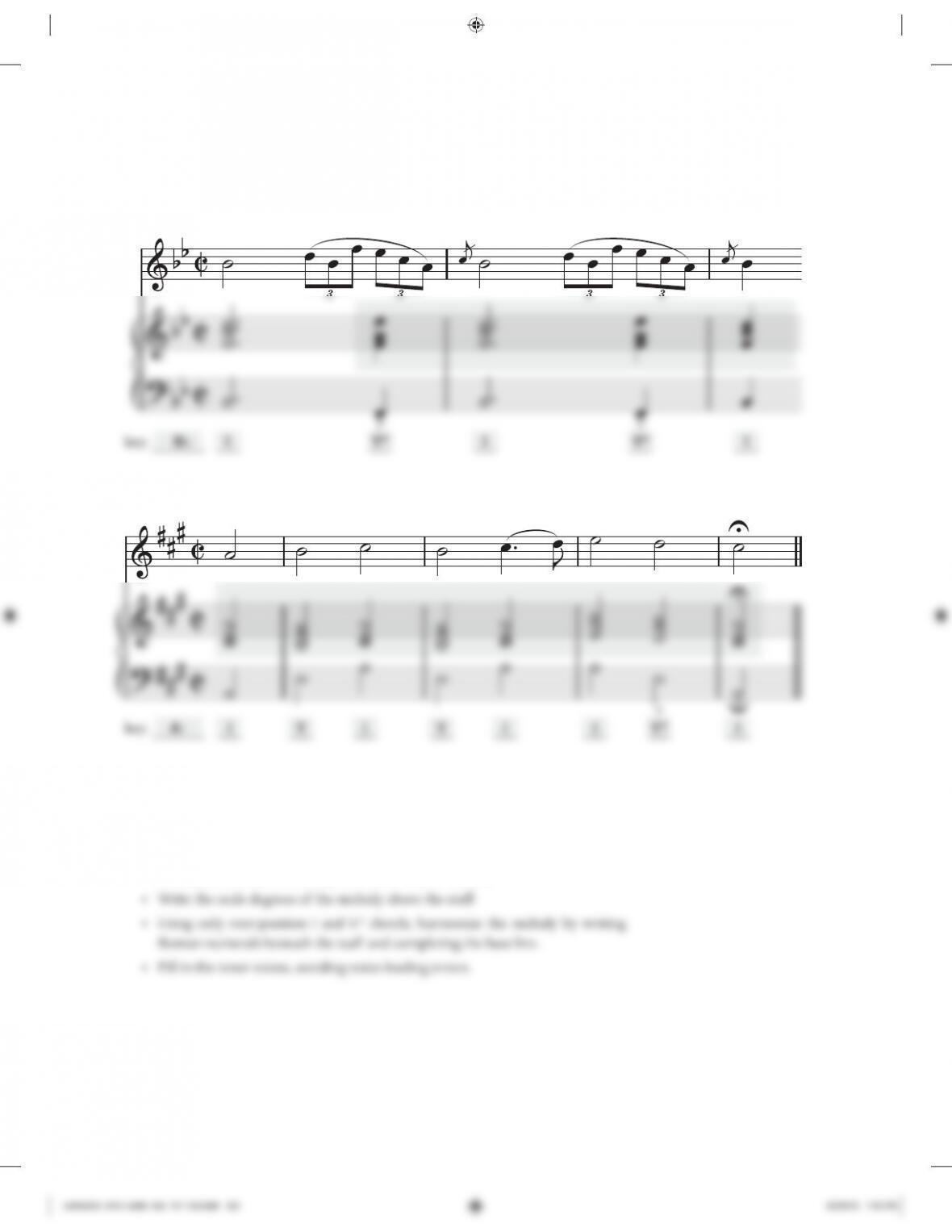
2. Keyboard format. For each of the following melodies:
• In the blanks beneath the sta, write the note names of the I and V7 chords.
Place parentheses around any notes that may be omitted.
• Write the scale degrees of the melody above the sta.
• Using only root-position I and V7 chords, harmonize the melody by writing
Roman numerals beneath the sta and completing the bass line.
• Fill in the inner voices, avoiding voice-leading errors. As always, the given note
should be the highest note of the chord.
124 | CHAPTER 10 | The Dominant Seventh Chord: V7
3. Using only root-position I , V, and V7 chords, harmonize the following melodies in
SATB format, labeling the Roman numerals.
F. ERROR DETECTION
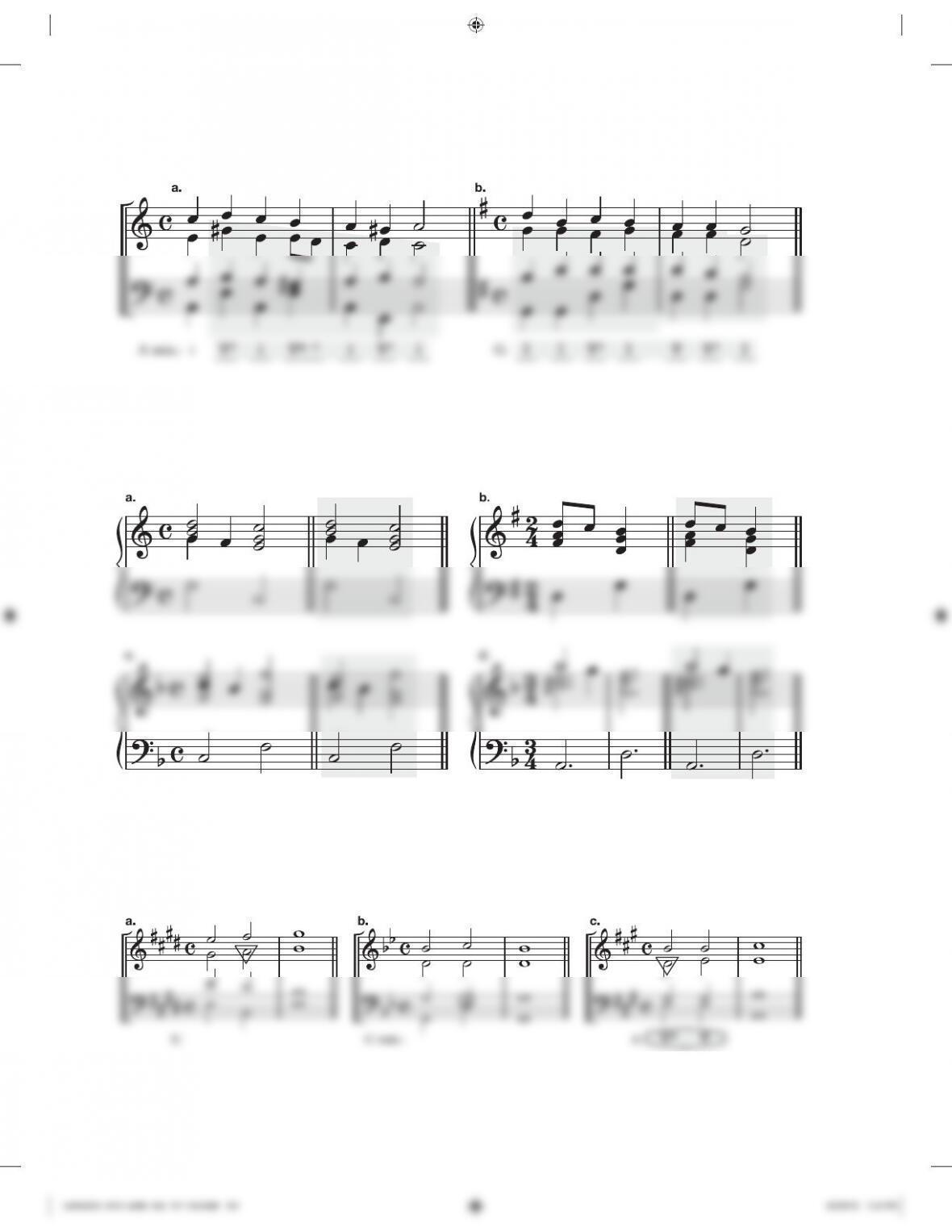
1. Each of the following V8-7–I progressions are incorrectly notated. Notate these
progressions properly in the blank measure that follows each.
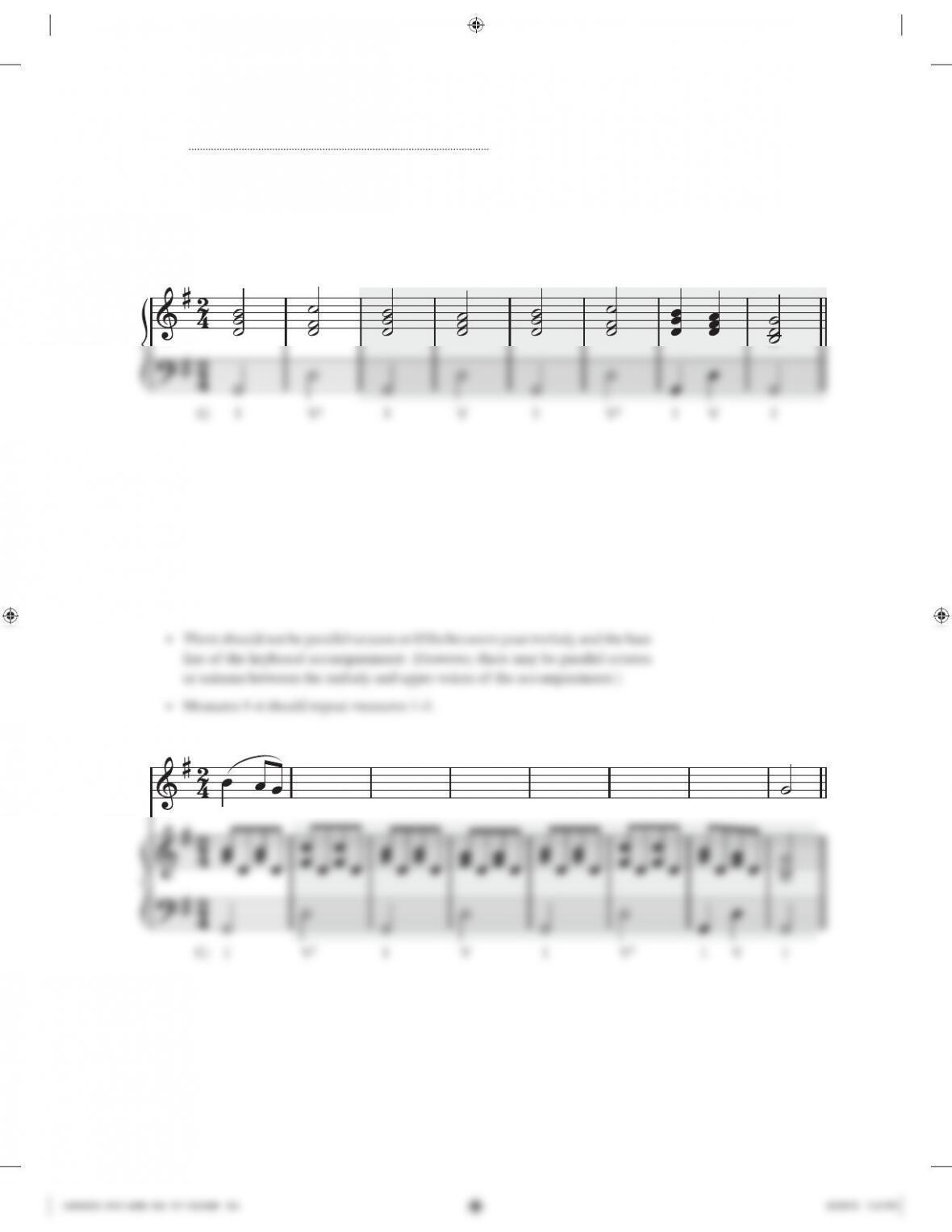
2. Mark the errors for each of the following progressions as follows:
• Circle any ˆ
7 not raised in a minor key.
• Place a triangle around any unresolved chordal seventh.
• Indicate with parallel lines any parallel octaves or fifths.
• Write and circle Roman numerals for faulty chord progressions.
NAME:
G. COMPOSITION
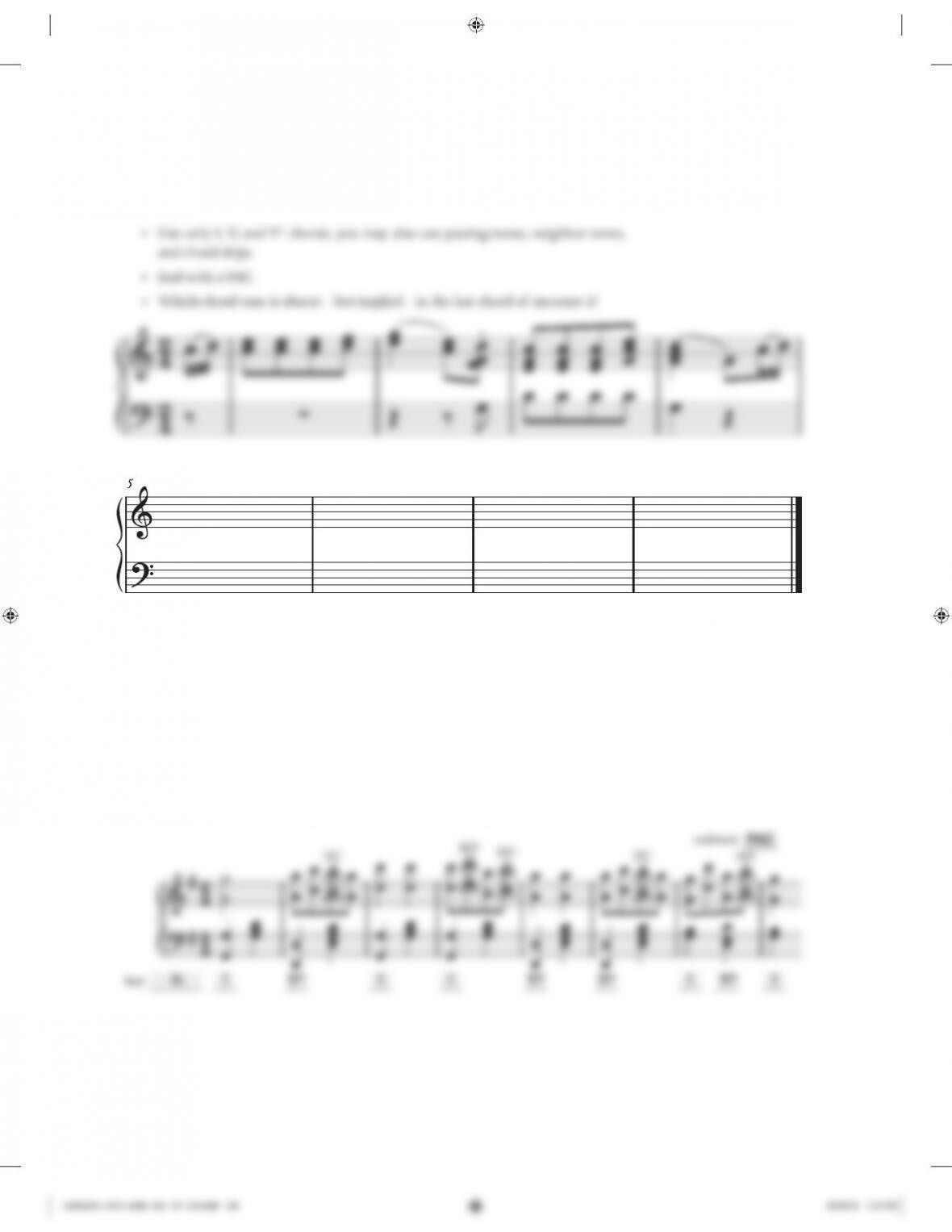
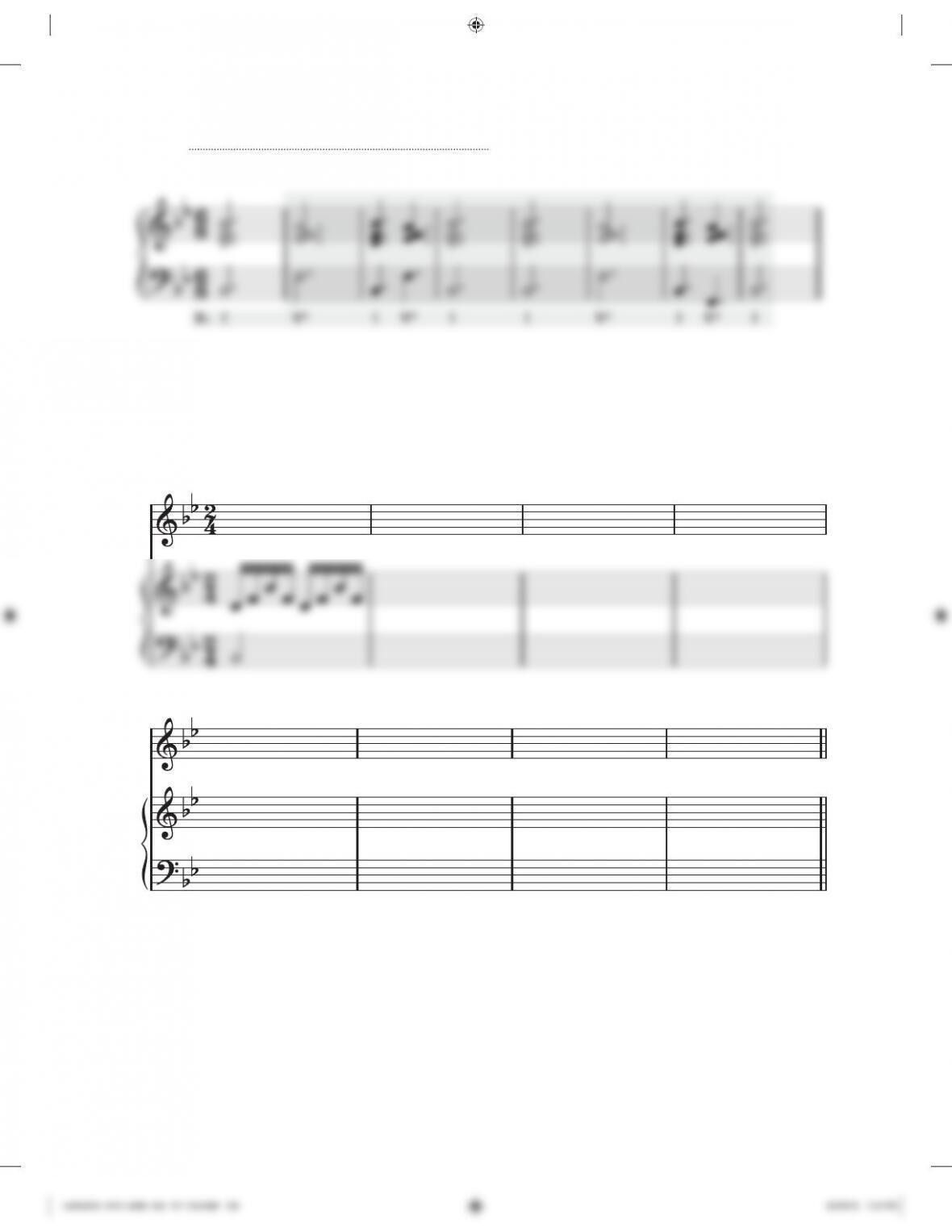
1. Realize the following chord progression in keyboard format, using correct voice
leading. Measures 5–6 should repeat measures 1–2.
2. Keyboard accompaniment.
• On the lower two staves below, turn your realization of the preceding chord
progression (using the same pitches) into a keyboard accompaniment,
continuing the pattern given in measure 1 and concluding on the first beat of
measure 8.
• Then on the top sta, finish a melody to go with the accompaniment.
• Use mostly chord tones, and decorate them with passing tones, neighbor tones,
and other embellishments.
126 | CHAPTER 10 | The Dominant Seventh Chord: V7
3. Compose an ending to this passage (which is based on a piece by Joseph Haydn) by
adding four measures.
• Measure 5 should be the same as measure 1, and the style of measures 5–8
should be consistent with measures 1–4.
H. ANALYSIS
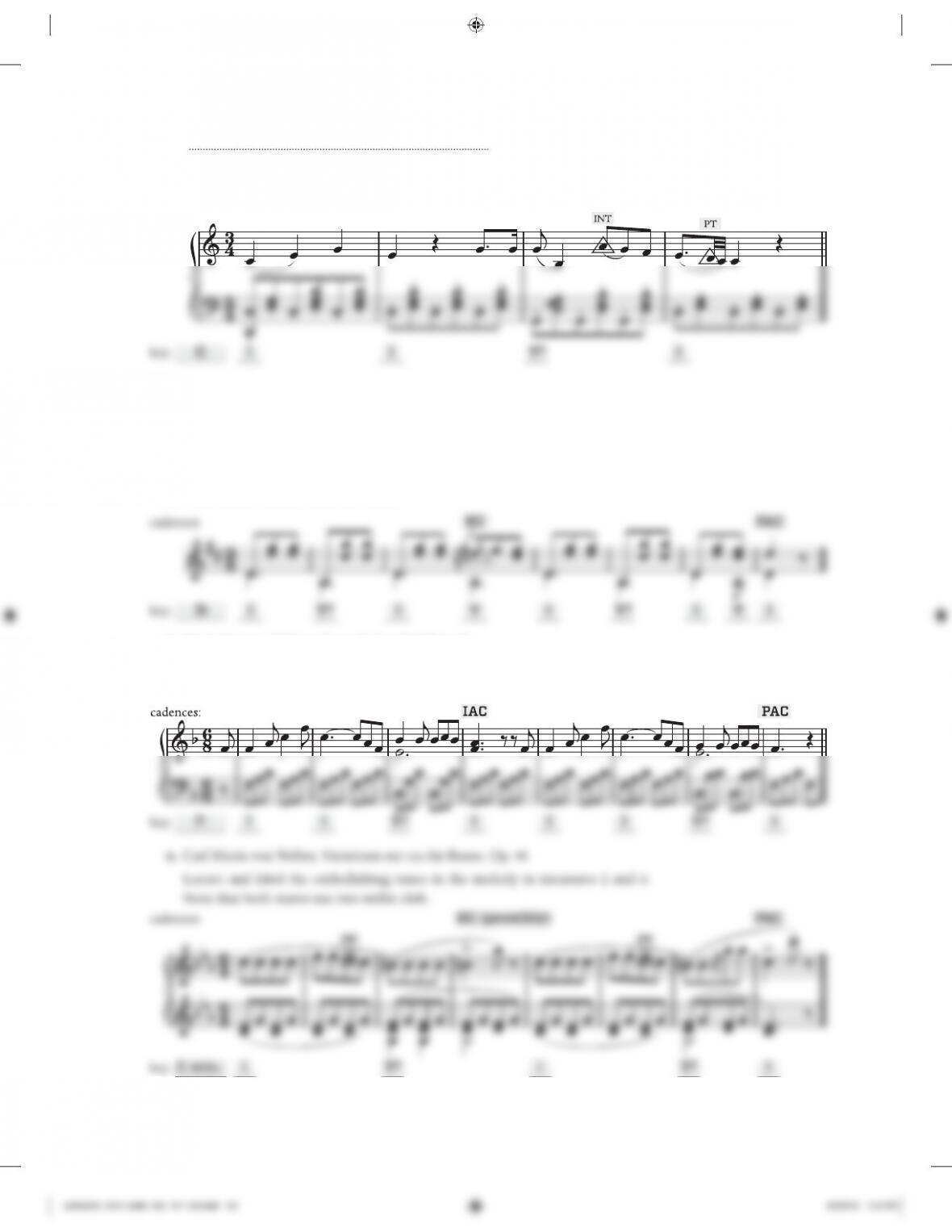
1. For each of the following excerpts, identify the key and label the Roman numerals.
Also label each embellishing tone (indicated by a triangle) as either a passing tone
(PT), neighbor tone (NT), or incomplete neighbor tone (INT). Where requested,
label the cadences.
a. Jacques Oenbach, “Galop infernal” from Orphée aux enfers
NAME:
b. Hector Berlioz, Le carnival romain
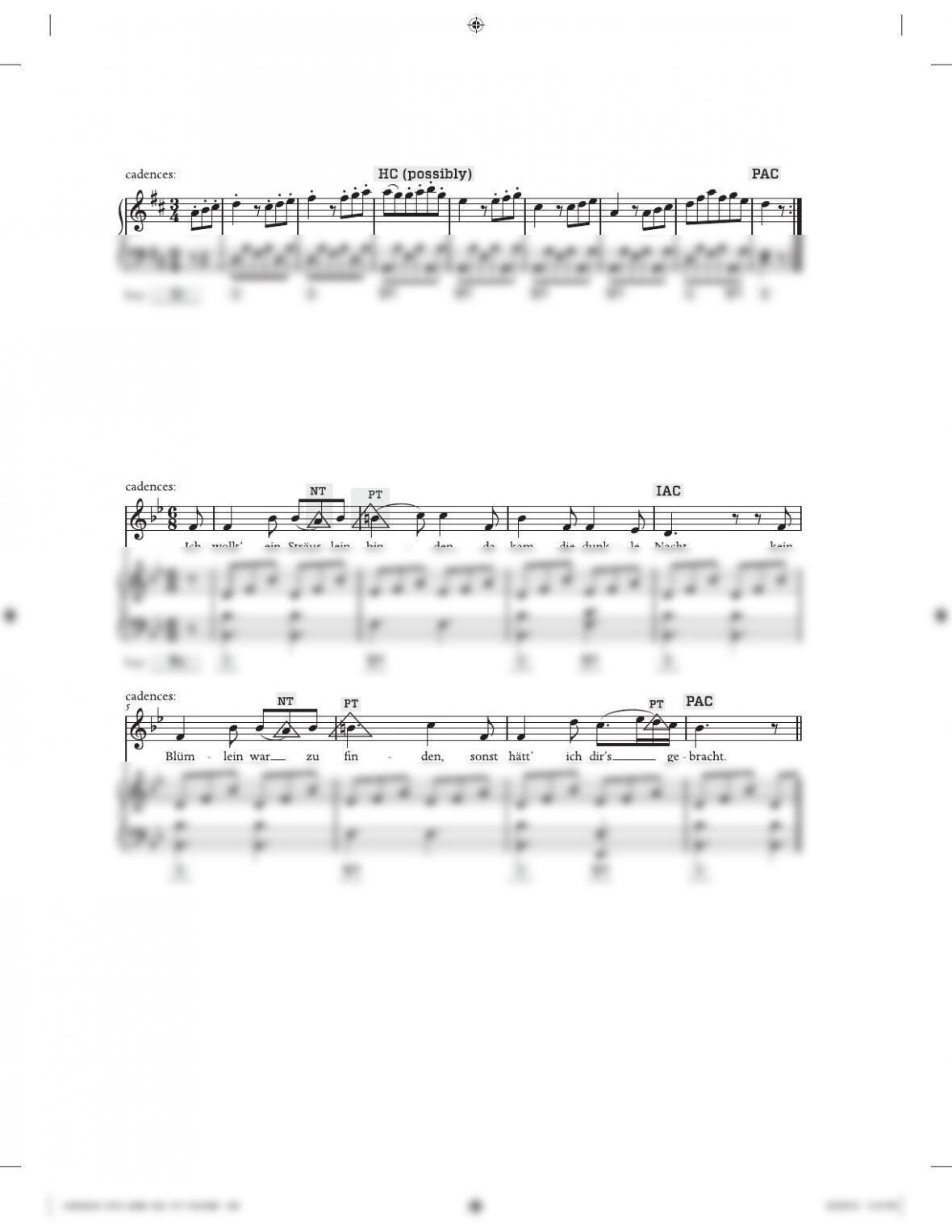
2. Each of the following excerpts consists of two phrases of four measures each.
• Determine the key of each excerpt and label the Roman numerals. Also, label
each cadence as either a PAC, IAC, or HC.
• Compare the two phrases within each excerpt: how are they similar, and how
are they dierent? Is the first or second phrase more complete?
a. Ferdinando Carulli, Waltz for Guitar
b. W. A. Mozart, “Sehnsucht nach dem Frühlinge”
In each measure, the lowest note of the arpeggio in the bass-clef sta serves as
the bass note of the chord for the entire measure.
128 | CHAPTER 10 | The Dominant Seventh Chord: V7
d. Ludwig van Beethoven, Ländler WoO 11, No. 2
e. Louise Reichardt, “Für die Laute”
• There are one or two chords per measure here. Label the chords with Roman
numerals. Locate and label the embellishing tones (as PT, or NT, or INT) in
mm. 1, 2, 5, 6, and 7.
• On the sta following the passage, complete a four-part harmonic model of
this passage based on the harmonies of your Roman numeral analysis.
Translation: I would bind a bouquet of owers, had not the dark night come, no owers were to be found, else
I’d have brought you some.
H. Analysis | 129
NAME:
• On the lower two staves below, turn your realization of the chord progression
above (using the same pitches) into a keyboard accompaniment, continuing the
pattern given in measure 1.
• Then on the top sta, compose a new melody to go with the accompaniment.
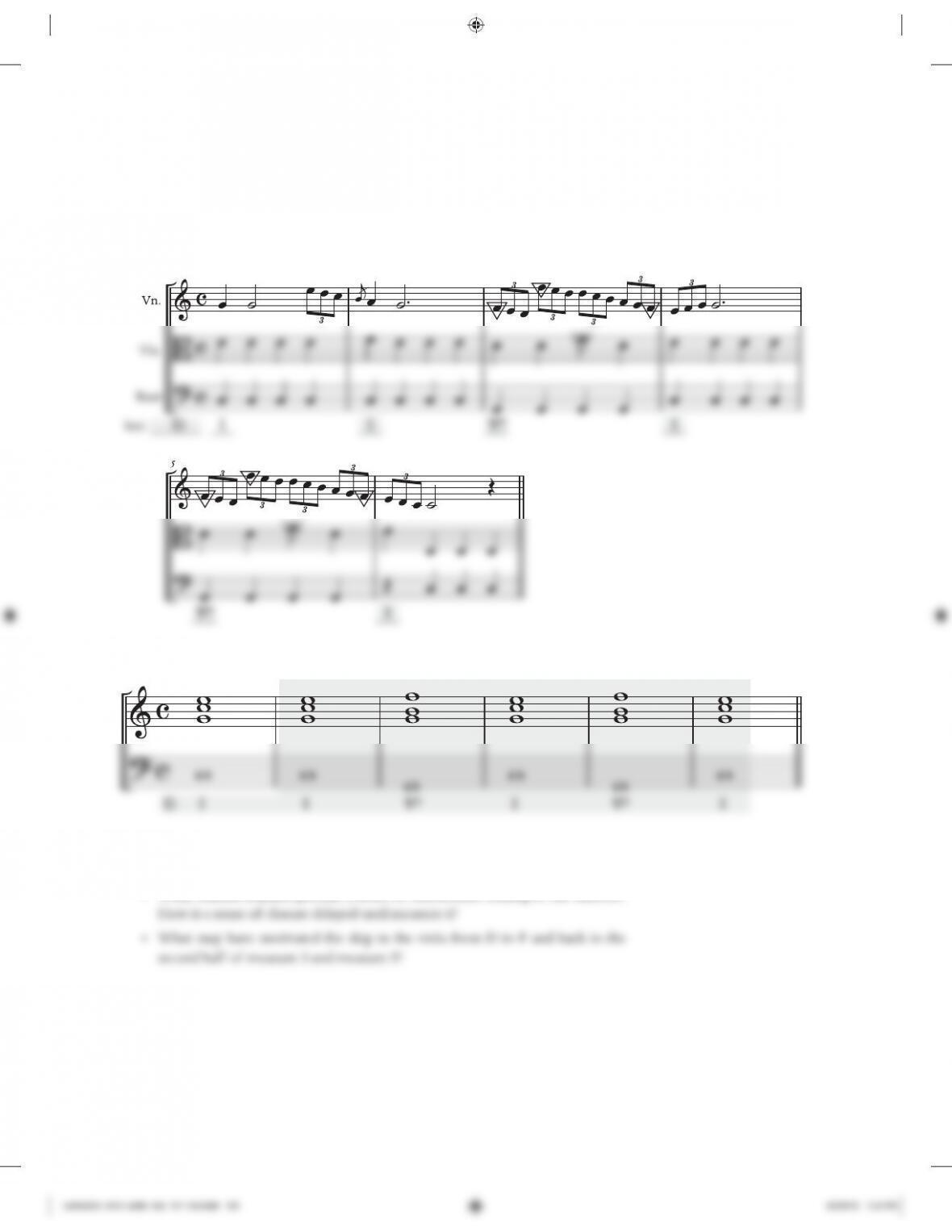
3. Giovanni Battista Ferrandini, Overture to Catone in Utica
• Identify the key and label the Roman numerals (one chord per measure) of the
passage below. Place a triangle around every chordal seventh of a V7.
• On the sta below the passage, complete a four-part harmonic model of this
passage based on the harmonies of your Roman numeral analysis.
• Note that this passage is six measures long. How may it be understood to be an
expansion of a simpler four-measure prototype?
• What musical features provide a sense of momentum leading to the cadence?