126
(5) 1. (x) (Fx Gx)AP/ (x)Fx (x)Gx
9. (x)Fx (x)Gx AP/ (x) (Fx Gx)
(7) 1. (x) (Fx Gx)AP/ ( x)Fx (x)Gx
127
(9) 1. ( x) (Fx Gx)AP/ ( x)Fx (x)Gx
Equivalence can actually be proven:
12. ~ ( x) (Fx Gx)AP/ ~ [( x)Fx (x)Gx]
128
(11) 1. (x) (Fx P)AP/ (x)Fx P
(13) 1. (x) (Fx P)AP/ ( x)Fx P
2. ( x)Fx AP/P
129
(15) 1. ( x) (P Fx)AP/P(x)Fx
2. ~ PAP/(x)Fx
EXERCISE 10-13:
(1) 2. ~ ( x)Fx AP/ ( x)Fx
3. (x) ~ Fx 2QN
130
(5) 4. ~ (Tb Rb)AP/Tb Rb
5. Rb 3UI
(7) 3. ~ ( x) ~ Fx AP/ ( x) ~ Fx
4. (x) ~ ~ Fx 3QN
(9) 3. ~ (x) (~ Sx ~Bx)AP/ (x) (~ Sx ~Bx)
4. ( x) ~ (~ Sx ~Bx) 3 QN
131
EXERCISE 10-14:
(1) 3. ~ ( x)Gx AP/ ( x)Gx
4. (x) ~ Gx 3QN
(3) 2. ~ ( x) (Fx Hxa)AP/ ( x) (Fx Hxa)
3. Fx (y)Hxy 1EI
(5) 2. ~ (y) [By (x) (Ax Cxy)] AP/ (y) [By (x) (Ax Cxy)]
3. ( y) ~ [By (x) (Ax Cxy)] 2 QN
132
(7) 2. ~ ( y) (x) (Fx Gy)AP/ ( y) (x) (Fx Gy)
3. (y) ~ (x) (Fx Gy) 2 QN
EXERCISE 11-1:
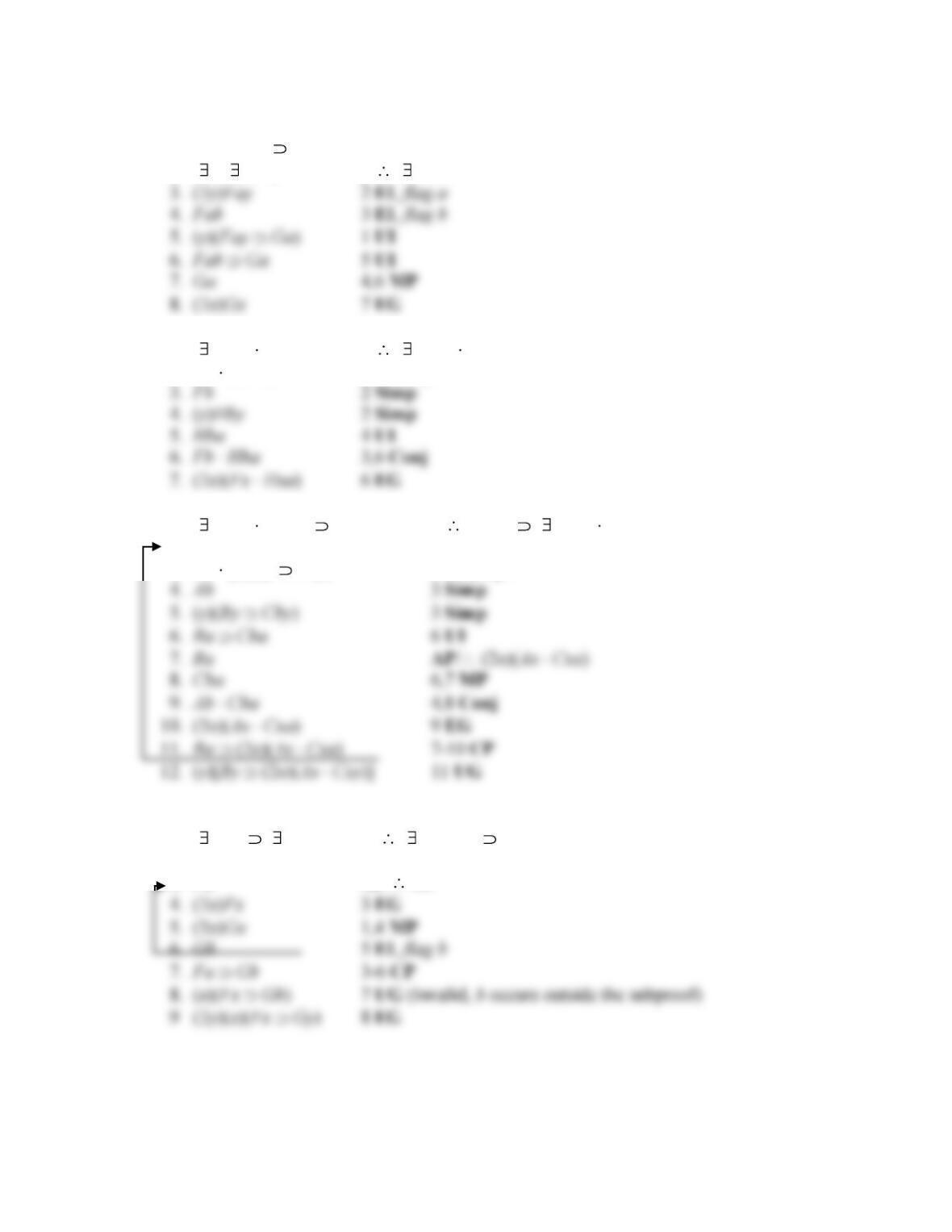
1. The problem is that it would allow for invalid inferences, basically moving from the
claim that there is at least one thing with a certain property to a claim that states or
assumes that everything has that property. For example, it would allow the following
inference which is clearly invalid.
133
EXERCISE 11-2:
(1) 1. (x)(y)(Fxy Gx) p
2. ( x)( y)Fxy p/ ( x)Gx
(3) 1. ( x)[Fx (y)Hxy] p/ ( x)(Fx Hxa)
2. Fb (y)Hby 1EI,flag b
(5) 1. ( x)[Ax (y)(By Cxy)] p/ (y)[By (x)(Ax Cxy)]
2. flag a
3. Ab (y)(By Cby) 1 EI,flag b
(7) Trying direct proof results in violating the third restriction on flagged constants:
1. ( x)Fx (x)Gx p / ( y)(x)(Fx Gy)
2. flag a
3. Fa AP/Gb
So one needs to use an indirect method:
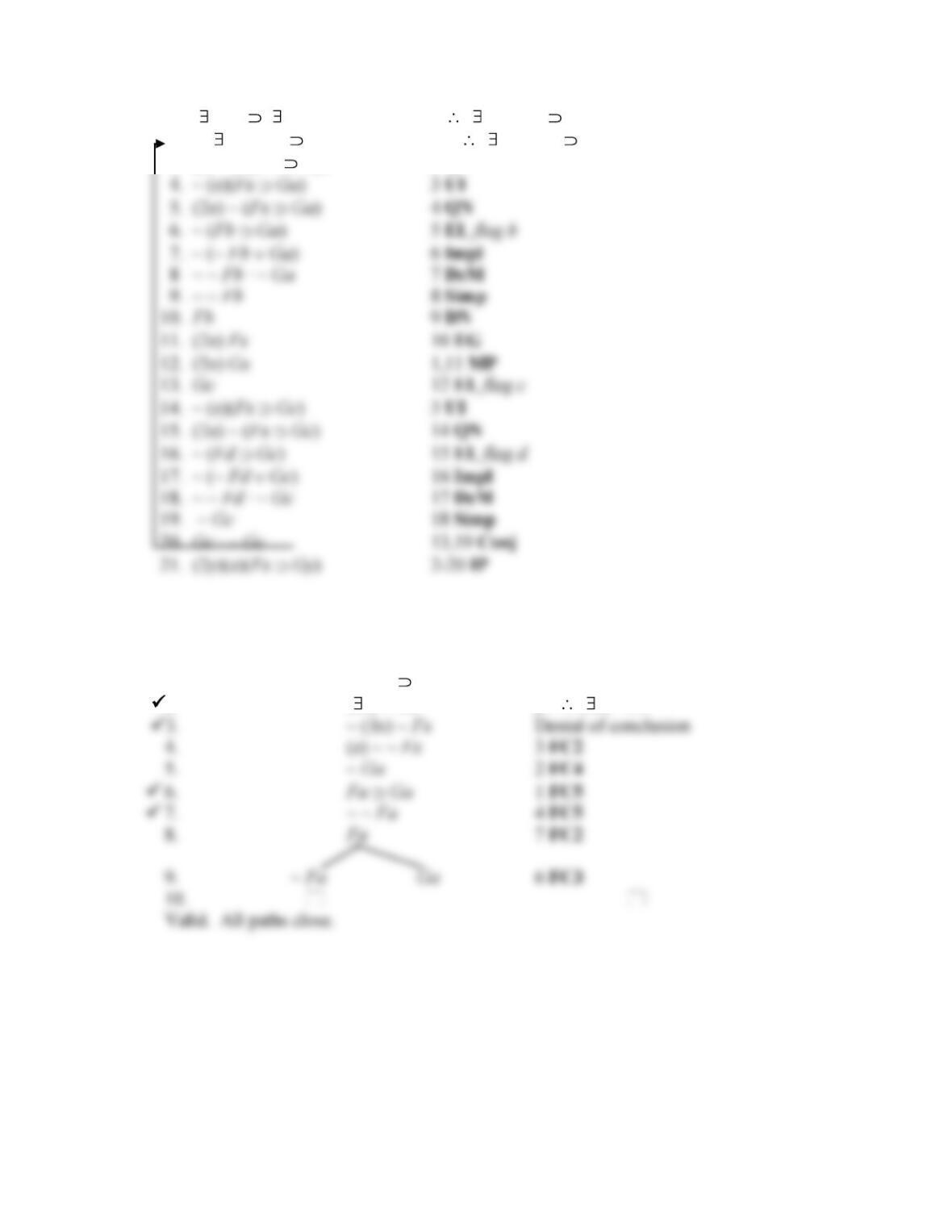
134
1. ( x)Fx (x)Gx p/ ( y)(x)(Fx Gy)
2. ~ ( y)(x)(Fx Gy)AP/ ( y)(x)(Fx Gy)
3. (y) ~ (x)(Fx Gy) 2 QN
EXERCISE 12-1:
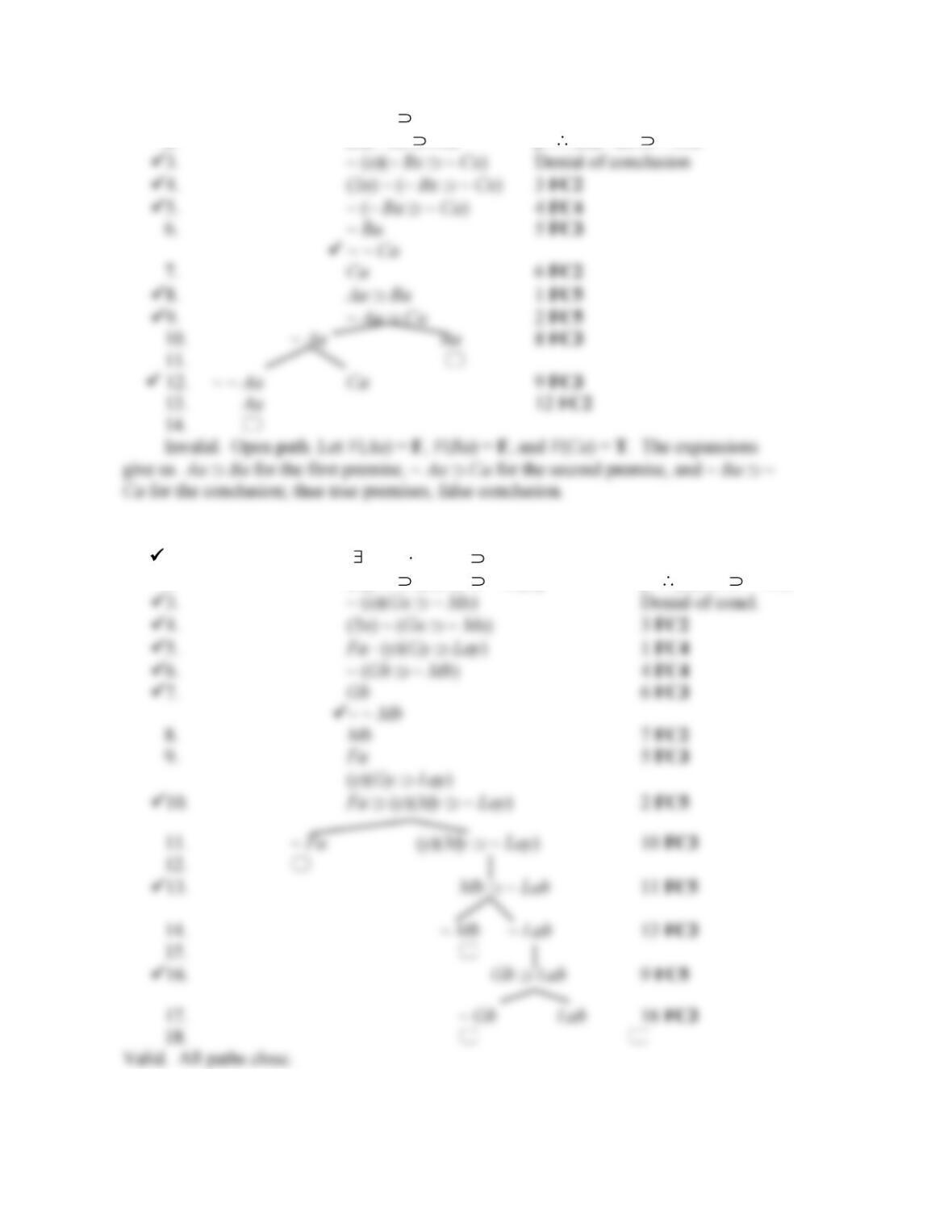
(1) 1. (x)(Fx Gx) p
2. ( x) ~ Gx p / ( x) ~ Fx
135
(3) 1. (x)(Ax Bx) p
2. (x)(~ Ax Cx) p / (x)(~ Bx ~Cx)
Number (5) can be done more easily using the unrestricted order method:
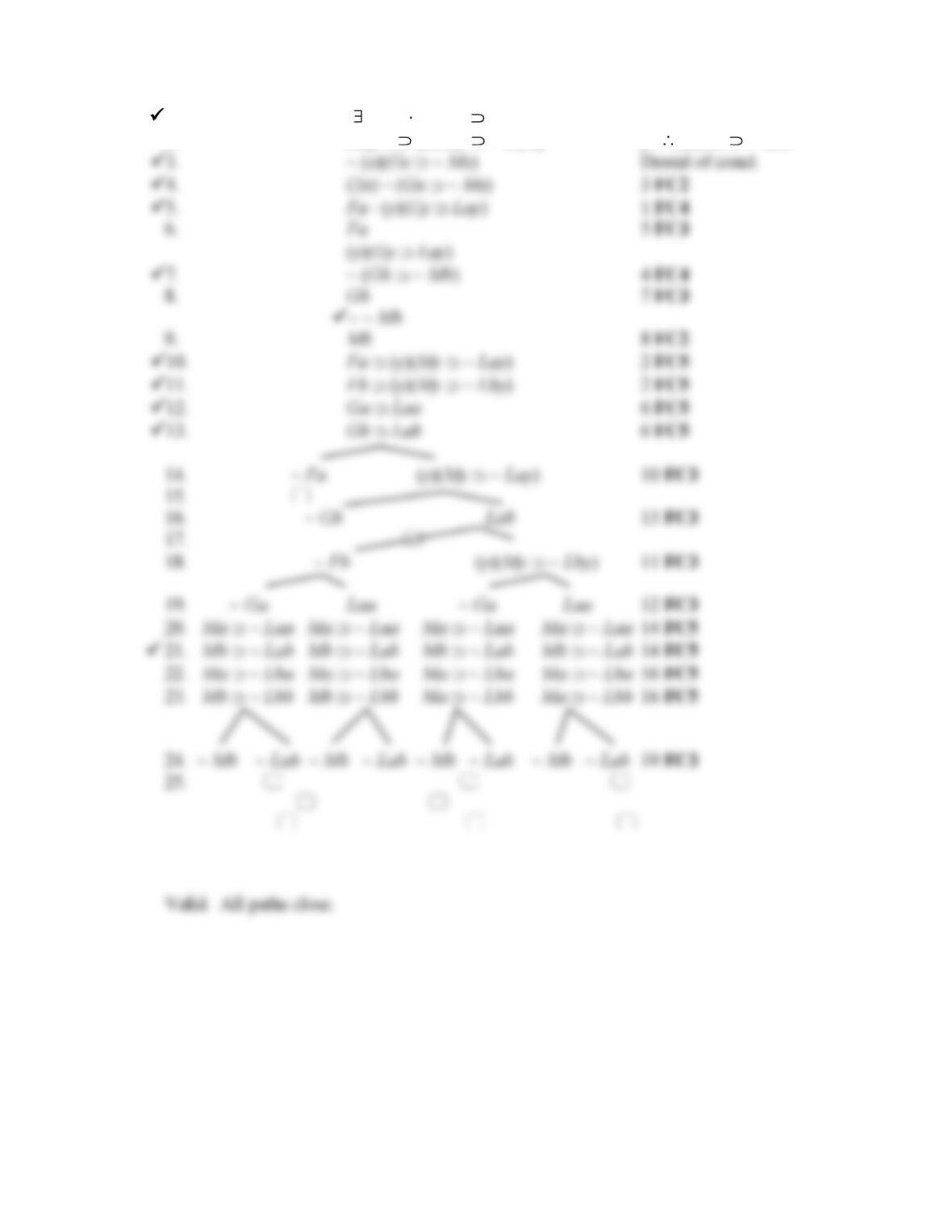
(5) 1. ( x)[Fx (y)(Gy Lxy)] p
2. (x)[Fx (y)(My ~Lxy)] p / (x)(Gx ~Mx)
Number (5) done by the prescribed order method is below:
136
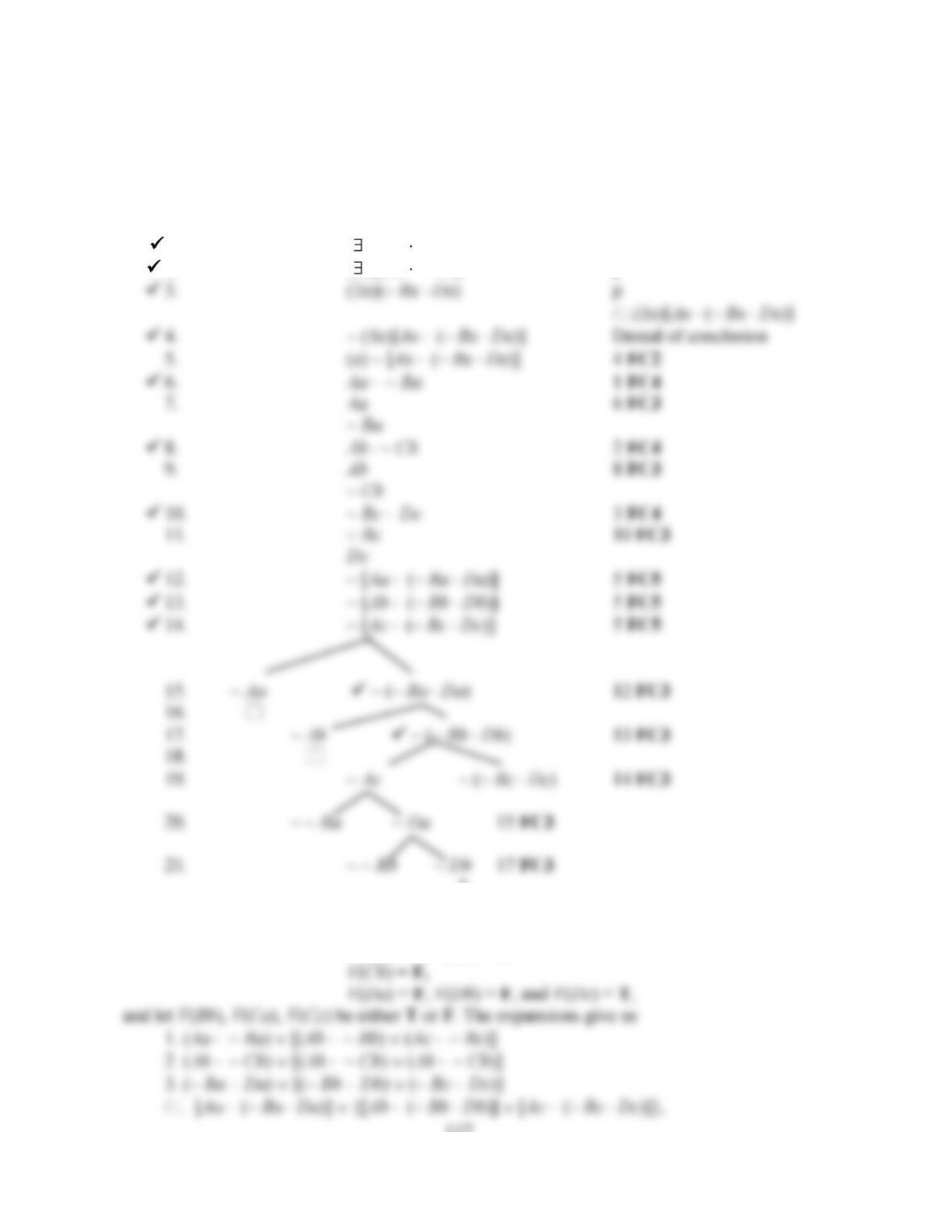
(5) 1. ( x)[Fx (y)(Gy Lxy)] p
2. (x)[Fx (y)(My ~Lxy)] p / (x)(Gx ~Mx)
137
(7) 1. ( x)(Ax ~Bx) p
2. ( x)(Ax ~Cx) p
*
Invalid. Open path.
In the branch marked with *, let V(Aa) = T,V(Ab) = T,V(Ac) = F,
V(Ba) = F,V(Bc) = F,
138