(13) 4. 2 Add
8. 1,7 MP
EXERCISE 4-4:
(1) 3. (QR) Q
(7) 3. ~ E
EXERCISE 4-5:
(1) 3. LR1,2 HS
(7) 4. A1,3 MP
(13) 4. (A D)
EXERCISE 4 6:
(1) 3. ~ ~ B2DN
(3) 3. ~ ~ T2DN
EXERCISE 4 7:
(1) 3. 1 Comm
(3) 3. 1 Comm
(7) 4. 2, 3 Conj
9. 8 DN
EXERCISE 4-8:
(1) 3. A(B C) 1 Exp
(5) 3. ~ C~B2Add
(7) 3. ~ H~ ~ K1DeM
4. ~ H3Simp
(13) 3. ~ A~B2Add
4. ~ (AB) 3 DeM
EXERCISE 4-9:
(1) 2. ~ ~ AB1Impl
3. AB2DN
(11) 2. A~~[L(~ M R)] 1 Add
(15) 2. [(A B)C]
[(A B)D] 1 Dist
EXERCISE 4 10:
(1) 3. ~ B1,2 MP
(9) 4. ~ A B 1Add
EXERCISE 4 11:
(1) 3. (AB) (A C) 1 Dist
(5) 2. [(AB)C]
[(A B)D] 1 Dist
(7) 2. (C D) (A B) 1 Comm
(11) 2. (AB)
EXERCISE 4-12:
(1) 4. A(B R) 1 Exp
5. BR2,4 MP
(3) 2. ~ (AH)
(M N) 1 Impl
(5) 3. K(L M) 2 Exp
(9) 5. H4Simp
6. HN5Add
(11) 5. (C A)D3Comm
6. C(A D) 5 Exp
(13) 4. ~ D~C1DeM
5. ~ C4Simp
10. A~A6,9 HS
11. ~ A~A10 Impl
10. A~ (D E) 9 Comm
11. A(~ D~E) 10 DeM
EXERCISE 4-13
(1) 4. ~ SB2Comm
5. SB4Impl
(3) 4. (CA)D3Comm
5. C(A D) 4 Exp
(5) 4. ~ P[(Q R)S] 1 Impl
5. [~ P(Q R)] S4Assoc
(7) 3. (A B) (A C) 2 Dist
4. AB3Simp
11. B10 Taut
(9) 5. P(R Q) 1 Dist
14. QR6,13 DS
15. VW2, 14 MP
16. ~ V4, 15 MT
(13) 3. (A B) (B A) 1 Equiv
4. AB3Simp
(15) 4. ~ E~F2DeM
8. (C~E)A6Impl
9. (~ EC)A8Comm
27. ~ ~ (AB) ~ (C D) 26 DN
28. ~ (~ A~B)
EXERCISE 4-14:
1. Because implicational argument forms are one-directional, if the premise is true
the conclusion must be true, but this does not guarantee that the two always have
the same truth value since the conclusion could be true when the premise is false.
So such a replacement may allow one to move from truth to falsehood. For
example if we use Simplification to replace the antecedent of a conditional, then
the truth of the original sentence does not guarantee the truth of the resulting
sentence:
5. If one added a rule for each tautological test statement form then each valid
argument form would have its own rule. Since any valid argument would be an
7. This can be done using the Rules of Replacement learned in this chapter: by
9. There will be 22= 4 rows, and since each entry in each row can be T or F, there
will be 24= 16 possible truth tables. Below are statement forms for each possible
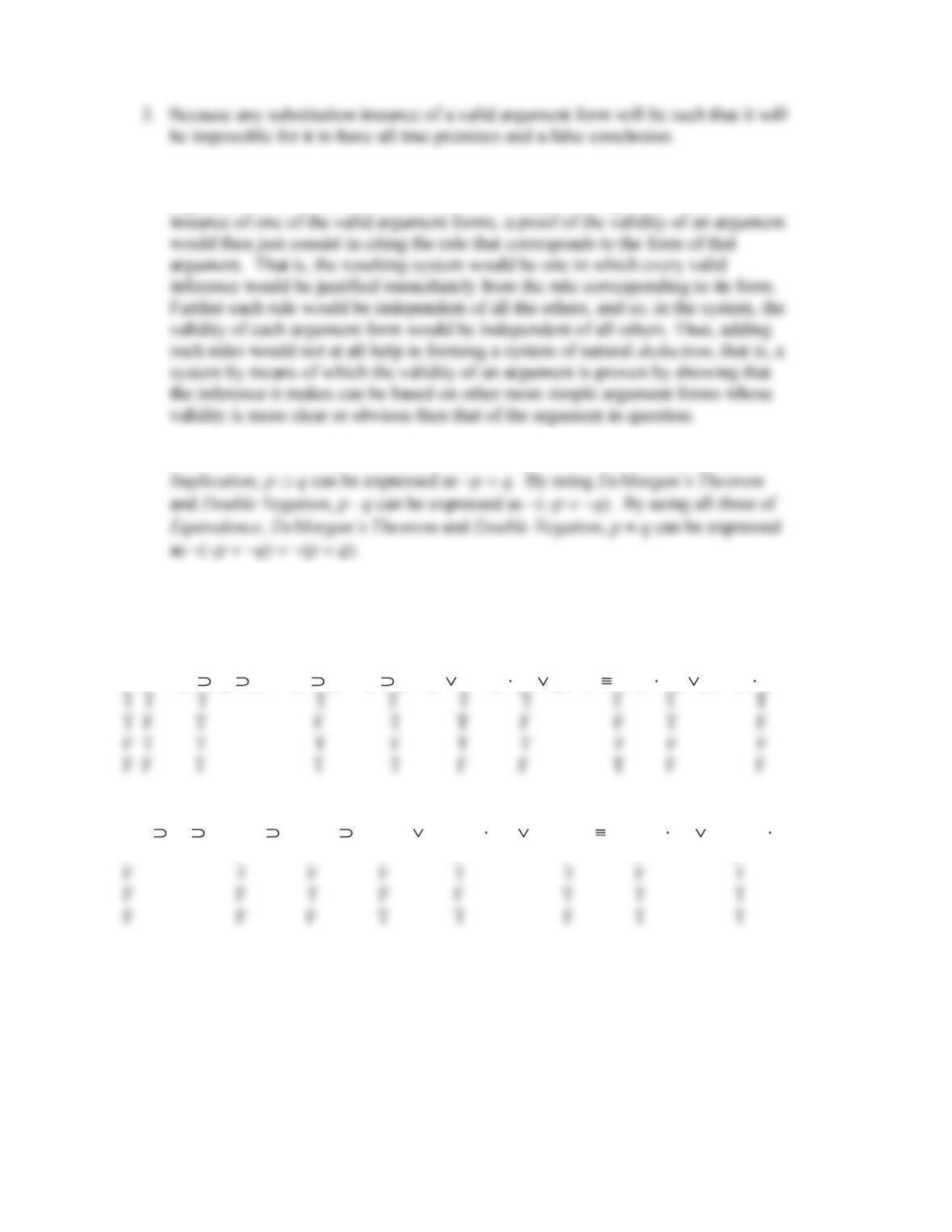
truth table:
p q p (q p)p q q p p q q (p q)p q p (q p)p q
~[p(q p)] ~(p q) ~(q p) ~(p q) ~[q(p q)] ~(p q) ~[p(q p)] ~(pq )
F F F F F F F F
EXERCISE 5-1:
(1) 2. AAP/A·B
(5) 2. AAP/B C
(7) 3. AAP/B·C
(9) 3. RAP/P
(13) 4. HAP/M
5. ~ ~ H4DN
(15) 2. (N P) (P N) 1 Equiv
3. NP2Simp
EXERCISE 5-2
(5) 4. PAP/~T
5. (QR)S1, 4 MP
(9) 5. ~SAP/~V
6. P(R Q) 1 Dist
(13) 3. A R AP/B S
4. (AB) (B A) 1 Equiv
(15) 4. ~A~BAP/ ~(C D)
5. ~ D~~ (E B) 1 DeM
6. ~ E~F2DeM
EXERCISE 5-3:
(1) 3. ~ AAP/A
4. B1, 3 DS
(3) 3. AAP/ ~A
4. BC1, 3 MP
(7) 5. ACAP/ ~ (A C)
6. BD1, 2, 5 CD
EXERCISE 5-4:
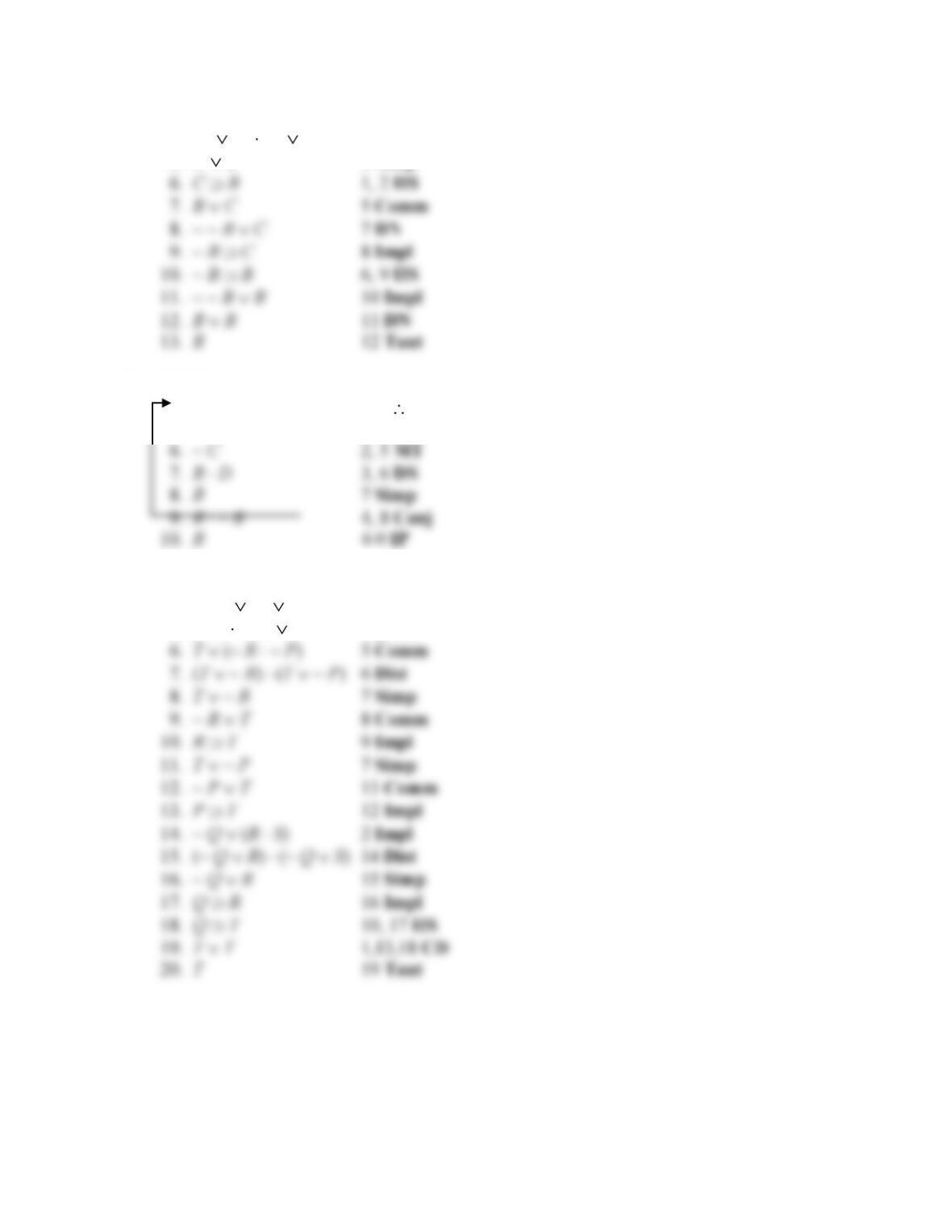
(1) Without IP:
4. (CB) (C D) 3 Dist
5. CB4Simp
(1) With IP:
4. ~ BAP/B
5. ~ A1, 4 MT
(3) Without IP:
4. ~ ( RP)T3Impl
5. (~ R~P)T4DeM
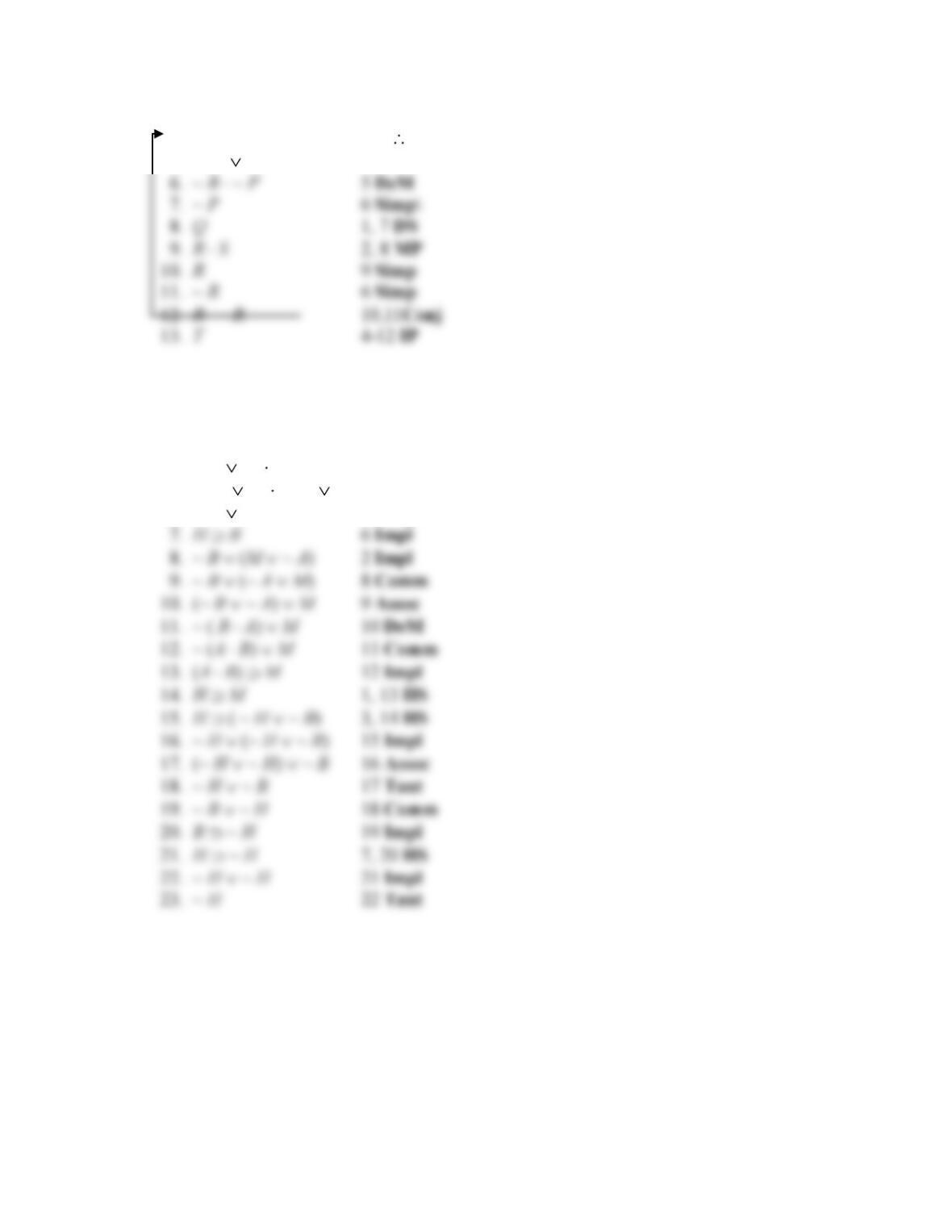
(3) With IP:
4. ~ TAP/T
5. ~ (RP) 3, 4 MT
(5)Without IP:
4. ~ H(A B) 1 Impl
5. (~ HA) (~ H B) 4 Dist
6. ~ HB5Simp