3100 CHAPTER 3. DYNAMIC RESPONSE
49. Consider the following second-order system with an extra pole:
H(s) = !2
np
(s+p)(s2+ 2!ns+!2
n):
Show that the unit step response is
y(t) = 1 + Aept +Bet sin(!dt);
where
A=!2
n
!2
n2!np+p2;
B=p
q(p22!np+!2
n)(1 2)
;
= tan1p12
+ tan1!np12
p!n
:
(a) Which term dominates y(t)as pgets large?
(b) Give approximate values for Aand Bfor small values of p.
(c) Which term dominates as pgets small? (Small with respect to what?)
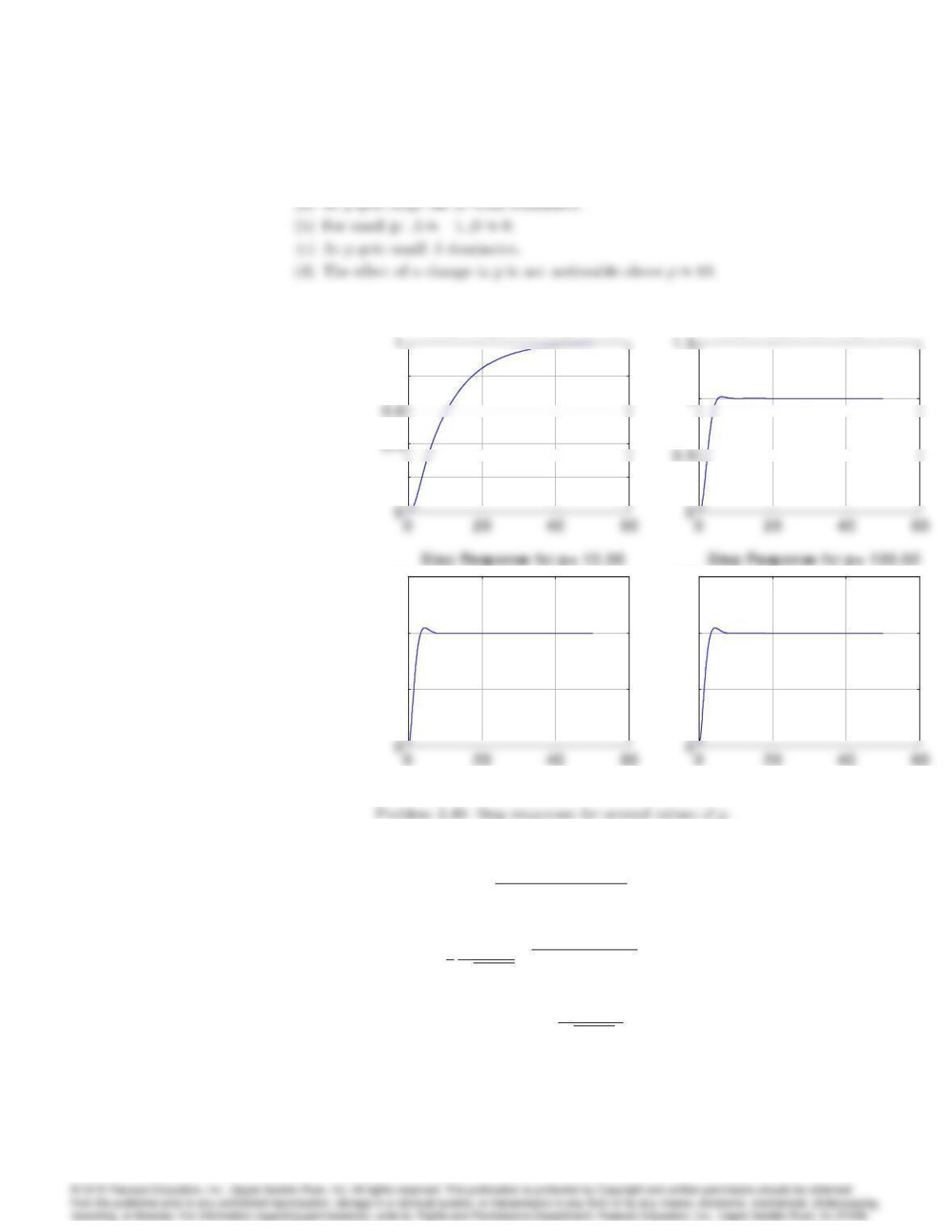
(d) Using the preceding explicit expression for y(t)or the step command
in Matlab, and assuming that !n= 1 and = 0:7, plot the step
response of the preceding system for several values of pranging from
very small to very large. At what point does the extra pole cease to
have much effect on the system response?
3101
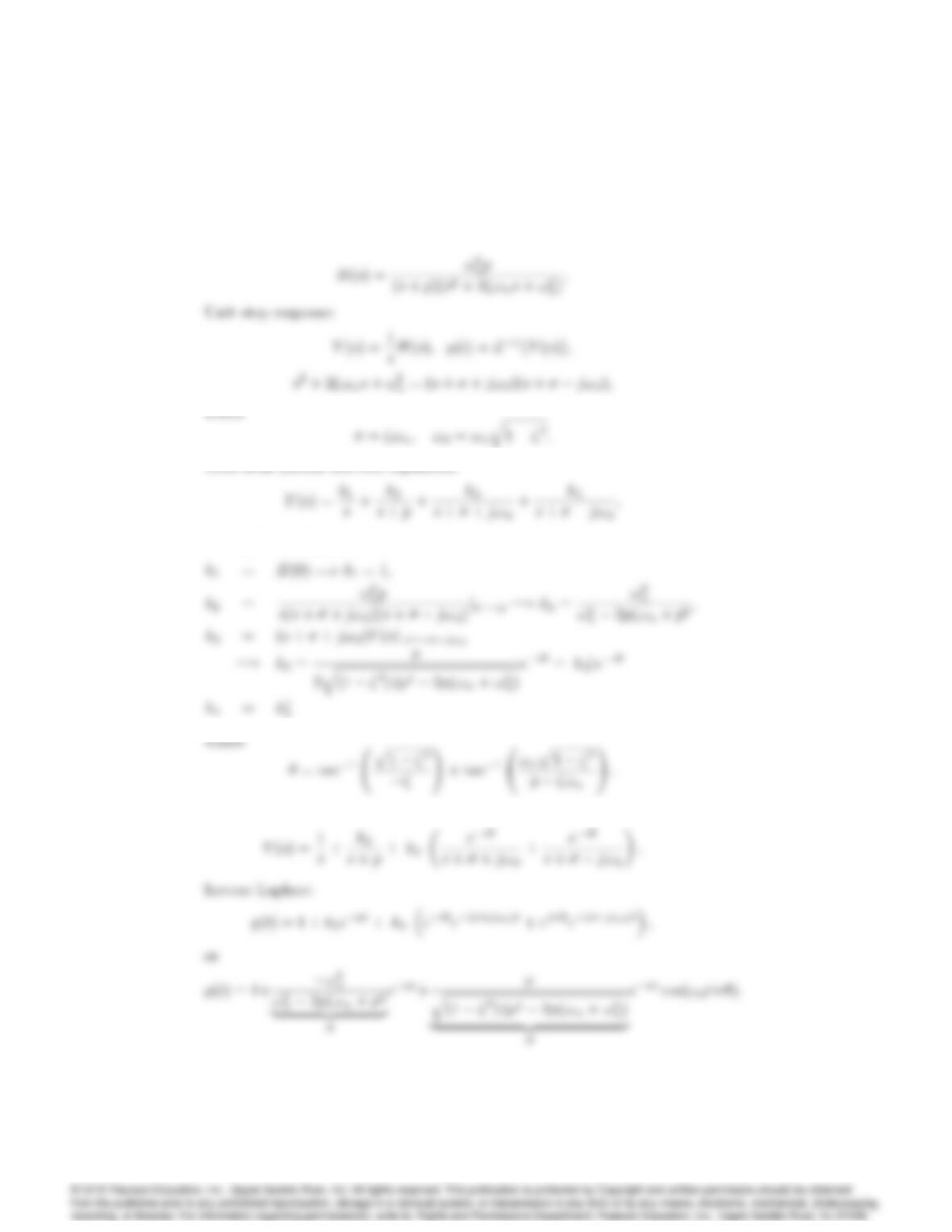
Solution:
Second-order system:
Thus from partial fraction expansion:
solving for k1; k2; k3;and k4:
Thus
3102 CHAPTER 3. DYNAMIC RESPONSE
0.2
0.8
Step Response for p= 0.10
Step Response for p= 1.00
0.5
1
1.5
0.5
1
1.5
0.2
0.8
Step Response for p= 0.10
Step Response for p= 1.00
0.5
1
1.5
0.5
1
1.5
50. Consider the second order unity DC gain system with one finite zero,
H(s) = !2
n(s+z)
z(s2+ 2!ns+!2
n):
(a) Show that the unit-step response is
y(t) = 1 1
z
et
p12p!2
n+z22!ncos(!dt1);
where
1= tan1z !n
p12z:
3103
(b) Derive an expression for the overshoot, Mp, for this system.
(c) For a given value of overshoot, Mp, how do we solve for and !n?
Solution:
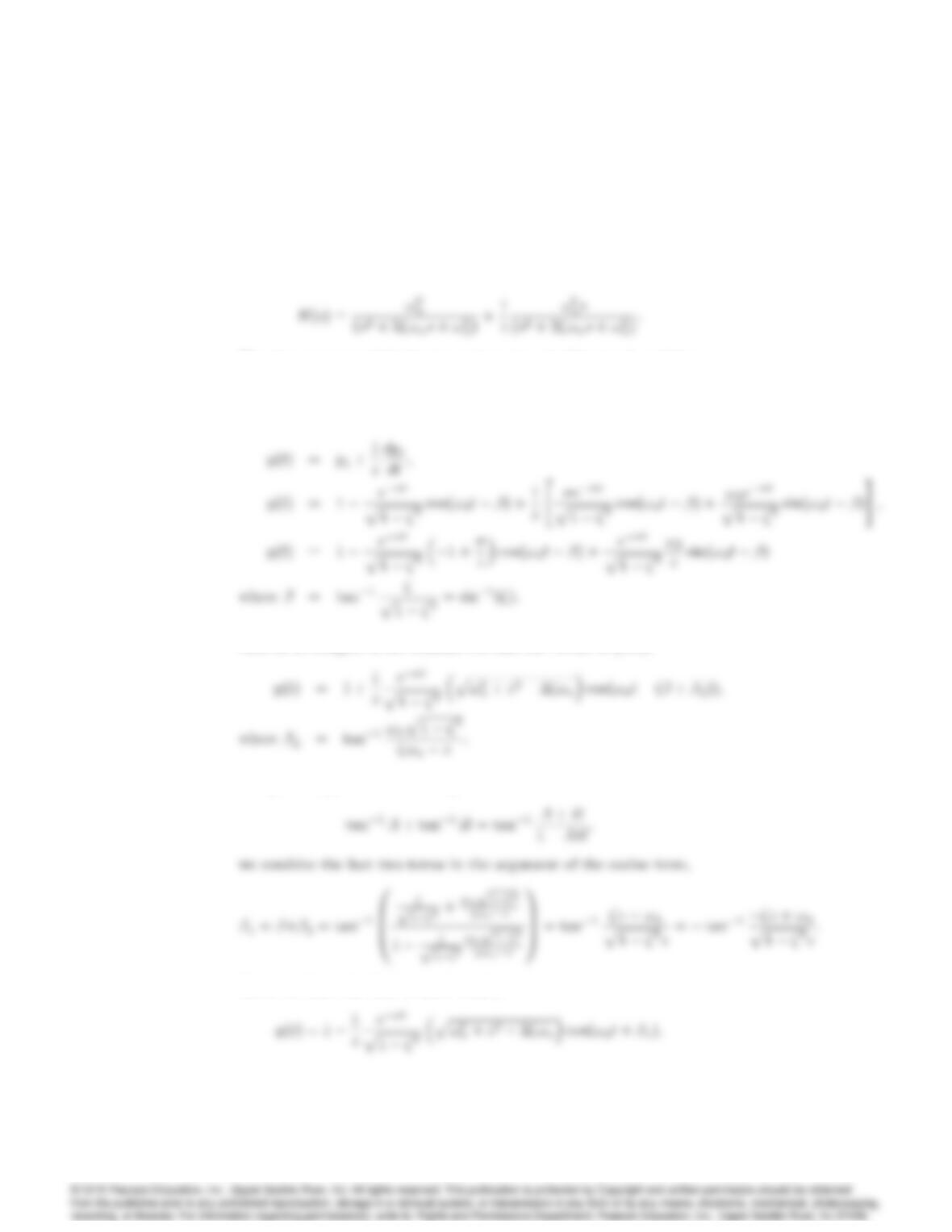
(a). We write the transfer function in partial fraction form,
The step response of the first term is as given in Chapter 3, and that
of the second term is simply the derivative of that (i.e., the impulse
response) scaled by 1=z:
Now as in Chapter 3 we combine the last two terms to yield,
Using the trigonometric identity,
Hence we have the final desired result,
3104 CHAPTER 3. DYNAMIC RESPONSE
(b) At peak time tp, we have that
is far away.
51. The block diagram of an autopilot designed to maintain the pitch attitude
of an aircraft is shown in Fig. 3.64. The transfer function relating the
elevator angle eand the pitch attitude is
(s)
e(s)=G(s) = 50(s+ 1)(s+ 2)
(s2+ 5s+ 40)(s2+ 0:03s+ 0:06);
where is the pitch attitude in degrees and eis the elevator angle in
degrees. The autopilot controller uses the pitch attitude error eto adjust
the elevator according to the transfer function
e(s)
e(s)=Dc(s) = K(s+ 3)
s+ 10 :
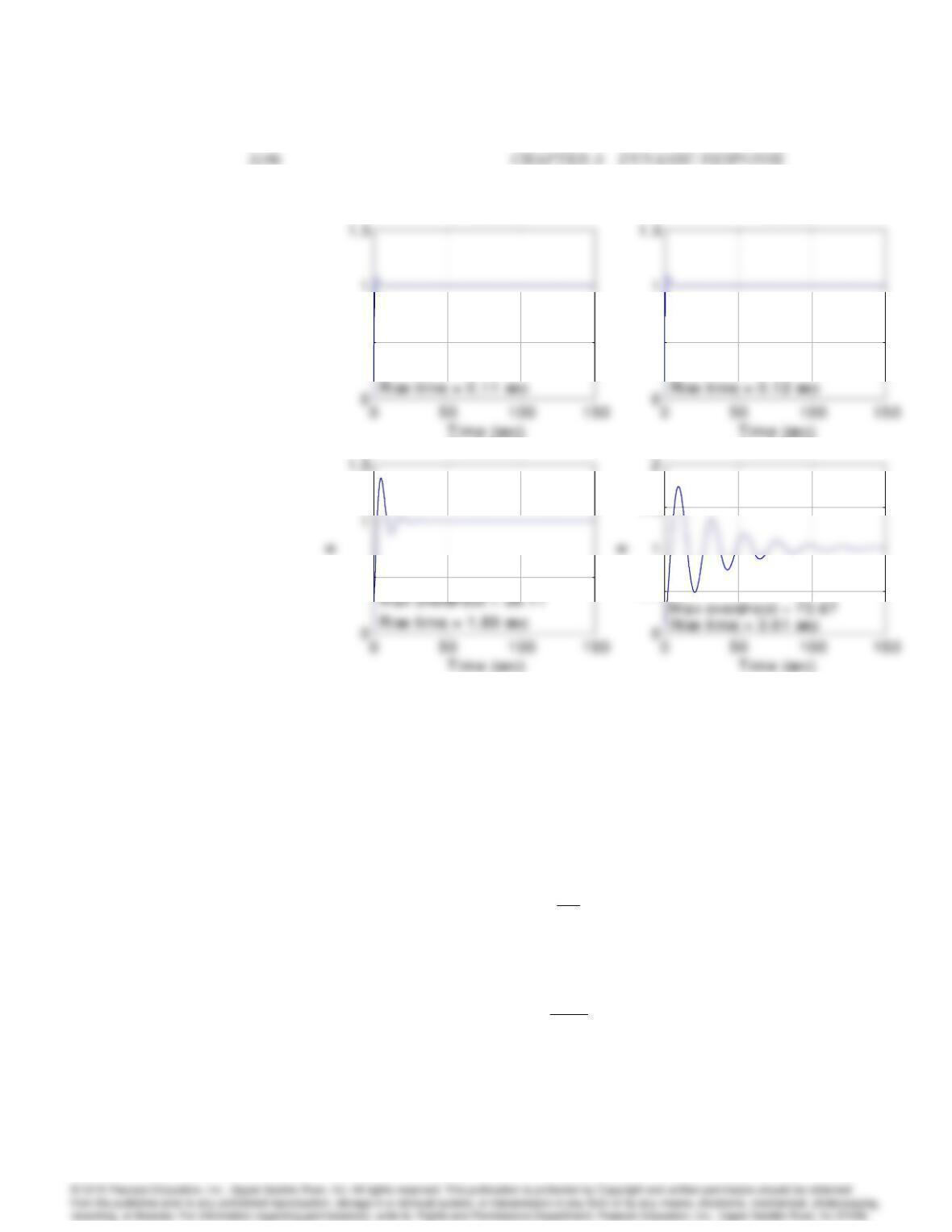
Using Matlab, find a value of Kthat will provide an overshoot of less
than 10% and a rise time faster than 0:5sec for a unit-step change in r.
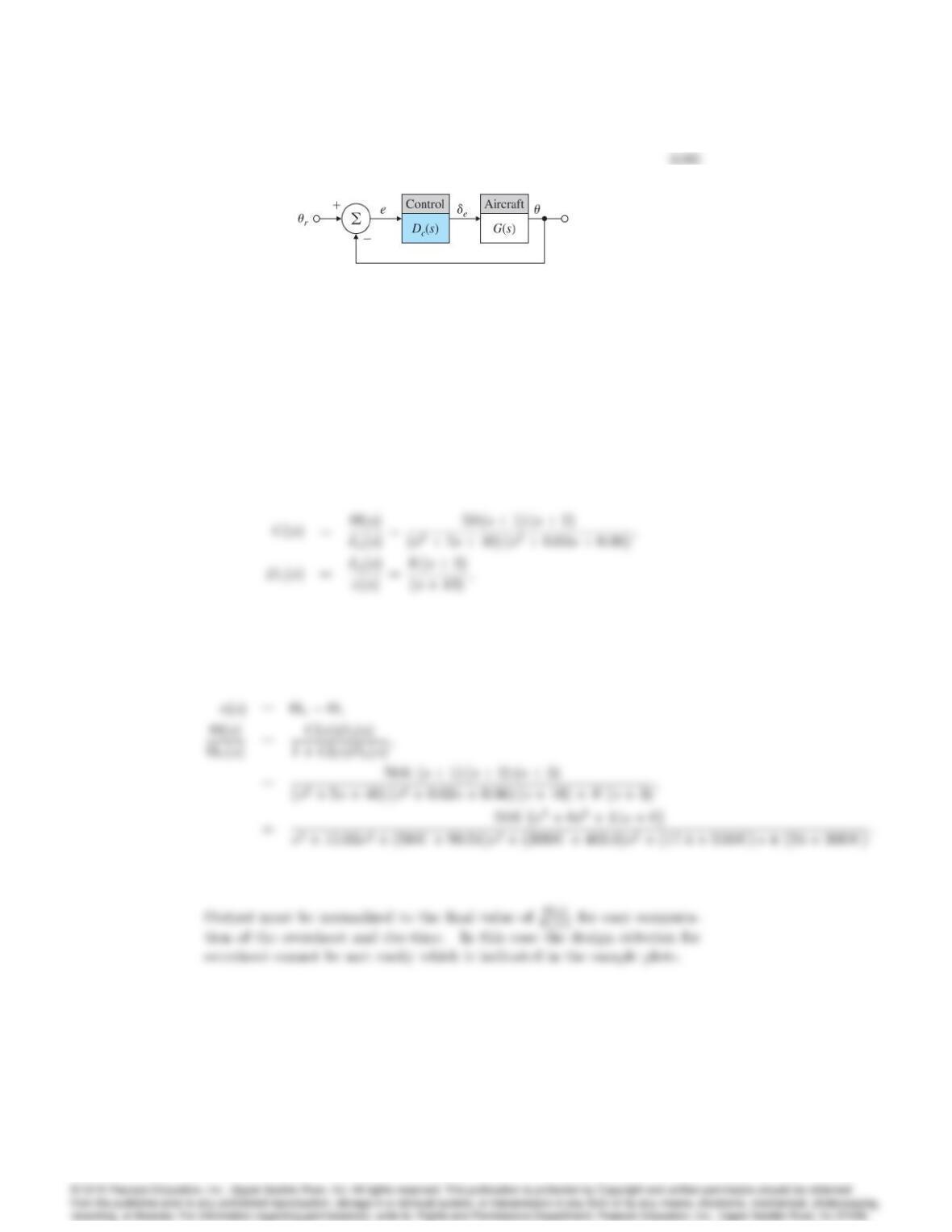
Figure 3.64: Block diagram of autopilot for Problem 3.51
After examining the step response of the system for various values of K,
comment on the difficulty associated with making rise-time and overshoot
measurements for complicated systems.
Solution:
where
0.5
K= 3.5000
θ
Max overshoot = 17.21
0.5
K= 3.0000
θ
Max overshoot = 12.31
0.5
K= 0.3000
0.5
1.5
K= 0.0300
0.5
K= 3.5000
θ
Max overshoot = 17.21
0.5
K= 3.0000
θ
Max overshoot = 12.31
0.5
K= 0.3000
0.5
1.5
K= 0.0300
Problem 3.51: Step responses for an autopilot for various values of K.
Problems and Solutions for Section 3.7: Sta–
bility
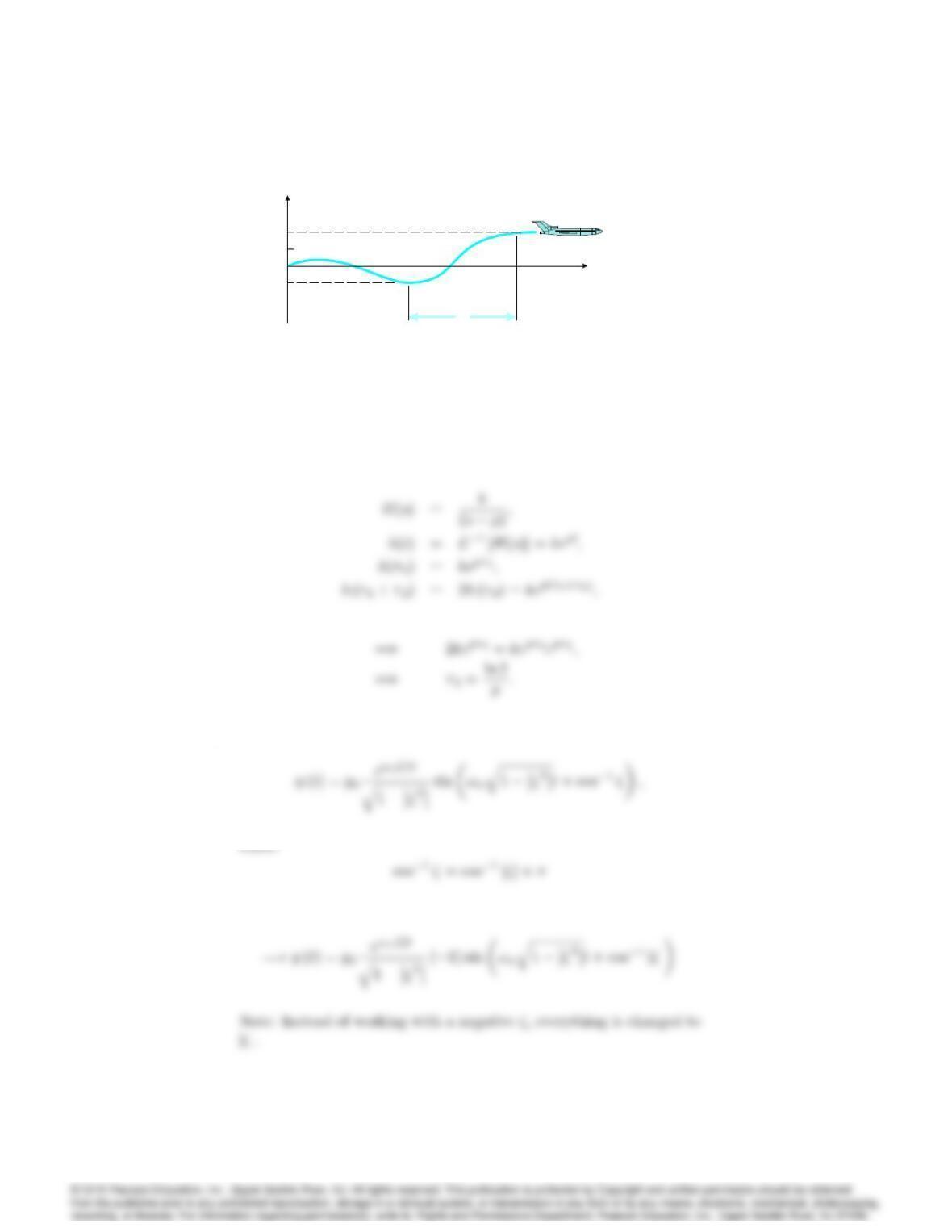
52. A measure of the degree of instability in an unstable aircraft response
is the amount of time it takes for the amplitude of the time response to
double (see Fig. 3.65), given some nonzero initial condition.
(a) For a first-order system, show that the time to double is
2=ln 2
p;
where pis the pole location in the RHP.
(b) For a second-order system (with two complex poles in the RHP),
show that
2=ln 2
!n
:
3107
T i m e
A m p l i t u d e
2A
A
0
2A
t2
Figure 3.65: Time to double
Solution:
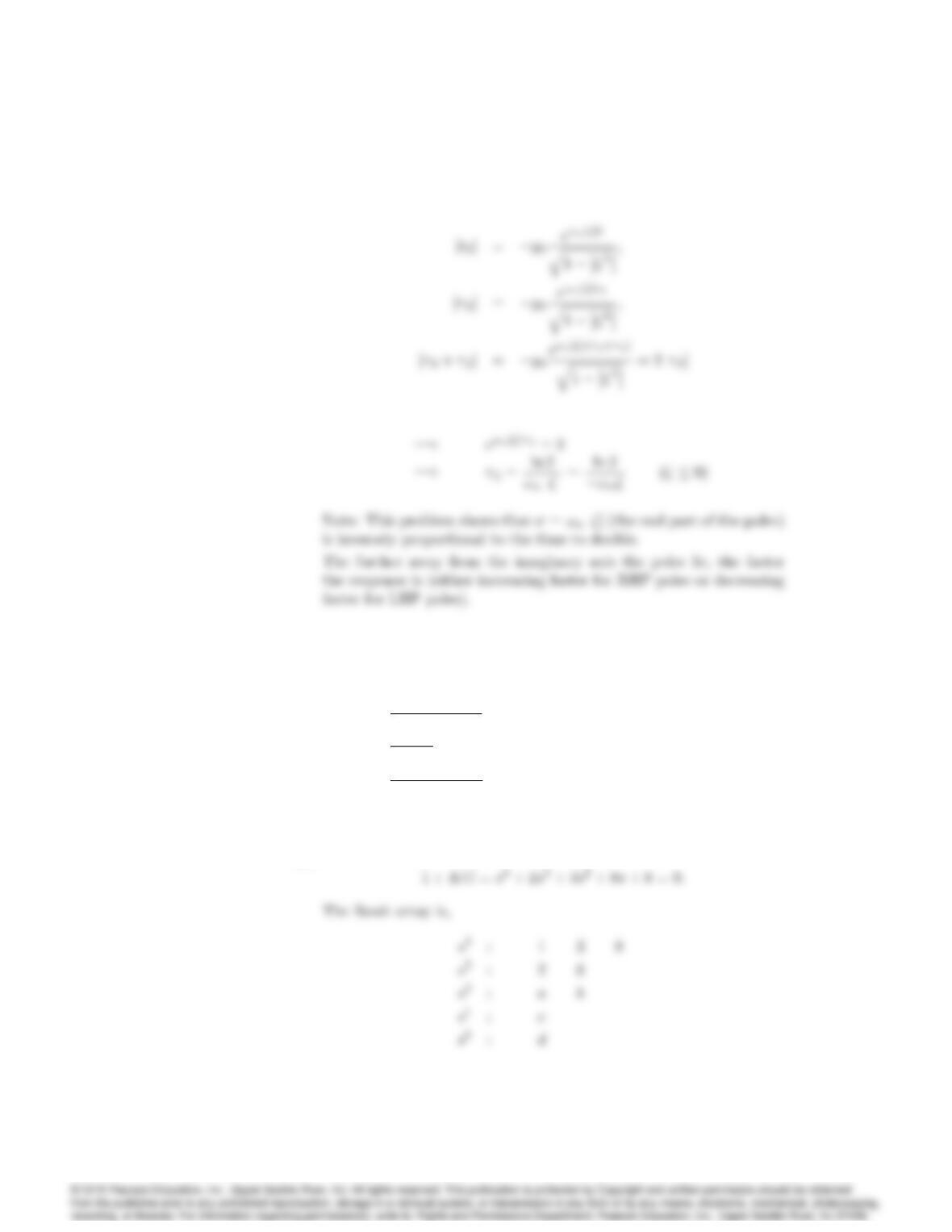
(a) First-order system, H(s)could be:
(b) Second-order system:
3108 CHAPTER 3. DYNAMIC RESPONSE
53. Suppose that unity feedback is to be applied around the listed open-loop
systems. Use Routh’s stability criterion to determine whether the resulting
closed-loop systems will be stable.
(a) KG(s) = 4(s+2)
s(s3+2s2+3s+4)
(b) KG(s) = 2(s+4)
s2(s+1)
(c) KG(s) = 4(s3+2s2+s+1)
s2(s3+2s2s1)
Solution:
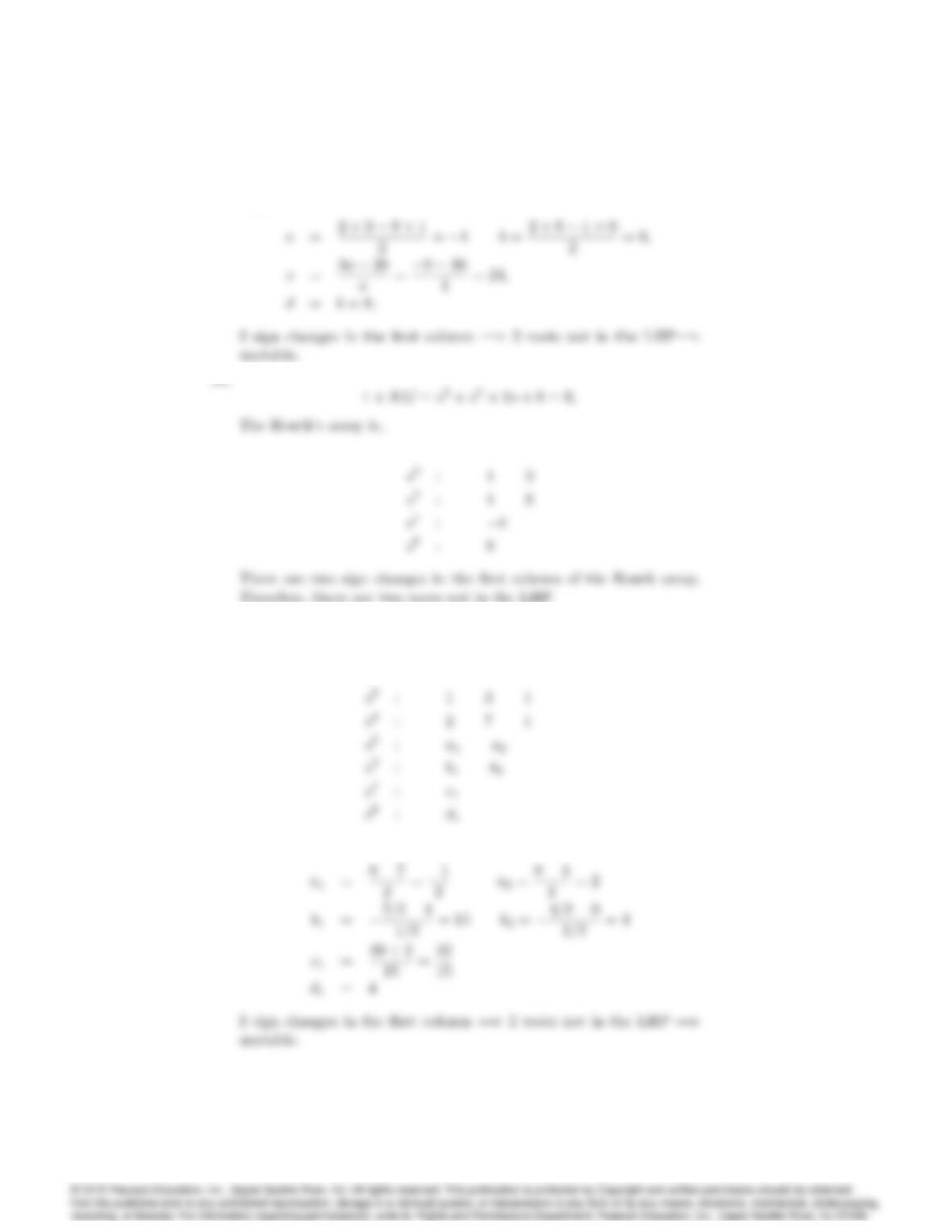
(a)
3109
where
(b)
Therefore, there are two roots not in the LHP.
(c)
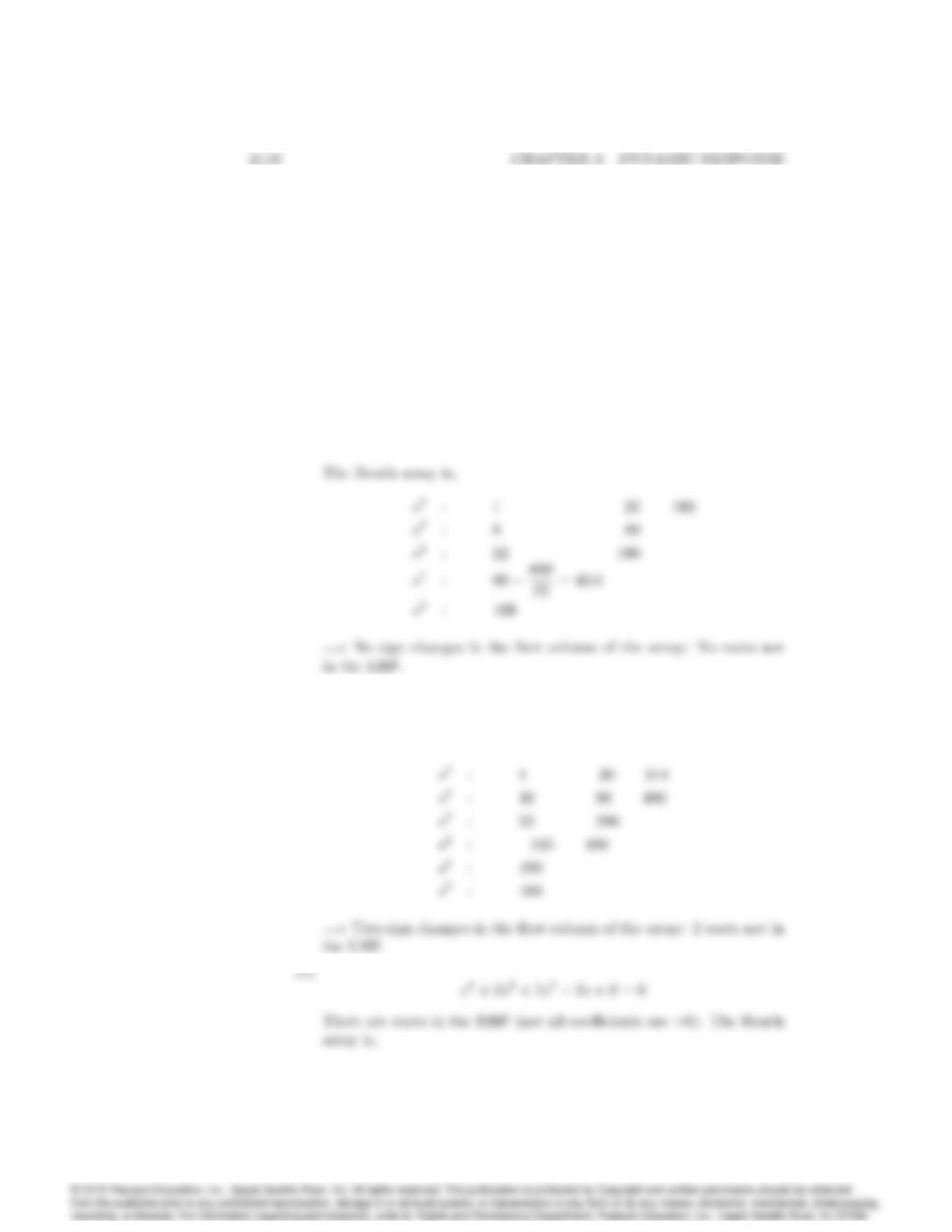
1 + KG =s5+ 2s4+ 3s3+ 7s2+ 4s+ 4 = 0:
The Routh array is,
where
54. Use Routh’s stability criterion to determine how many roots with positive
real parts the following equations have:
(a) s4+ 8s3+ 32s2+ 80s+ 100 = 0.
(b) s5+ 10s4+ 30s3+ 80s2+ 344s+ 480 = 0.
(c) s4+ 2s3+ 7s22s+ 8 = 0.
(d) s3+s2+ 20s+ 78 = 0.
(e) s4+ 6s2+ 25 = 0.
Solution:
(a)
s4+ 8s3+ 32s2+ 80s+ 100 = 0
(b)
s5+ 10s4+ 30s3+ 80s2+ 344s+ 480 = 0