K= 200.0000
K= 400.0000
1.5
K= 1000.0000
1.5
K= 2000.0000
K= 200.0000
K= 400.0000
1.5
K= 1000.0000
1.5
K= 2000.0000
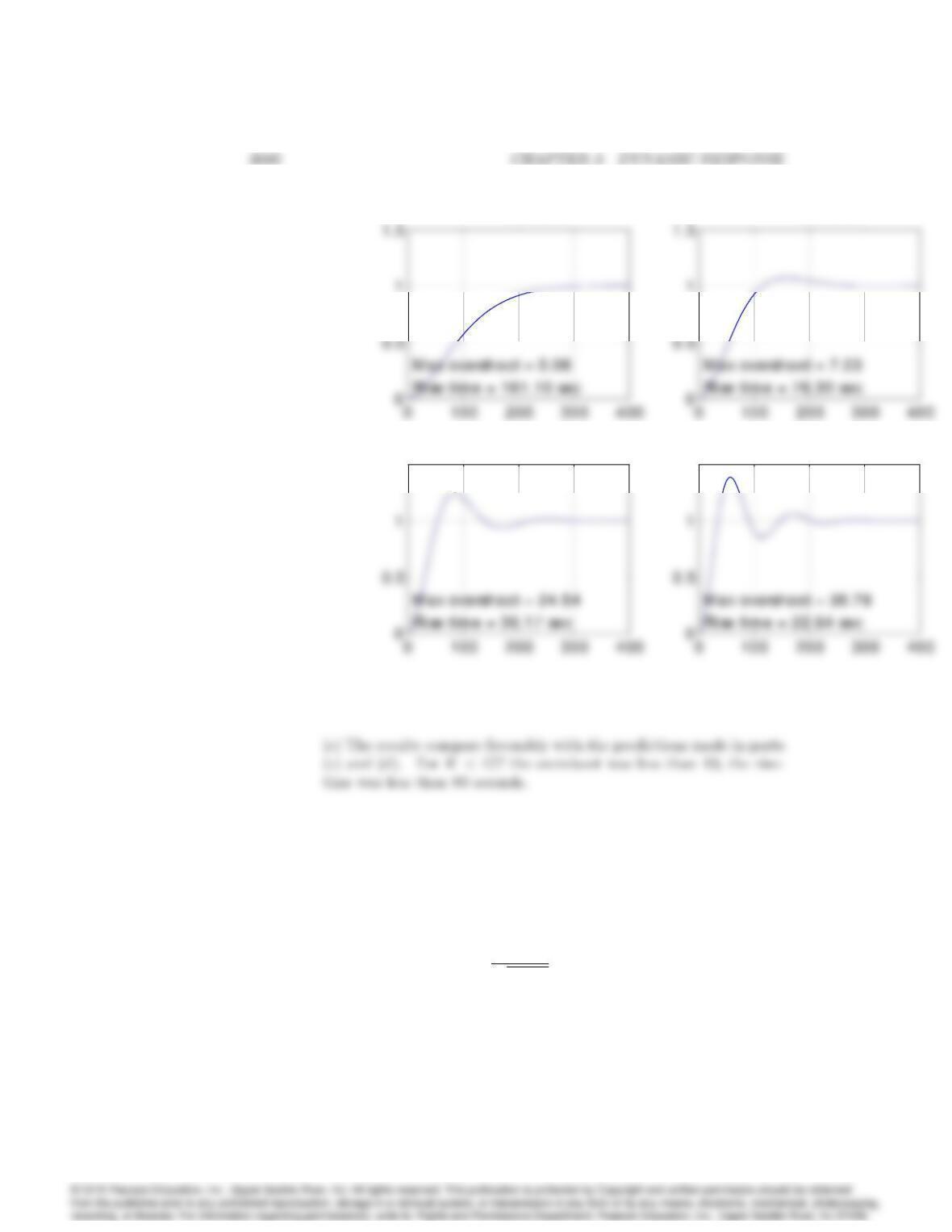
(e) Problem 3.36: Step responses for several values of K.
37. (a) Show that the second-order system
•y+ 2!n_y+!2
ny= 0; y(0) = yo;_y(0) = 0;
has the response
y(t) = yo
et
p12sin(!dt+ cos1):
Prove that, for the underdamped case ( < 1), the response oscilla-
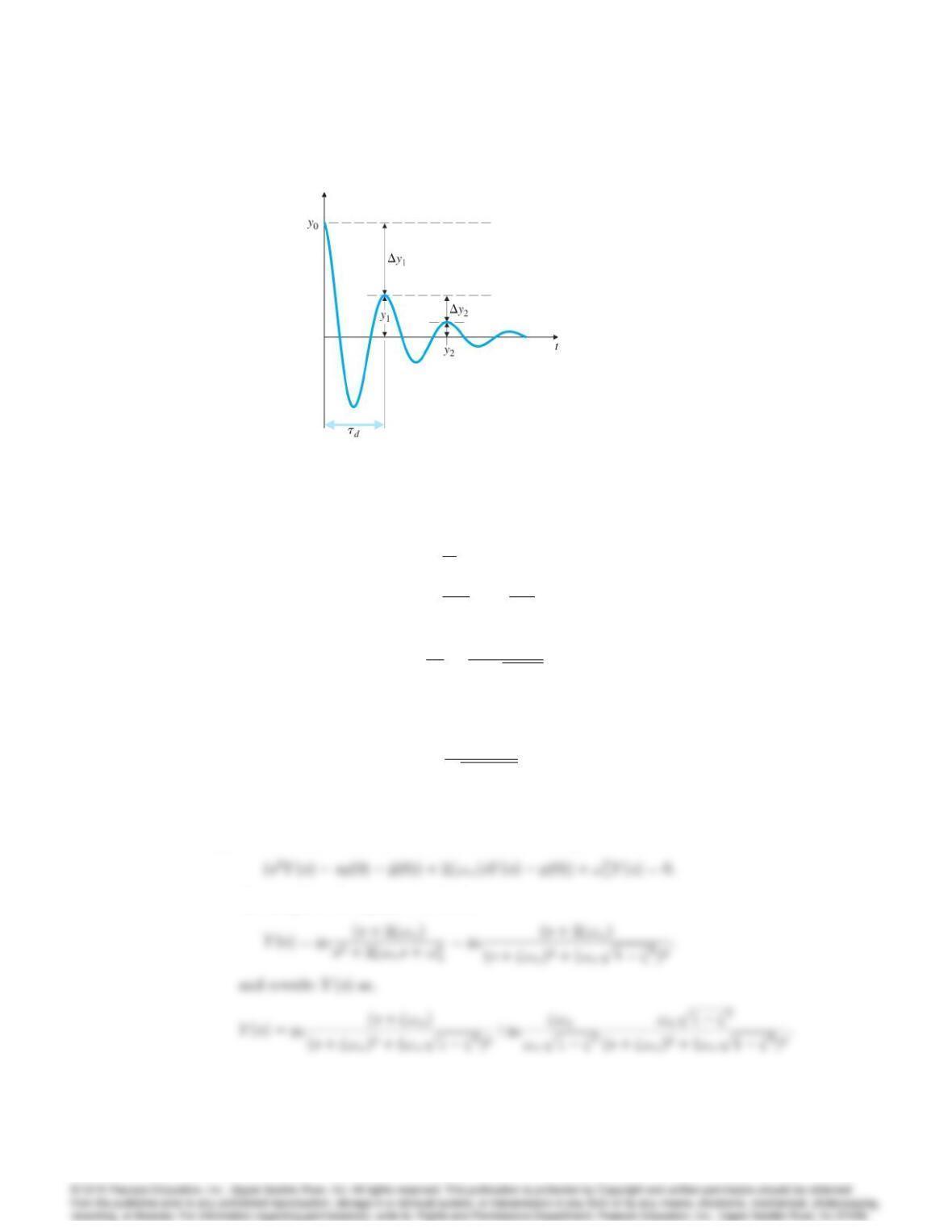
tions decay at a predictable rate (see Fig. 3.62) called the logarith-
3081
Figure 3.62: Definition of logarithmic decrement
mic decrement
= ln yo
y1
=d
= ln y1
y1
=ln yi
yi
;
where
d=2
!d
=2
!np12;
is the damped natural period of vibration.
The damping coefficient in terms of the logarithmic decrement is then
=
p42+2:
Solution:
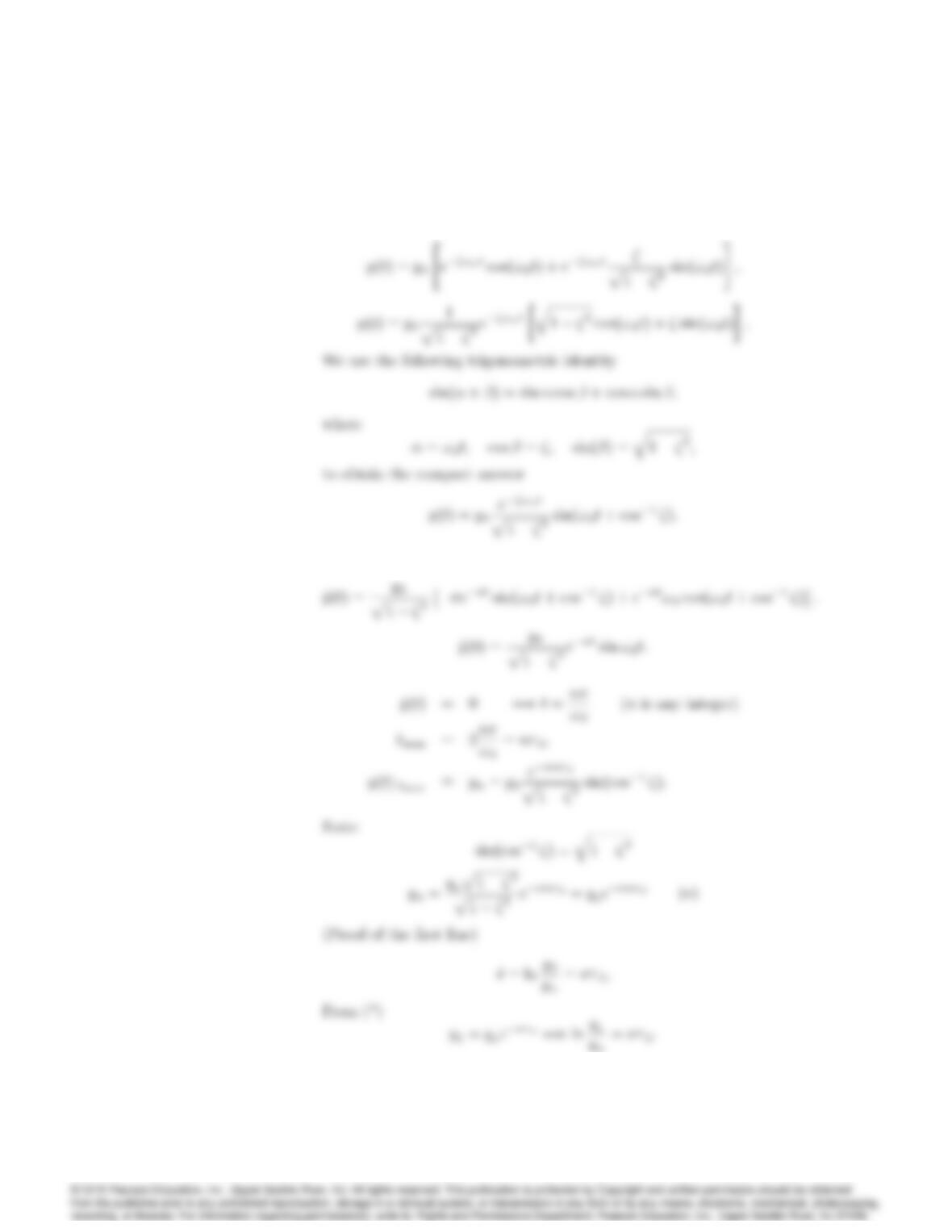
(a) We take Laplace transform of both sides of the equation to obtain
We complete the squares to obtain,
3082 CHAPTER 3. DYNAMIC RESPONSE
Using Items #19, #20 from theTable of Laplace Transorms we ob-
tain,
(b)
3083
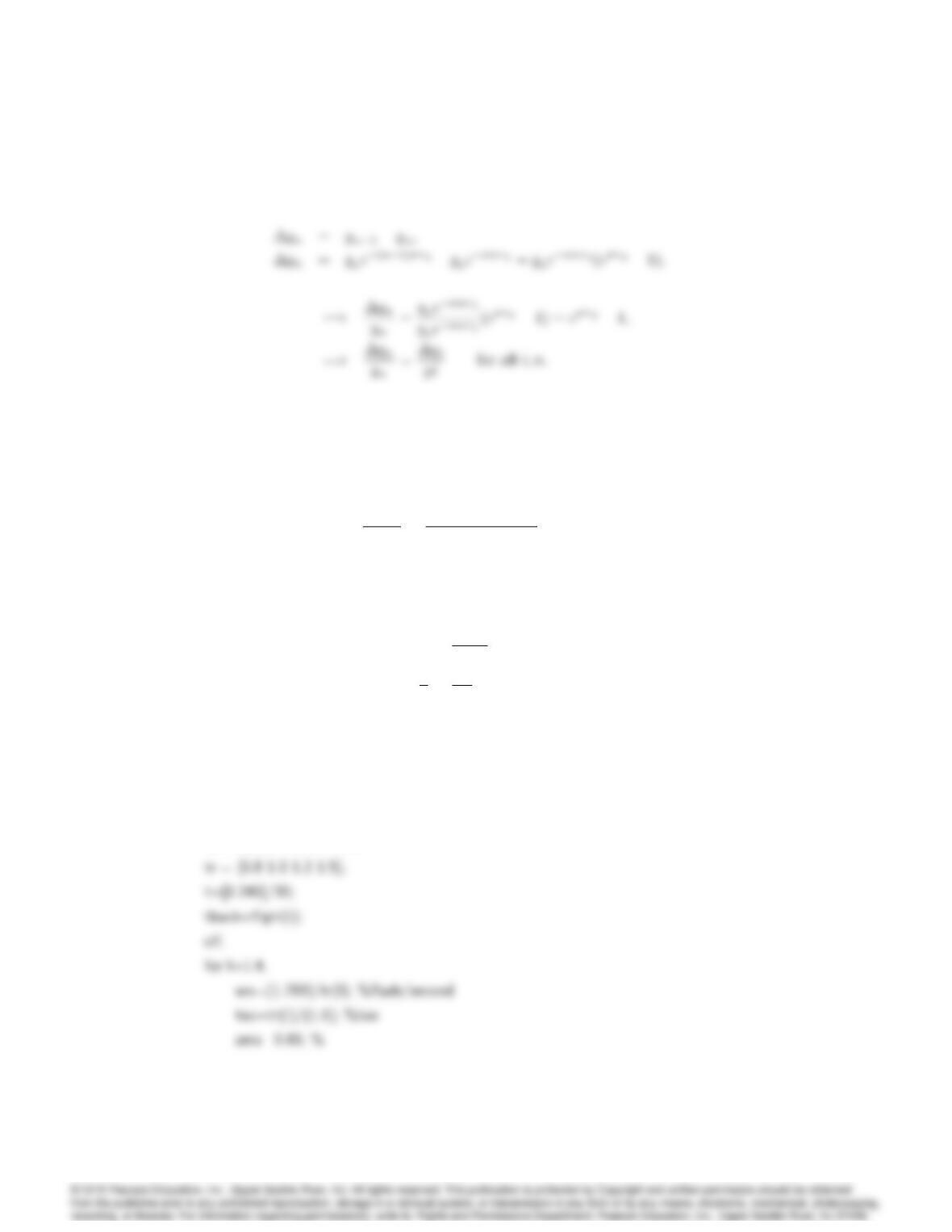
(Proof of the second line)
Problems and Solutions for Section 3.5: Ef-
fects of Zeros and Additional Poles
38. In aircraft control systems, an ideal pitch response (qo)versus a pitch
command (qc)is described by the transfer function
Qo(s)
Qc(s)=!2
n(s+ 1=)
s2+ 2!ns+!2
n
:
The actual aircraft response is more complicated than this ideal transfer
function; nevertheless, the ideal model is used as a guide for autopilot
design. Assume that tris the desired rise time and that
!n=1:789
tr
,
1
=1:6
tr
,
= 0:89.
Show that this ideal response possesses a fast settling time and minimal
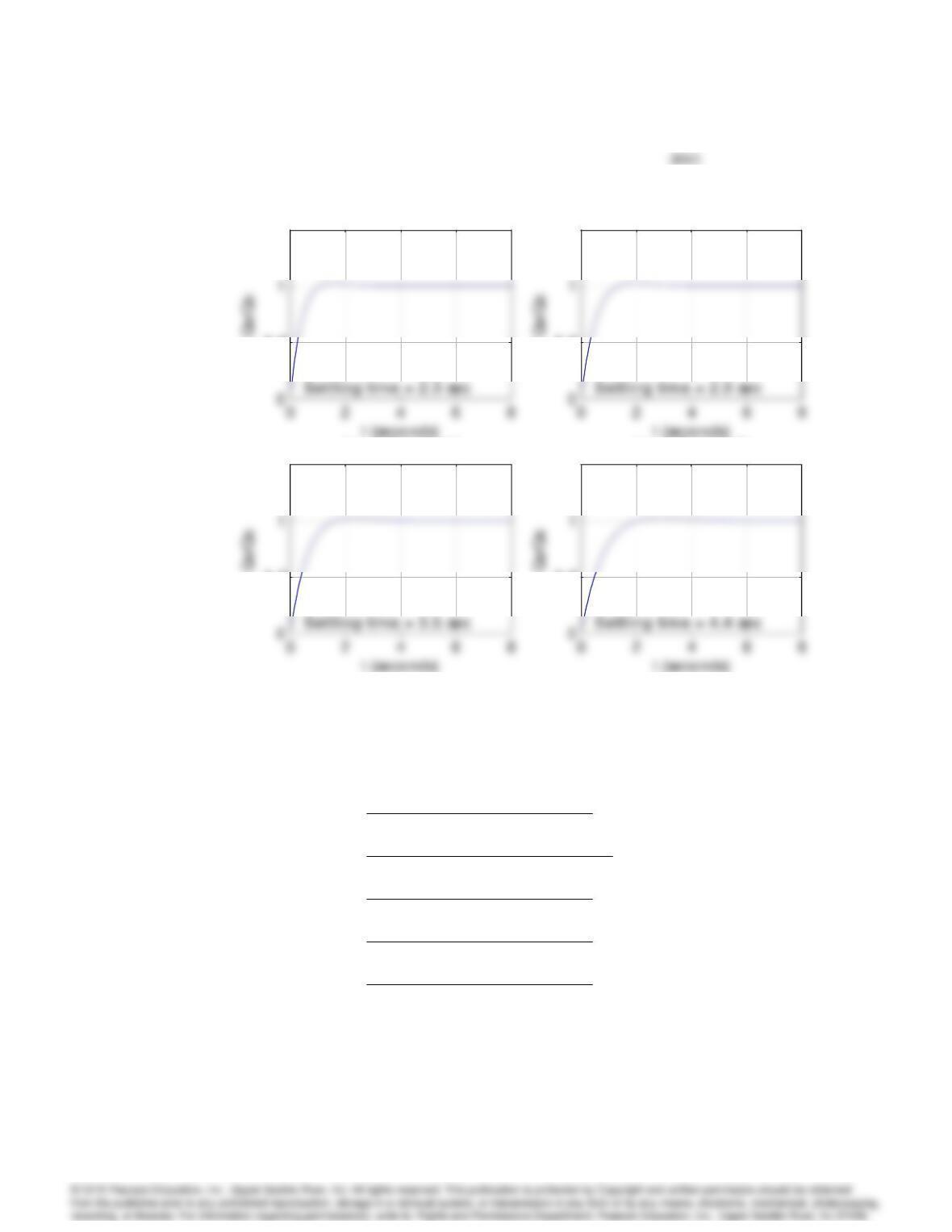
overshoot by plotting the step response for tr= 0:8, 1.0, 1.2, and 1.5 sec.
Solution:
The following program statements in Matlab produce the following plots:
% Problem 3.38 FPE7e
3084 CHAPTER 3. DYNAMIC RESPONSE
b=tau*(wn^2)*[1 1/tau];
titletext=sprintf(’tr=%3.1f seconds’,tr(I));
yind=find(abs(yback-1)>0.01);
0.5
1.5
tr = 0.8 seconds
Max overshoot = 2.3%
0.5
1.5
tr = 1.0 seconds
Max overshoot = 2.3%
0.5
1.5
tr = 1.2 seconds
Max overshoot = 2.3%
0.5
1.5
tr = 1.5 seconds
Max overshoot = 2.3%
0.5
1.5
tr = 0.8 seconds
Max overshoot = 2.3%
0.5
1.5
tr = 1.0 seconds
Max overshoot = 2.3%
0.5
1.5
tr = 1.2 seconds
Max overshoot = 2.3%
0.5
1.5
tr = 1.5 seconds
Max overshoot = 2.3%
Problem 3.38: Ideal pitch response.
39. Approximate each of the transfer functions given below with a second
order transfer function.
G1(s) = (0:5s+ 1)(s+ 1)
(0:55s+ 1)(0:95s+ 1)(s2+s+ 1);
G2(s) = (0:5s+ 1)(s+ 1)
(0:55s+ 1)(0:95s+ 1)(s2+ 0:2s+ 1);
G3(s) = (0:5s+ 1)(s+ 1)
(0:95s+ 1)(0:05s+ 1)(s2+s+ 1);
G4(s) = (0:5s+ 1)(s+ 1)
(0:55s+ 1)(0:05s+ 1)(s2+s+ 1);
G5(s) = (0:5s+ 1)(0:02s+ 1)
(0:55s+ 1)(0:95s+ 1)(s2+s+ 1):
Solution: Approximated by standard second-order system; = 0:5and
3086 CHAPTER 3. DYNAMIC RESPONSE
Mp= 17%:
Approximated by standard second-order, = 0:1(light damping).
40. A system has the closed-loop transfer function
Y(s)
R(s)=T(s) = 2700(s+ 25)
(s+ 1)(s+ 45)(s+ 60)(s2+ 8s+ 25);
where Ris a step of size 7.
(a) Give an expression for the form of the output time history as a sum
of terms showing the shape of each component of the response.
(b) Give an estimate of the settling time of this step response.
Solution:
(a) T(0) = 1,R(s) = 7
s:
41. Consider the system shown in Fig. 3.63, where
G(s) = 1
s(s+ 3) and Dc(s) = K(s+z)
s+p:
Find K,z, and pso that the closed-loop system has a 10% overshoot to a
step input and a settling time of 1.5 sec (1% criterion).
Solution:
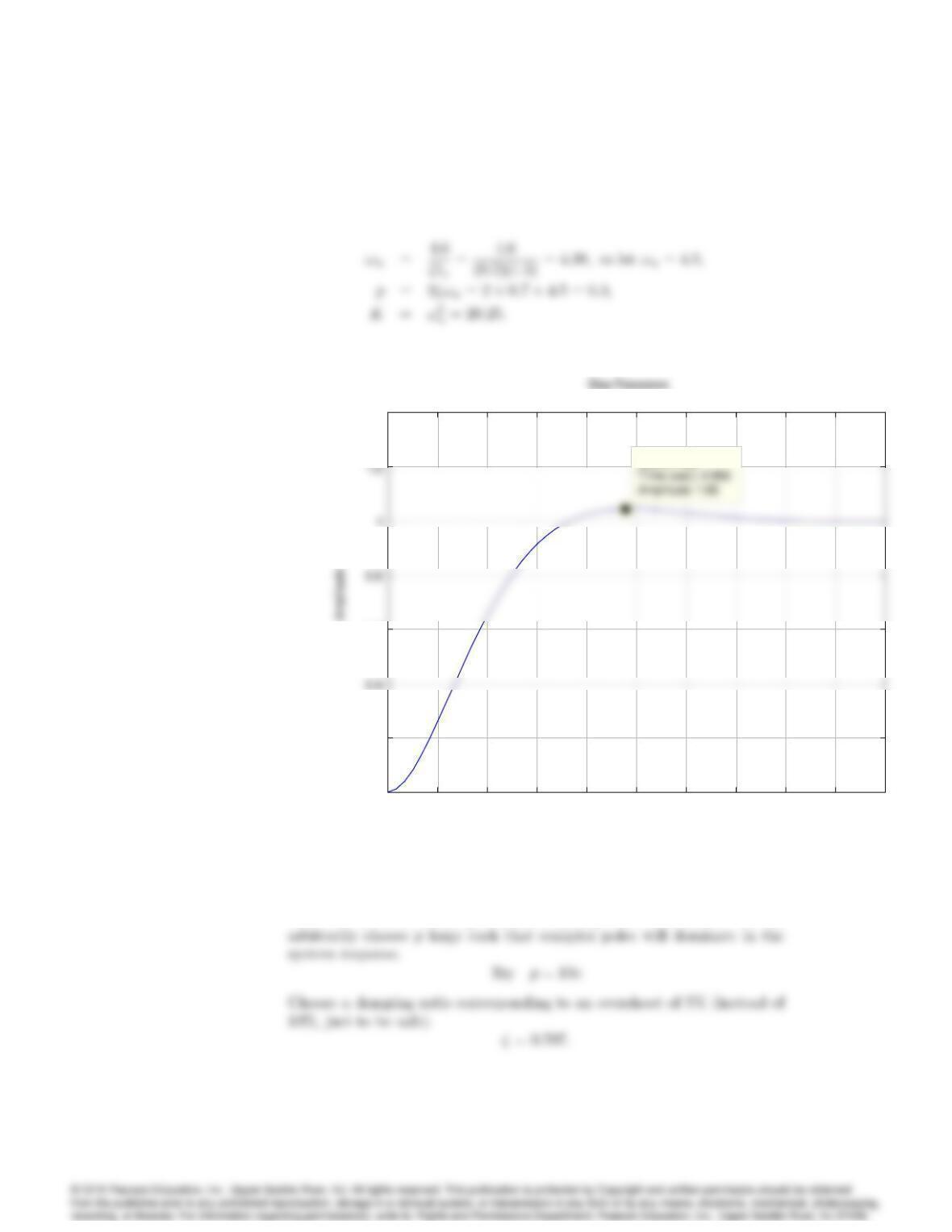
For the 10% overshoot:
Method I.
From inspection, if z= 3,(s+ 3) will cancel out and we will have a
standard form transfer function. As perfect cancellation is impossible,
assign za value that is very close to 3, say 3:1. But in determining the K
and p, assume that (s+ 3) and(s+ 3:1) cancelled out each other. Then:
As the additional pole and zero will affect the system response, pick some
larger damping ratio.
3088 CHAPTER 3. DYNAMIC RESPONSE
Let = 0:7
00.2 0.4 0.6 0.8 11.2 1.4 1.6 1.8 2
0
0.2
0.6
1.4
Time (sec)
00.2 0.4 0.6 0.8 11.2 1.4 1.6 1.8 2
0
0.2
0.6
1.4
System: sys
Step response: Method I.
Method II.
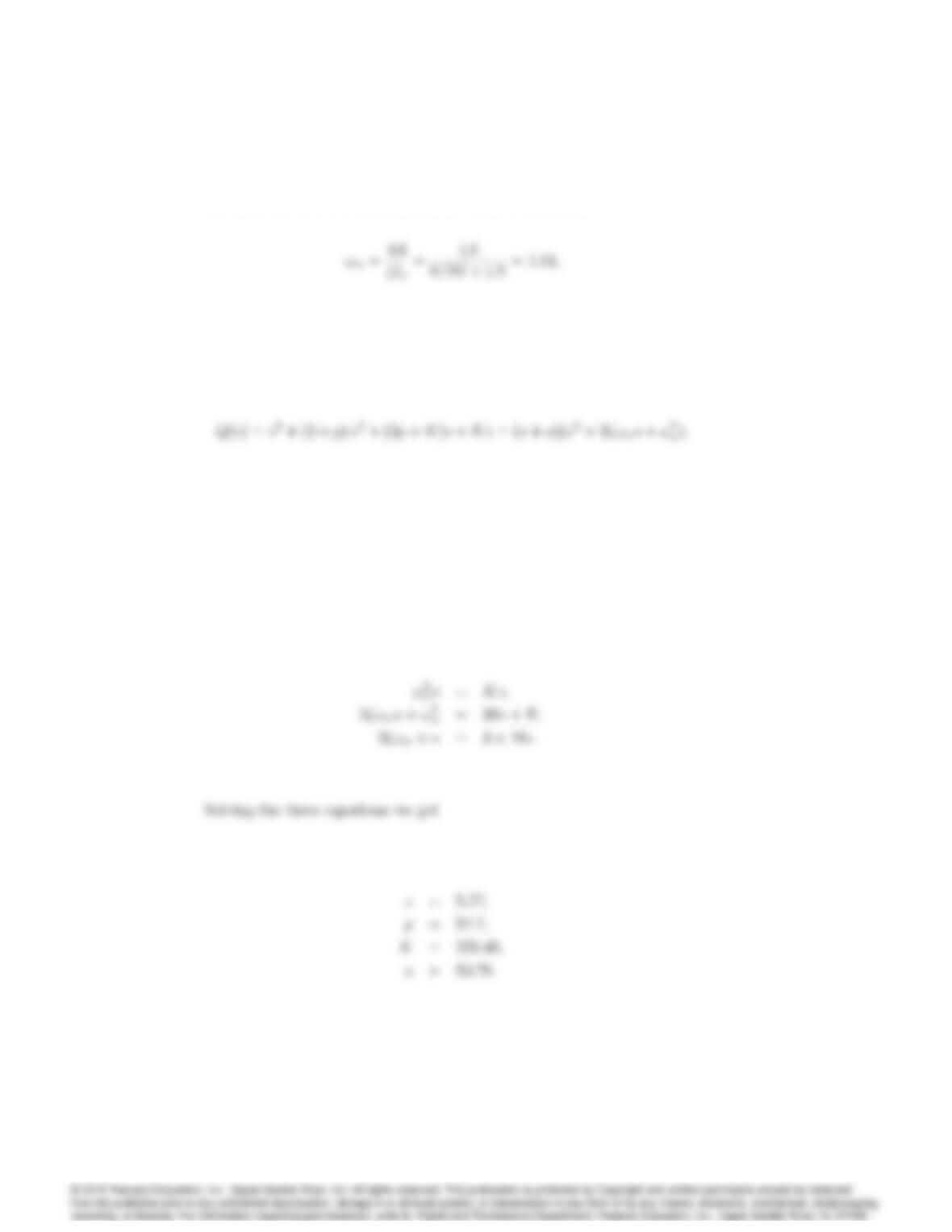
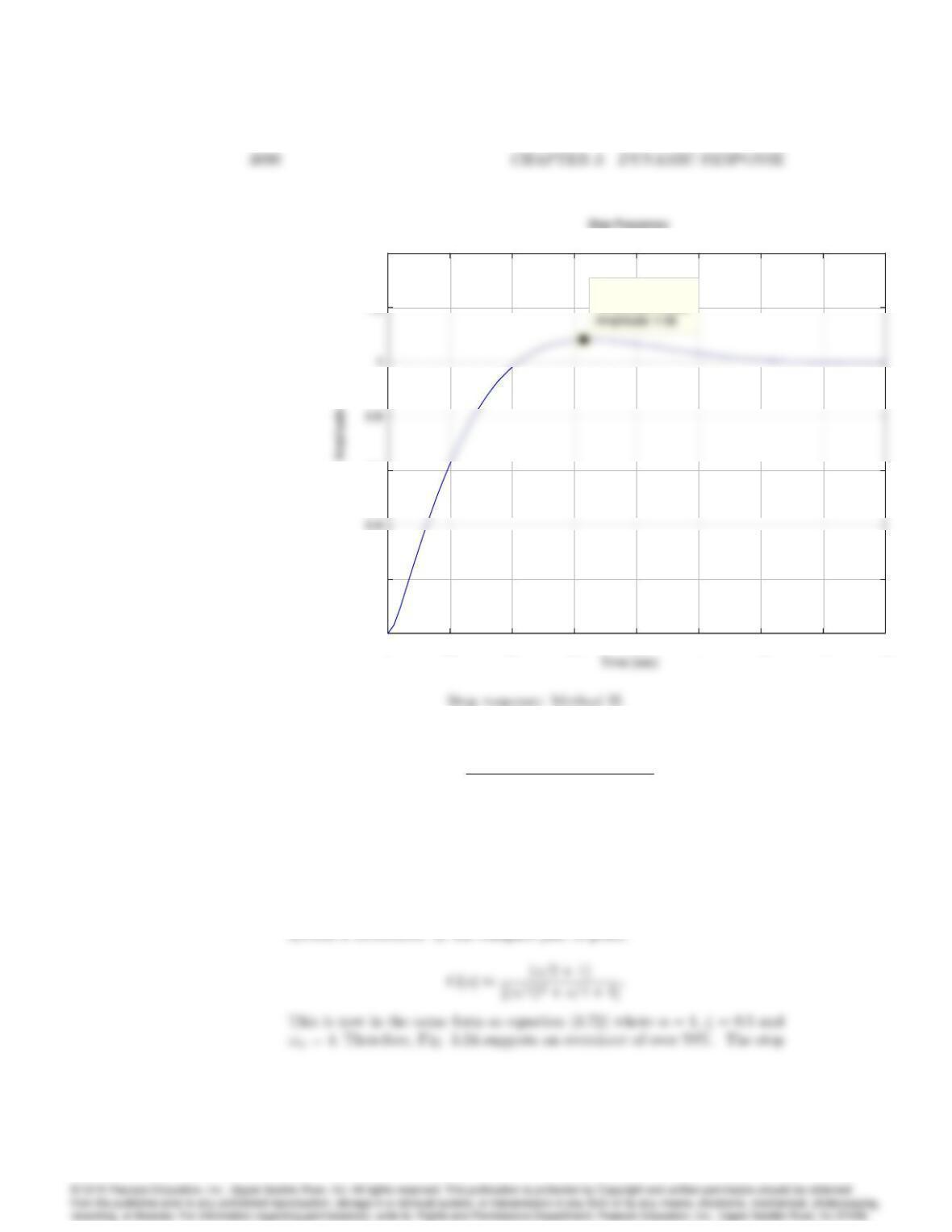
There are 3unknowns (z; p; K)and only 2specified conditions. We can
3089
From the formula for settling time (with a 1% criterion)
adding some margin, let !n= 4:88:The characteristic equation is
We want the characteristic equation to be the product of two factors, a
couple of conjugated poles (dominant) and a non-dominant real pole far
form the dominant poles.
Equate the coefficients of like powers of sin the expressions of the char-
acteristic equation.
00.2 0.4 0.6 0.8 11.2 1.4 1.6
0
0.2
0.6
1.4
00.2 0.4 0.6 0.8 11.2 1.4 1.6
0
0.2
0.6
1.2
1.4
System: sys
Time ( sec): 0.628
42. NSketch the step response of a system with the transfer function
G(s) = s=2 + 1
(s=40 + 1)[(s=4)2+s=4 + 1]:
Justify your answer on the basis of the locations of the poles and zeros.
(Do not find inverse Laplace transform.) Then compare your answer with
the step response computed using Matlab.
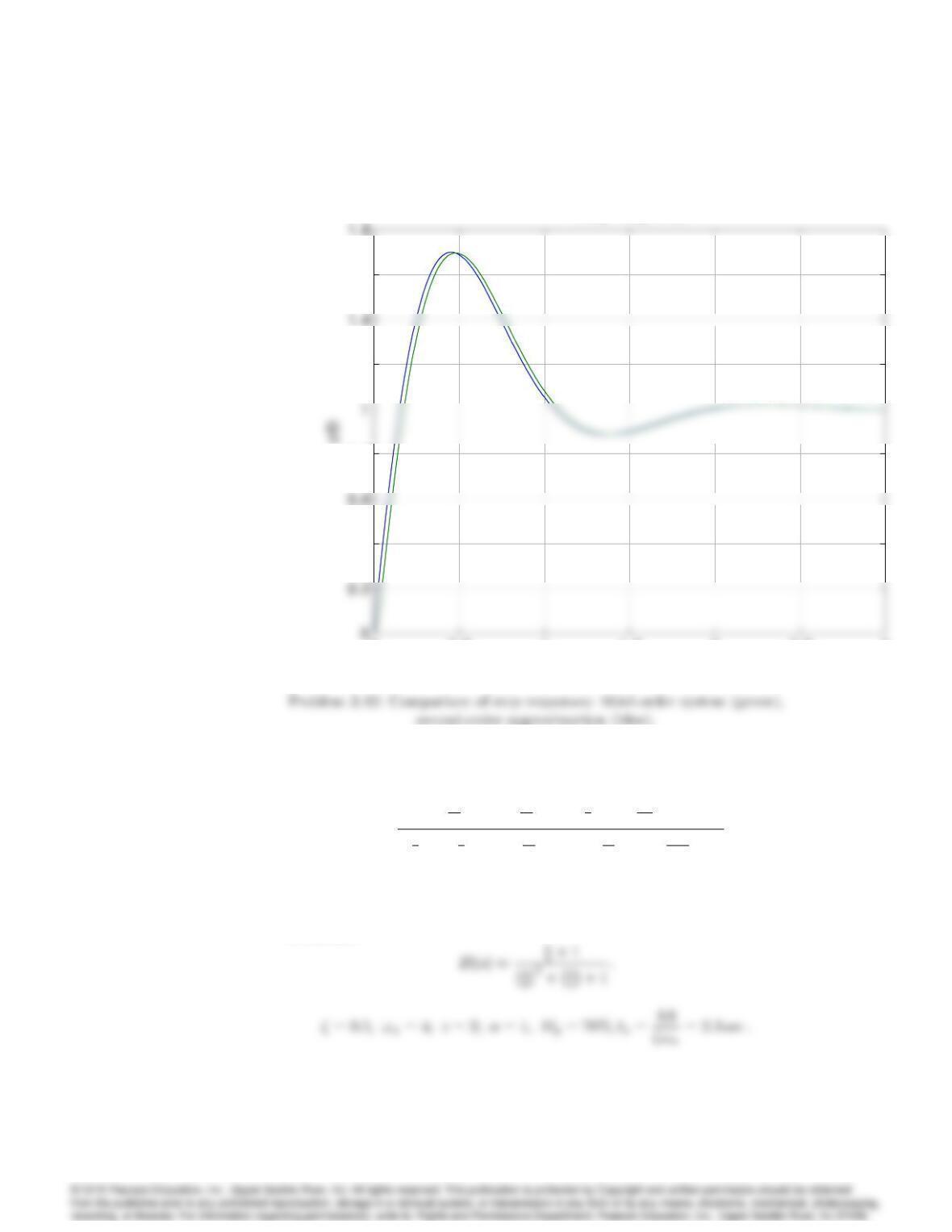
Solution:
From the location of the poles, we notice that the real pole is a factor of
20 away from the complex pair of poles. Therefore, the response of the
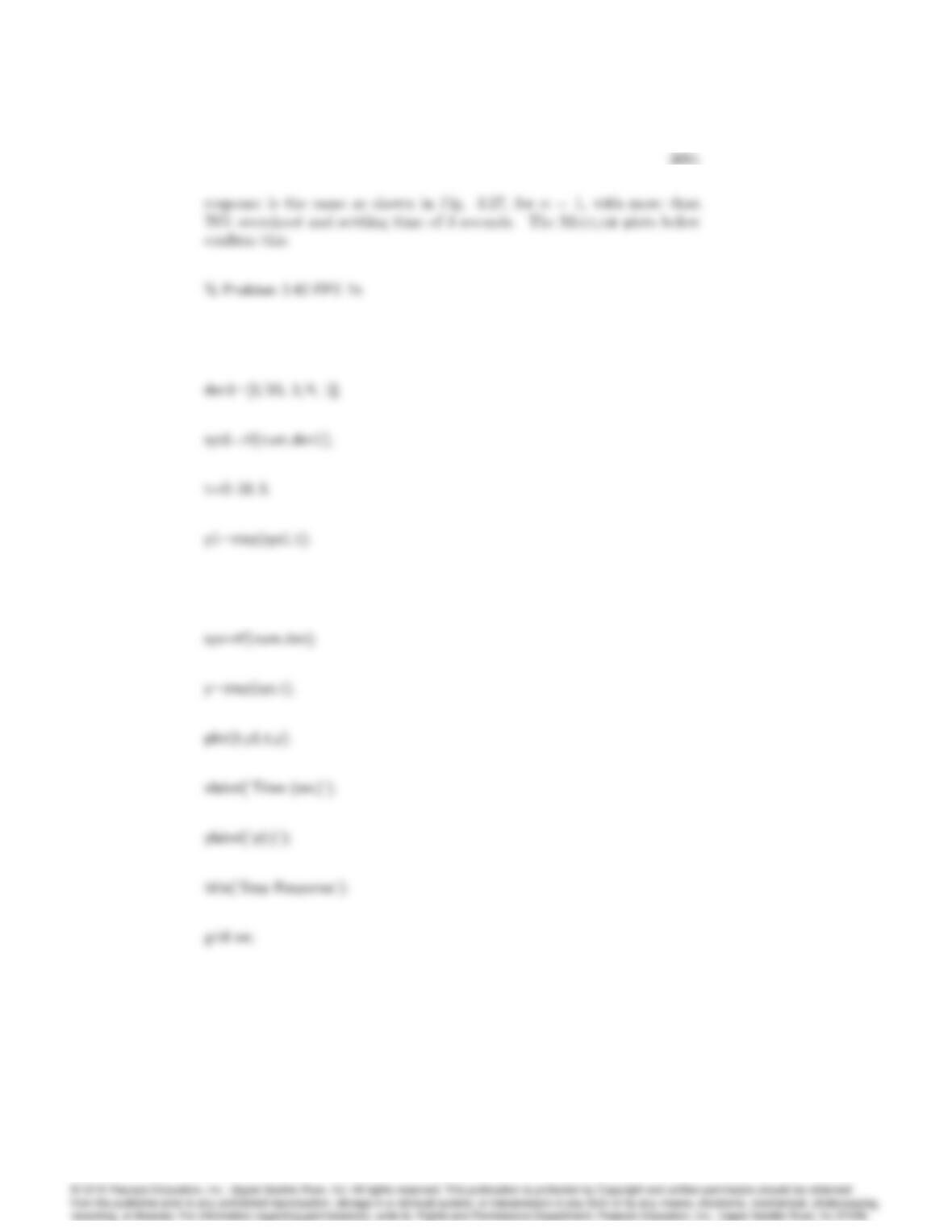
num=[1/2, 1];
den=conv([1/40, 1],den1);
3092 CHAPTER 3. DYNAMIC RESPONSE
00.5 11.5 22.5 3
0.4
0.8
1.2
1.6
Time (sec)
Step Response
00.5 11.5 22.5 3
0.4
0.8
1.2
1.6
Time (sec)
Step Response
43. A closed-loop transfer function is given below
H(s) = hs
102+ 0:1s
10+ 1is
2+ 1 s
0:1+ 1
hs
42+s
4+ 1ihs
102+ 0:09s
10+ 1is
0:02 + 1:
Estimate the percent overshoot, Mp, and the transient settling time, ts
for this system.
Solution:
44. A transfer function, G(s), is given below.
G(s) = hs
1002+ 0:01s
100+ 1i
hs
102+s
10+ 1is
5+ 1hs
1002+ 0:1s
100+ 1i:
If a step input is applied to this plant, what do you estimate the rise-
time, settling time, and overshoot to be? Give a brief statement of your
reasons, in each case.
Solution:
45. Three closed-loop transfer functions are given below.
Y(s)
R(s)=T1(s) = 2
(s2+ 2s+ 2);
Y(s)
R(s)=T2(s) = 2(s+ 3)
2(s2+ 2s+ 2);
Y(s)
R(s)=T3(s) = 6
(s+ 3)(s2+ 2s+ 2):
In each case, provide estimates of the rise-time, settling time, and percent
overshoot to a unit step input in r.
Solution:
(a) tr=1:8
!n=1:8
p2= 1:2728 sec,ts=4:6
!n= 4:6 sec,Mp= 5% for = 0:5.
46. Five transfer functions with unity DC gain are given below.
(a) Which transfer function (s) will meet an overshoot specification of
Mp5%?
(b) Which transfer function (s) will meet a rise time specification of tr
0:5sec?

3094 CHAPTER 3. DYNAMIC RESPONSE
(c) Which transfer function (s) will meet a settling time specification of
ts2:5sec?
G1(s) = 40
(s2+ 4s+ 40);
G2(s) = 40
(s+ 1)(s2+ 4s+ 40);
G3(s) = 120
(s+ 3)(s2+ 4s+ 40);
G4(s) = 20(s+ 2)
(s+ 1)(s2+ 4s+ 40);
G5(s) = 36040=401 (s2+s+ 401)
(s2+ 4s+ 40)(s2+s+ 901):
Solution:
47. Consider the two nonminimum phase systems,
G1(s) = 2(s1)
(s+ 1)(s+ 2);(1)
G2(s) = 3(s1)(s2)
(s+ 1)(s+ 2)(s+ 3):(2)
(a) Sketch the unit step responses for G1(s)and G2(s), paying close
attention to the transient part of the response.
(b) Explain the difference in the behavior of the two responses as it relates
to the zero locations.
(c) Consider a stable, strictly proper system (that is, mzeros and npoles,
where m < n). Let y(t)denote the step response of the system. The
step response is said to have an undershoot if it initially starts off in
the “wrong” direction. Prove that a stable, strictly proper system has
an undershoot if and only if its transfer function has an odd number
of real RHP zeros.
Solution:
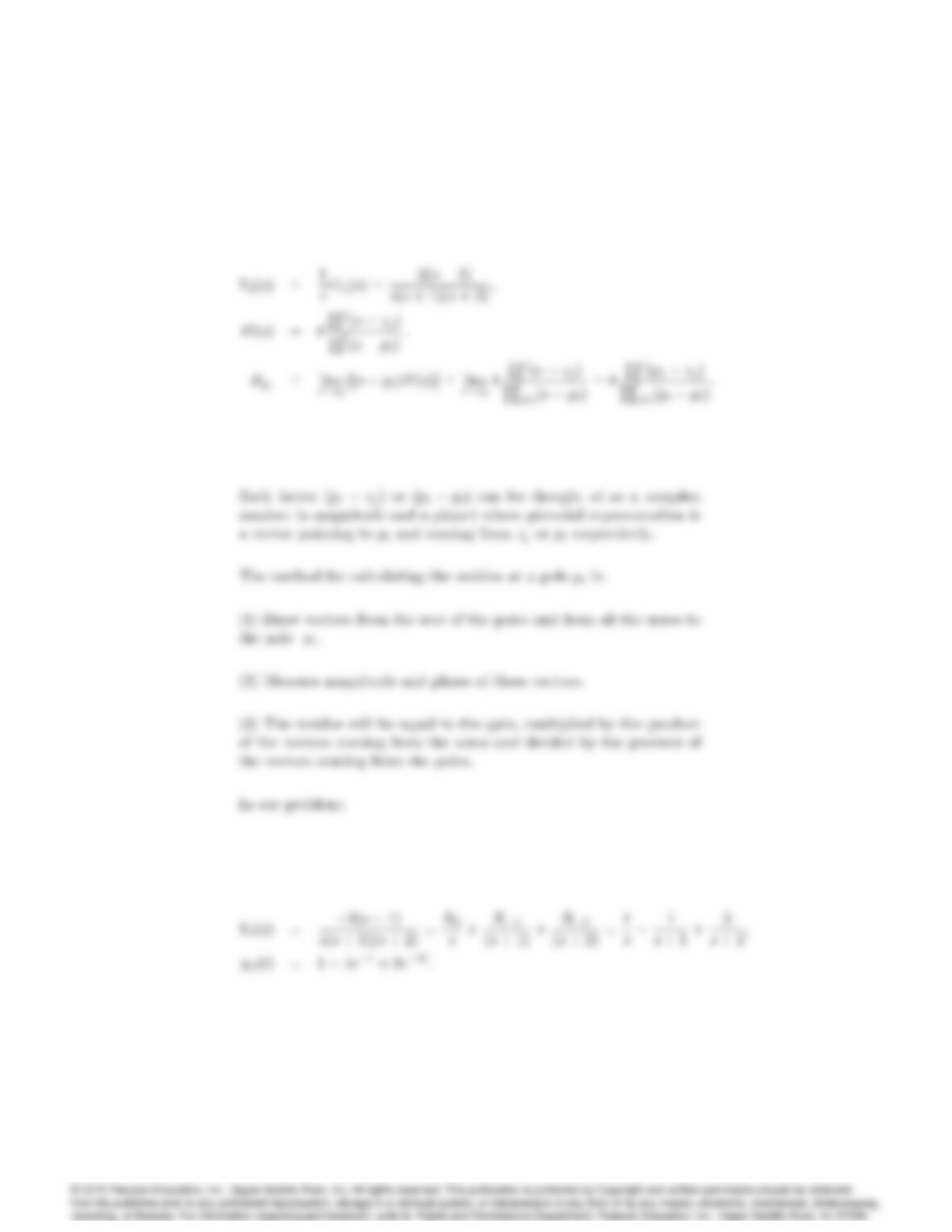
(a) For G1(s) :
3095
–0.2
0.4
0.8
y1(t)
–0.2
0.4
0.8
Problem 3.47: Step response for a non-minimum phase system with
one real RHP zero.
For G2(s) :
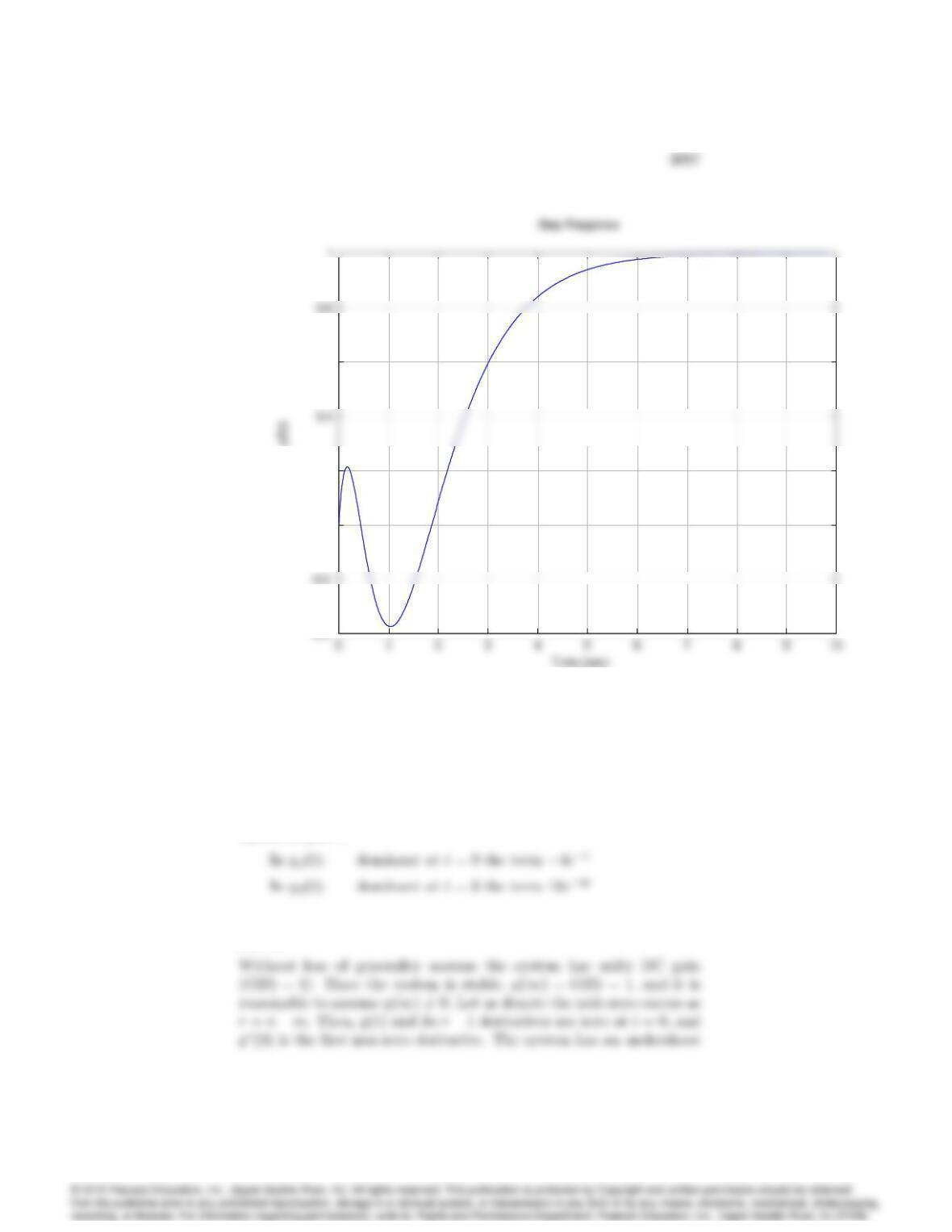
0
0.2
0.6
0
0.2
0.6
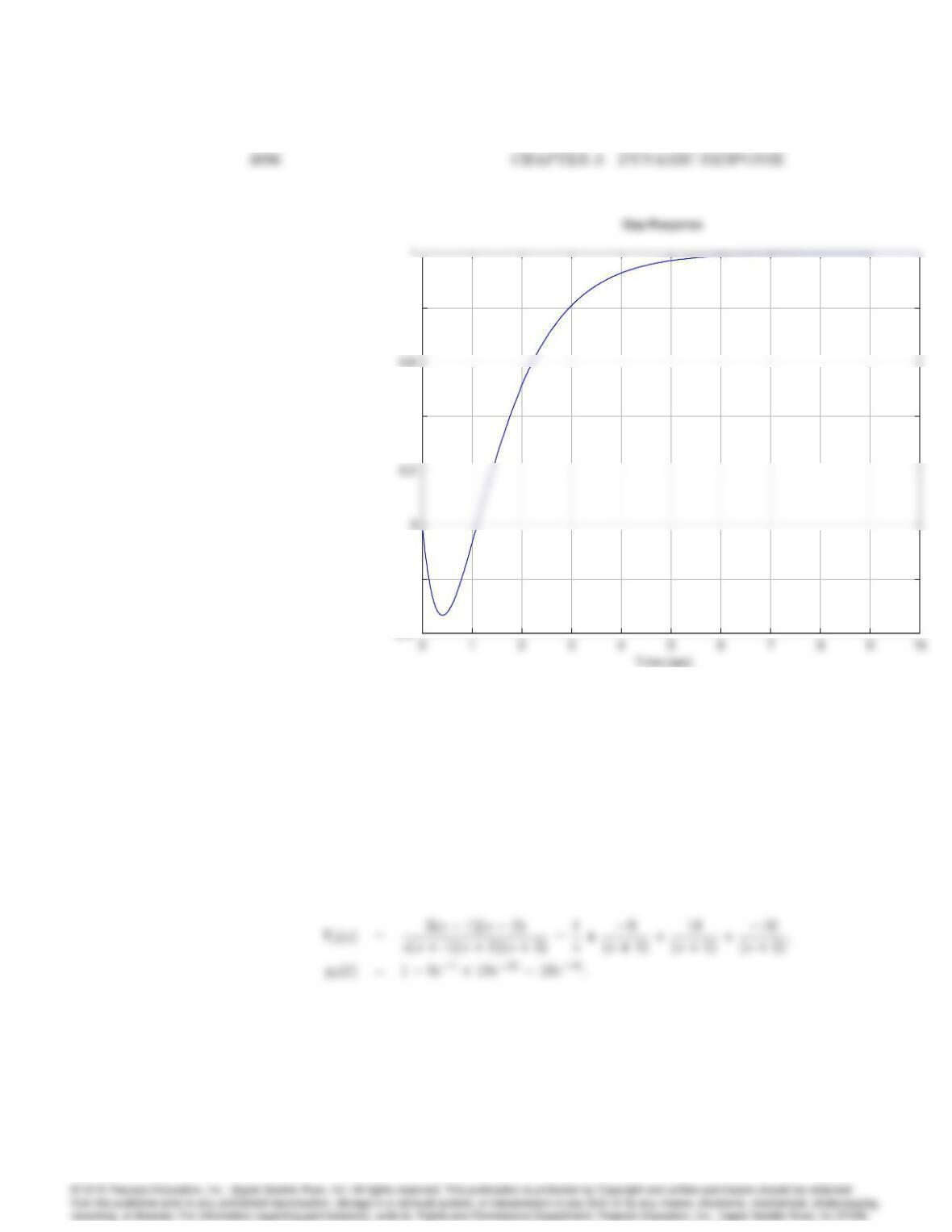
Problem 3.47: Step response of a non-minimum phase system with
two real zeros in the RHP.
(b) The first system presents an “undershoot”. The second system, on
the other hand, starts off in the right direction.
The reasons for this initial behavior of the step response will be an-
alyzed in part c.
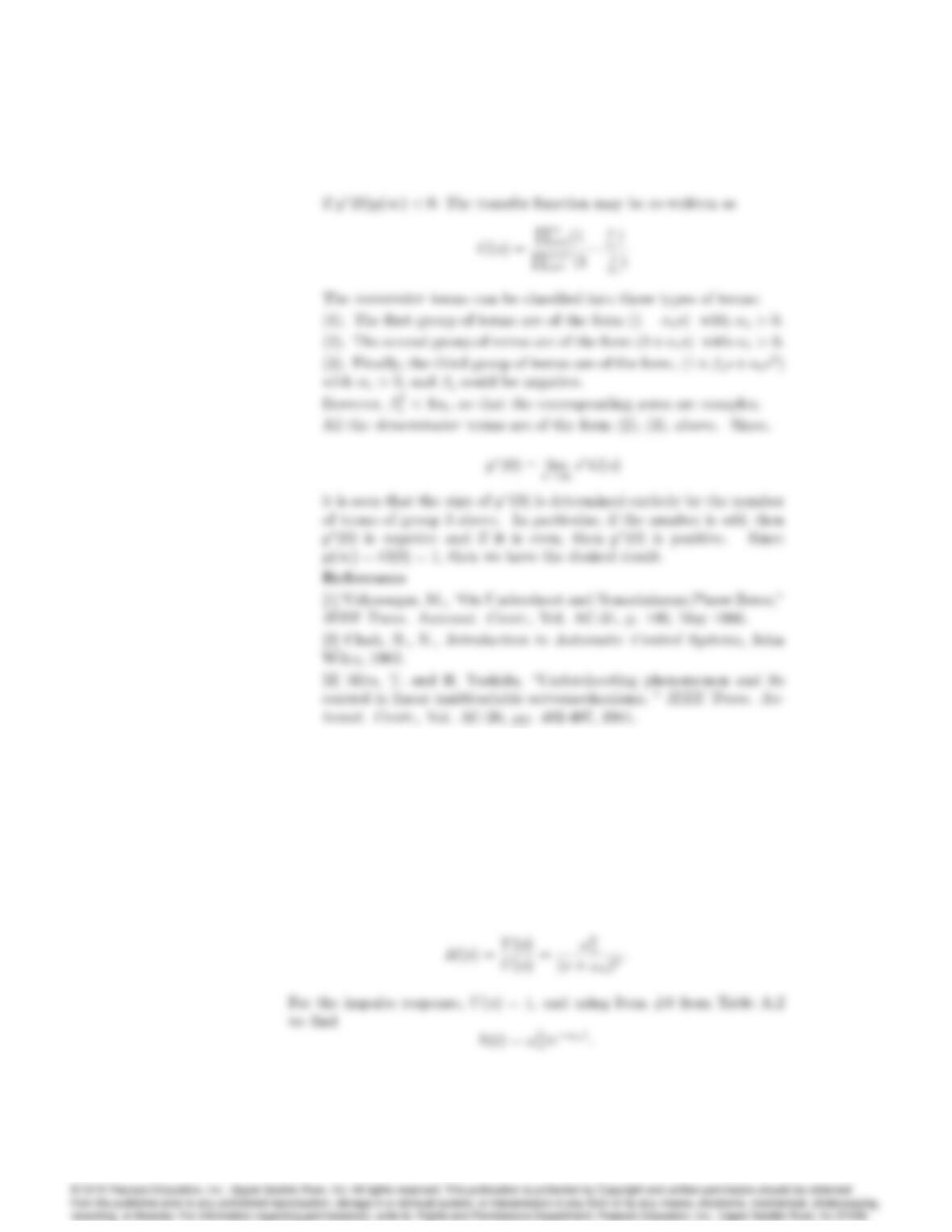
(c) The following concise proof is from Reference [1] (see also References
[2]-[3]).
3098 CHAPTER 3. DYNAMIC RESPONSE
48. Find the relationships for the impulse response and the step response
corresponding to Equation (3.65) for the cases where,
(a) the roots are repeated.
(b) the roots are both real. Express your answers in terms of hyperbolic
functions (sinh,cosh) to best show the properties of the system response.
(c) the value of the damping coefficient, , is negative.
Solution:
(a) In this case we have = 1
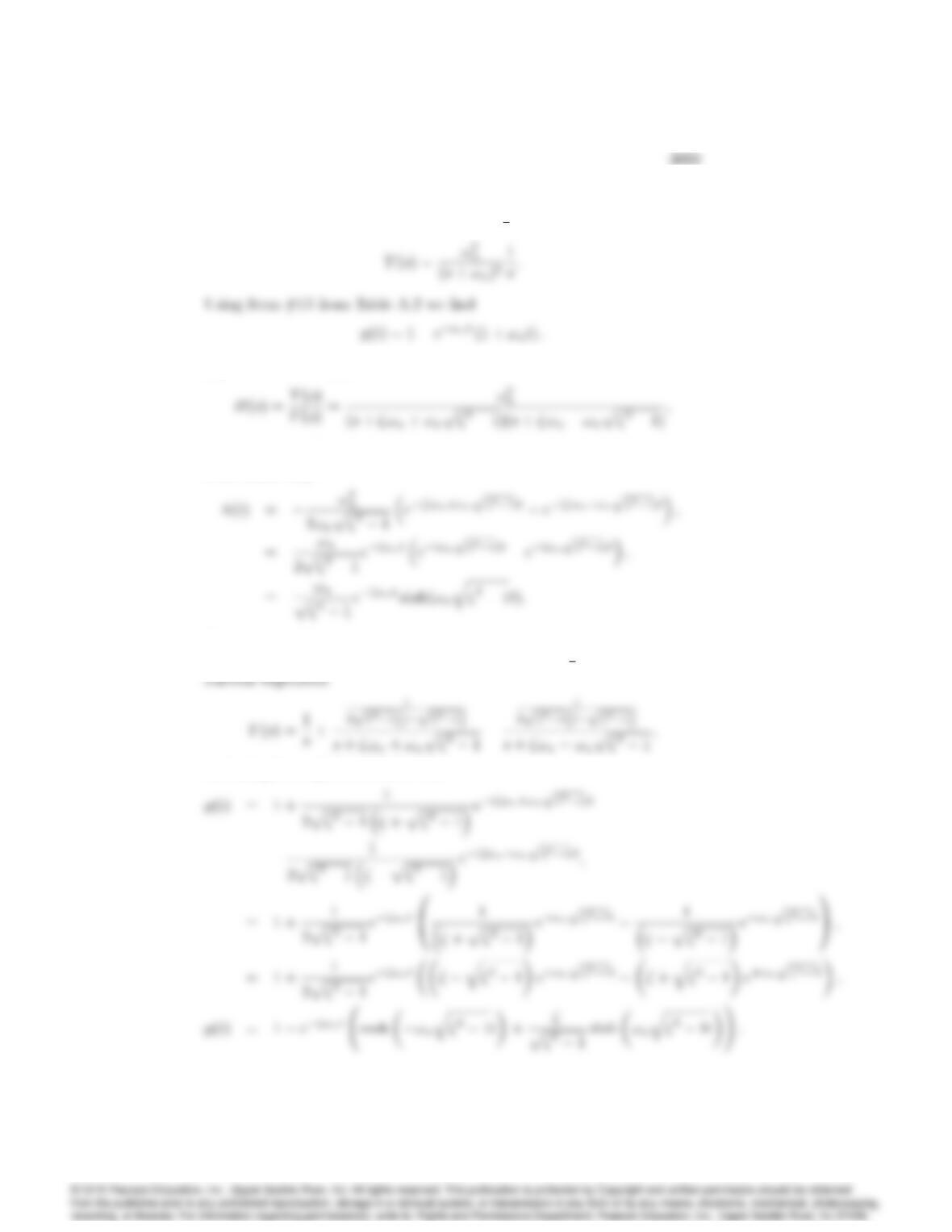
We can then integrate the impulse response to obtain the step response.
Alternatively, for a unit step input, U(s) = 1
sand
(b) We re-write H(s)as follows
where jj>1. For the impulse response, U(s) = 1 and using Item #13
from Table A.2,
We can then integrate the impulse response to obtain the unit step re-
sponse. Alternatively, for a unit step input, U(s) = 1
sand using partial
and using Item #7 from Table A.2