2020 CHAPTER 2. DYNAMIC MODELS
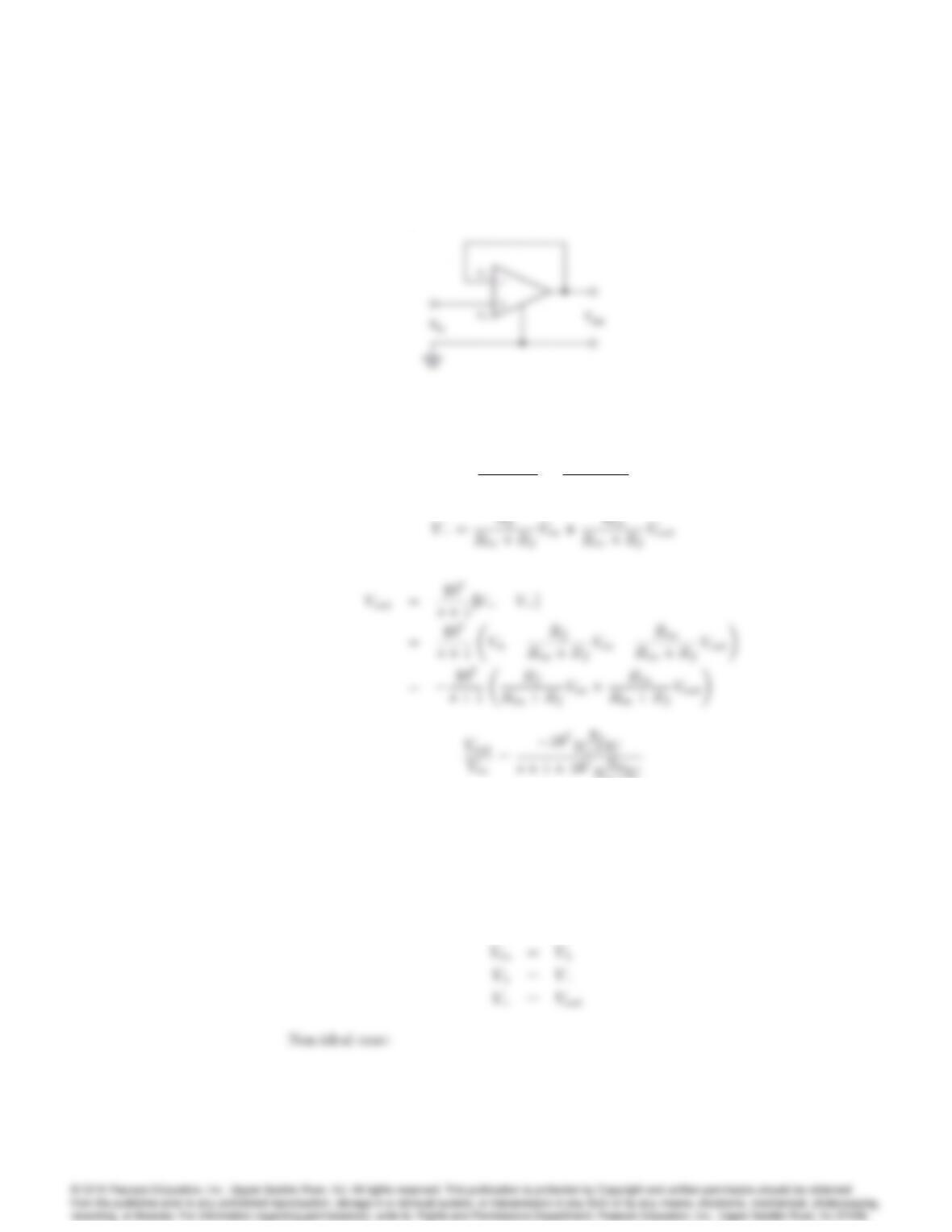
Figure 2.48: Circuit for Problem 12.
(a)
Vin V
Rin
=VVout
Rf
12. Show that the op amp connection shown in Fig. 2.48 results in Vo=Vin
if the op amp is ideal. Give the transfer function if the op amp has the
non-ideal transfer function of Problem 2.11.
Solution:
Ideal case:
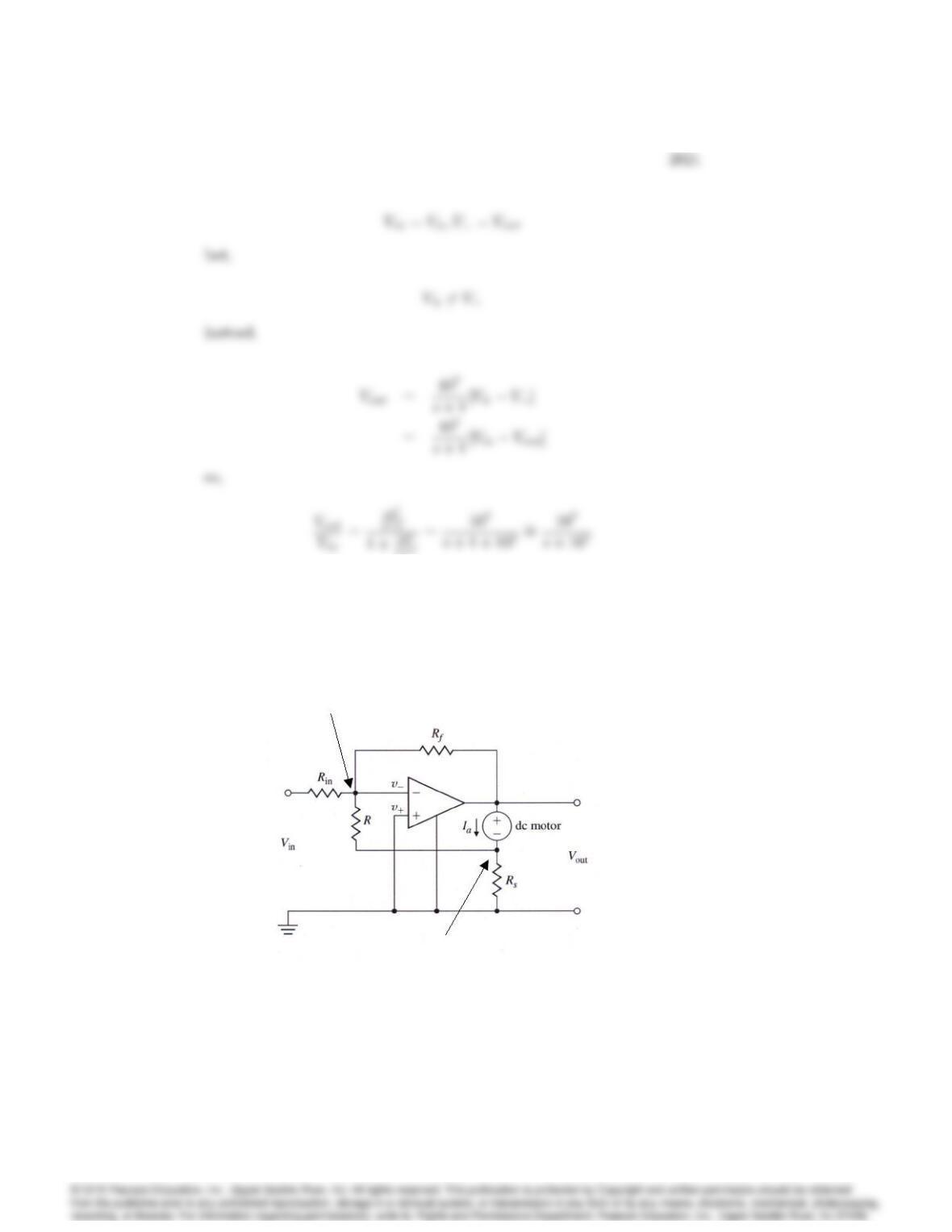
13. A common connection for a motor power amplifier is shown in Fig. 2.49.
The idea is to have the motor current follow the input voltage and the
connection is called a current amplifier. Assume that the sense resistor,
Rsis very small compared with the feedback resistor, Rand find the
transfer function from Vin to Ia:Also show the transfer function when
Rf=1:
Node A
Node B
Figure 2.49: Op Amp circuit for Problem 13 with nodes marked.
Solution:
2022 CHAPTER 2. DYNAMIC MODELS
The dynamics of the motor is modeled with negligible inductance as
Substituting this into Eq.93
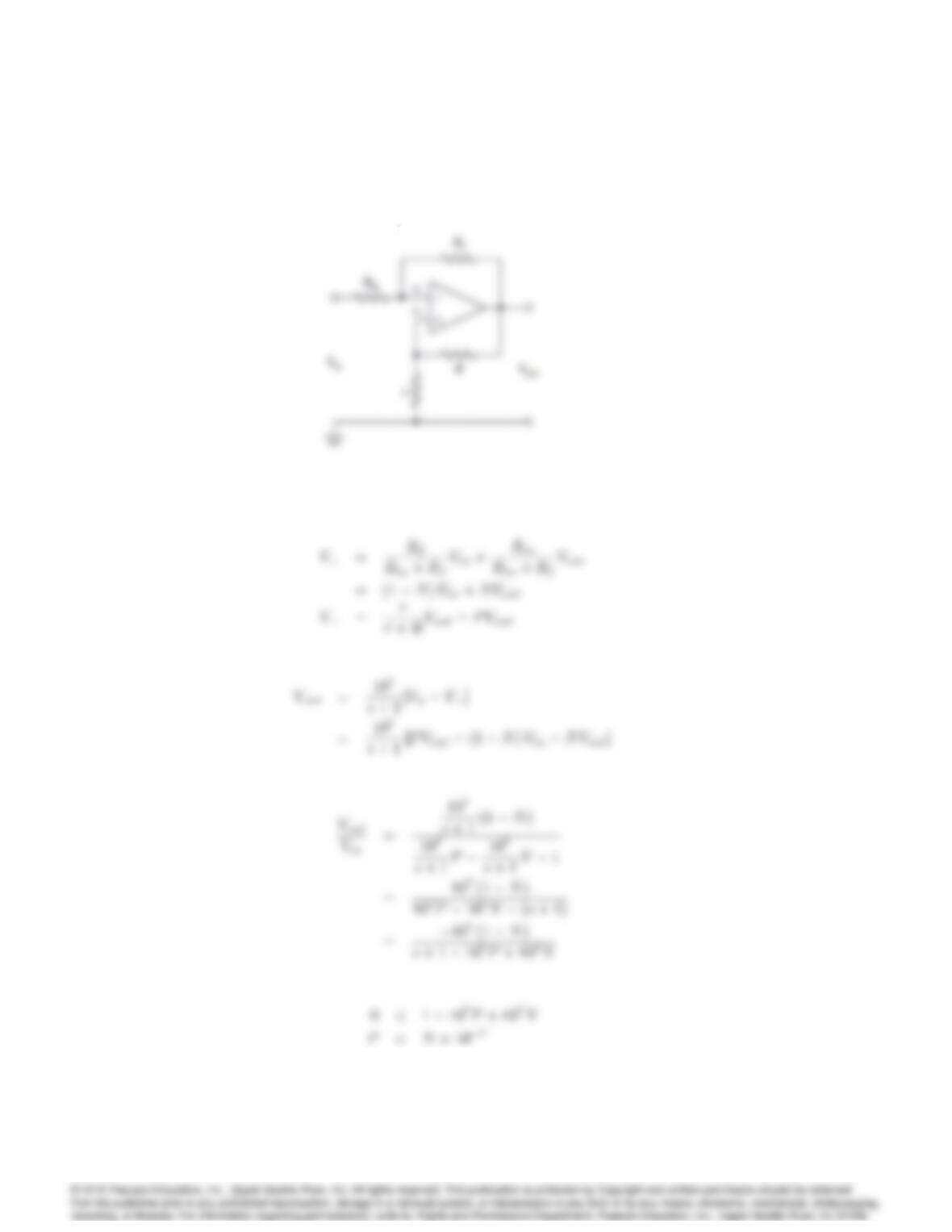
14. An op amp connection with feedback to both the negative and the positive
terminals is shown in Fig 2.50. If the op amp has the non-ideal transfer
function given in Problem 11, give the maximum value possible for the
positive feedback ratio, P=r
r+Rin terms of the negative feedback
ratio,N=Rin
Rin +Rf
for the circuit to remain stable.
Solution:
2023
Figure 2.50: Op Amp circuit for Problem 14.
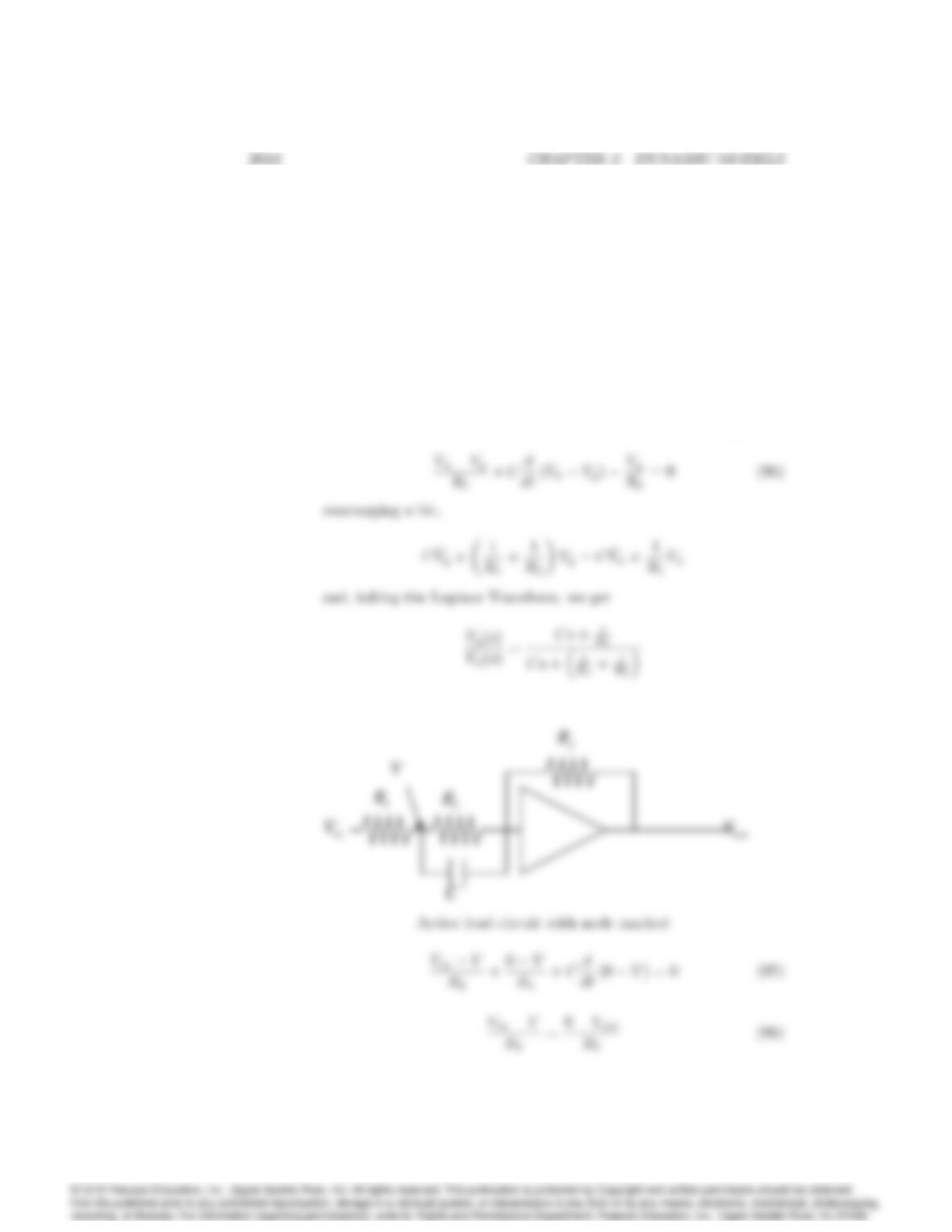
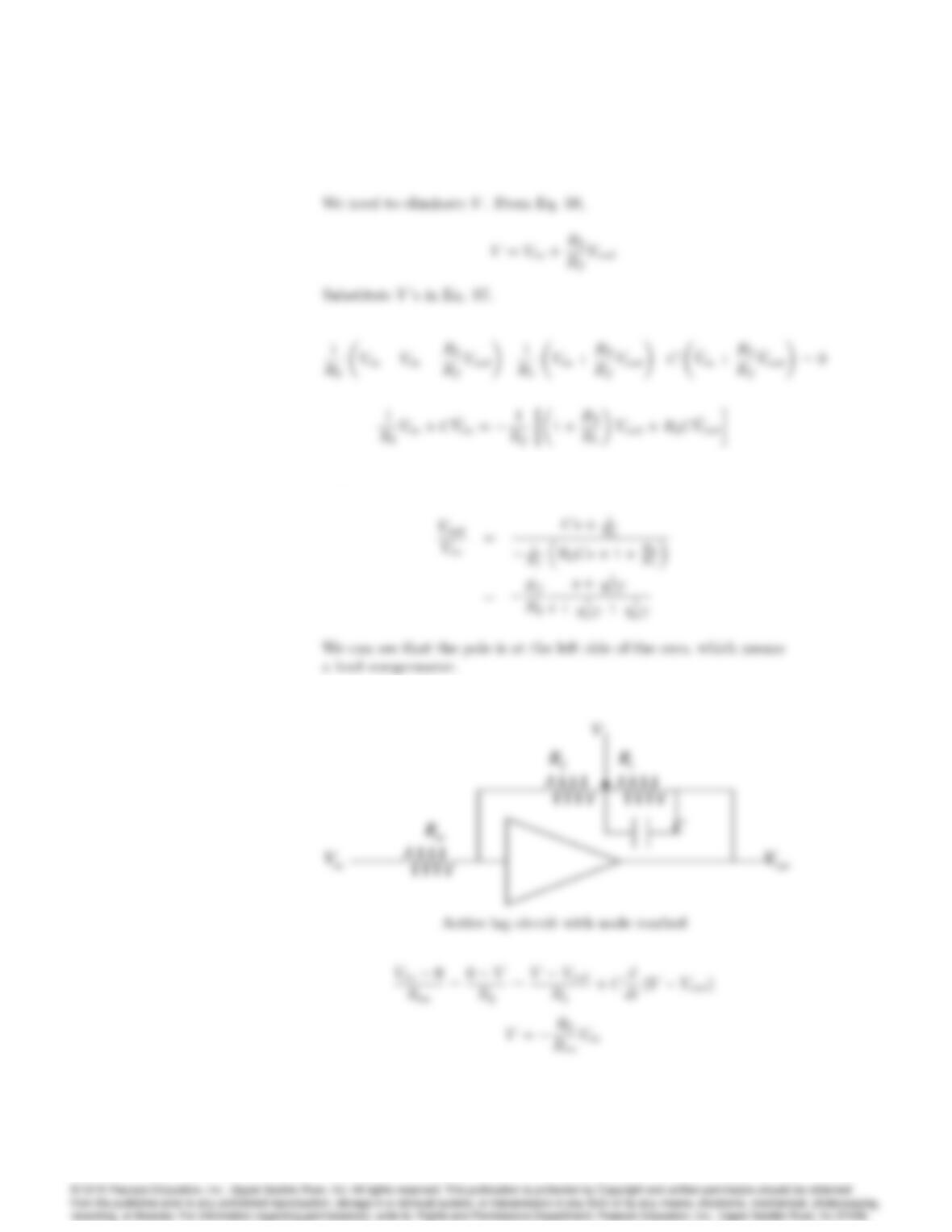
15. Write the dynamic equations and find the transfer functions for the circuits
shown in Fig. 2.51.
(a) passive lead circuit
(b) active lead circuit
(c) active lag circuit.
(d) passive notch circuit
Solution:
(a) Passive lead circuit
With the node at y+, summing currents into that node, we get
(b) Active lead circuit
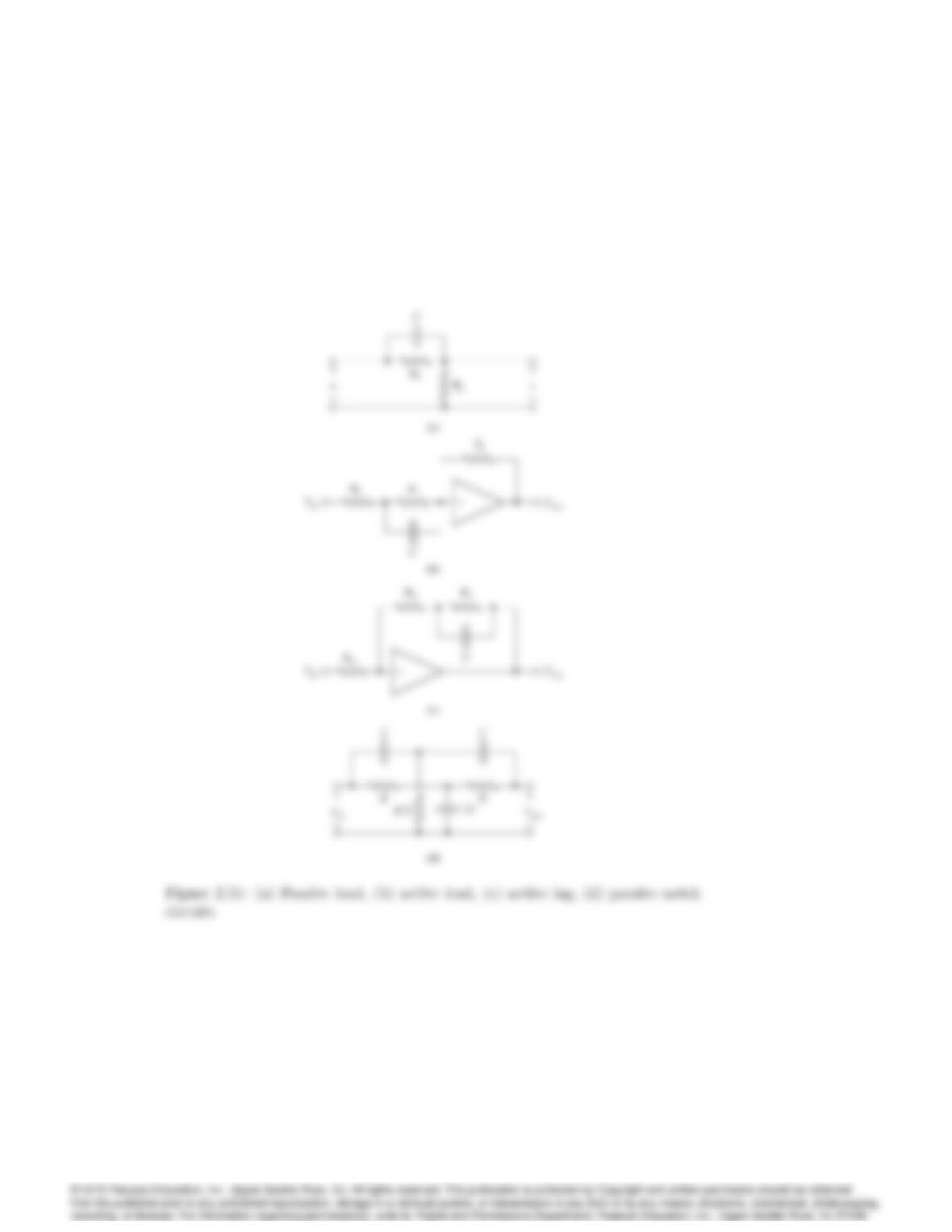
2025
2026 CHAPTER 2. DYNAMIC MODELS
Laplace Transform
(c) active lag circuit
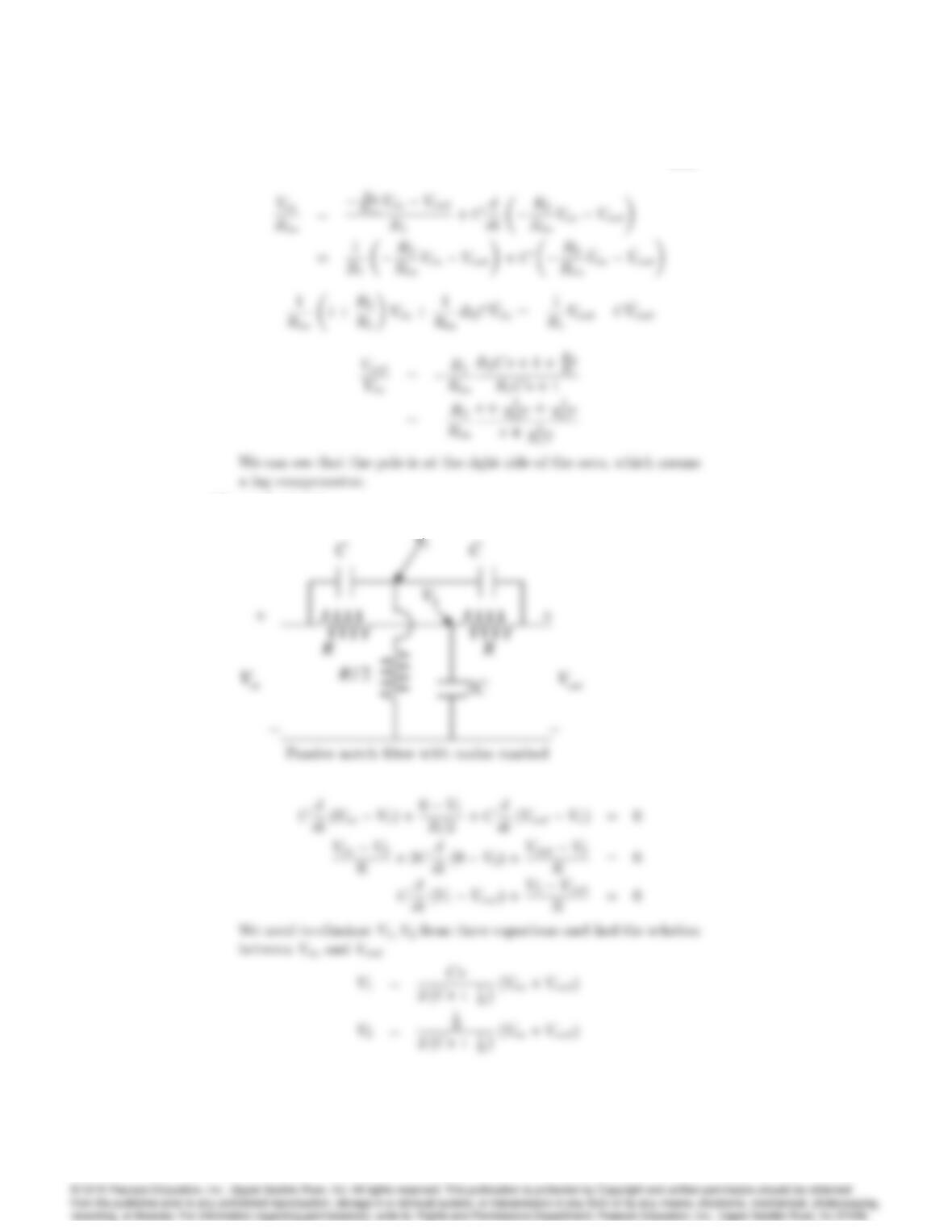
2027
(d) notch circuit
2028 CHAPTER 2. DYNAMIC MODELS
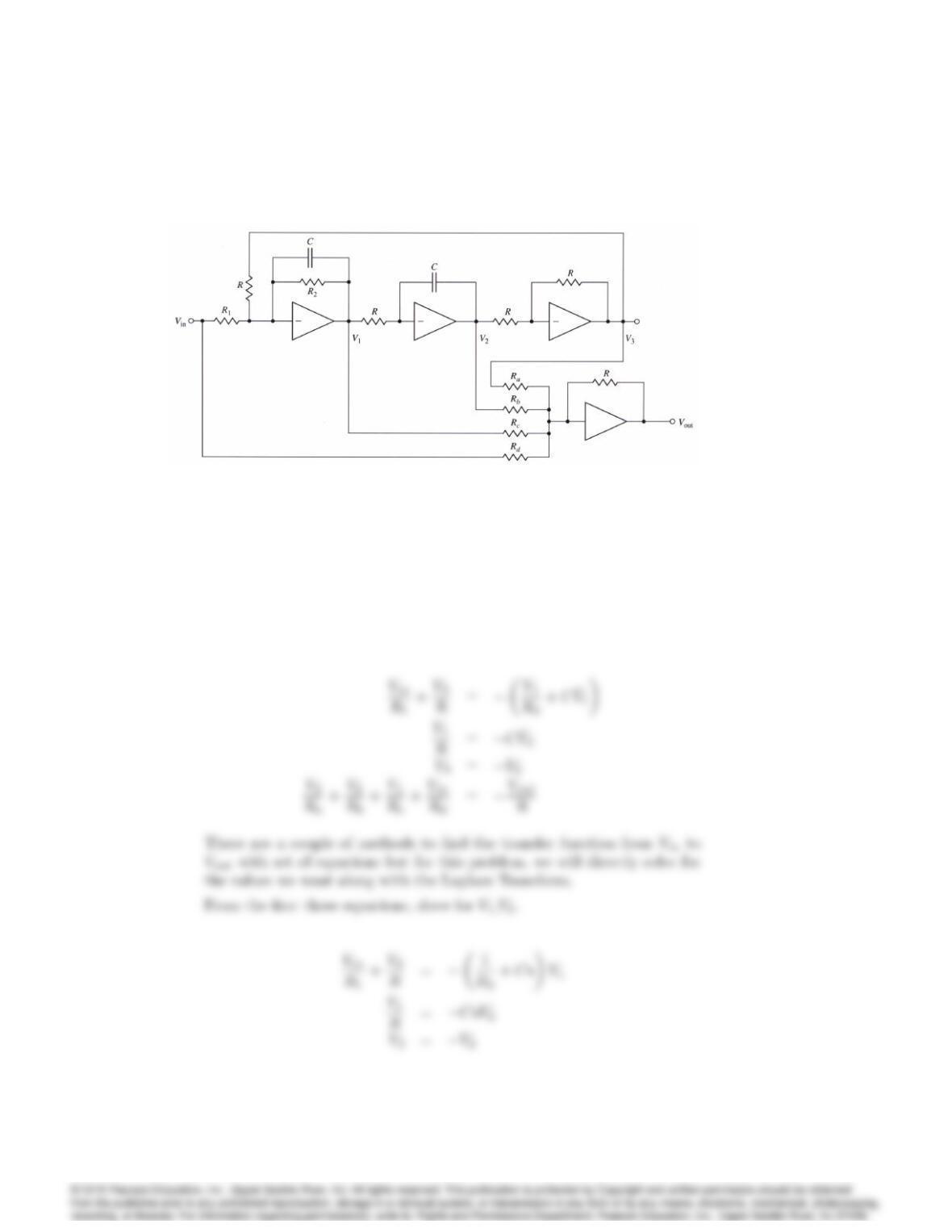
16. The very ‡exible circuit shown in Fig. 2.52 is called a biquad because
its transfer function can be made to be the ratio of two second-order or
quadratic polynomials. By selecting di¤erent values for Ra; Rb; Rc;and
Rdthe circuit can realise a low-pass, band-pass, high-pass, or band-reject
(notch) filter.
(a) Show that if Ra=R; and Rb=Rc=Rd=1;the transfer function
from Vin to Vout can be written as the low-pass filter
Vout
Vin
=A
s2
!2
n
+ 2s
!n
+ 1
(99)
where
A=R
R1
!n=1
RC
=R
2R2
2029
Figure 2.52: Op-amp biquad
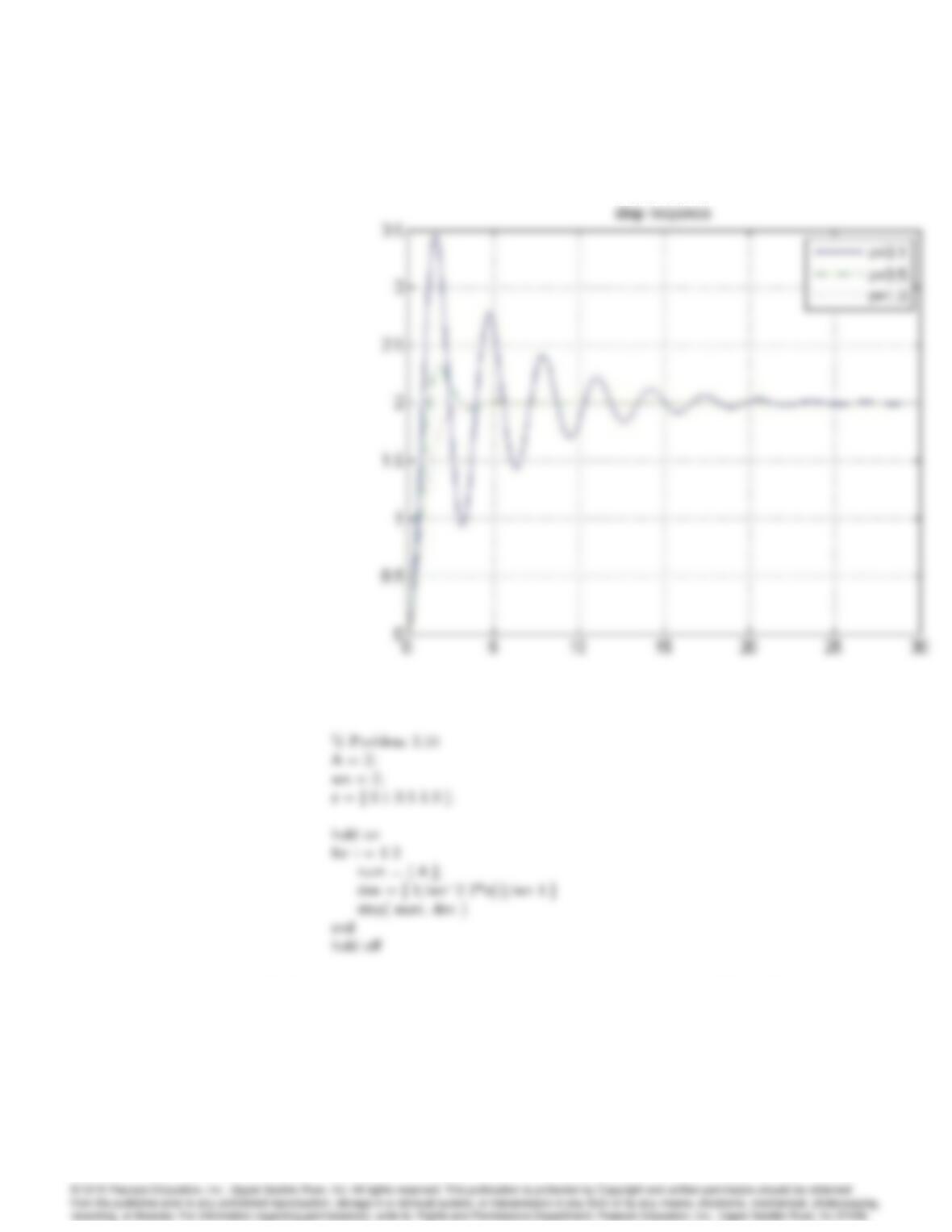
(b) Using the MATLAB comand step compute and plot on the same
graph the step responses for the biquad of Fig. 2.52 for A= 2;
!n= 2;and = 0:1;0:5;and 1:0:
Solution:
Before going in to the specific problem, let’s find the general form of the
transfer function for the circuit.
2030 CHAPTER 2. DYNAMIC MODELS
Plug in V1,V2and V3to the fourth equation.
Finally,
2031
(a) If Ra=R; and Rb=Rc=Rd=1;
(b) Step response using MatLab
2032 CHAPTER 2. DYNAMIC MODELS
Step responses
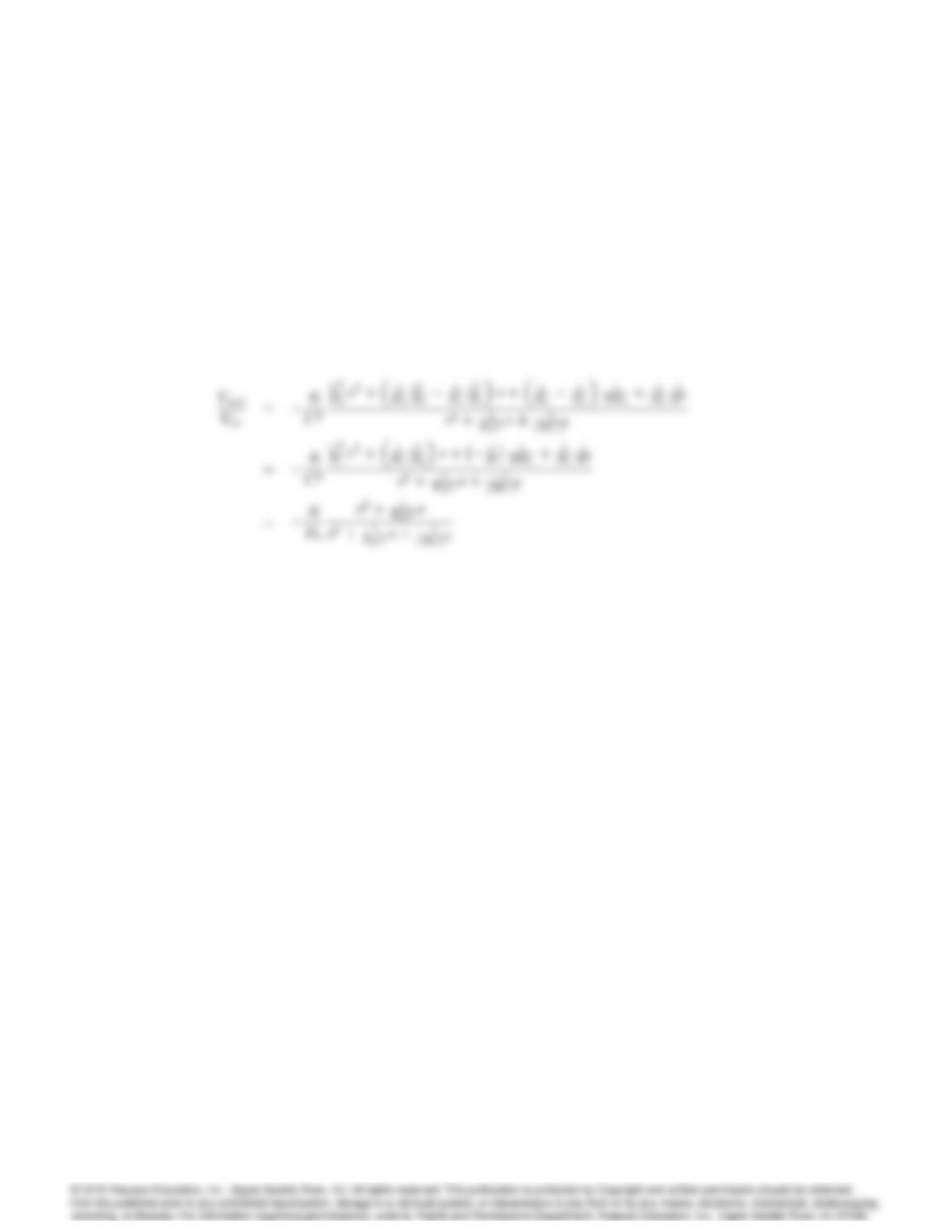
17. Find the equations and transfer function for the biquad circuit of Fig. 2.52
if Ra=R; Rd=R1and Rb=Rc=1:
Solution:
2033
2034 CHAPTER 2. DYNAMIC MODELS
Problems and Solutions for Section 2.3
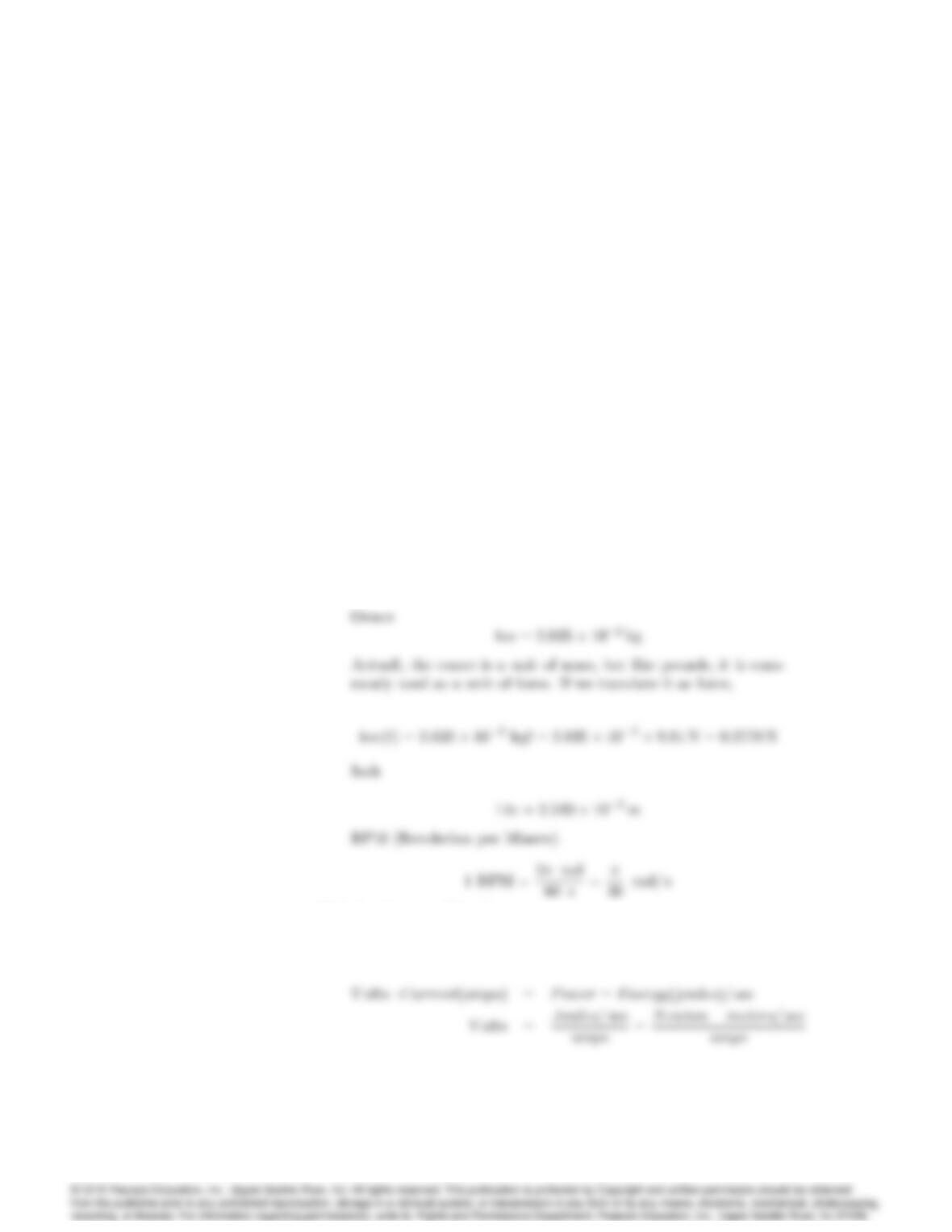
18. The torque constant of a motor is the ratio of torque to current and is
often given in ounce-inches per ampere. (ounce-inches have dimension
force-distance where an ounce is 1=16 of a pound.) The electric constant
of a motor is the ratio of back emf to speed and is often given in volts per
1000 rpm. In consistent units the two constants are the same for a given
motor.
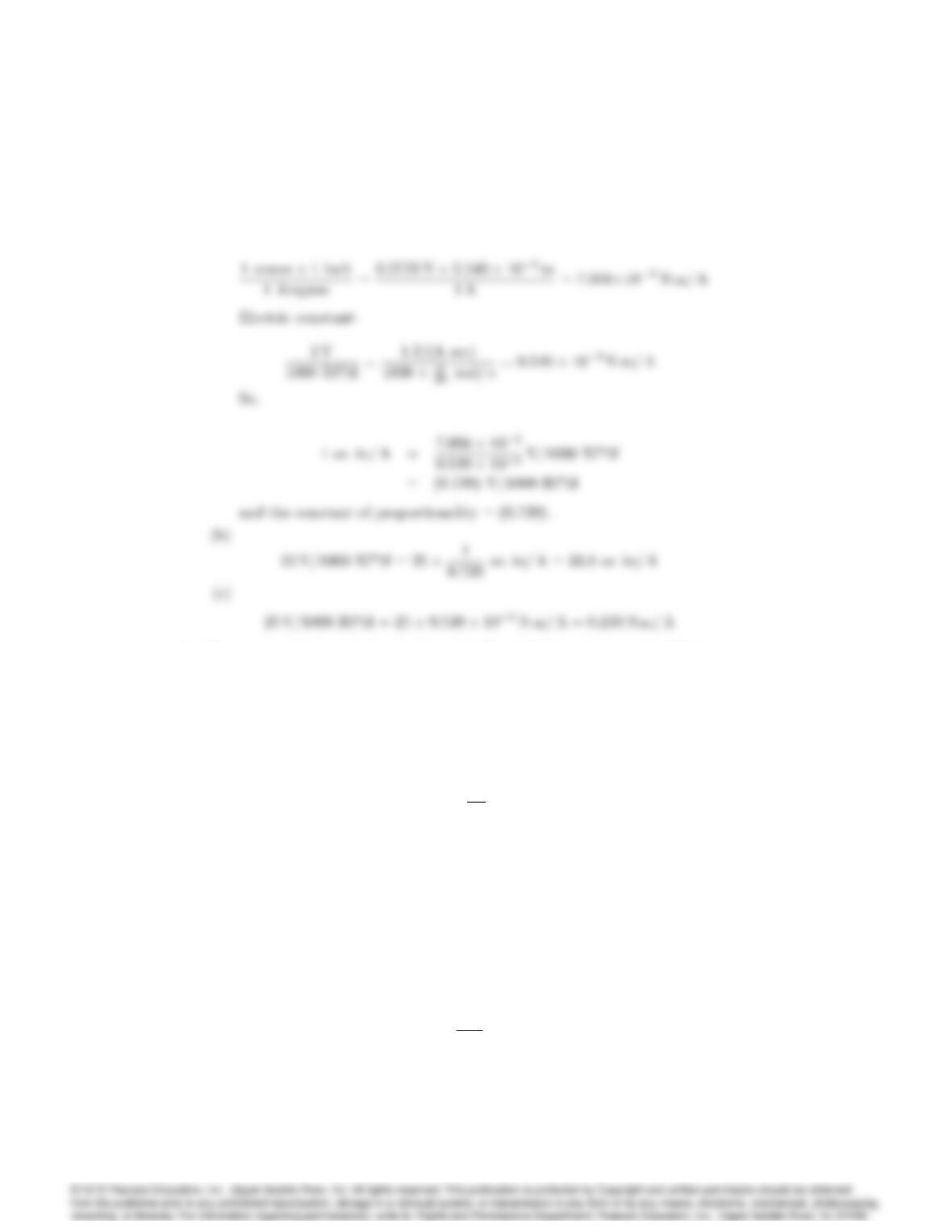
(a) Show that the units ounce-inches per ampere are proportional to
volts per 1000 rpm by reducing both to MKS (SI) units.
(b) A certain motor has a back emf of 25 V at 1000 rpm. What is its
torque constant in ounce-inches per ampere?
(c) What is the torque constant of the motor of part (b) in newton-meters
per ampere?
Solution:
Before going into the problem, let’s review the units.
Some remarks on non SI units.
Relation between SI units
–Voltage and Current
2035
(a) Relation between torque constant and electric constant.
Torque constant:
19. The electromechanical system shown in Fig. 2.53 represents a simplified
model of a capacitor microphone. The system consists in part of a parallel
plate capacitor connected into an electric circuit. Capacitor plate ais
rigidly fastened to the microphone frame. Sound waves pass through the
mouthpiece and exert a force fs(t)on plate b, which has mass Mand is
connected to the frame by a set of springs and dampers. The capacitance
Cis a function of the distance xbetween the plates, as follows:
C(x) = “A
x;
where
“= dielectric constant of the material between the plates;
A= surface area of the plates:
The charge qand the voltage eacross the plates are related by
q=C(x)e:
The electric field in turn produces the following force feon the movable
plate that opposes its motion:
fe=q2
2“A