Solution Manual
Chapter 7. Unary Heterogeneous Systems
7.1. In developing the conditions for equilibrium in a unary
heterogeneous system, why is it necessary to first devise the
apparatus for handling open systems?
Answer to 7.1.
7.2. Consider a system consisting of three phases, S, L and G.
Follow the sequence of steps below to derive the conditions for
equilibrium in this three phase system.
a. Write expressions for the change in entropy for each
phase separately.
b. Write out the expression for the change in entropy for
the three phase system, without constraints.
c. Write out the isolation constraints for this three phase
system including the conservation of energy, volume and
total number of moles.
d. Use the isolation constraints to write dU‘G, dV’G and
dnG in terms of the other variables.
e. Use these relations to eliminate dU’G, dV’G and dnG
from the expression for the entropy of the three phase
system.
f. Collect terms.
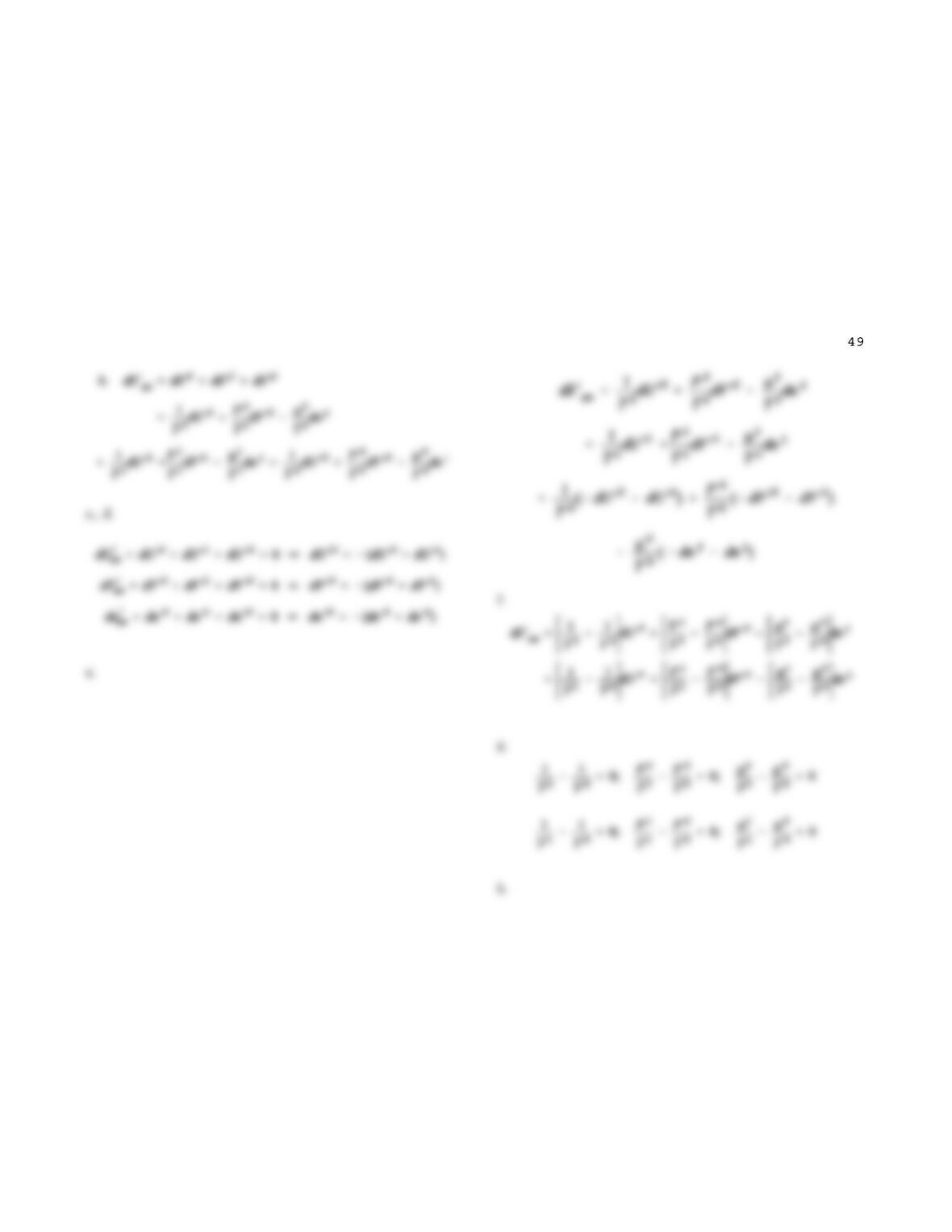
g. Set the coefficients of the six independent differentials
equal to zero.
h. Write the conditions for equilibrium.
Chapter 7. Unary Heterogeneous System
Chapter 7. Unary Heterogeneous System
7.3. Compute and plot the chemical potential surface • •(T,P) for
a monatomic ideal gas in the range 5 K < T < 1000 K and 10-5
atm < P < 10 atm. Assume the gas is helium with S298 = 126.04
J/ Mol K.
a. On the same graph sketch plausible surfaces for the
chemical potential of the liquid and solid phases as
functions of temperature and pressure.
b. Use these sketches to illustrate the construction of the
phase diagram for a system that exhibits these three
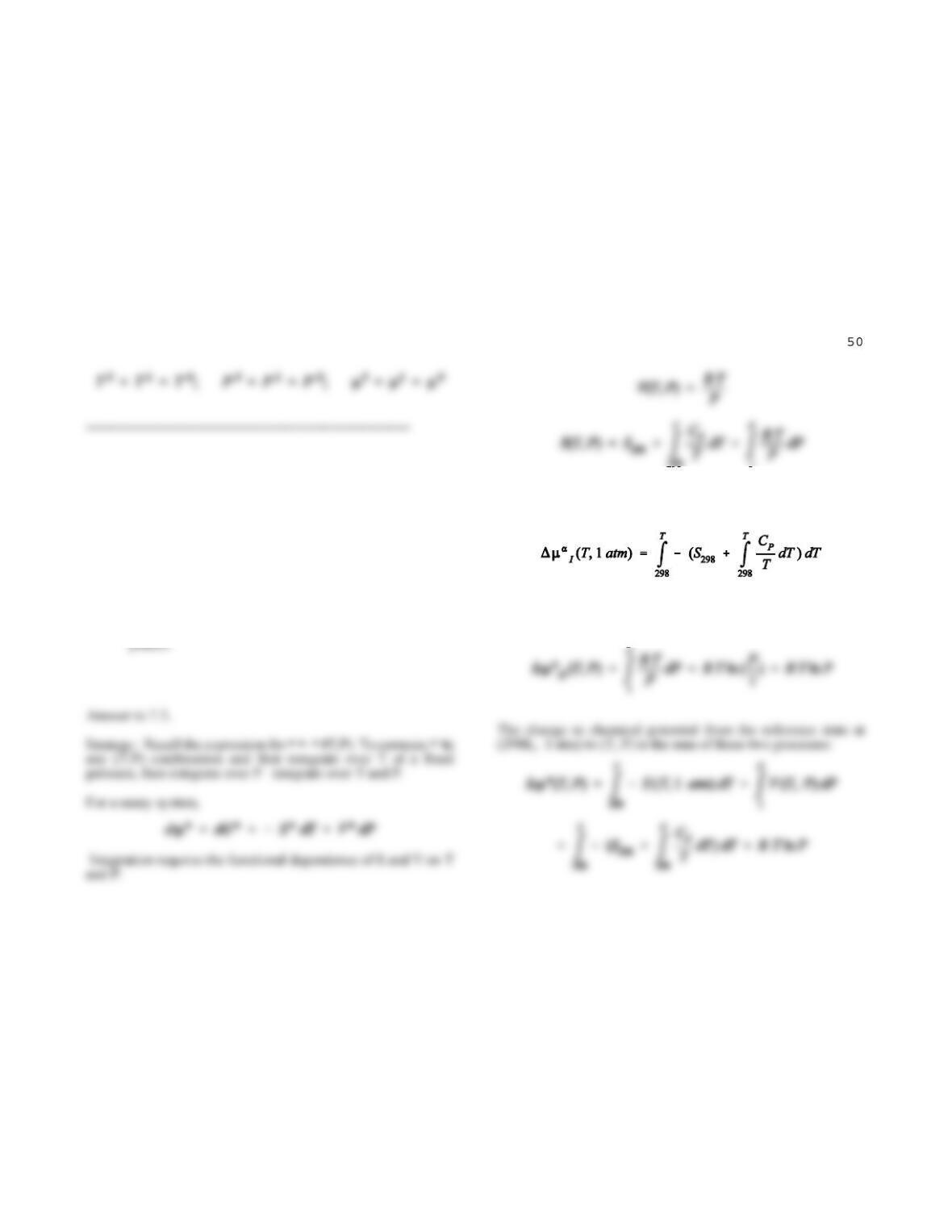
Evaluation of the chemical potential function requires a two step
integration. First fix P at 1 atm and integrate over T:
Step II is a process at fixed T and changes the pressure from 1
atm to a variable P:

Chapter 7. Unary Heterogeneous System
Input the data for S298 and CP and integrate. Plot the resulting
dependent term in • •H(T,P) is negligible for ordinary pressures.
Look up some typical values for the thermodynamic properties
involved in this pressure dependent term and identify the
conditions under which it is, in fact, negligible.
Answer to 7.4.
For each phase,
Chapter 7. Unary Heterogeneous System
where
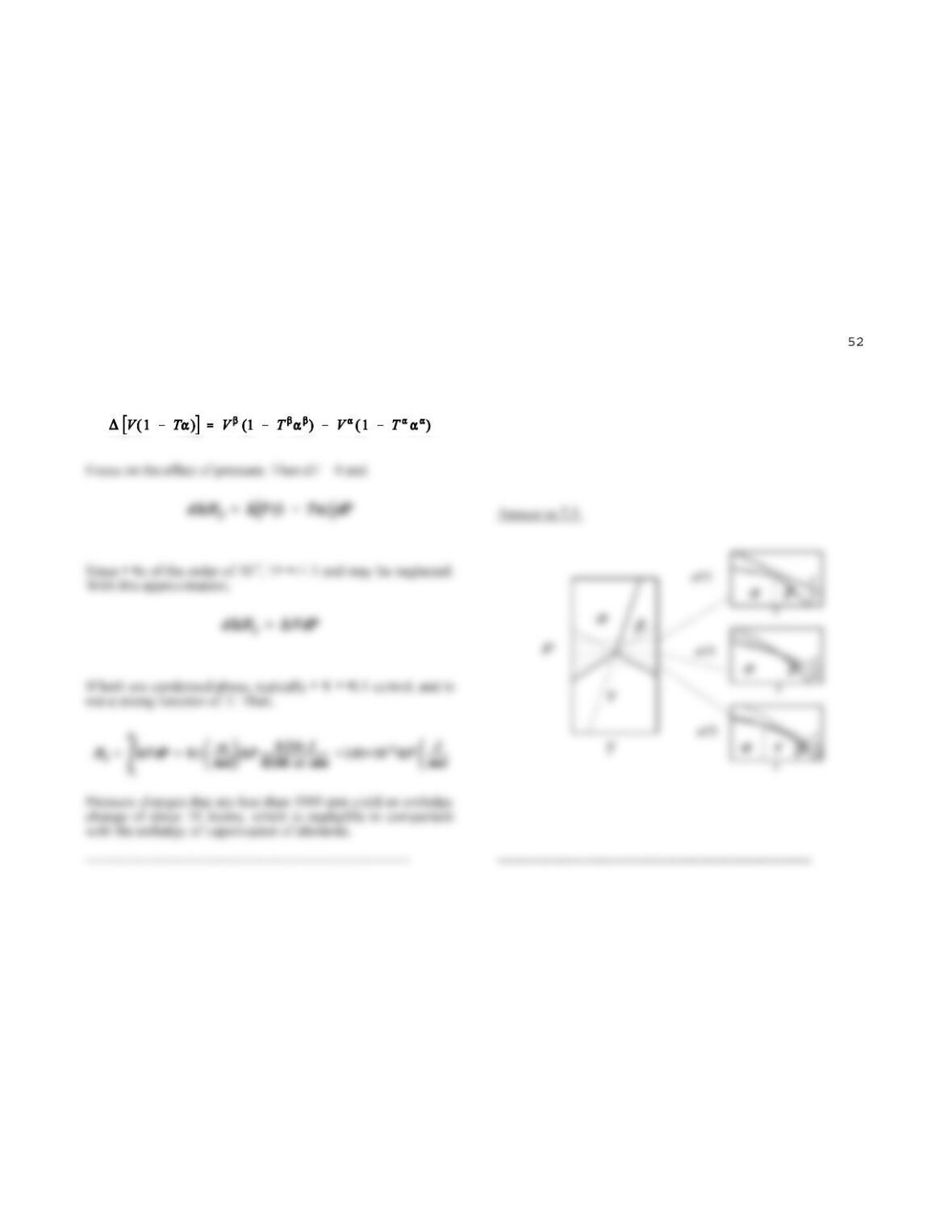
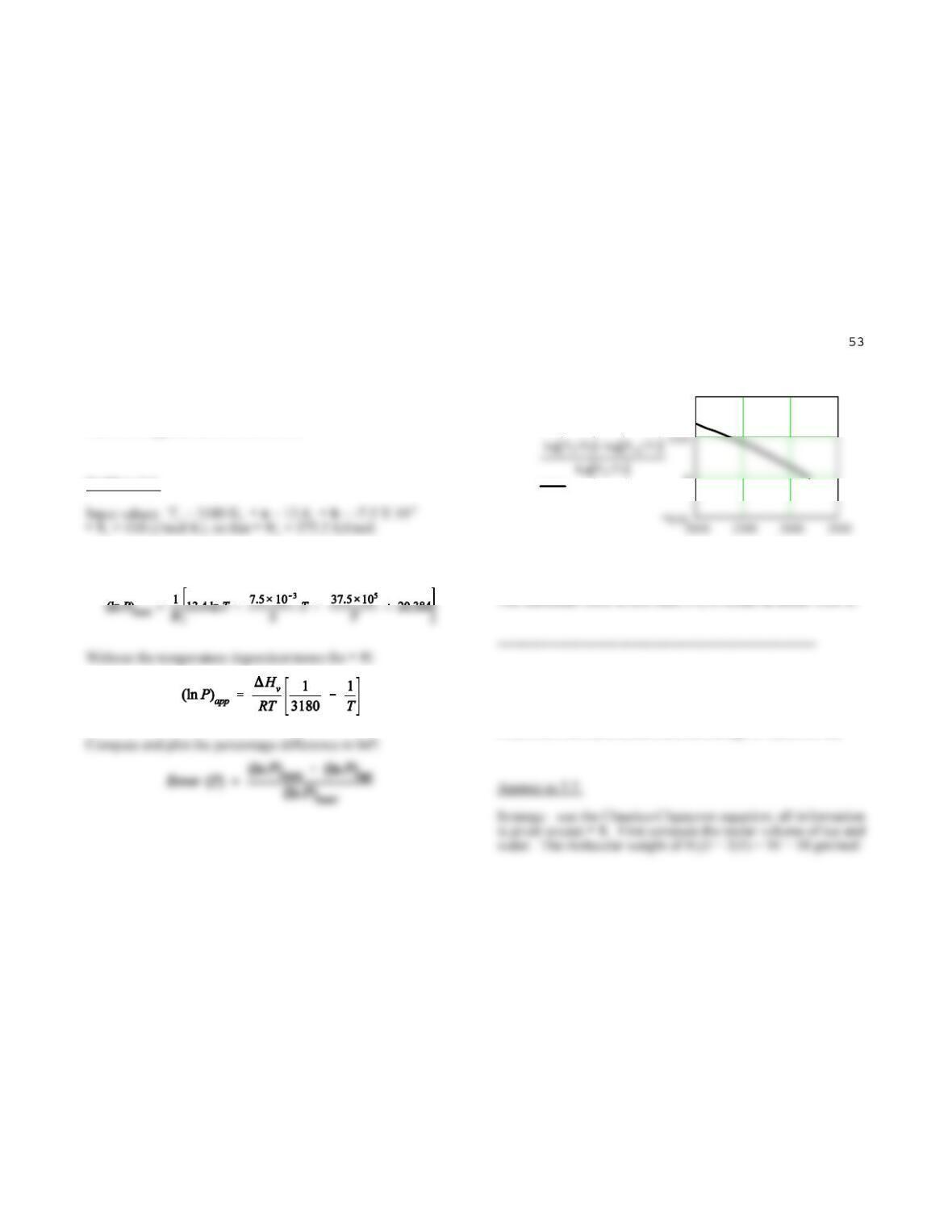
7.5. Sketch curves representing the variation of the molar Gibbs
free energy with temperature at the pressure corresponding to a
triple point for an element. Repeat this sketch for a pressure
slightly above and slightly below the triple point.
Chapter 7. Unary Heterogeneous System
0
0.02
T
7.6. A relatively useful and simple integrated form of the
Clausius-Clapeyron equation is obtained [equation (7.39)] if the
temperature dependence of the heat of vaporization is neglected.
Estimate the temperature interval over which this assumption is
valid for a typical element like nickel.
Problem 7.6.
Calculate ln P(T) including the temperature dependence, Eq.
(7.36):
The maximum error is less than 2%; it occurs at about 1200 K.
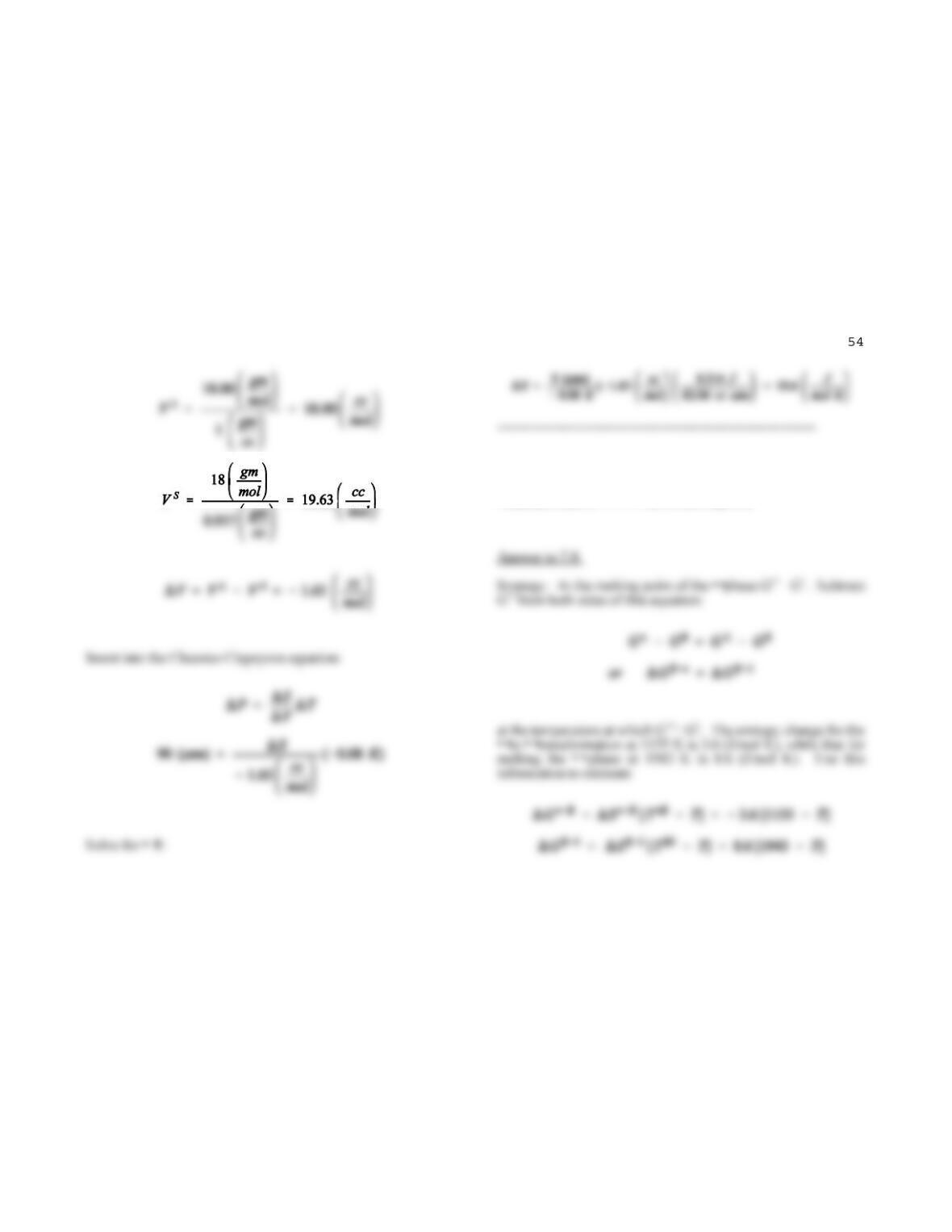
7.7. At one atmosphere pressure pure water ice melts at 0oC. At
10 atm, the melting point is found to be -0.8oC. The density of
water at 0oC is 1.000 gm/cc, while that of ice is 0.917 gm/cc.
From this information, estimate the entropy of fusion of ice.
Chapter 7. Unary Heterogeneous System
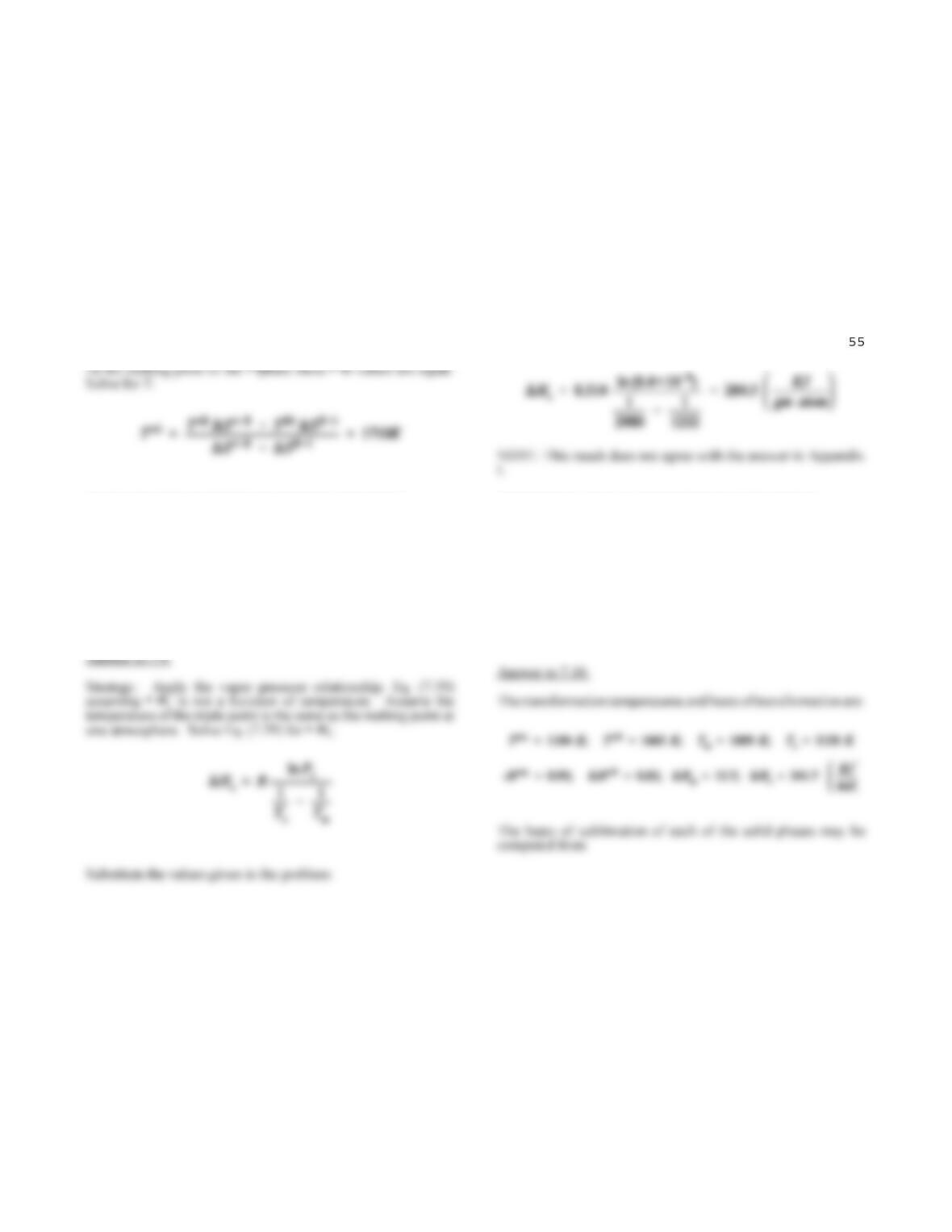
7.8. Estimate the melting point of the HCP (• •) phase form of
pure titanium at one atmosphere pressure. Note that • • is
metastable above 1155 K at one atmosphere.
Chapter 7. Unary Heterogeneous System
———–———–——————–———————––
7.9. At one atmosphere pressure pure germanium melts at 1232
K and boils at 2980 K. The pressure at the triple point (S,L,G) is
8.4X10⁻⁸ atm. Estimate the heat of vaporization of germanium.
———–———–——————–———————––
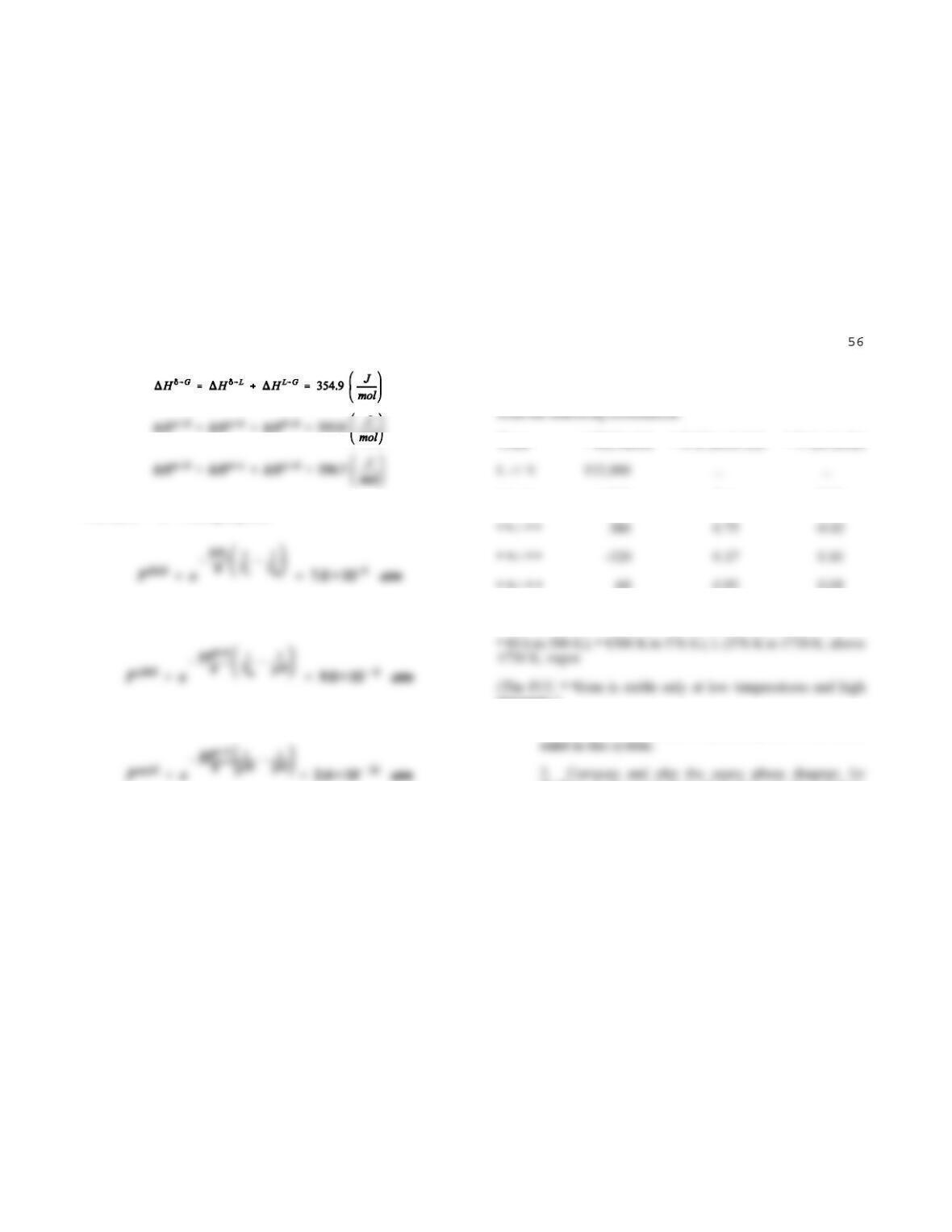
7.10. Assuming that the pressure dependence of the
transformation temperatures may be neglected below one
atmosphere, calculate the pressures at the triple points (• •,• •,G),
(• •,• •,G) and (• •,L,G) for pure iron. Assume also that all heats of
transformation are temperature independent.
Chapter 7. Unary Heterogeneous System
For the (• • + L + G) triple point:
For the (• • + • • + G) triple point:
For the (• • + • • + G) triple point:
———–———–——————–———————–—
7.11. Thallium exists in the following forms: vapor (V), liquid
(L), face centered cubic (• •), body centered cubic (• •) and
hexagonal (• •). Estimate and plot a phase diagram for thallium
Trans • •H(J/mole) • •S (J/(mole K)) • •V (cc/mole)
• • -> L 4,300 7.4 0.39
• • -> • • 60 0.92 0.08
At one atmosphere the stable phase forms are:
pressures.)
1. List all of the possible two phase equilibria that could
thallium in the range from 10 -15 atm to 1 atm and from
300K to 2000K. For the part of the diagram above 1
atmosphere plot (T, P) axes. Below 1 atmosphere plot the
axes as (-1/T, log P). Assume all • •CP terms are
negligible.
Assume • •cP = 0 for all transformations. Consider only the
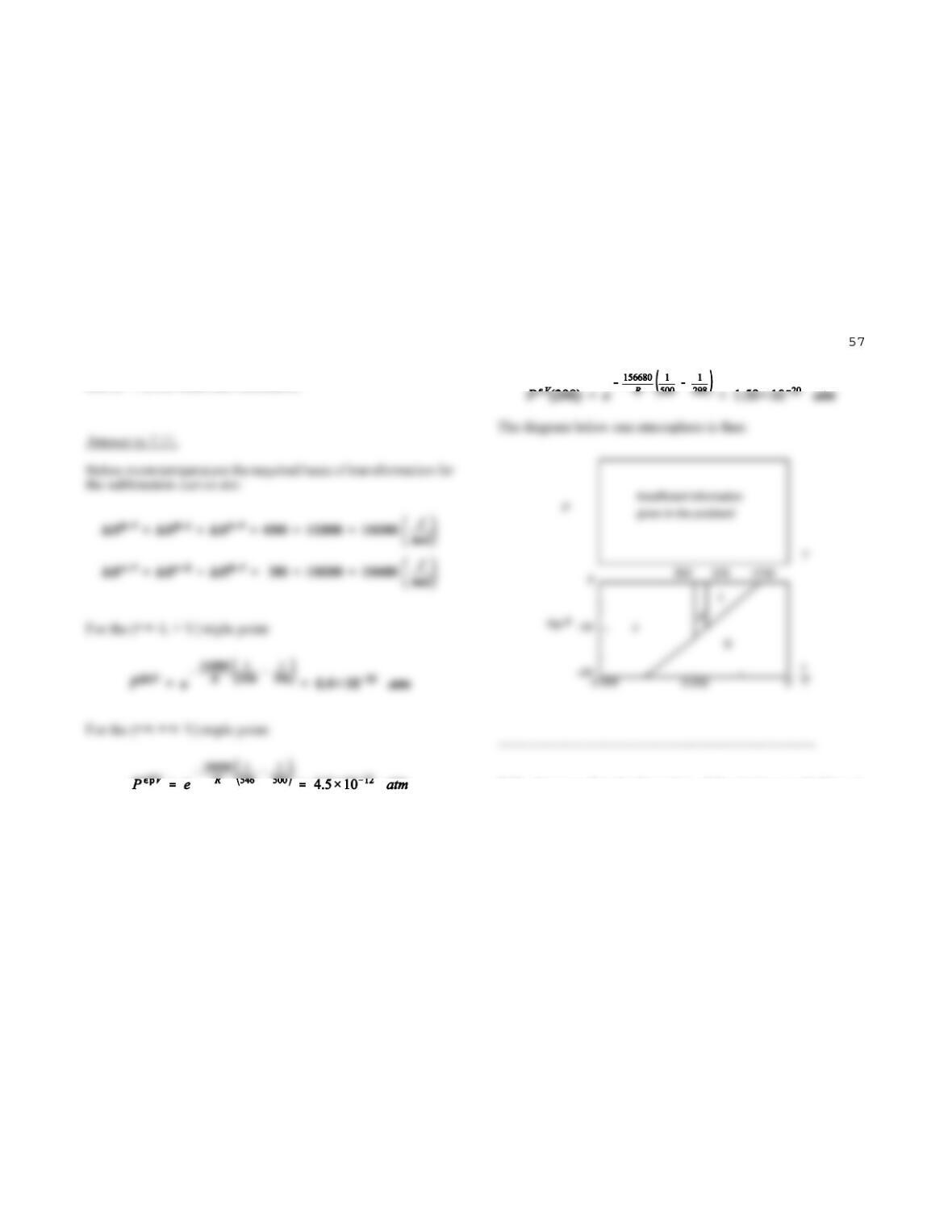
Chapter 7. Unary Heterogeneous System
following equilibria: (• •+• •), (• •+• •), (• •+• •), (• •+L), • •+V), (• •+V)
and (L+V); the others are metastable.
The • •V line intersects the axis of the diagram at 298 K. The
corresponding pressure at 298 K is
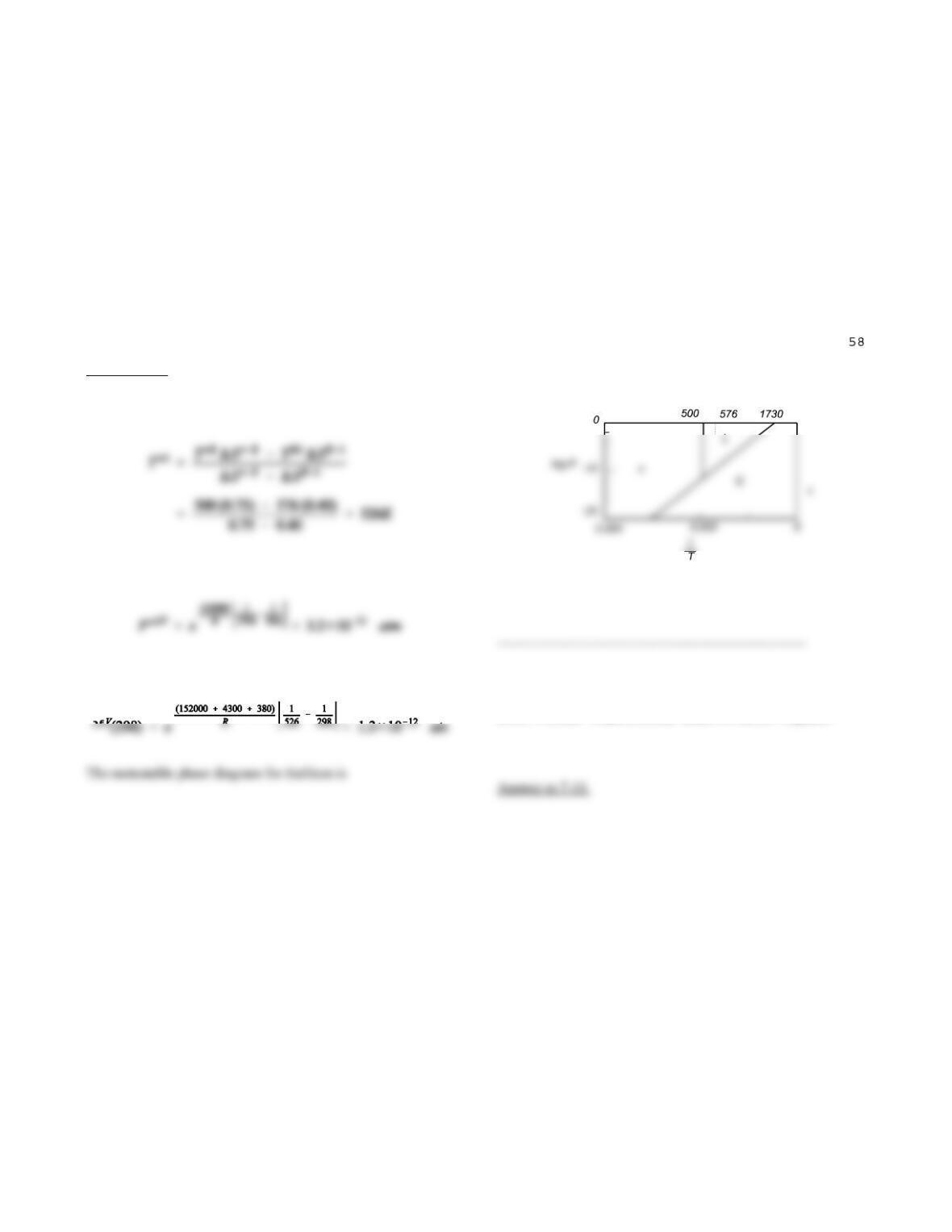
7.12. Suppose that the formation of the • • phase in thallium is
sluggish and, during times that are practical for experimental
measurements, it does not nucleate and form. Recalculate the
metastable phase diagram for thallium below one atmosphere
pressure assuming the • • phase is absent.
Chapter 7. Unary Heterogeneous System
Problem 7.12.
Strategy: This problem is analogous to Problem 7.8. The
metastable melting point of the • • phase in this case is
The corresponding triple point pressure is:
The intercept of the • •V line at 298 K is given by
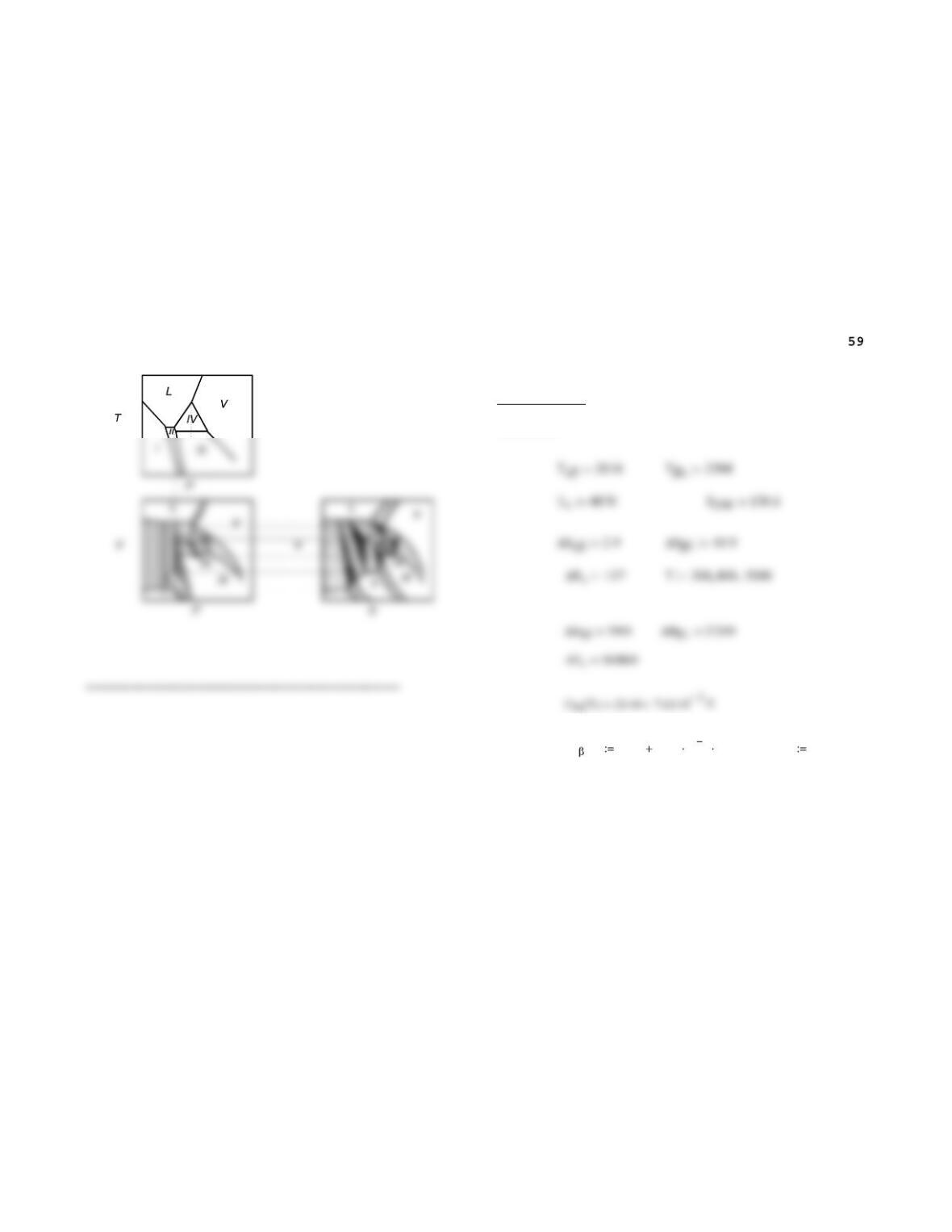
7.13. Sketch a plausible phase diagram for bismuth, Figure 7.10,
on (P, V) axes. Make a similar sketch in the (S, V) plane.
CPT( ) 10.29 10.77 10 3T CPL T( ) 33.47
7.14. According to Appendix B and C, the element hafnium
exists in four phase forms at ambient pressure: • • (hexagonal) 298
K – 2016 K; • • (BCC) 2016 K – 2504 K; L (liquid) 2504 K – 4870
K) and G (gas) above 4870 K. Given the following additional
information (O. Kubaschewski, C.B. Alcock and P.J. Spencer,
Materials Thermochemistry, 6th Ed, Pergamon Press (1993),
p.281): CP
• •
(T) = 10.29 + 10.77 x 10 -3 T; CP
L(T) = 33.47 (J/mol-
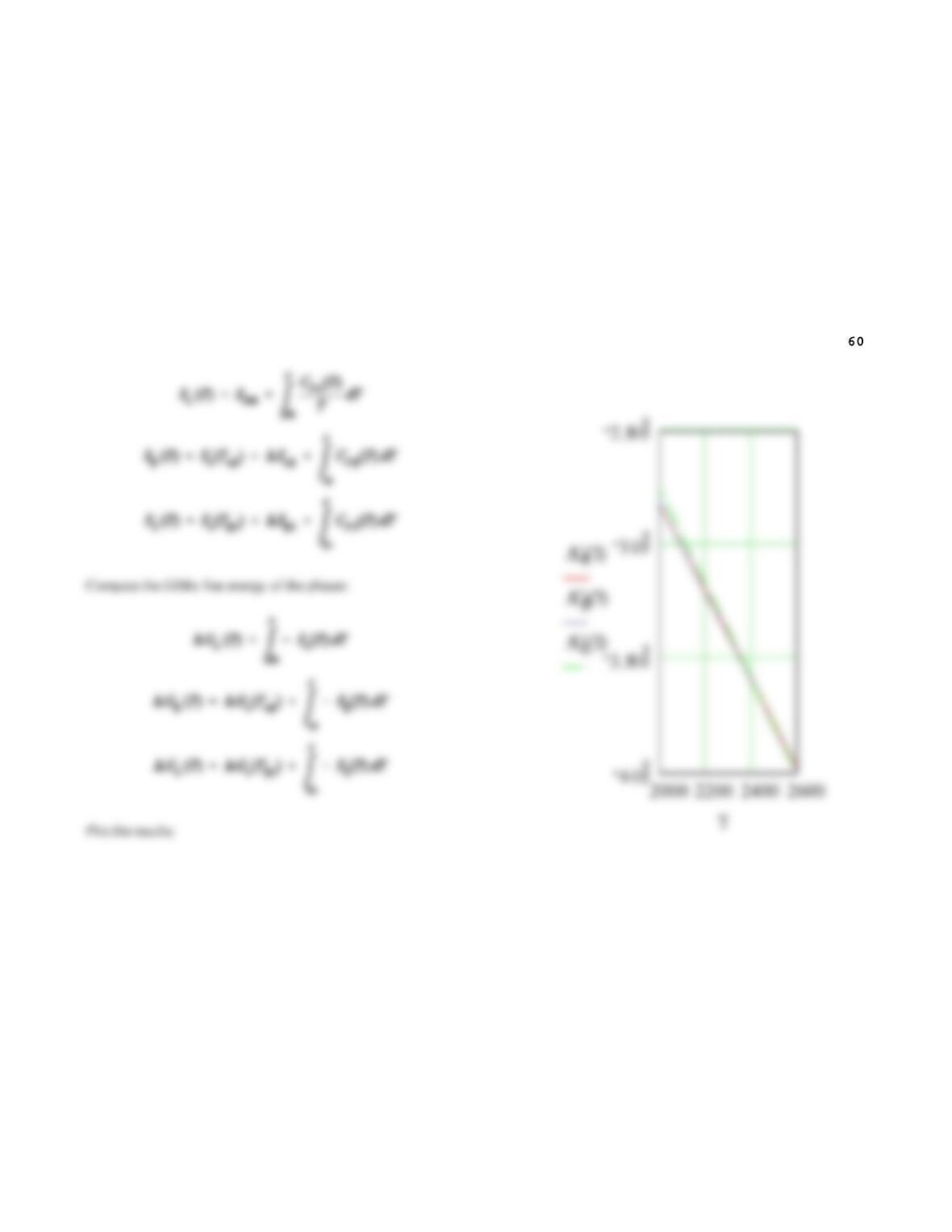
K) and assuming the vapor behaves ideally compute and plot the
Gibbs free energy of hafnium as a function of temperature,
relative the hexagonal phase at 298 K for all four phases. The
result may be viewed as a phase stability calculation for hafnium.
Answer to 7.14
Data Base
Compute the absolute entropies of the phases:
Chapter 7. Unary Heterogeneous System