
Chapter 6. Statistical Thermodynamics
Chapter 6. Statistical Thermodynamics
6.1. Explain in words your understanding of the difference
between phenomenological thermodynamics and statistical
thermodynamics.
Answer to 6.1.
Phenomenological thermodynamics describes the behavior of
matter in terms of experimentally measured properties of systems
———–———–——————-——–————-—–
6.2. Show by listing all of the macrostates that the number of
macrostates possible for a system composed of ten particles that
may occupy three energy levels is 60.
Answer to 6.2.
List the macrostates systematically:
(1,9,0), (0,1,9), (1,0,9), (8,0,2), (8,1,1), (8,2,0),
(2,2,6), (3,1,6), (4,0,6), (5,0,5), (5,1,4), (5,2,3),
(5,3,2), (5,4,1), (5,5,0), (0,5,5), (1,5,4), (2,5,3),
(3,5,2), (4,5,1), (1,4,5), (2,3,5), (3,2,5), (4,1,5)
———–———–——————-——–————-—–
6.3 Consider a system with two particles a and b that may each
exhibit any of four energy levels, • •
1,• •
2,• •
3 and • •
4.
Answer to 6.3.
a. N0 = 2; r = 4. total microstates = rNo = 42 = 16.
Chapter 6. Statistical Thermodynamics
b. Enumerate the microstates:
———–———–——————-——–————-—
6.4. Calculate the number of microstates corresponding to each
of the following combinations:
a. A system with three particles and four energy levels.
b. A system with 15 particles and four energy levels.
c. A system with four particles and 15 energy levels.
d. A cluster of 50 particles each of which may reside in
any of 30 energy levels.
e. 1000 particles that may reside in 100 energy levels.
Answer to 6.4.
6.5. Consider a model in which the available energy levels are
linearly spaced along the energy axis:
• •
n = (n + ½)• •
o (n = 0, 1, 2, … 9)
The system contains ten particles. Consider two macrostates:
{0,0,1,2,4,2,1,0,0,0} … State I
and {0,1,1,2,2,2,1,1,0,0} … State II
a. Which macrostate has the higher energy?
b. Which macrostate has the higher entropy?
c. Which macrostate is more likely to be observed?
Chapter 6. Statistical Thermodynamics
Answer to 6.5.
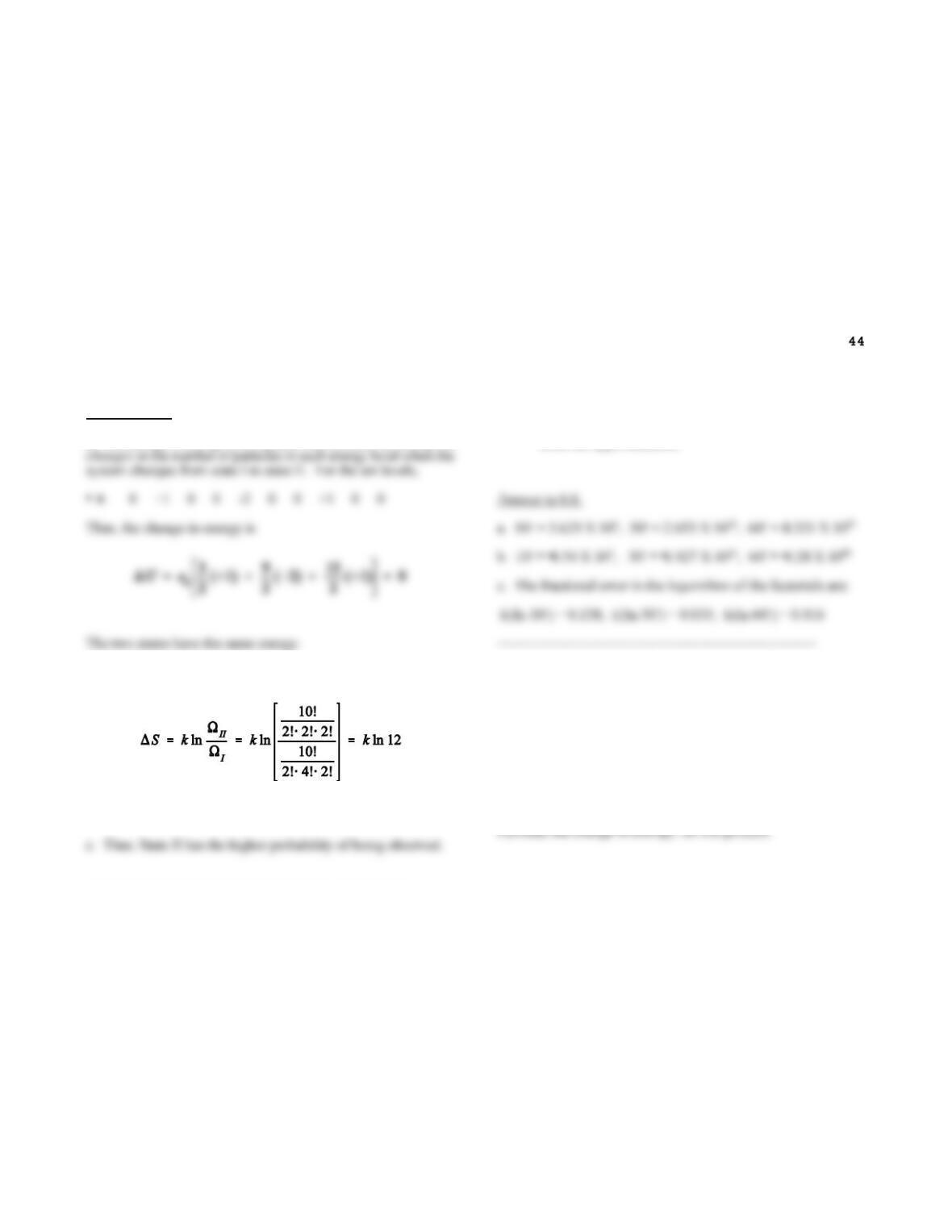
a. The change in energy is computed most directly by noting the
b. To compare the entropies apply
State II has the higher entropy.
———–———–——————-——–————-—–
6.6. Compute the factorials of the following numbers: 10; 30; 60,
a. Directly.
b. Using Stirling’s approximation.
c. In each case, compute the error in ln x! that results
from the approximation.
6.7. A system containing 500 particles and 15 energy levels is in
the following macrostate:
{14,18,27,38,51,78,67,54,32,27,23,20,19,17,15}
This system experiences a process in which the number of
particles in each energy level changes by the following amounts:
{0, 0,-1,-1,-2, 0,+1,+1,+2,+2,+1, 0,-1,-1,-1}
Chapter 6. Statistical Thermodynamics
0 100 200 300 400 500
9
6184236 10 211
10
20
C 100 T( )
C 200 T( )
C 300 T( )
C 500 T( )
T T T T
Answer to 6.7.
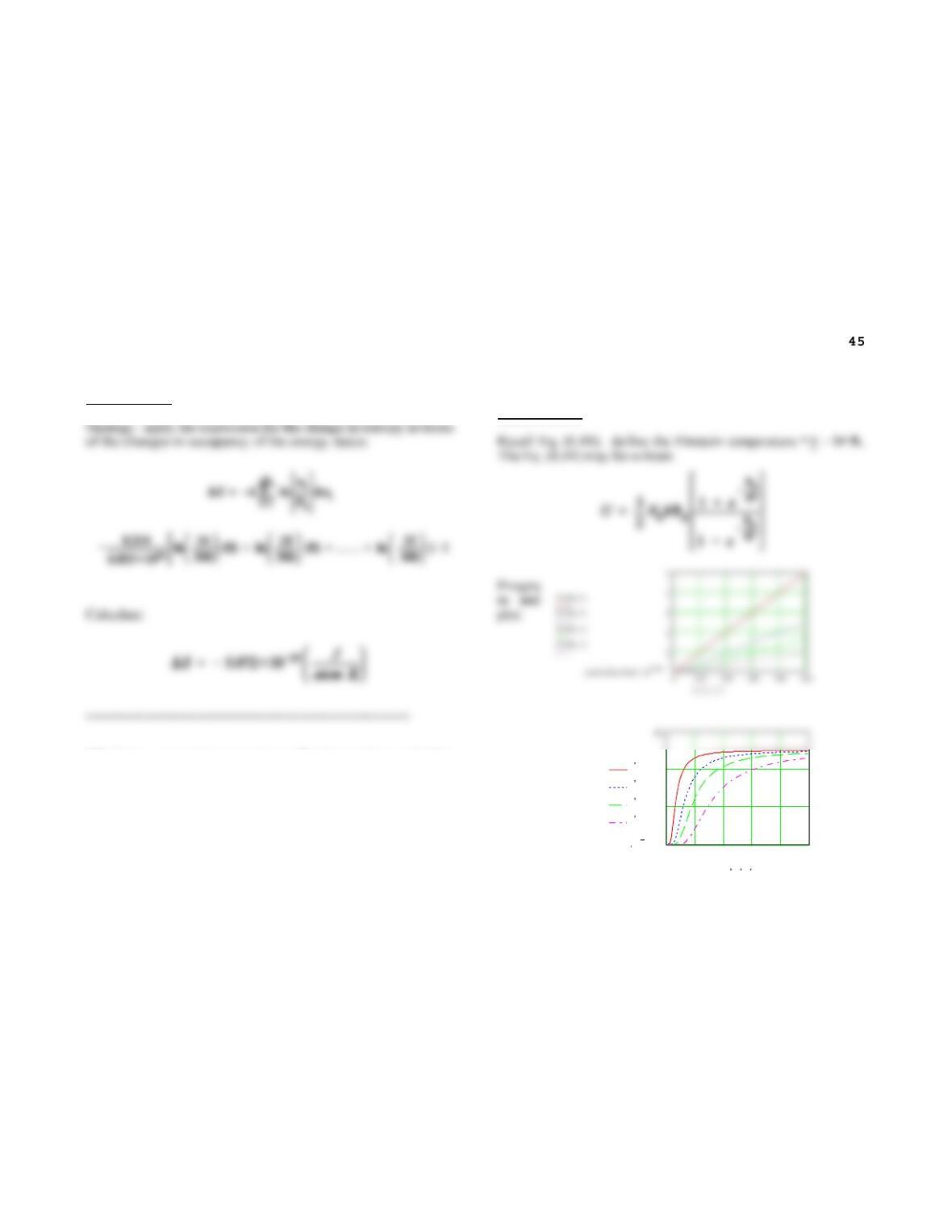
6.8. Using a convenient computer applications package, calculate
and plot the partition function for the Einstein model as a
function of (T/• •
E). Calculate and plot the heat capacity at
constant volume of a simple cubic Einstein crystal as a function
of temperature in the range from 0 < T < 1000 K. Repeat the
calculation for each of the following values of the Einstein
temperature, • •
E:
100 K; 200 K; 300 K; 500 K.
Answer to 6.8.
Chapter 6. Statistical Thermodynamics
6.9. Use the Einstein model to compute the change in internal
energy of crystal when it is heated reversibly at one atmosphere
pressure from 90 to 210 K. Assume • •
E = 250 K.
6.10. Compute the change in entropy when one mole of a
monatomic ideal gas is compressed from an initial condition at
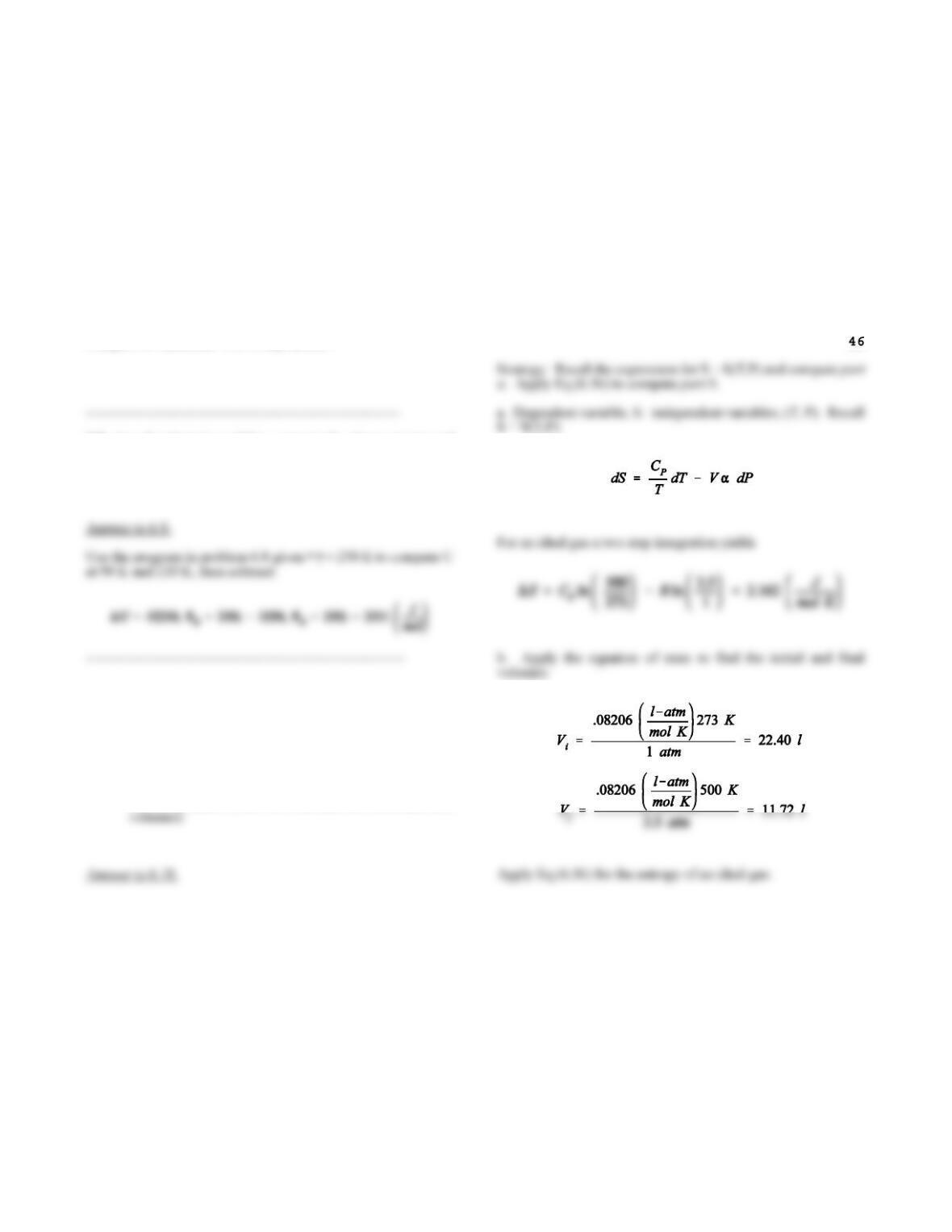
273 K and 1 atm to a final condition of 500 K at 3.5 atm.
a. Make the calculation using familiar phenomenological
thermodynamics.
b. Repeat the calculation using the results of statistical
thermodynamics. (Hint: first calculate the initial and final
Chapter 6. Statistical Thermodynamics
6.11. At ordinary temperatures and pressures the heat capacity of
ammonia (NH3) is 37 J/mole. Apply the principle of equipartition
of energy to speculate on the spatial arrangement of the atoms in
the ammonia molecule.
Answer 6.11.