
Chapter 5. Equilibrium
Chapter 5. Equilibrium in Thermodynamic
Systems
5.1. Discuss the meaning of the statement: “An equilibrium state
Answer to 5.1.
5.2. Give three illustrative examples each of
a. An equilibrium state;
b. A steady state.
Answer to 5.2.
a. (1). A mixture of reacting gas molecules constrained to
a fixed temperature, e.g., H2, O2 and H2O at 600 K, will
achieve its equilibrium composition after a relatively
short time.
first expand to its fullest, then, at a fixed volume, increase
its internal pressure until it reaches an equilibrium value.
and liquid and solid phase distribution that persists as
long as molten metal is poured in at the top and solid steel
is withdrawn from the bottom.
———–———–——————-——–————-——-
Chapter 5. Equilibrium
5.3. State in outline form the logical steps that lead to our
general criterion for equilibrium.
highest entropy that the system, once isolated from its
surroundings, can exhibit.
5.4. Contrast the concepts presented in this chapter as
a. Criterion for equilibrium; and
(1). For a system at constant U, V and nk, S is a
maximum.
5.5. State in words and mathematically the set of relationships
implied by the statement that a thermodynamic system is isolated
surroundings. Mathematically, the requirement that no work is
exchanged with the surroundings is met if the boundary is rigid
and cannot move. Thus, dV’sys,iso = 0. If no matter crosses the
Chapter 5. Equilibrium
———–———–——————-——–————-—–
5.6. The development presented in this chapter describes the
behavior of an isolated system. Systems of practical interest are
rarely isolated from their surroundings in their approach toward
equilibrium. How is it then possible to conclude that the results
of this development are general, i.e., are not limited to an isolated
system?
approach to equilibrium it may exchange matter, heat and work
with the surroundings. Eventually, it arrives at the time invariant
condition at which it is said to be in equilibrium with itself and its
surroundings. It has exhausted its capacity for change. That final
state will be characterized by a specific distribution of values of
the intensive properties of the system.
———–———–——————-——–————-—-
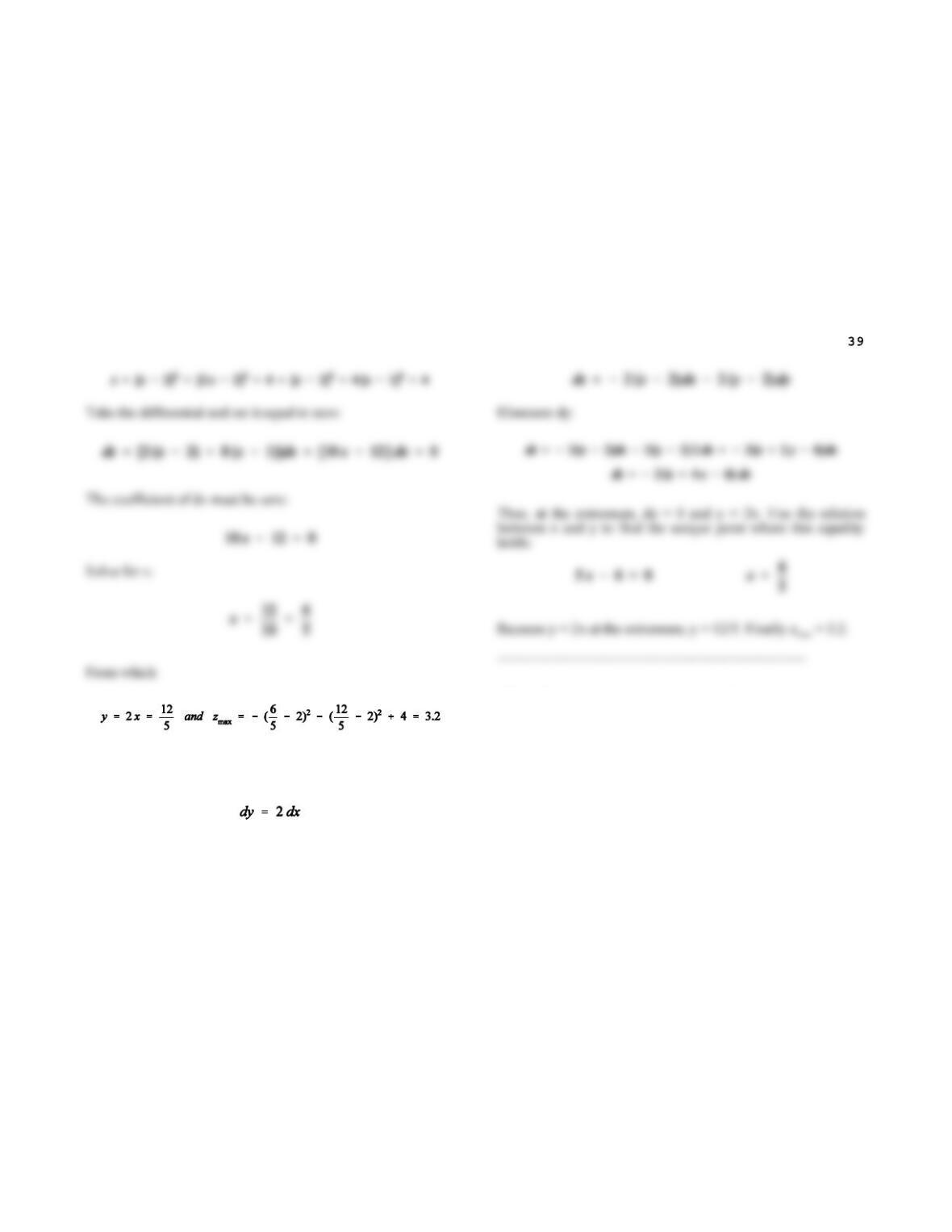
5.7. Find the extreme values of the function
Find the constrained maximum of this function corresponding to
a. Solve the problem first by eliminating y as a variable
and finding the extreme value of the function z = z[x,
y(x)]
b. Then solve the same problem by writing the
differential forms of the two equations and substituting
for dy in the expression for dz; then set the resulting
coefficient of dx equal to zero.
Chapter 5. Equilibrium
b. The differential of y in the constraining equation is:
The differential of the function:
5.8. The steps in the strategy for finding conditions for
equilibrium are:
a. Write an expression for the change in entropy of the
system when it is taken through an arbitrary process.
b. Write the isolation constraints in differential form.
c. Use the isolation constraints to eliminate dependent
variables in the expression for the entropy.
d. Collect terms.
e. Set the coefficients of each differential equal to zero.
f. Solve these equations for the conditions for
equilibrium.
Chapter 5. Equilibrium
Use the example of a unary two phase system presented in
Section 5.4 to write out each of these steps mathematically.
Chapter 5. Equilibrium
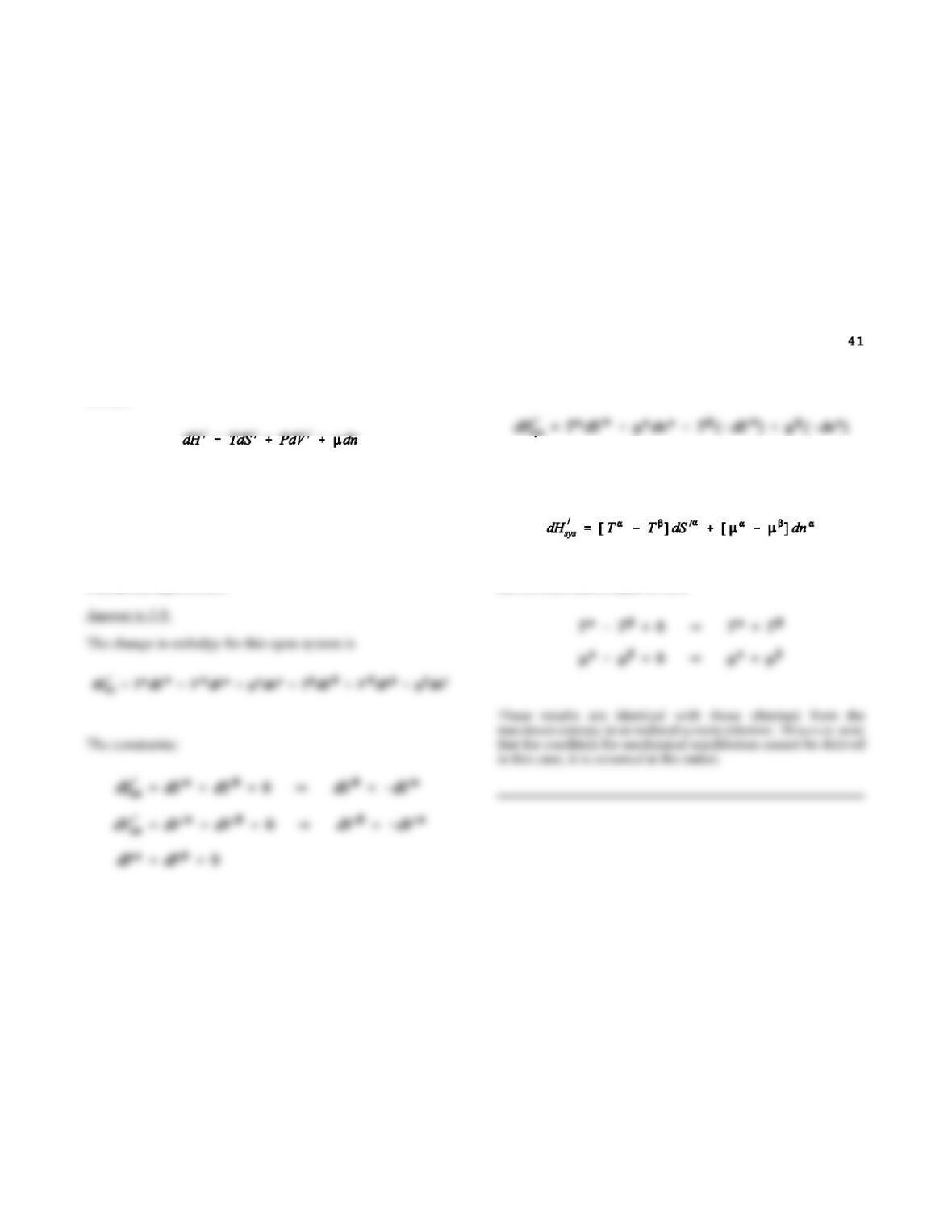
5.9. The combined statement of the first and second laws for the
change in enthalpy of a unary single phase system may be
written:
Use this result to write an expression for the change in enthalpy
of a two phase (• • + • •) system. If the entropy, pressure and total
number of moles are constrained to be constant, then the criterion
for equilibrium is that the enthalpy is a minimum. Paraphrase the
strategy used to deduce the conditions for equilibrium in an
isolated system to derive them for a system constrained to
constant S’, P and n. What happens to the condition for
mechanical equilibrium?
Eliminate dependent variables:
Collect terms:
Set the coefficients equal to zero: