L
EARNING
O
UTCOME
1
Discriminate between nociceptive and neuropathic pain categories.
Concepts for Lecture
1. Physiological pain is experienced when an intact, properly function-
ing nervous system signals that tissues are damaged, requiring atten-
tion and proper care. This type of pain may be transient (for
2. Neuropathic pain is experienced by individuals who have damaged
or malfunctioning nerves. The nerves may be abnormal due to ill-
ness, injury, or undetermined reasons. Peripheral neuropathic pain
(e.g., phantom limb, carpal tunnel) follows damage and/or sensitiza-
L
EARNING
O
UTCOME
2
Describe the four processes involved in nociception and how pain interven-
tions can work during each process.
Concepts for Lecture
1. The physiological processes related to pain perception are described
as nociception. Four physiological processes are involved: transduc-
tion, transmission, perception, and modulation.
During the transduction phase, noxious stimuli trigger the
release of biochemical mediators (e.g., prostaglandins, bradykinin,
C
HAPTER
46
PAIN MANAGEMENT
S
UGGESTIONS FOR
C
LASSROOM
A
CTIVITIES
• Provide additional examples of the various types
of pain.
•
Discuss referred pain.
S
UGGESTIONS FOR
C
LINICAL
A
CTIVITIES
• Explore the various types of pain experienced
S
UGGESTIONS FOR
C
LASSROOM
A
CTIVITIES
•
Review the physiology of pain transmission
using Figure 46–3 in the text.
• Provide the students with other interventions
for pain, and have them relate the interven-
tions to the four processes involved in
nociception.
S
UGGESTIONS FOR
C
LINICAL
A
CTIVITIES
• Have the students explore the care plans for
various clients on the clinical unit to deter-
CHAPTER 46 / Pain Management 335
the spinal cord and ascension via the spinothalamic tracts to the
brainstem and thalamus. The third segment involves transmission of
signals between the thalamus and the sensory cortex when pain
perception occurs. Opioids block the release of neurotransmitters,
particularly substance P, which stops the pain at the spinal level.
Capsaicin may also deplete substance P and inhibit the transmission
of pain signals.
L
EARNING
O
UTCOME
3
Describe the gate control theory and its application to nursing care.
Concepts for Lecture
1. According to Melzack and Wall’s gate control theory (1965), small–
diameter (A-delta or C) peripheral nerve fibers carry signals of nox-
ious stimuli to the dorsal horn, where these signals are modified
when they are exposed to the substantia gelatinosa that may be im-
S
UGGESTIONS FOR
C
LASSROOM
A
CTIVITIES
•
Provide the students with examples of inter-
ventions to reduce pain and ask them to use
the gate control model to explain the rationale
for each intervention.
S
UGGESTIONS FOR
C
LINICAL
A
CTIVITIES
• Arrange for a nurse from a pain control clinic
336 CHAPTER 46 / Pain Management
Higher centers of the brain, especially those associated with af-
L
EARNING
O
UTCOME
4
Describe factors that can affect a person’s perception of and reaction to pain.
Concepts for Lecture
1. Numerous factors can affect an individual’s perception of and reac-
tion to pain. These include the individual’s ethnic and cultural val-
an individual is willing to tolerate. Additionally, there are significant
variations in the expressions of pain.
The age and developmental stage of a client is an important var-
iable that will influence both the reaction to and the expression of
pain. Age variations and related nursing interventions are presented
Past pain experiences alter a client’s sensitivity to pain. Individ-
uals who have personally experienced pain or who have been ex-
posed to the suffering of someone close are often more threatened by
anticipated pain than individuals without a pain experience. In addi-
tion, the success or lack of success of pain relief measures influences
an individual’s expectations for relief and future response to inter-
ventions.
S
UGGESTIONS FOR
C
LASSROOM
A
CTIVITIES
• Invite a panel of clients who are experiencing or
have experienced pain to discuss factors that they
believe influenced their pain experience and how
nurses helped or could have helped them deal
with their pain.
•
Have the students discuss situations when they
have experienced pain and the factors that in-

CHAPTER 46 / Pain Management 337
L
EARNING
O
UTCOME
5
Identify subjective and objective data to collect and analyze when assessing
pain.
Concepts for Lecture
1. Many health facilities are making pain assessment the fifth vital
sign. Pain should be assessed every time vital signs are evaluated
with a simple question such as “Are you experiencing any discom-
fort right now?”
A comprehensive assessment of the pain experience (physiolog-
2. There are wide variations in nonverbal responses to pain, including
facial expression, vocalizations like moaning and groaning or crying
3. Physiological responses vary with the origin and duration of pain.
Increased blood pressure, pulse rate, respiratory rate, pallor, diapho-
resis, and pupil dilation may occur early due to sympathetic nervous
L
EARNING
O
UTCOME
6
Identify examples of nursing diagnoses for clients with pain.
Concepts for Lecture
1. NANDA includes the following diagnostic labels for clients experi-
2.
Because the presence of pain can affect so many facets of a person’s
functioning, pain may be the etiology of other nursing diagnoses. Exam-
S
UGGESTIONS FOR
C
LASSROOM
A
CTIVITIES
•
Have the students practice completing a pain
assessment on a partner.
S
UGGESTIONS FOR
C
LINICAL
A
CTIVITIES
• Discuss the pain assessment tool used in the
institution. Have the students assess their cli-
ents’ pain using the tool, if appropriate. Dis-
cuss findings in postconference.
S
UGGESTIONS FOR
C
LASSROOM
A
CTIVITIES
• Have the students determine the difference in the
defining characteristics for the diagnoses of
Acute Pain and Chronic Pain.
•
Provide the students with a case study of a
client with chronic pain. Have them identify
appropriate nursing diagnoses for this client.
S
UGGESTIONS FOR
C
LINICAL
A
CTIVITIES
338 CHAPTER 46 / Pain Management
L
EARNING
O
UTCOME
7
Individualize a pain treatment plan based on clinical and personal goals,
while setting objective outcome criteria by which to evaluate a client’s re-
sponse to interventions for pain.
Concepts for Lecture
1. The established goals for the client will vary according to the diag-
2. Practice Guidelines: Individualizing Care for Clients with Pain lists
the following guidelines to follow when caring for clients with pain.
These guidelines include: establish a trusting relationship; consider
3. Nursing interventions may include a variety of pharmacologic and
nonpharmacologic interventions.
Developing a plan that incorporates a wide range of strategies is
L
EARNING
O
UTCOME
8
Compare and contrast barriers to effective pain management affecting nurses
and clients.
Concepts for Lecture
1.
Misconceptions and biases can affect pain management. These may in-
volve attitudes of the nurse or the client as well as knowledge deficits.
Clients and families may lack knowledge of the adverse effects
of pain and may have misinformation regarding the use of analge-
S
UGGESTIONS FOR
C
LASSROOM
A
CTIVITIES
•
Provide the students with a case study of a cli-
ent experiencing pain. Have the students devel-
op a plan of care for the client.
S
UGGESTIONS FOR
C
LASSROOM
A
CTIVITIES
•
Have the students design a questionnaire
about misconceptions regarding pain and ad-
minister the questionnaire to college students.
Discuss findings.
S
UGGESTIONS FOR
C
LINICAL
A
CTIVITIES
• Invite several nurses who work in hospice
settings to discuss common misconceptions
and biases about pain they have identified in
2. Clients may not report pain because of the following: unwillingness
to trouble staff who they believe are busy; don’t want to be labeled
as “complainer” or “bad”; fear of receiving an injection; belief that
unrelieved pain is expected (as part of recovery); belief that others
L
EARNING
O
UTCOME
9
Differentiate tolerance, physical dependence, pseudoaddiction, and addiction.
Concepts for Lecture
1. Addiction is a primary, chronic, neurobiologic disease, with genetic,
psychosocial, and environmental factors influencing its development
2. Physical dependence is a state of adaptation that is manifested by a
L
EARNING
O
UTCOME
10
Describe pharmacologic interventions for pain.
Concepts for Lecture
1. Pharmacologic pain management involves the use of opioids (narcot-
2. There are three primary types of opioids:
• Full agonists:
These pure opioid drugs bind tightly to mu receptor
sites, producing maximum pain inhibition, an agonist effect. A full
• Mixed agonists-antagonists:
Agonist-antagonist analgesic drugs
can act like opioids and relieve pain (agonist effect) when given to
S
UGGESTIONS FOR
C
LASSROOM
A
CTIVITIES
• Provide examples of tolerance, dependence, and
addiction. Have the students identify each.
•
Invite a nurse who works with individuals
who have drug addiction to discuss the pro-
cess of addiction and related behaviors.
erance and dependence.
S
UGGESTIONS FOR
C
LASSROOM
A
CTIVITIES
•
Invite a nurse practitioner who practices in a
hospice setting to discuss common medica-
tions used for pain and the process used in
pain management.
istration records and identify common medi-
cations used for treatment of pain. Ask the
students to relate the medication to the type of
340 CHAPTER 46 / Pain Management
3. Nonopioids include acetaminophen and NSAIDs, such as ibuprofen
or aspirin. NSAIDs have anti-inflammatory, analgesic, and antipyret-
ic effects, whereas acetaminophen has only analgesic and antipyretic
4.
A coanalgesic agent (formerly known as an adjuvant) is a medication
that is not classified as a pain medication but has properties that may re-
duce pain alone or in combination with other analgesics, relieve other
L
EARNING
O
UTCOME
11
Describe the World Health Organization’s ladder step approach developed
for cancer pain control.
Concepts for Lecture
1. For clients with mild pain (1–3 on a 0–10 scale), step 1 of the anal-
gesic ladder, nonopioid analgesics (with or without a coanalgesic), is
the appropriate starting point.
nonopioid medicine (e.g., oxycodone with acetaminophen,
hydrocodone with ibuprofen) is provided with or without
S
UGGESTIONS FOR
C
LASSROOM
A
CTIVITIES
•
Invite a nurse practitioner who practices in
hospice or oncology units to discuss the appli-
cation of the WHO approach for treating
cancer pain.
CHAPTER 46 / Pain Management 341
L
EARNING
O
UTCOME
12
Describe rational polypharmacy.
1. The three-step approach focuses on aligning the proper analgesic
with the intensity of pain. This has evolved into “rational polyphar-
macy,” which demands that health professionals be aware of all in-
L
EARNING
O
UTCOME
13
Identify risks and benefits of various analgesic delivery routes and analgesic
delivery technologies.
Concepts for Lecture
1. Opioids have traditionally been administered by oral, subcutaneous,
intramuscular, and intravenous routes. Newer methods of delivering
opiates have been developed to circumvent potential obstacles that
occur with these traditional routes. Examples include transnasal,
transmucosal, and transdermal drug therapy; continuous subcutane-
ous infusions; and intraspinal infusions.
agent, it immediately enters the bloodstream and begins to work.
2. Transnasal agents enter the bloodstream immediately, and onset of
3. Transdermal therapy delivers a relatively stable plasma drug level
5. Continuous subcutaneous infusion (CSCI) is particularly helpful for
clients whose pain is poorly controlled by oral medications, who are
S
UGGESTIONS FOR
C
LASSROOM
A
CTIVITIES
• Invite a nurse anesthetist to discuss the various
methods of providing local analgesia, including
advantages, disadvantages, and nursing implica-
tions.
•
Provide the students with a list of medications
used for pain. Ask the students to identify the
possible routes of administration, comparing
and contrasting the onset and duration of each
method of administration.
S
UGGESTIONS FOR
C
LINICAL
A
CTIVITIES
6. The intramuscular route should be avoided if possible because of
7. The intravenous (IV) route provides rapid and effective relief with
few side effects. However, just as the onset of pain relief occurs in 5
8. The intraspinal route is delivery of opiates into the epidural or in-
trathecal (subarachnoid) space. The intraspinal route provides supe-
rior analgesia with less medication used. The intrathecal route
In contrast, the epidural space is separated from the spinal cord
by the dura mater, which acts as a barrier to drug diffusion. In addi-
tion, it is filled with fatty tissues and an extensive venous system.
9.
Patient-controlled analgesia (PCA) minimizes the roller-coaster effects
of peaks of sedation and valleys of pain that occur with the traditional
L
EARNING
O
UTCOME
14
Describe nonpharmacologic pain control interventions.
Concepts for Lecture
1. Nonpharmacologic pain management consists of a variety of physi-
46–8). Physical modalities include cutaneous stimulation, ice or
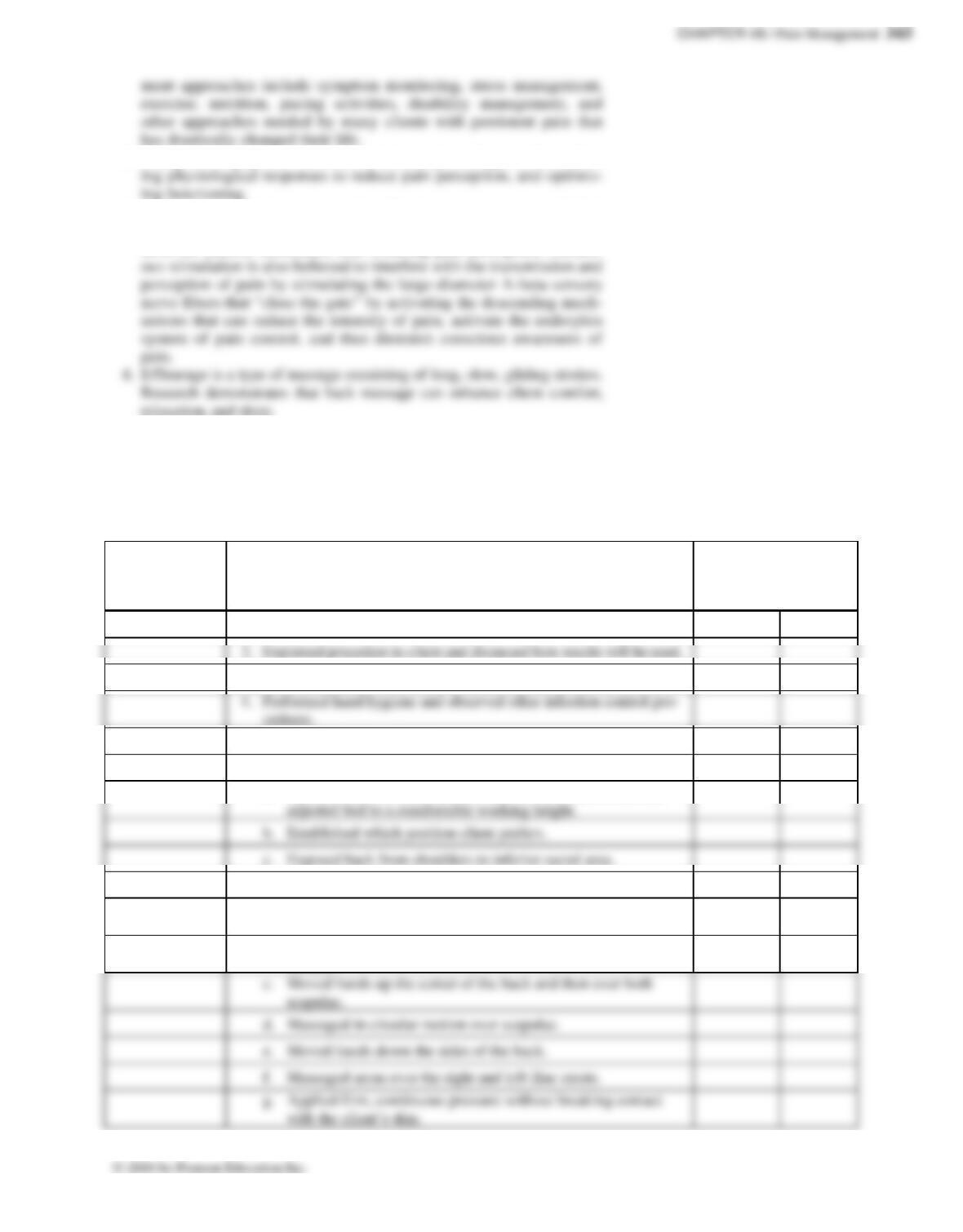
2. The goals of physical intervention include providing comfort, alter-
3. Cutaneous stimulation can provide effective temporary pain relief. It
distracts the client and focuses attention on the tactile stimuli, away
from the painful sensations, thus reducing pain perception. Cutane-
relaxation, and sleep.
L
EARNING
O
UTCOME
15
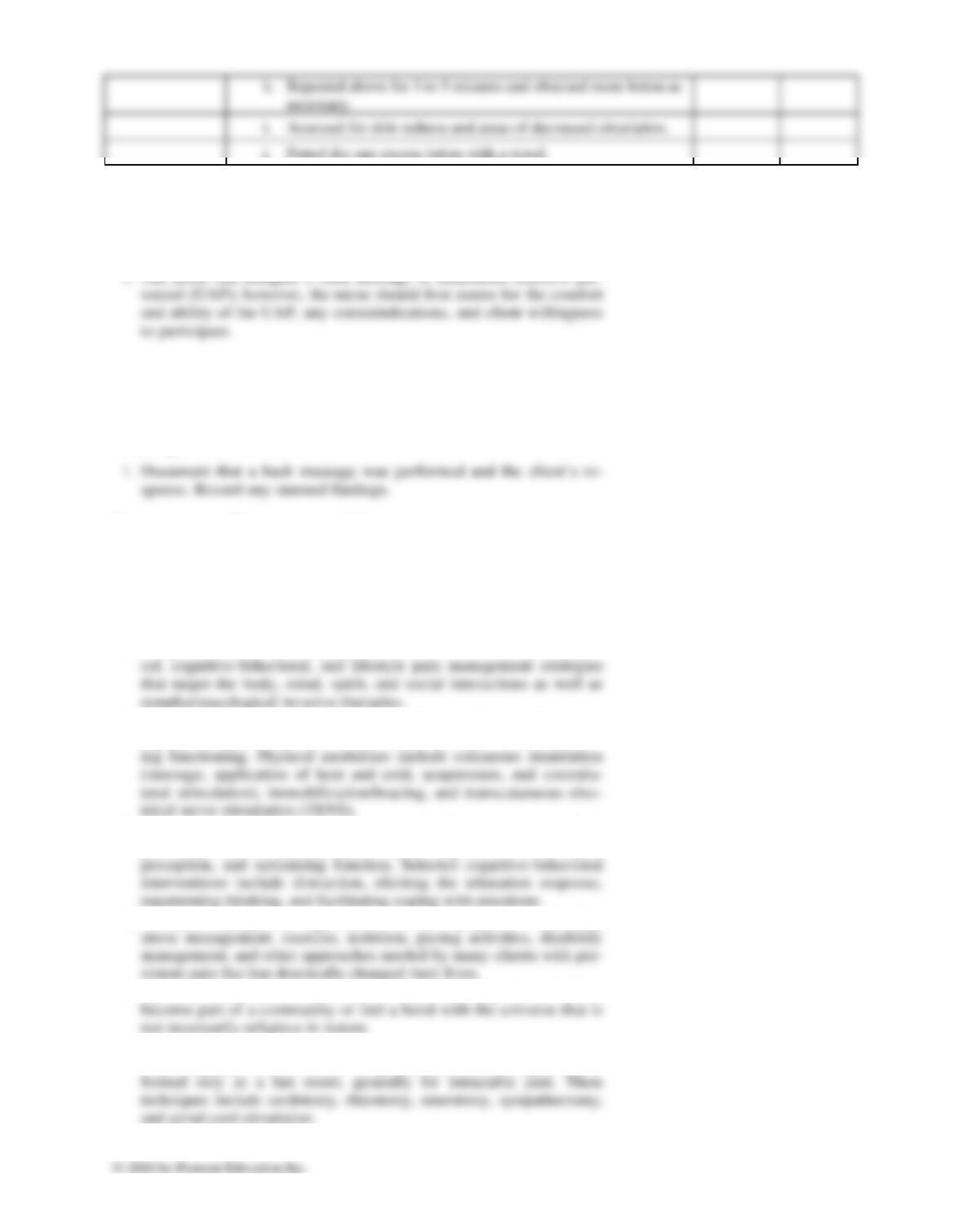
Verbalize the steps used in performing a back massage.
Concepts for Lecture
ESSENTIAL/
CRITICAL
ELEMENT?
SKILL 46–1: PROVIDING A BACK MASSAGE
COMPETENCY
DEMONSTRATED?
Yes
No
1. Introduced self and verified client’s identity.
2. Explained procedure to client and discussed how results will be used.
3. Gathered appropriate equipment.
5. Provided for client privacy.
6. Prepared client:
adjusted bed to a comfortable working height.
a. Assisted client to move to near side of bed within reach and
7. Massaged back.
a. Poured small amount of lotion onto palms of hands and held it
for a minute.
b. Using palm, began in the sacral area using smooth, circular
strokes.
c. Moved hands up the center of the back and then over both
scapulae.
g. Applied firm, continuous pressure without breaking contact
with the client’s skin.
344 CHAPTER 46 / Pain Management
i. Assessed for skin redness and areas of decreased circulation.
j. Patted dry any excess lotion with a towel.
L
EARNING
O
UTCOME
16
Recognize when it is appropriate to delegate aspects of back massage to unli-
censed assistive personnel.
L
EARNING
O
UTCOME
17
Demonstrate appropriate documentation and reporting of back massage.
Concepts for Lecture
L
EARNING
O
UTCOME
18
List three nonpharmocologic interventions directed at each of the following:
the body, the mind, the spirit, and social interactions.
Concepts for Lecture
1. Nonpharmacologic pain management consists of a variety of physi-
2. The goals of physical interventions include providing comfort, alter-
ing physiological responses to reduce pain perception, and optimiz-
3. The goals of mind–body (cognitive-behavioral) interventions include
providing comfort, altering psychological responses to reduce pain
4. Lifestyle management approaches include symptom monitoring,
5. Spiritual interventions may include rituals that help the individual
6.
Nonpharmacologic invasive techniques include interrupting pain path-
ways surgically. Because this interruption is permanent, surgery is per-