Chapter 4. Thermodynamic Variables and Relations
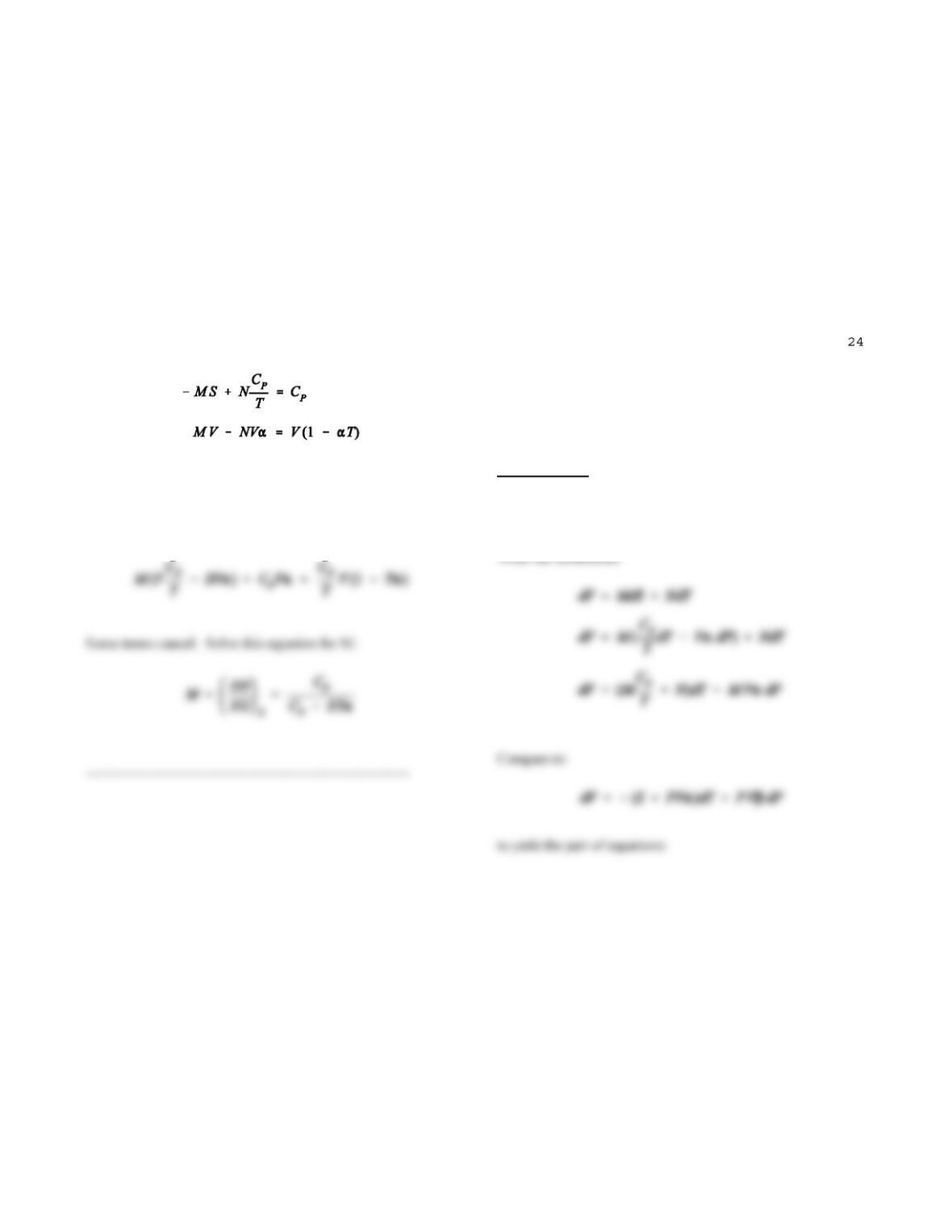
Since M is the coefficient sought in the problem, solve these
equations by multiplying the first by V• • and the second by
CP/T and adding the two equations. The term involving the
coefficient N cancels in this addition and
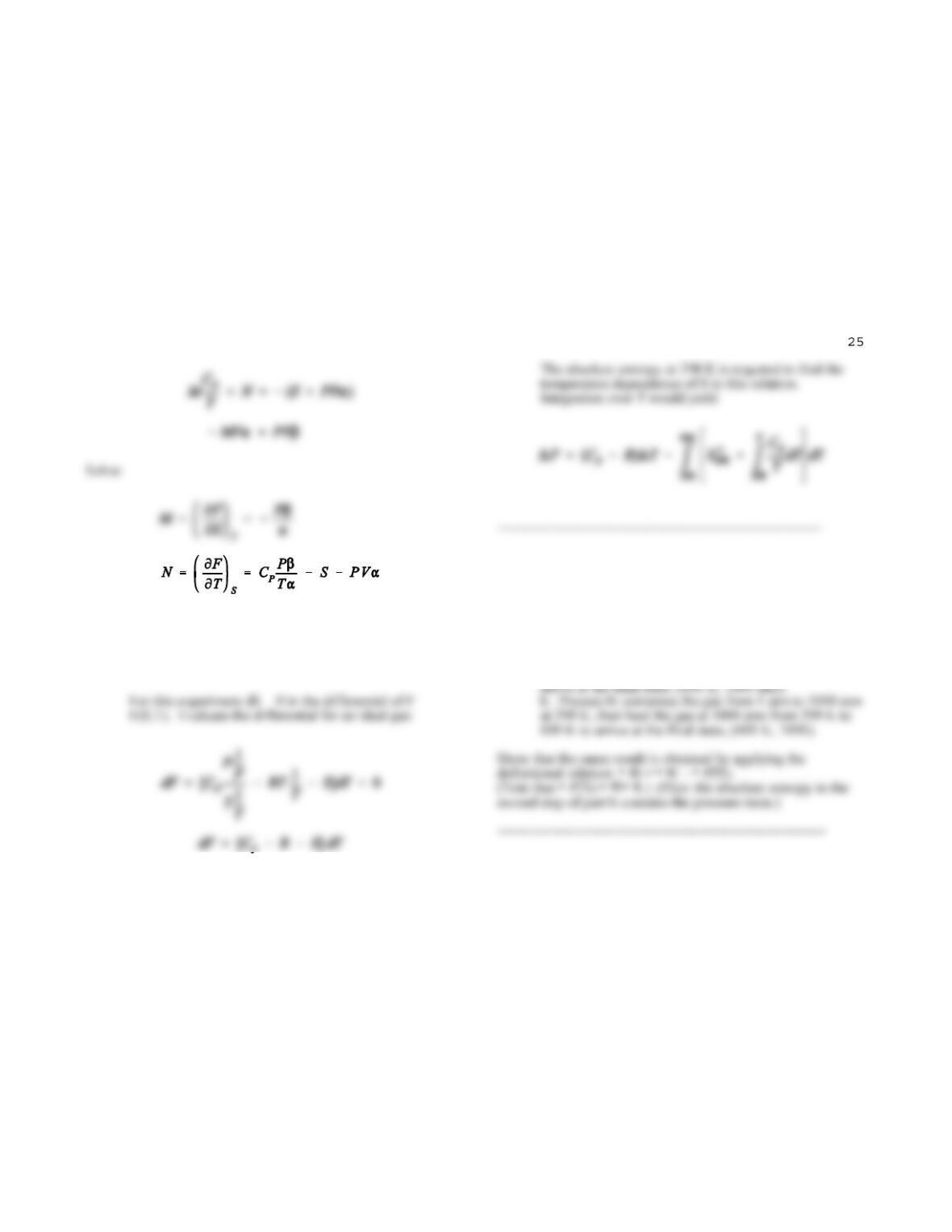
4.10. Derive the relationship that describes the dependence of
Helmholtz free energy upon entropy and temperature. Design
an experiment which would require this relationship in
analyzing the results.
Answer to 4.10.
Dependent variables: (S, T); independent variable: F.
Function required: F = F(S, T)
Chapter 4. Thermodynamic Variables and Relations
One mole of an ideal gas is expanded adiabatically and
reversibly from 300 K to 560 K. Compute the change in
Helmholtz free energy.
##4.11. Demonstrate that the change in a state function for a
process is independent by calculating the change in Gibbs free
energy for two processes that change the state of one mole of a
monatomic ideal gas from (298 K, 1 atm) to (600 K, 1000
atm):
a. Process A: heat the gas at 1 atm from 298 K to 600
K, then compress it at 600 K from 1 atm to 1000 atm to
4.12. A system is designed that permits continuous
Chapter 4. Thermodynamic Variables and Relations
programmed control of the pressure and volume of the gas that
it contains. The system is filled with one gram atom of helium
and brought to an initial condition of one atmosphere and 18
liters. It is then reversibly compressed to 12 liters along a
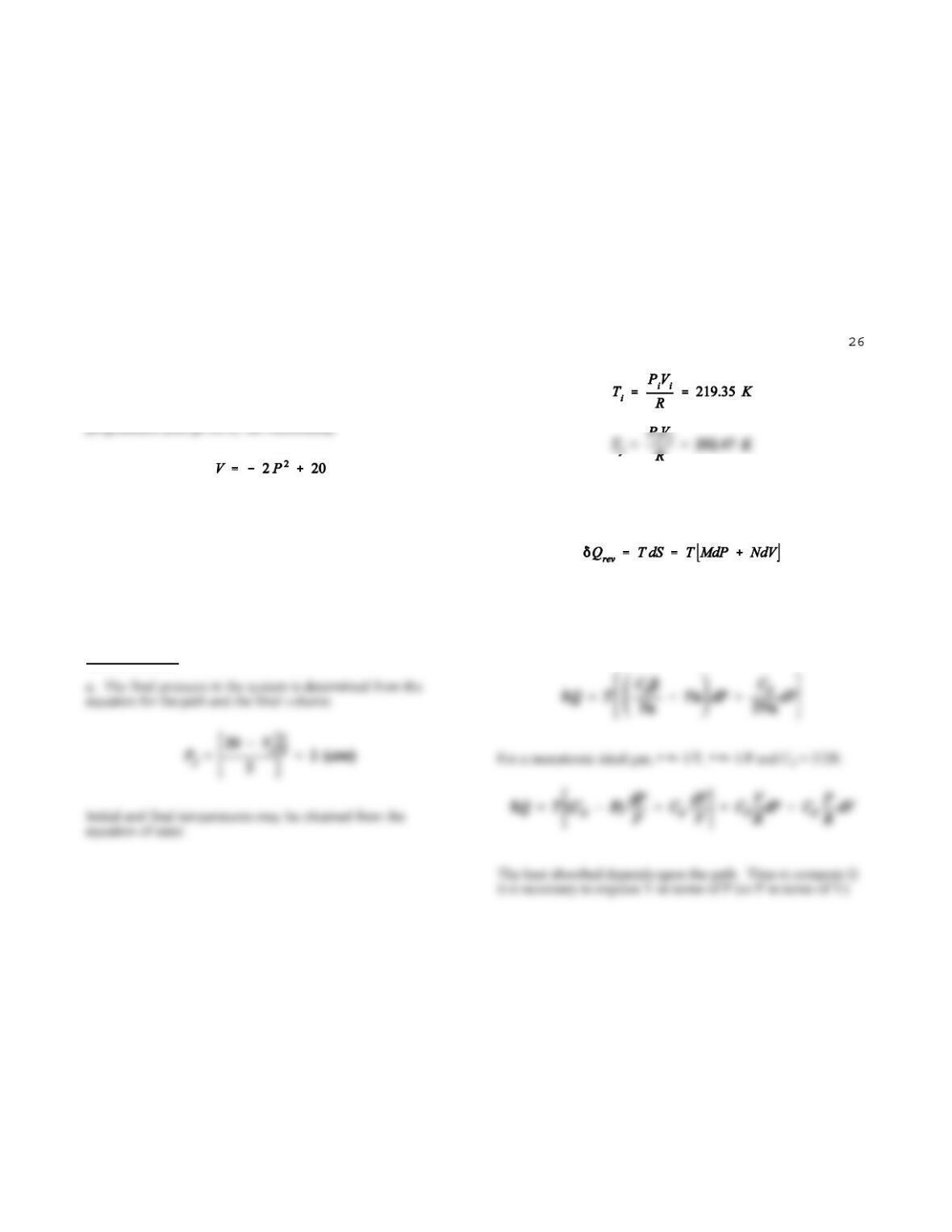
programmed path given by the relationship
where P is in atmospheres and V is in liters. Compute:
a. The initial and final temperature of the system.
b. The heat absorbed by the system.
c. The work done by the system.
d. The changes in U, H, F, G and S.
Answer to 4.12.
b. Since the process is reversible, the heat absorbed along the
specified path is:
Here P and V have been chosen as independent variables
because the path is specified in terms of P and V. The values
of M and N for S = S(P, V) have been obtained in example 4.3:
Chapter 4. Thermodynamic Variables and Relations
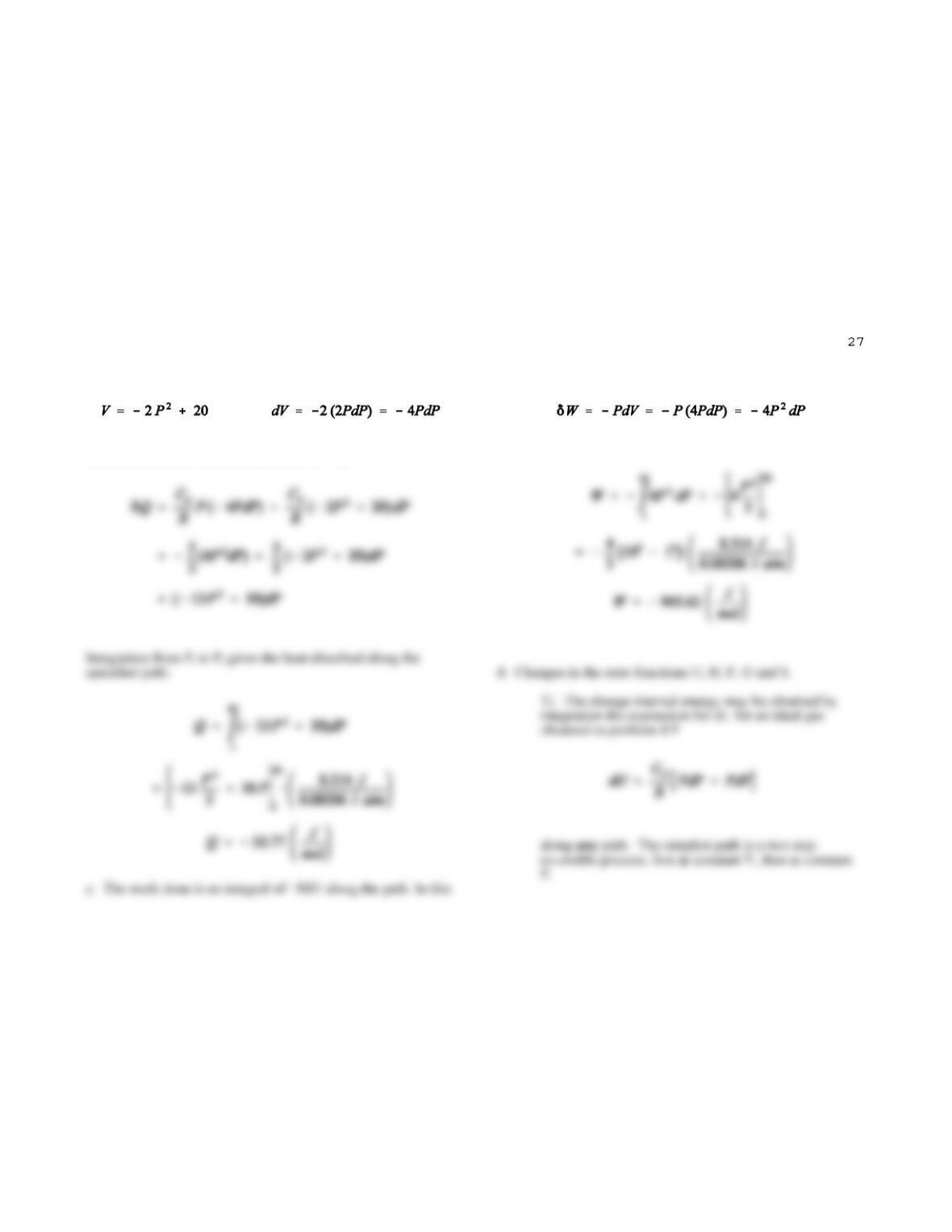
using the path relationship. Since
Insert these values into the expression for • •Q:
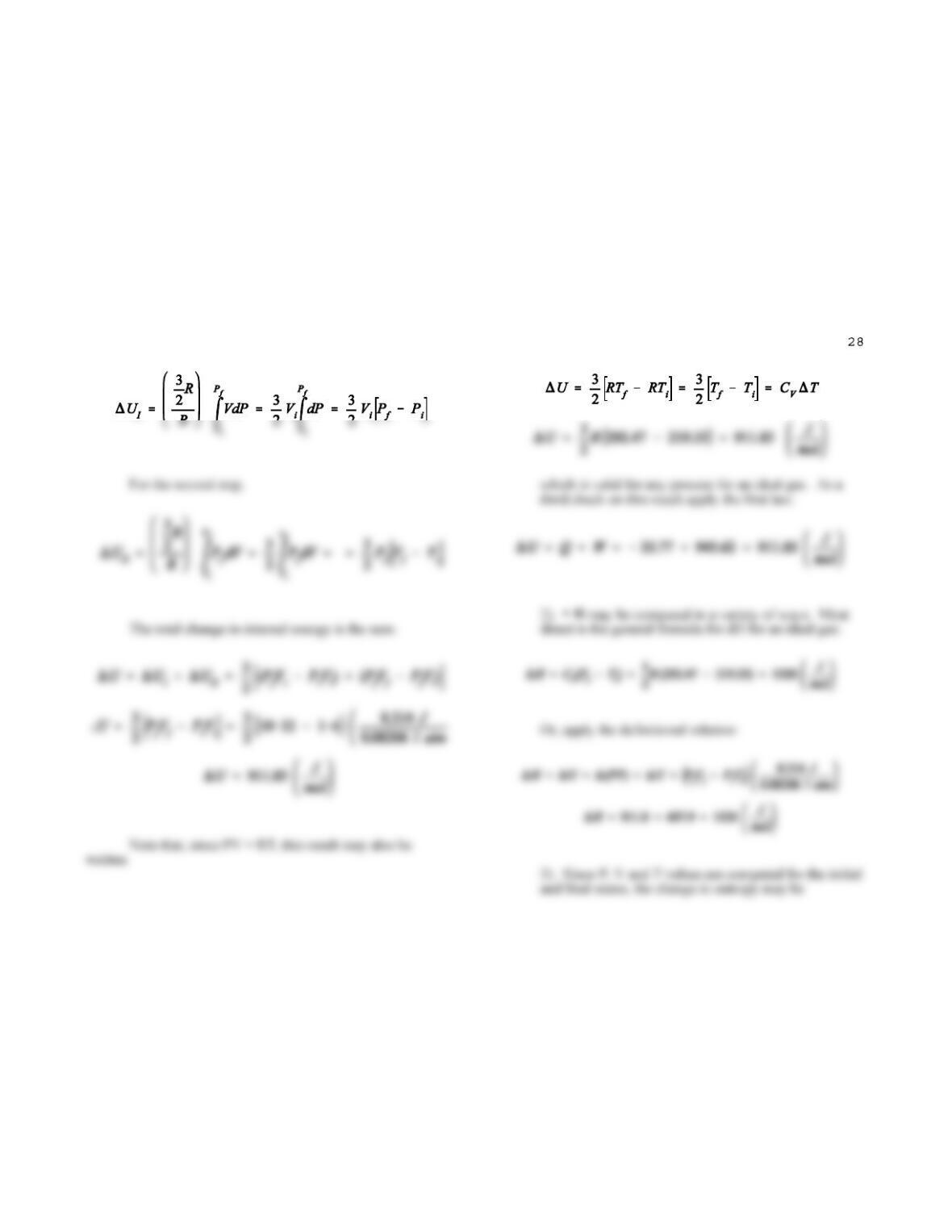
case, use the path equation to write dV in terms of dP:
Integration gives the work done for the process:
Chapter 4. Thermodynamic Variables and Relations
Chapter 4. Thermodynamic Variables and Relations
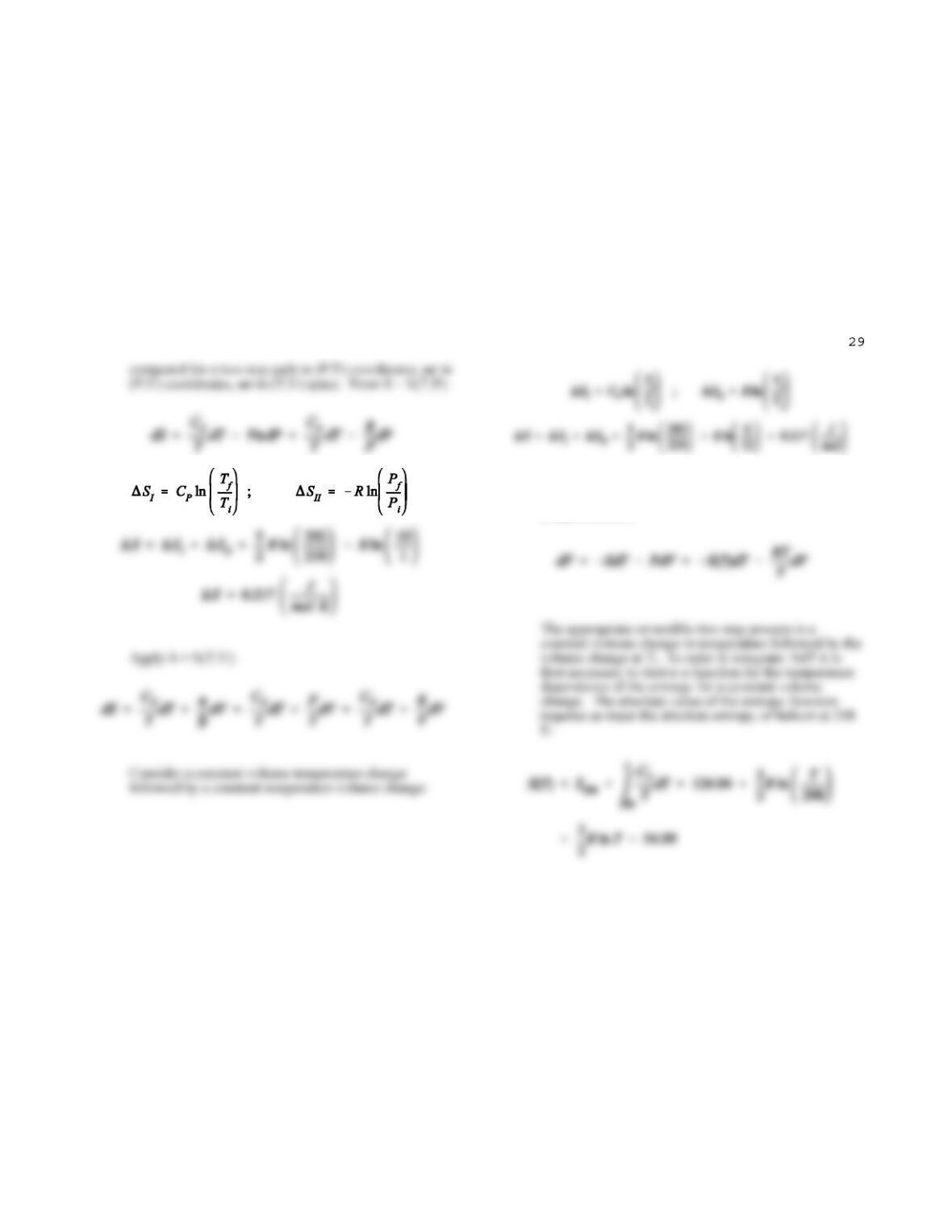
4). To compute the change in Helmholtz free energy
between the initial and final states the simplest relation
to use is F(T,V):
Chapter 4. Thermodynamic Variables and Relations
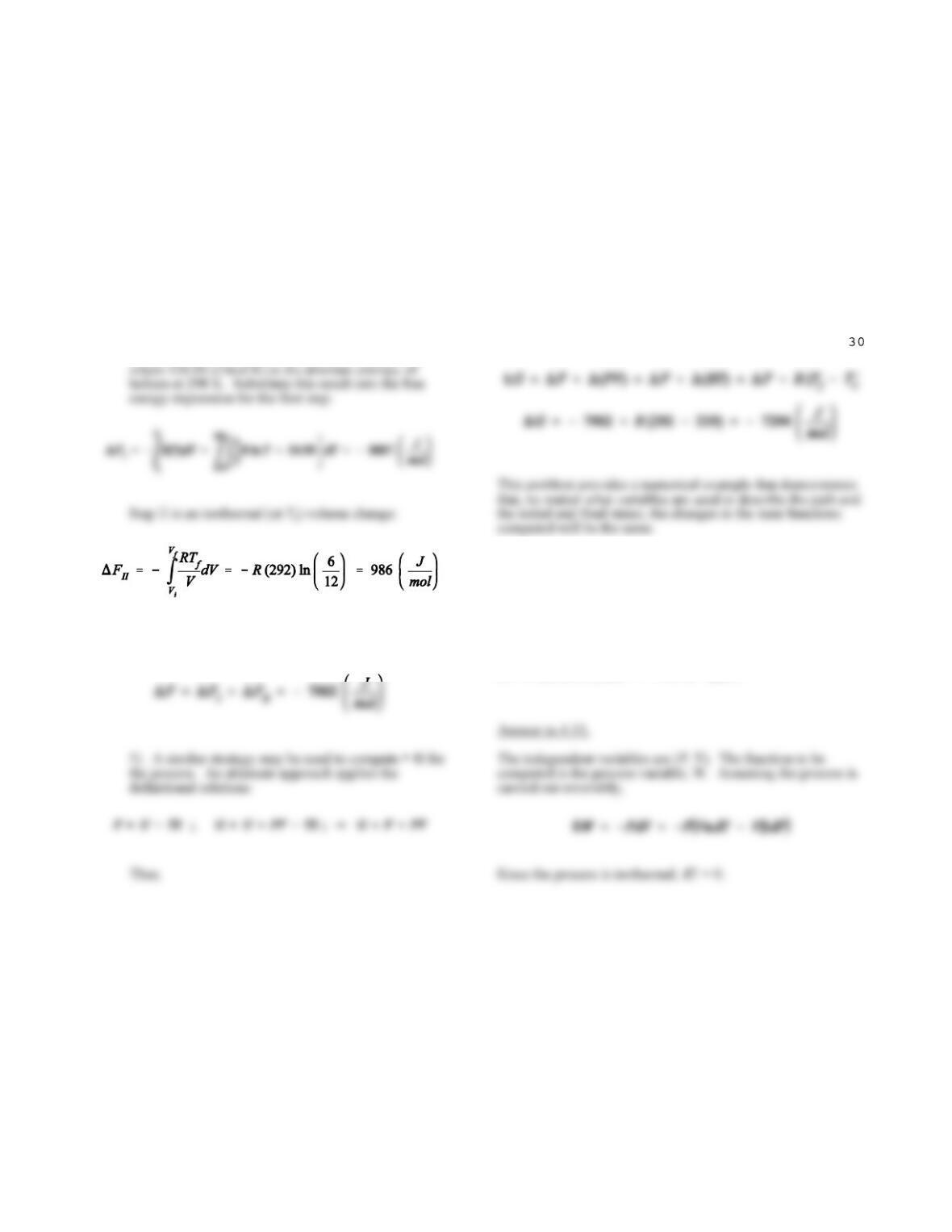
The total change in free energy is the sum:
———–——–——–——–——-——-——–———-
4.13. Estimate the pressure increase required to impart one
Joule of mechanical work in reversibly compressing one mole
of silver at room temperature. What pressure rise would be
required to impart one Joule of work to one mole of alumina at
room temperature? For alumina take the molar volume to be
25.715 (cc-mol-1) and • • = 7.0 x 10⁻⁷ (atm)-1
Chapter 4. Thermodynamic Variables and Relations
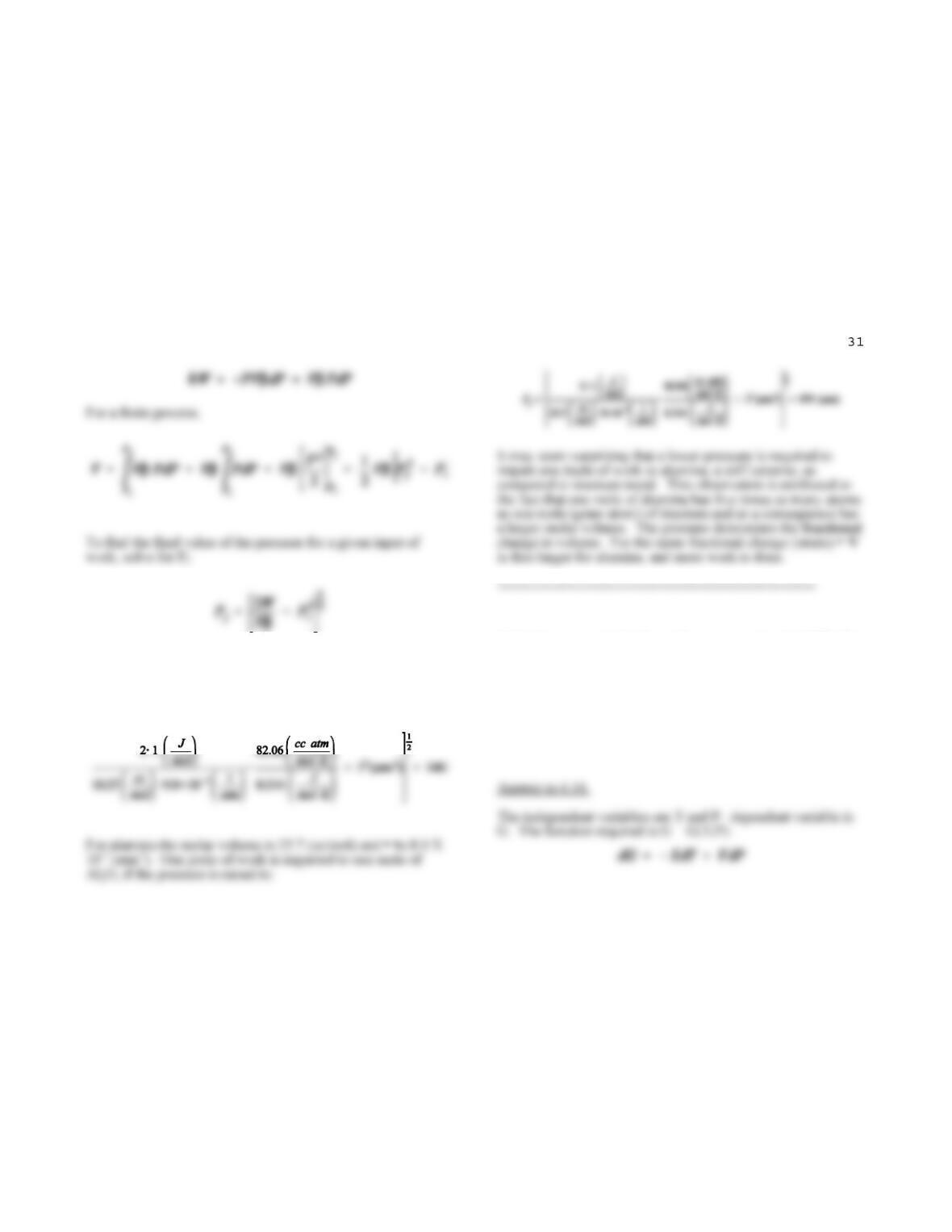
For silver, the molar volume is 10.27 (cc/mol) and • • may be
estimated as 10-7 (atm-1). Insert the value of the initial pressure
and calculate:
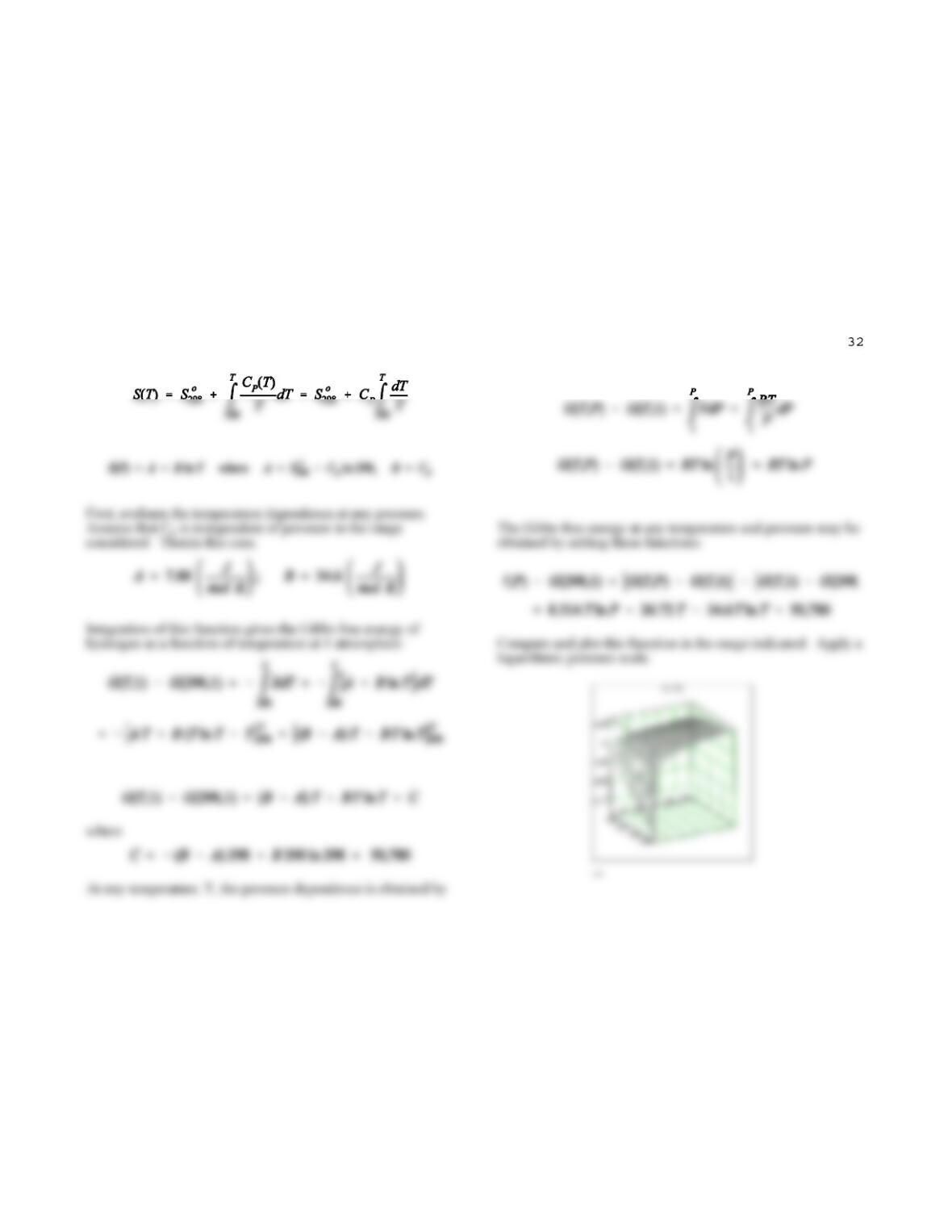
4.14. Compute and plot the surface representing the Gibbs free
energy of hydrogen gas as a function of temperature and
pressure in the range from (298K, 10-10 atm) to (1000K, 100
atm). Use (298K, 1 atm) as the zero point for the calculation.
The absolute entropy of H2 at 298K and 1 atm is 130.57
(J/mol-K); assume that CP = 7/2 R (J/mol-K) is independent of
P and T.
Chapter 4. Thermodynamic Variables and Relations
integrating
Chapter 4. Thermodynamic Variables and Relations
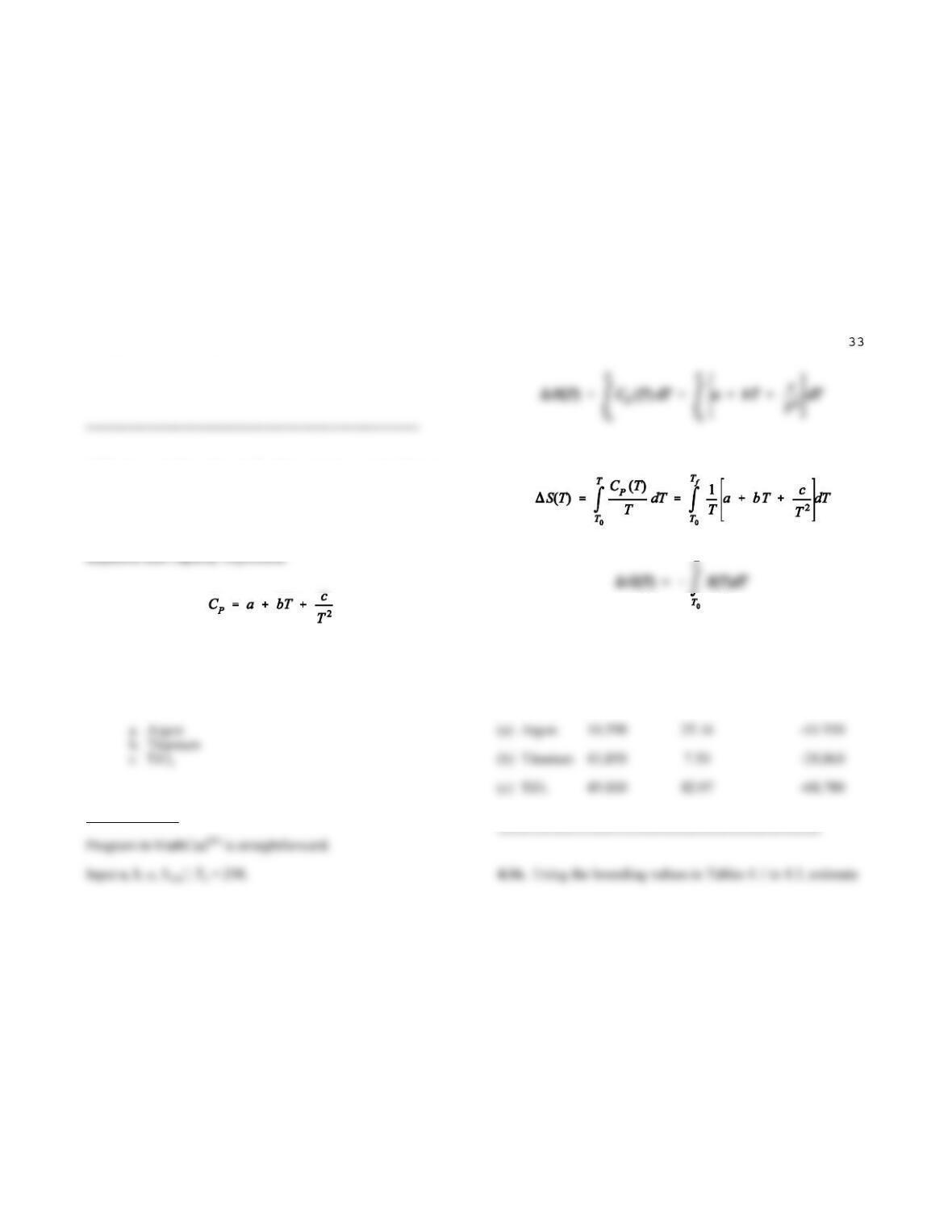
4.15. Use a mathematics applications program, spreadsheet or
computer language to program and plot the generic equations
for computing the temperature dependence of enthalpy,
entropy and Gibbs free energy as a function of temperature at
one atmosphere pressure. Assume as input the absolute
entropy of the substance at 298K and values of a, b and c in the
Use the program to compute H, S and G (relative to their
values at 298K) as functions of temperature at one atmosphere
for
Answer to 4.15.
For a final temperature Tf = 1000 K,
System • •H (J/mol) • •S (J/mol K) • •G
(J/mol)
Chapter 4. Thermodynamic Variables and Relations
H298 237000
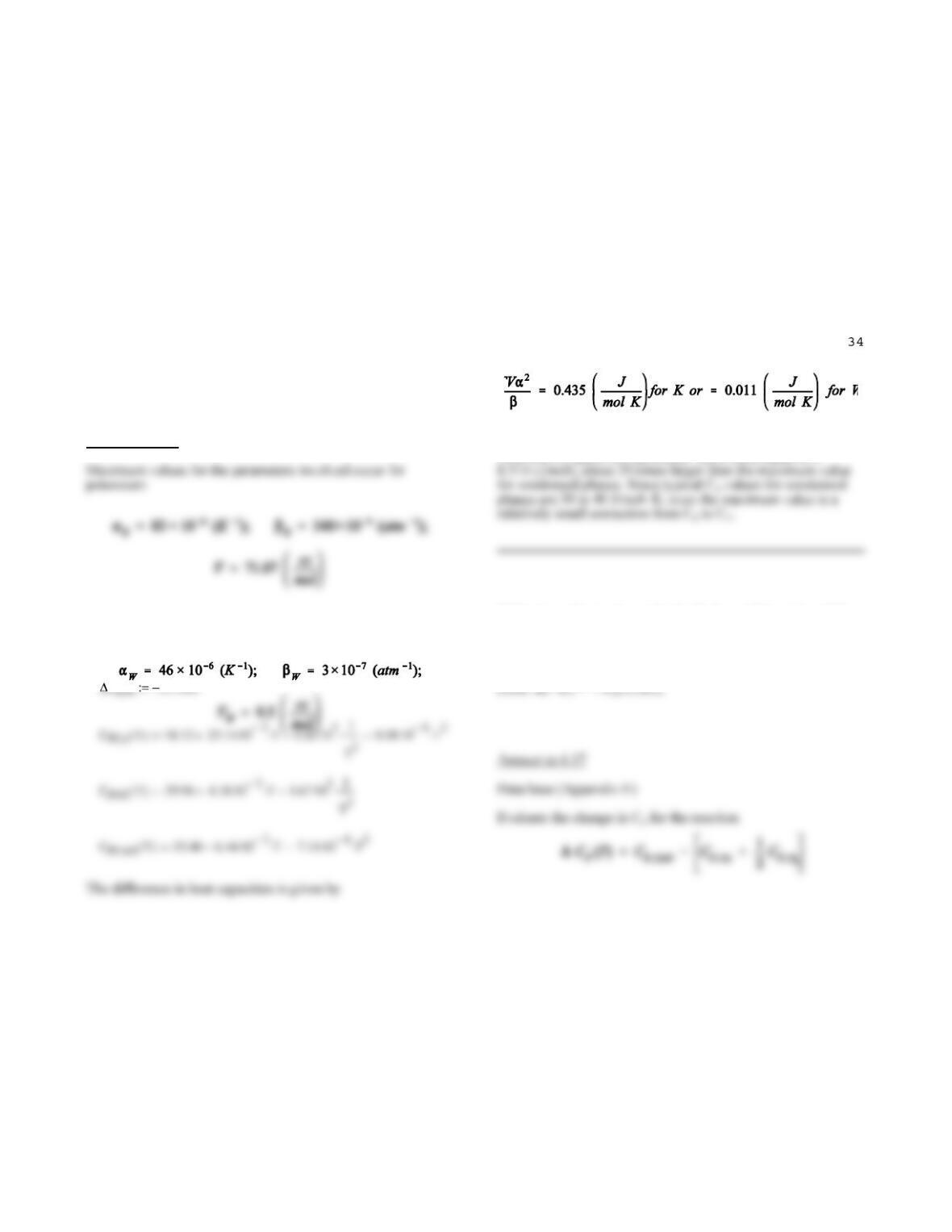
the range of the magnitude of the difference between CP and CV
for condensed phases.
Answer to 4.16.
The minimum values correspond to tungsten:
Note that for gases this parameter has a value equal to R =
4.17. According to Appendix E, The heat of formation of the
compound CoO is – 237700 J. Compute the enthalpy change
for this reaction as a function of temperature in the range from
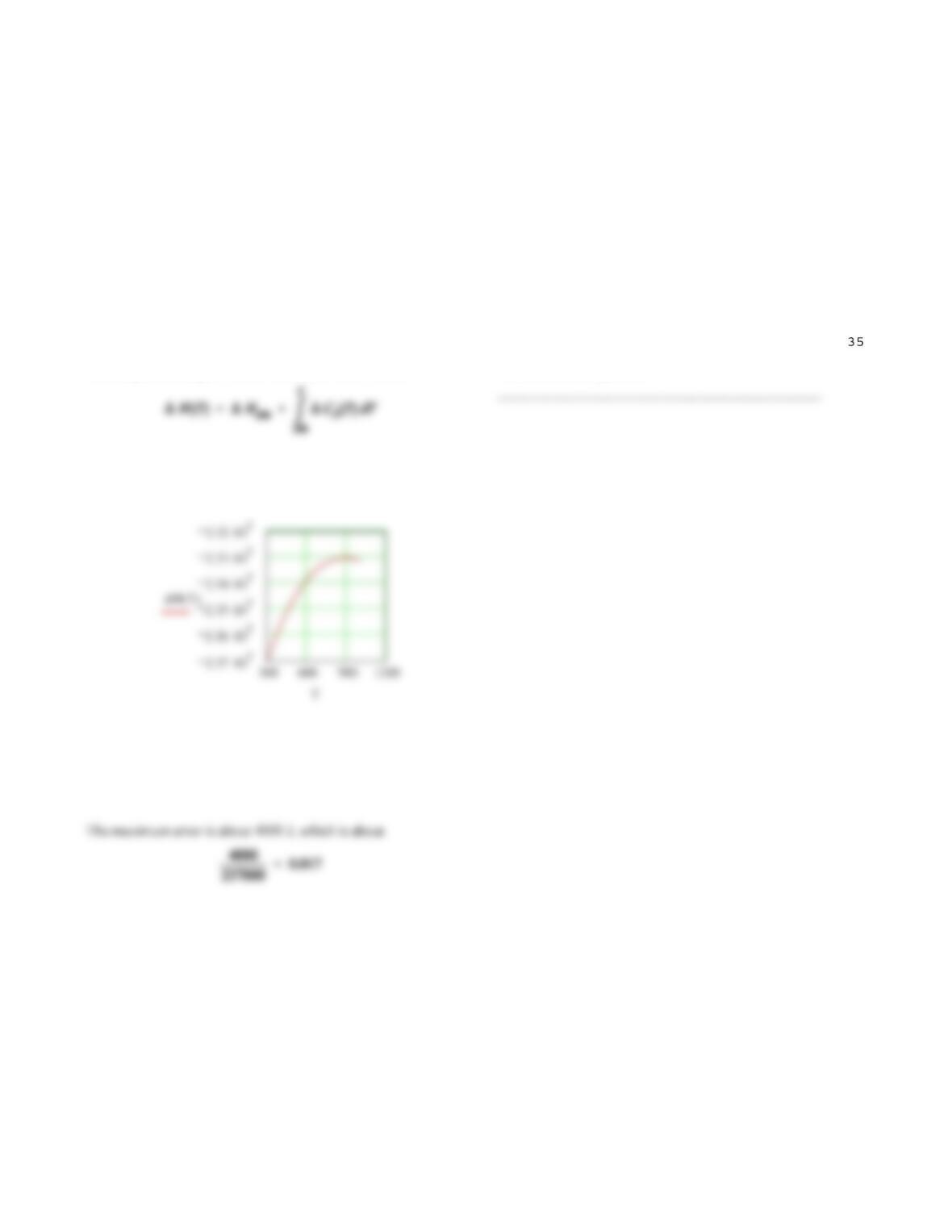
300 K to 1000 K. What is the maximum error incurred in this
range if it is assumed that • •CP is independent of temperature.
Chapter 4. Thermodynamic Variables and Relations
The temperature dependence of the heat of formation is
Plot the result:
i.e., less than two per cent.