L
EARNING
O
UTCOME
1
Identify the purposes of the physical examination.
Concepts for Lecture
1. The purposes of the physical examination include the following:
• Obtain baseline data about the client’s functional abilities.
• Supplement, confirm, or refute data obtained in the nursing
history.
L
EARNING
O
UTCOME
2
Explain the four techniques used in physical examination: inspection, palpa-
tion, percussion, and auscultation.
Concepts for Lecture
2. Inspection is visual examination using the sense of sight. It should be
3. Palpation is examination of the body using the sense of touch. The
pads of the fingers are used to determine texture, temperature, vibra-
4. Percussion is the act of striking the body surface to elicit sounds that
5.
Auscultation is the process of listening to sounds produced within the
body. Auscultation can be direct, using the unaided ear, or indirect, using
C
HAPTER
30
HEALTH ASSESSMENT
S
UGGESTIONS FOR
C
LASSROOM
A
CTIVITIES
• Provide examples to illustrate the various
purposes of the physical examination.
S
UGGESTIONS FOR
C
LINICAL
A
CTIVITIES
•
Have the students review the nursing physical
examinations performed on their assigned clients
S
UGGESTIONS FOR
C
LASSROOM
A
CTIVITIES
•
Set up an inspection unit in the nursing laborato-
ry. Position a manikin in an orthopneic position.
Apply wounds, dressings, and so on. Divide the
students into groups and give each group a spe-
cific amount of time to inspect the client. Com-
pare and contrast findings from each group.
• Demonstrate the use of the otoscope and oph-
cussion on each other.
•
Have the students practice listening to heart,
lung, and abdominal sounds on assigned clients.
• If possible, assign students to assist with an
CHAPTER 30 / Health Assessment 177
L
EARNING
O
UTCOME
3
Identify expected findings during health assessment.
Concepts for Lecture
1. Physical findings may either be normal or represent deviations from
normal.
The initial assessment of physical findings provides baseline da-
ta about the client’s functional abilities against which subsequent as-
Significant deviations from normal should be reported to the
client’s primary care provider.
Normal findings and deviations from normal are indicated in
each skill in this chapter:
• Appearance and Mental Status (Skill 30–1)
• Skin (Skill 30–2)
• Hair (Skill 30–3)
• Nails (Skill 30-4)
• Neck (Skill 30–10)
• Thorax and Lungs (Skill 30–11)
• Heart, Central Vessels, and Peripheral Vascular System (Skills
30–12, 30–13)
• Breast and Axilla (Skill 30 –14)
• Abdomen (Skill 30–15)
L
EARNING
O
UTCOME
4
Verbalize the steps used in performing selected examination procedures:
a. Assessing appearance and mental status
b. Assessing the skin
c. Assessing the hair
d. Assessing the nails
j. Assessing the neck
k. Assessing the thorax and lungs
l. Assessing the heart and central vessels
S
UGGESTIONS FOR
C
LASSROOM
A
CTIVITIES
• Provide the students with several physical
examination documentations. Have the stu-
dents identify normal and deviations from
normal in these examinations.
S
UGGESTIONS FOR
C
LINICAL
A
CTIVITIES
• Have the students perform appropriate physi-
178 CHAPTER 30 / Health Assessment
m. Assessing the peripheral vascular system
n. Assessing the breasts and axillae
ESSENTIAL/
CRITICAL
ELEMENT?
SKILL 30–1: ASSESSING APPEARANCE AND MENTAL
STATUS
COMPETENCY
DEMONSTRATED?
Yes
No
1. Introduced self and verified client’s identity.
2. Explained procedure to client and discussed how results will be
used.
tion control procedures.
4. Provided for client privacy.
5. Observed body build, height, and weight in relation to the cli-
ent’s age, lifestyle, and health.
6. Observed the client’s posture and gait, standing, sitting, and
walking.
7. Observed the client’s overall hygiene and grooming.
8. Noted body and breath odor in relation to activity level.
9. Observed for signs of distress in posture or facial expression.
10. Noted obvious signs of health or illness (e.g., skin color or
breathing).
12. Noted the client’s affect/mood; assessed the appropriateness of
the client’s responses.
13. Listened for speech quantity (amount and pace) and quality
(loudness, clarity, inflection).
14. Listened for relevance and organization of thoughts.
ESSENTIAL/
CRITICAL
ELEMENT?
SKILL 30–2: ASSESSING THE SKIN
COMPETENCY
DEMONSTRATED?
Yes
No
1. Introduced self and verified client’s identity.
2. Explained procedure to client and discussed how results will be
used.
3. Gathered appropriate equipment.
4. Performed hand hygiene and observed other infection control
5. Provided for client privacy.
6. Inquired about the client’s history related to the skin.
7. Inspected skin color, including areas not usually exposed to
sun, under natural light.
8. Inspected uniformity of skin color.
when pressed by a finger. Measured circumference of extremity.
9. Assessed for edema. If present, noted location, color, temperature,
limeter ruler to measure lesions.
10. Inspected, palpated, and described skin lesions. Applied gloves
if open or draining lesions. Palpated lesions to determine shape
11. Observed and palpated skin moisture.
12. Palpated skin temperature. Compared the extremities using the
backs of the fingers.
13. Noted skin turgor (fullness or elasticity) by lifting and pinching
the skin below the clavicle or on the forearm.
ESSENTIAL/
CRITICAL
ELEMENT?
SKILL 30–3: ASSESSING THE HAIR
COMPETENCY
DEMONSTRATED?
Yes
No
1. Introduced self and verified client’s identity.
used.
3. Gathered appropriate equipment.
appropriate infection control procedures.
5. Provided for client privacy.
6. Inquired about the client’s history related to the hair.
7. Inspected the evenness of growth over the scalp.
8. Inspected hair thickness or thinness.
9. Inspected hair texture and oiliness.
the hairline at the neck.
10. Noted presence of infections or parasite infestations by parting
11. Inspected amount of body hair.
12. Removed and discarded gloves. Performed hand hygiene.
ESSENTIAL/
CRITICAL
ELEMENT?
SKILL 30–4: ASESSING THE NAILS
COMPETENCY
DEMONSTRATED?
Yes
No
1. Introduced self and verified client’s identity.
used.
3. Observed appropriate infection control procedures.
5. Inquired about the client’s history related to the nails.
angle.
7. Inspected fingernail and toenail texture.
8. Inspected fingernail and toenail bed color.
9. Inspected tissues surrounding nails.
time for color to return completely.
10. Performed blanch test of capillary refill. Pressed two or more
180 CHAPTER 30 / Health Assessment
ESSENTIAL/
CRITICAL
ELEMENT?
SKILL 30–5: ASSESSING THE SKULL AND FACE
COMPETENCY
DEMONSTRATED?
Yes
No
1. Introduced self and verified client’s identity.
2. Explained procedure to client and discussed how results will be
used.
3. Observed appropriate infection control procedures.
4. Provided for client privacy.
5. Inquired about the client’s history related to the skull and face.
6. Inspected the skull for size, shape, and symmetry.
7. Inspected the facial features.
8. Inspected the eyes for edema and hollowness.
ESSENTIAL/
CRITICAL
ELEMENT?
SKILL 30–6: ASSESSING THE EYE STRUCTURES AND
VISUAL ACUITY
COMPETENCY
DEMONSTRATED?
Yes
No
1. Introduced self and verified client’s identity.
2. Explained procedure to client and discussed how results will be
used.
3. Gathered appropriate equipment.
4. Performed hand hygiene and observed other appropriate infec-
tion control procedures.
5. Provided for client privacy.
6. Inquired about the client’s history related to the eyes.
7. Inspected the eyebrows for hair distribution, alignment, skin
quality, and movement.
8. Inspected the eyelashes for evenness of distribution and direc-
tion of curl.
9. Inspected the eyelids for surface characteristics (e.g., skin quali-
ence of lesions.
11. Inspected the cornea for clarity and texture.
12. Inspected the pupils for color, shape, and symmetry of size.
13. Assessed each pupil’s direct and consensual reaction to light.
a. Partially darkened the room.
penlight.
sponse of the other pupil.
14. Assessed each pupil’s reaction to accommodation.
a. Held an object about 10 cm from the bridge of the client’s
nose.
15. Assessed peripheral visual fields.
a. Had the client sit directly facing the nurse at a distance of 60
to 90 cm.
b. Asked the client to cover the right eye with a card and look
directly at the nurse’s nose.
c. Covered or closed own eye directly opposite the client’s
covered eye and looked directly at the client’s nose.
d. Held an object in fingers, extended arm, and moved the ob-
ject into the visual field from various points in the periphery.
16. Assessed six ocular movements to determine eye alignment and
coordination.
comfortable distance, such as 30 cm, in front of the client’s
eyes.
eyes only.
d. Stopped the movement of the penlight periodically so that
nystagmus could be detected.
a. Stood directly in front of the client and held penlight at a
17. Assessed for location of corneal light reflex by shining penlight
on pupil in corneal surface.
18. Had the client fixate on near or far object. Covered one eye and
observed for movement in the uncovered eye.
zine or newspaper held at a distance of 36 cm, wearing correc-
tive lenses if used.
19. Assessed near vision by asking the client to read from a maga-
20. Assessed distance vision; asked the client to wear corrective
lenses, unless they are only for reading.
a. Asked the client to stand or sit 6 m from a Snellen or charac-
ter chart, cover the eye not being tested, and identify the let-
ters on the chart.
21. If the client was unable to see the top line of the Snellen-type
chart, performed one or more of the following vision tests:
a. Light perception: Shone penlight into client’s eye from a lat-
eral position and then turned light off. Asked the client to
state whether the light is on or off.
b. Hand movements: Held hand 20 cm from the client’s face
and moved it slowly back and fourth. Asked the client to
state when the hand stopped moving.
c. Counting fingers: Held up fingers 30 cm from the client’s
face and asked the client to count the fingers.
b. Asked the client to look first at the top of object and then at
a distant object behind the penlight. Alternated gaze from
the near to the far object.
c. Asked the client to look at the near object and then moved
182 CHAPTER 30 / Health Assessment
ESSENTIAL/
CRITICAL
ELEMENT?
SKILL 30–7: ASSESSING THE EARS AND HEARING
COMPETENCY
DEMONSTRATED?
Yes
No
1. Introduced self and verified client’s identity.
used.
3. Gathered appropriate equipment.
control procedures.
5. Provided for client privacy.
ing.
7. Positioned the client comfortably, seated if possible.
8. Inspected the auricles for color, symmetry of size, and position.
9. Palpated auricles for texture, elasticity, and areas of tenderness.
a. Gently pulled the auricle upward, downward, and backward.
b. Gently folded the pinna forward.
c. Gently pushed in on the tragus.
10. Inspected the external ear canal for cerumen, skin lesions, pus,
and blood.
11. Visualized the tympanic membrane using an otoscope.
a. Attached speculum to otoscope. Used the largest diameter
that fit near the ear canal without causing discomfort.
with fingers and ulnar surface of the hand against the cli-
avoiding pressure by the speculum against either side of the
ear canal.
e. Inspected the tympanic membrane for color and gloss.
b. Tipped the client’s head away from self and straightened ear
12. Assessed client’s response to normal voice tones. If client had
difficulty hearing the normal voice, proceeded with the follow-
ing tests:
a. Watch tick test: Had the client occlude one ear. Out of the
client’s sight, placed a ticking watch 2 to 3 cm from the un-
occluded ear. Asked what the client could hear. Repeated
with the other ear.
b. Tuning fork tests:
i. Placed the base of the vibrating fork on top of the cli-
ent’s head and asked where the client hears the noise.
ii. Held handle of activated tuning fork on the mastoid
process of one ear until the client states that vibration
can no longer be heard. Immediately held still vibrating
fork prongs in front of the client’s ear canal. Asked
whether client then heard the sound.
CHAPTER 30 / Health Assessment 183
ESSENTIAL/
CRITICAL
ELEMENT?
SKILL 30–8: ASSESSING THE NOSE AND SINUSES
COMPETENCY
DEMONSTRATED?
Yes
No
2. Explained procedure to client and discussed how results will be
used.
4. Performed hand hygiene and observed other appropriate infec-
tion control procedures.
6. Inquired about the client’s history related to the nose and sinus-
es.
8. Inspected the external nose for deviations in shape, size, or color
and flaring or discharge from the nares.
9. Lightly palpated the external nose to determine any areas of
tenderness, masses, and displacements of bone and cartilage.
tency of the opposite naris.
10. Determined patency of both nasal cavities. Asked the client to
11. Inspected the nasal cavities using a flashlight or a nasal specu-
lum.
12. Observed for the presence of redness, swelling, growths, and
13. Inspected the nasal septum between the nasal chambers.
14. Palpated the maxillary and frontal sinuses for tenderness.
ESSENTIAL/
CRITICAL
ELEMENT?
SKILL 30–9: ASSESSING THE MOUTH AND
OROPHARYNX
COMPETENCY
DEMONSTRATED?
Yes
No
2. Explained procedure to client and discussed how results will be
used.
4. Performed hand hygiene and observed other appropriate infec-
tion control procedures.
6. Inquired about the client’s history related to the mouth and oro-
pharynx.
8. Inspected the outer lips for symmetry of contour, color, and tex-
ture. Asked the client to purse the lips as if to whistle.
9. Inspected the inner lips and buccal mucosa for color, moisture,
texture, and the presence of lesions.
10. Inspected the teeth and gums while examining the inner lips and
buccal mucosa.
broken or worn areas.
11. Inspected the dentures. Asked the client to remove complete or
ture. Asked the client to protrude the tongue.
12. Inspected the surface of the tongue for position, color, and tex-
13. Inspected tongue movement. Asked the client to roll the tongue
upward and move it from side to side.
lum. Asked the client to place the tip of the tongue against the
roof of the mouth.
14. Inspected the base of the tongue, the mouth floor, and the frenu-
15. Inspected the hard and soft palate for color, shape, texture, and
the presence of bony prominences.
16. Inspected the uvula for position and mobility while examining
the palates.
17. Inspected the oropharynx for color and texture. Inspected one
side at a time to avoid eliciting the gag reflex.
18. Inspected the tonsils for color, discharge, and size.
ESSENTIAL/
CRITICAL
ELEMENT?
SKILL 30–10: ASSESSING THE NECK
COMPETENCY
DEMONSTRATED?
Yes
No
1. Introduced self and verified client’s identity.
2. Explained procedure to client and discussed how results will be
used.
3. Performed hand hygiene and observed appropriate infection
control procedures.
4. Provided for client privacy.
5. Inquired about the client’s history related to the neck.
6. Inspected the neck muscles for abnormal swellings or masses.
7. Observed head movement. Asked client to:
a. Move the chin to the chest.
b. Move the head back so that the chin points upward.
d. Turn the head to the right and to the left.
8. Assessed muscle strength.
b. Shrugged the shoulders against the resistance of the examin-
a. Asked the client to turn the head to one side against the re-
9. Palpated the entire neck for enlarged lymph nodes.
a. Palpated the nodes using the pads of the fingers.
d. Palpated the anterior cervical nodes and posterior cervical nodes.
e. Palpated the deep cervical nodes.
10. Palpated the trachea for lateral deviation.
11. Inspected the thyroid gland.
CHAPTER 30 / Health Assessment 185
ESSENTIAL/
CRITICAL
ELEMENT?
SKILL 30–11: ASSESSING THE THORAX AND LUNGS
COMPETENCY
DEMONSTRATED?
Yes
No
1. Introduced self and verified client’s identity.
2. Explained procedure to client and discussed how results will be
used.
3. Gathered appropriate equipment.
control procedures.
5. Provided for client privacy.
6. Inquired about the client’s history related to the thorax and
lungs.
7. Inspected the shape and symmetry of thorax from posterior and
lateral views.
9. Palpated the posterior thorax for temperature and skin integrity;
bulges, tenderness, or abnormal movements.
10. Palpated the posterior thorax for respiratory excursion.
11. Palpated the thorax for vocal fremitus.
12. Percussed the thorax.
b. Compared one side of the lung with the other.
13. Auscultated the chest using the diaphragm of the stethoscope.
a. Used the systematic zigzag procedure in percussion.
14. Inspected breathing patterns (e.g., respiratory rate and rhythm).
15. Inspected the costal angle and the angle at which the ribs enter
the spine.
17. Palpated the anterior thorax for respiratory excursion.
18. Palpated tactile fremitus in the same manner as for the posterior
thorax.
19. Percussed the anterior thorax systematically.
20. Auscultated the trachea.
21. Auscultated the anterior thorax.
186 CHAPTER 30 / Health Assessment
ESSENTIAL/
CRITICAL
ELEMENT?
SKILL 30–12: ASSESSING THE HEART AND CENTRAL
VESSELS
COMPETENCY
DEMONSTRATED?
Yes
No
1. Introduced self and verified client’s identity.
2. Explained procedure to client and discussed how results will be
used.
3. Gathered appropriate equipment.
4. Performed hand hygiene and observed other appropriate infec-
tion control procedures.
5. Provided for client privacy.
6. Inquired about the client’s history related to the heart and central
valve areas of the heart.
7. Simultaneously inspected and palpated the precordium for the
8. Auscultated the heart in all four anatomic sites: aortic, pulmon-
ic, tricuspid, and apical.
9. Palpated the carotid arteries one at a time.
small pillow.
11. Inspected the jugular veins for distention while the client was
12. If jugular distention was present, assessed the jugular venous
pressure.
ESSENTIAL/
CRITICAL
ELEMENT?
SKILL 30–13: ASSESSING THE PERIPHERAL VASCULAR
SYSTEM
COMPETENCY
DEMONSTRATED?
Yes
No
1. Introduced self and verified client’s identity.
2. Explained procedure to client and discussed how results will be
used.
3. Performed hand hygiene and observed appropriate infection
control procedures.
4. Provided for client privacy.
5. Inquired about the client’s history related to the peripheral vas-
cular system.
tematically to determine the symmetry of the pulses.
6. Palpated the peripheral pulses on both sides of the client’s body
pendent and when limbs are elevated.
7. Inspected the peripheral veins in the arms and legs for the pres-
8. Assessed the peripheral leg veins for signs of phlebitis.
a. Inspected the calves for redness and swelling over vein sites.
edema, and skin changes.
10. Assessed the adequacy of arterial flow if arterial insufficiency is
suspected using the capillary refill test.
ESSENTIAL/
CRITICAL
ELEMENT?
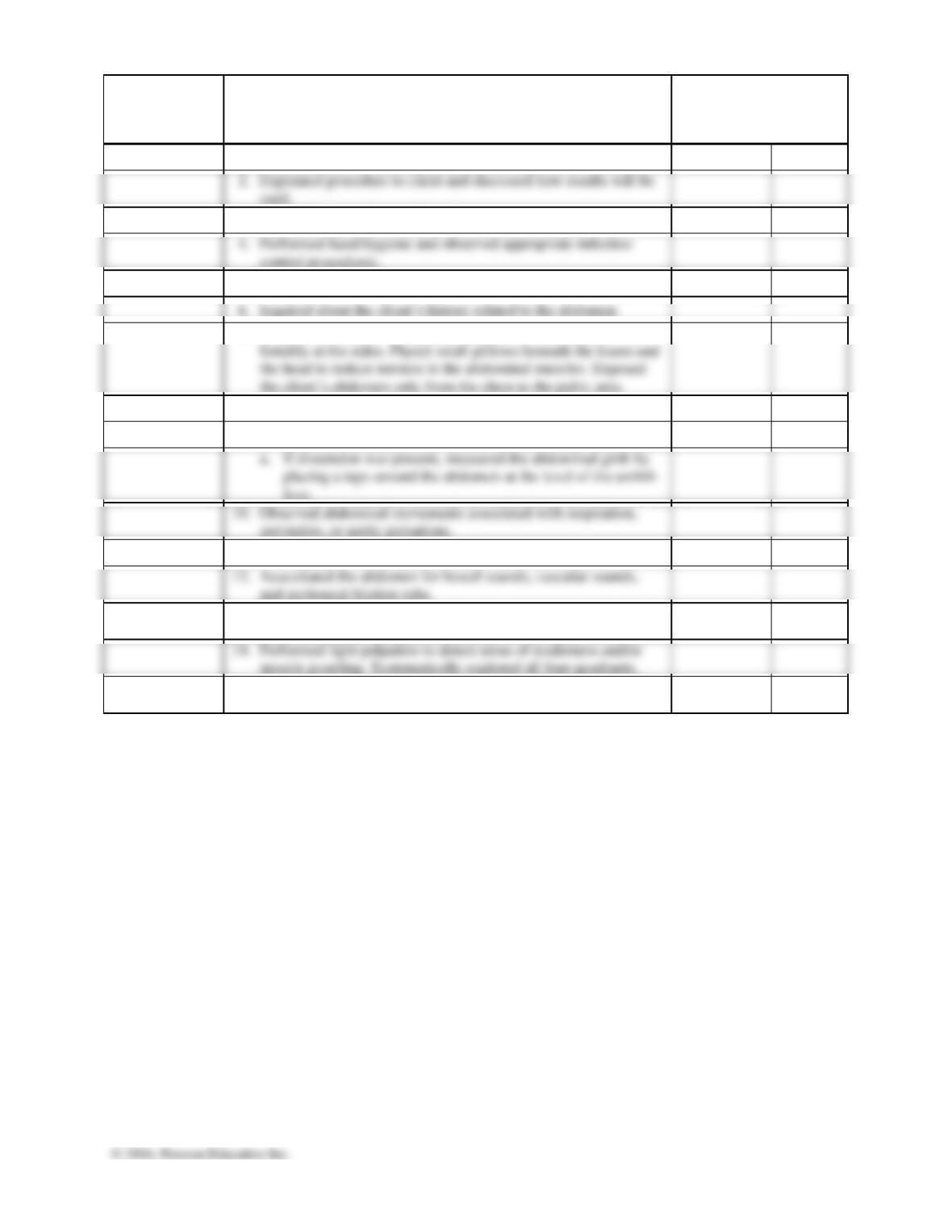
SKILL 30–14: ASSESSING THE BREASTS AND AXILLAE
COMPETENCY
DEMONSTRATED?
Yes
No
1. Introduced self and verified client’s identity.
used.
3. Gathered appropriate equipment.
control procedures.
5. Provided for client privacy.
6. Inquired about the client’s history related to the breasts and axil-
lae.
7. Inspected the breasts for size, symmetry, and contour or shape
while the client was in a sitting position.
cular areas, swelling, or edema.
8. Inspected the skin of the breast for localized discolorations or
9. Emphasized any retraction by having the client:
face characteristics, and any masses or lesions.
11. Inspected the nipples for size, shape, position, color, discharge,
and lesions.
12. Palpated the axillary, subclavicular, and supraclavicular lymph
13. Palpated the breast for masses, tenderness, and any discharge
from the nipples using a systematic pattern.
Noted also any tenderness on palpation.
14. Palpated the areolae and the nipples for masses. Compressed
15. Taught the client the technique of breast self-examination.
188 CHAPTER 30 / Health Assessment
ESSENTIAL/
CRITICAL
ELEMENT?
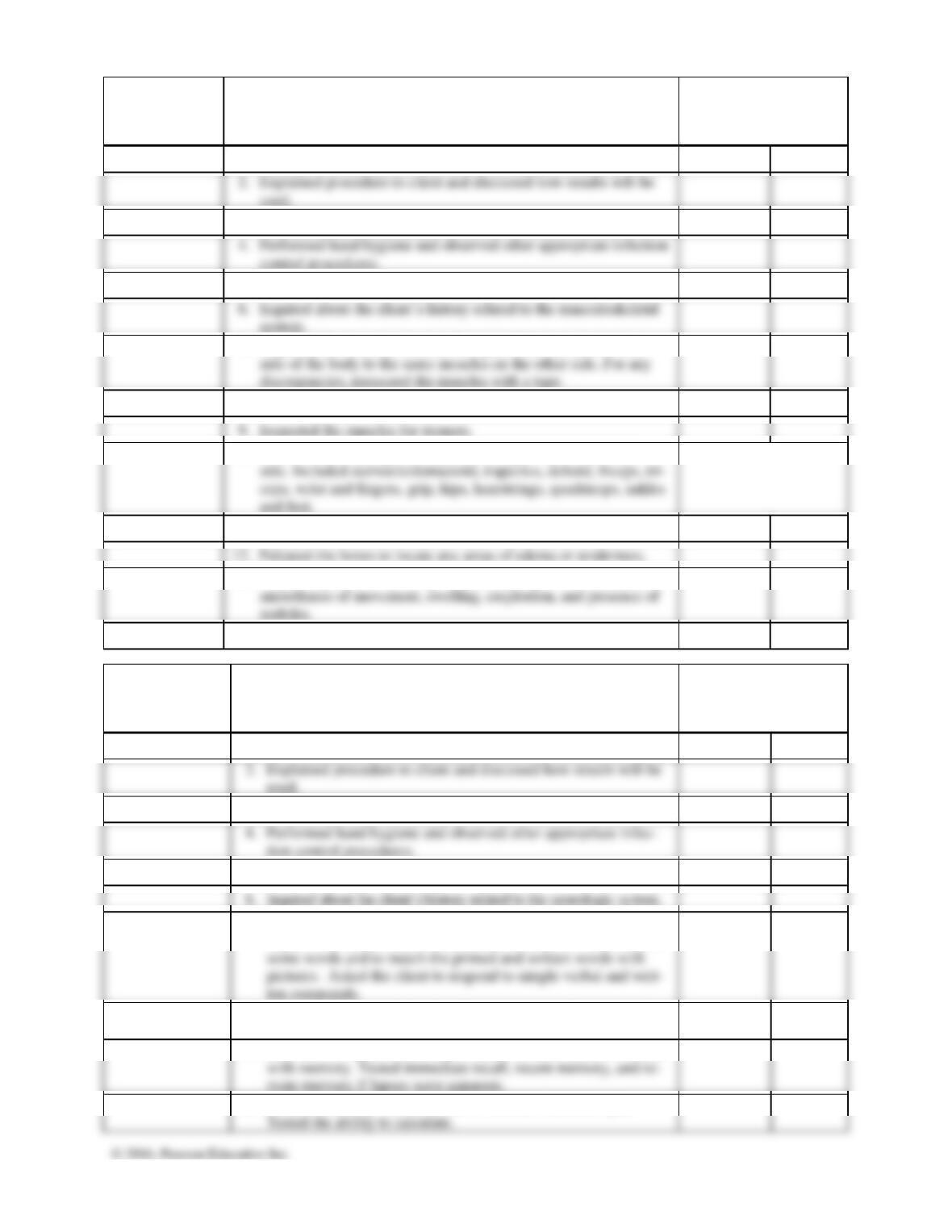
SKILL 30–15: ASSESSING THE ABDOMEN
COMPETENCY
DEMONSTRATED?
Yes
No
1. Introduced self and verified client’s identity.
used.
3. Gathered appropriate equipment.
control procedures.
5. Provided for client privacy.
6. Inquired about the client’s history related to the abdomen.
7. Assisted the client to a supine position, with arms placed com-
8. Inspected the abdomen for skin integrity.
9. Inspected the abdomen for contour and symmetry.
10. Observed abdominal movements associated with respiration,
11. Observed the vascular pattern.
12. Auscultated the abdomen for bowel sounds, vascular sounds,
and peritoneal friction rubs.
13. Percussed several areas in each of the four quadrants to deter-
mine presence of tympany and dullness.
14. Performed light palpation to detect areas of tenderness and/or
muscle guarding. Systematically explored all four quadrants.
15. Palpated the area above the pubic symphysis if the client’s histo-
ry indicated possible urinary retention.
CHAPTER 30 / Health Assessment 189
ESSENTIAL/
CRITICAL
ELEMENT?
SKILL 30–16: ASSESSING THE MUSCULOSKELETAL
SYSTEM
COMPETENCY
DEMONSTRATED?
Yes
No
1. Introduced self and verified client’s identity.
2. Explained procedure to client and discussed how results will be
used.
3. Gathered appropriate equipment.
4. Performed hand hygiene and observed other appropriate infection
control procedures.
5. Provided for client privacy.
discrepancies, measured the muscles with a tape.
7. Inspected the muscles for size. Compared the muscles on one
8. Inspected the muscles and tendons for contractures.
9. Inspected the muscles for tremors.
and feet.
10. Tested muscle strength. Compared the right side with the left
11. Inspected the skeleton for structure.
12. Palpated the bones to locate any areas of edema or tenderness.
nodules.
13. Inspected joints for swelling. Palpated each joint for tenderness,
14. Assessed joint range of motion.
ESSENTIAL/
CRITICAL
ELEMENT?
SKILL 30–17: ASSESSING THE NEUROLOGIC SYSTEM
COMPETENCY
DEMONSTRATED?
Yes
No
1. Introduced self and verified client’s identity.
used.
3. Gathered appropriate equipment.
4. Performed hand hygiene and observed other appropriate infec-
tion control procedures.
5. Provided for client privacy.
ten commands.
7. If the client displayed difficulty speaking, pointed to common
objects and asked client to name them. Asked the client to read
8. Determined the client’s orientation to time, place, and person.
Asked the client why he or she is seeing a health care provider.
mote memory if lapses were apparent.
9. Listened for lapses in memory. Asked the client about difficulty
Tested the ability to calculate.
10. Tested the ability to concentrate or maintain attention span.
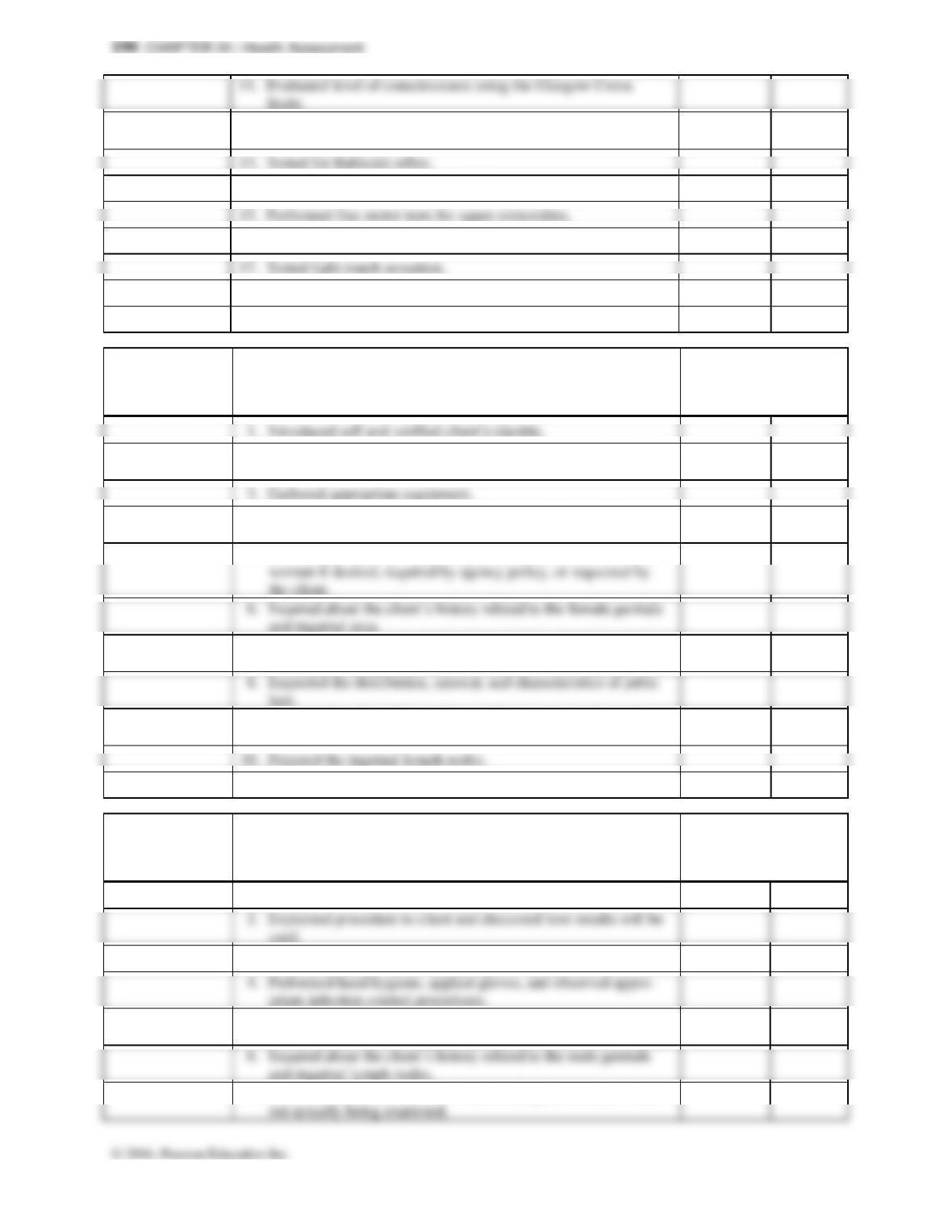
Scale.
12. Tested each cranial nerve not already evaluated in another com-
ponent of the health assessment.
13. Tested for Babinski reflex.
14. Tested gross motor function and balance.
15. Performed fine motor tests for upper extremities.
16. Performed fine motor tests for lower extremities.
17. Tested light-touch sensation.
18. Assessed pain sensation.
19. Tested position or kinesthetic sensation.
ESSENTIAL/
CRITICAL
ELEMENT?
SKILL 3–18: ASSESSING THE FEMALE GENITALS AND
INGUINAL AREA
COMPETENCY
DEMONSTRATED?
Yes
No
1. Introduced self and verified client’s identity.
2. Explained procedure to client and discussed how results will be
used.
3. Gathered appropriate equipment.
4. Performed hand hygiene, applied gloves, and observed other
appropriate infection control procedures.
the client.
5. Provided for client privacy. Requested the presence of another
6. Inquired about the client’s history related to the female genitals
and inguinal area.
7. Covered the pelvic area with a sheet or drape at all times when
not actually being examined. Positioned the client supine.
hair.
9. Inspected the skin of the pubic area for parasites, inflammation,
swelling, and lesions.
10. Palpated the inguinal lymph nodes.
11. Removed and discarded gloves. Performed hand hygiene.
ESSENTIAL/
CRITICAL
ELEMENT?
SKILL 30–19: ASSESSING THE MALE GENITALS AND
INGUINAL AREA
COMPETENCY
DEMONSTRATED?
Yes
No
1. Introduced self and verified client’s identity.
2. Explained procedure to client and discussed how results will be
used.
3. Gathered appropriate equipment.
priate infection control procedures.
5. Provided for client privacy. Requested the presence of another per-
son if desired, required by agency policy, or requested by the client.
and inguinal lymph nodes.
not actually being examined.
7. Covered the pelvic area with a sheet or drape at all times when
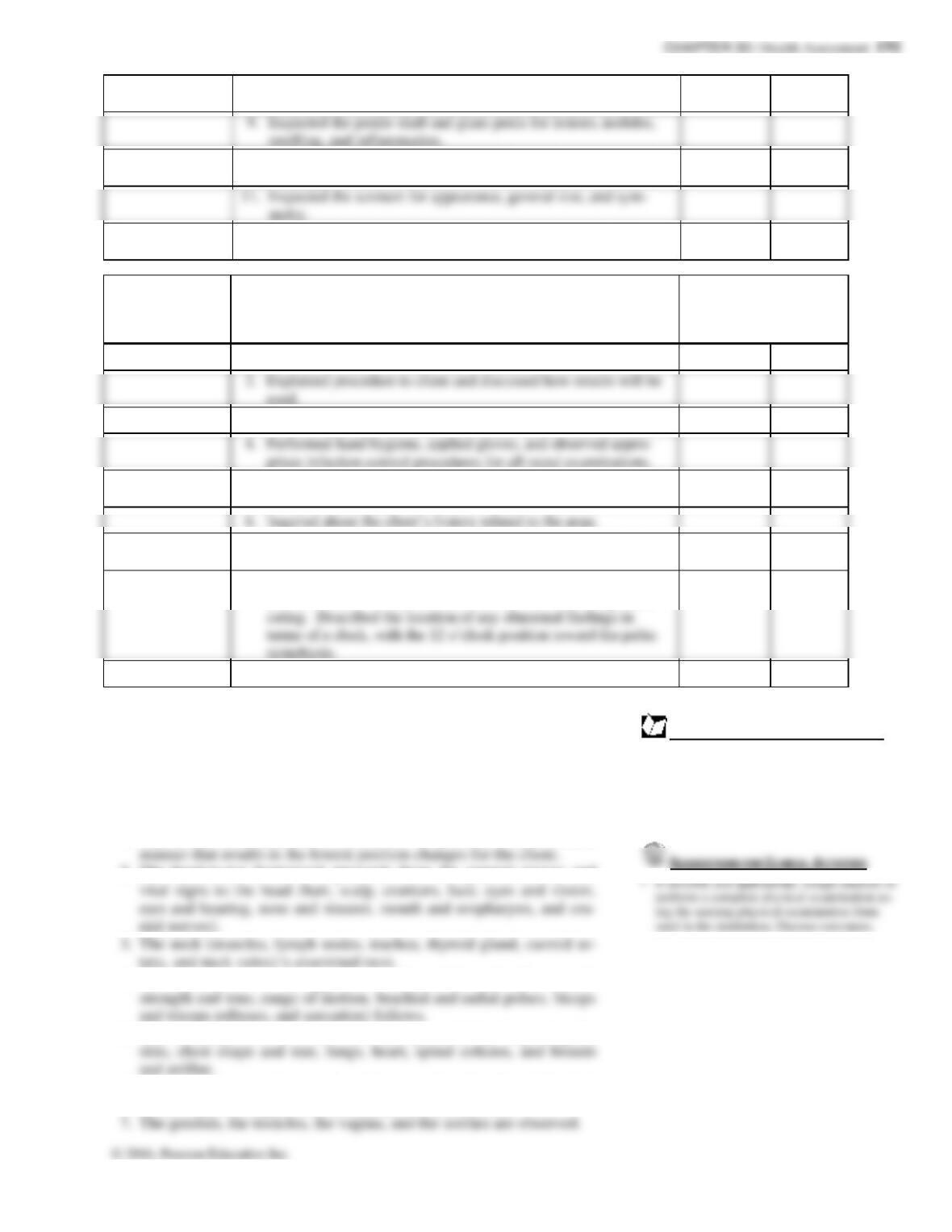
8. Inspected the distribution, amount, and characteristics of pubic
hair.
swelling, and inflammation.
10. Inspected the urethral meatus for swelling, inflammation, and
discharge.
11. Inspected the scrotum for appearance, general size, and sym-
metry.
12. Inspected both inguinal areas for bulges while the client is
standing, if possible.
ESSENTIAL/
CRITICAL
ELEMENT?
SKILL 30–20: ASSESSING THE ANUS
COMPETENCY
DEMONSTRATED?
Yes
No
1. Introduced self and verified client’s identity.
used.
3. Gathered appropriate equipment.
4. Performed hand hygiene, applied gloves, and observed appro-
priate infection control procedures for all rectal examinations.
5. Provided for client privacy. Draped the client appropriately to
prevent undue exposure of body parts.
6. Inquired about the client’s history related to the anus.
7. Positioned the client in a left lateral or Sims’ position with the
upper leg acutely flexed.
8. Inspected the anus and surrounding tissue for color, integrity,
and skin lesions. Asked the client to bear down as though defe-
9. Removed and discarded gloves. Performed hand hygiene.
L
EARNING
O
UTCOME
5
Describe suggested sequencing to conduct a physical health examination in
an orderly fashion.
Concepts for Lecture
1. The health assessment is conducted in a systematic and efficient
2. The head–to-toe framework proceeds from the general survey and
4. The examination of the upper extremities (skin and nails, muscle
5. The examination of the chest and back proceeds by inspecting the
6. The assessment continues to the abdomen where the skin, abdominal
sounds, specific organs, and femoral pulses are checked.
S
UGGESTIONS FOR
C
LASSROOM
A
CTIVITIES
• Show a video of a complete physical examina-
tion. Instruct the students to note the sequence
of the examination.
8. The anus and rectum are observed.
9.
Last, the lower extremities are inspected. These consist of the skin and
toenails; gait and balance; range of motion; popliteal, posterior tibial,
and pedal pulses; and tendon and plantar reflexes.
LEARNING OUTCOME 6
Discuss variations in examination techniques appropriate for clients of differ-
ent ages.
Concepts for Lecture
1. When assessing adults, it is important to recognize that individuals
of the same age differ markedly.
Be aware of normal physiologic changes that occur with age.
Also be aware of stiffness of muscles and joints from aging changes
or history of orthopedic surgery. Expose only areas of the body to be
examined, and permit ample time for the client to answer questions
L
EARNING
O
UTCOME
7
Recognize when it is appropriate to delegate assessment skills to unlicensed
assistive personnel.
Concepts for Lecture
1. Due to the substantial knowledge and skill required, assessment is
not delegated to UAP. However, many aspects are observed during
2.
Collection of specific data such as vital signs or urine output may be
delegated to the UAP provided adequate instruction and supervision is
supplied by the nurse.
L
EARNING
O
UTCOME
8
Demonstrate appropriate documentation and reporting of health assessment.
Concepts for Lecture
2. Document the procedure,
including the date and time it was per-
S
UGGESTIONS FOR
C
LASSROOM
A
CTIVITIES
• Show a video of physical examinations per-
formed on children and elderly adults. Com-
pare and contrast.
S
UGGESTIONS FOR
C
LINICAL
A
CTIVITIES
• Assign students to observe in clinics where
clients of various ages are seen (e.g., well–
child clinics, clinics in Veterans Administra-
tion facilities). Have the students report on
observations of variation in techniques that
3. Older adults with osteoporosis can lose several inches in height. Be
4.
Document lesions by taking a photo (if client consents). Another method
that can be used is to lay clean double-thick clear plastic (such as a gro-