
Chapter 3. The Laws of Thermodynamics 5
Chapter 3. The Laws of Thermodynamics
3.1. The laws of thermodynamics are “pervasive”. Explain in
detail the meaning of this important statement.
Answer to 3.1.
“Pervasive” means that the laws apply
———–———–——————-——–————-—-
3.2. List the kinds of energy conversions involved in
propelling an automobile.
Answer to 3.2.
Electrical energy (the spark) combines with chemical energy
the pistons in the engine block; the mechanical work is then
transmitted through the crankshaft and transmission to the axle
———–———–——————-——–————-——
3.3. List the kinds of energy conversions involved in operating
a hand calculator.
Answer to 3.3.
Chemical energy stored in a battery is converted to electrical
energy that flows through the connectors and integrated
3.4. List the kinds of energy conversions involved in using
your arm and hand to turn the page in this text.
Answer to 3.4.

Chapter 3. The Laws of Thermodynamics 6
Stored chemical energy derived from food products and
oxygen is converted to electrical energy which generates
patterns in the brain that are transmitted through the neural
network to muscles in the arm and hand. These signals induce
chemical and electrical changes in the required muscles
causing them to contract appropriately; this contraction is
converted to the mechanical work involved in the motion of the
arm and hand as they move their weight and that of the paper
in a gravitational field.
3.5. Suppose the convention were adopted that defines W and
W’ in the first law of thermodynamics to be the “work done by
the system on the surroundings“.
a. Write the first law with this alternate convention.
b. Why do the signs change?
Answer to 3.5.
a.
b. With this convention W is defined to be positive when it is
———–———–——————-——–————-—-
3.6. Give five examples of the operation of the second law of
thermodynamics in your daily experience; they must be
different from those given in the text.
Answer to 3.6.
1. The morning coffee cools with time.
———–———–——————-——–————-—–
3.7. Biological systems, – organelles, cells, organs, plants and
animals,– are highly ordered, yet form spontaneously. Does the
formation and growth of biological systems violate the second
law of thermodynamics? Explain your answer.
Answer to 3.7.
3.8. “Irreversible” is an awkward adjective. Why is this term
so appropriate in its application to the description of processes
Chapter 3. The Laws of Thermodynamics 7
in thermodynamics? Suggest two or three alternate words or
phrases that might be used to replace “irreversible” in these
contexts.
Answer to 3.8.
Irreversible means:
“Incapable of being reversed”
———–———–——————-——–————-——
3.9. Contrast the relative magnitudes of the entropy transfer
versus entropy production in the following processes:
a. A thermally insulated container has two
compartments of equal size. Initially one side is filled
with a gas and the other is evacuated. A valve is
opened and the gas expands to fill both compartments.
b. A gas contained in a steel cylinder is slowly
Answer to 3.9.
a. In the thermally insulated case there is no entropy transfer;
the total entropy change in this case is entropy production.
b. Slow expansion minimizes dissipation effects, and thus is
accompanied by a small production of entropy; most of the
entropy change in this case is entropy transfer.
3.10. Consider an isolated system (no heat, matter or work
may be exchanged with the surroundings) consisting of three
equilibrium. Then the valve to the C side is opened,
and the system again comes to equilibrium.
b. Both valves are opened simultaneously, the gas
expands freely into both compartments, and the system
comes to its equilibrium.
Which of these processes produces more entropy?
Answer to 3.10.
Chapter 3. The Laws of Thermodynamics 8
———–———–——————-——–————-—–
temperature. Application of equation (3.10) suggests that the
heat absorbed by the system during this process is
Answer to 3.11.
———–———–——————-——–————-——
3.12. Give three examples of processes that are important in
materials science that are thermodynamically “irreversible”.
Answer 3.12
a. Heat flow is crucial in many industrial refining operations in
b. Most microstructural changes in materials involve a
c. Ions implanted in the fabrication of dopant layers in thin
films in integrated circuits are not removed by simply
———–———–——————-——–————-—–
3.13. The notion of a “reversible” process is a fiction in the real
Answer to 3.13.
If the property changes that are of interest in a real irreversible
Chapter 3. The Laws of Thermodynamics 9
two states. Calculation of changes for a reversible process is
very much simpler than for irreversible processes because
internal intensive properties like temperature and pressure are
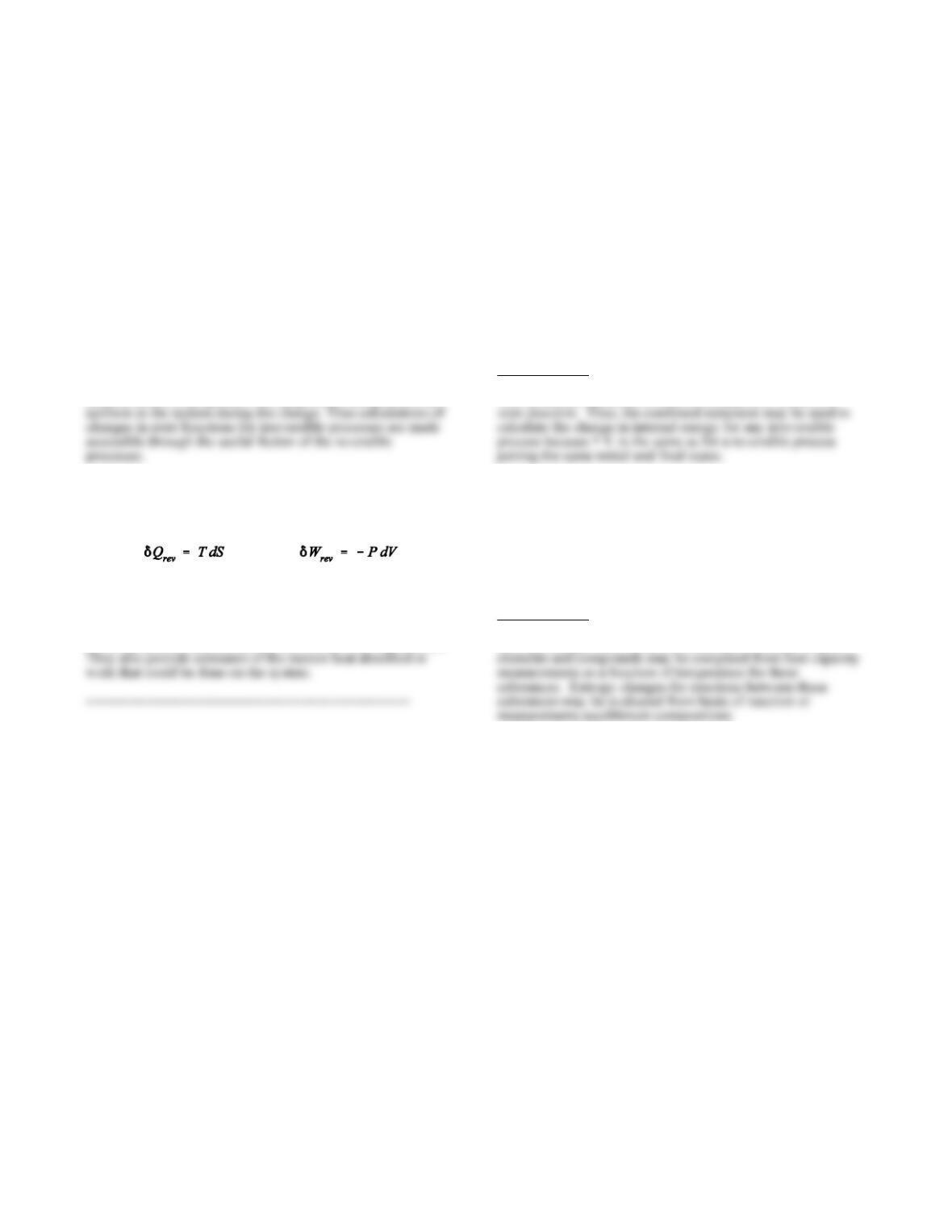
In addition, for reversible processes general relationships are
available for computing W and Q from state function
information by integrating
along the simplest path that connects the initial and final states.
These results may be used to estimate properties of real
evolving systems that are carried out slowly, near equilibrium.
3.14. The combined statement of the first and second laws of
thermodynamics, equation (3.15), evaluates the heat absorbed
and mechanical work done on a system with relationships that
are only valid for reversible processes. Since reversible
processes do not occur in the real world, how is it possible for
the combined statement to play an important role in the
analysis of practical “irreversible” processes encountered in
nature and in technology?
Answer to 3.14.
The combined statement is used to evaluate dU, which is a
———–———–——————-——–————-—–
3.15. Describe the kinds of experimental observations that
have been invoked to support the hypothesis that the entropy of
all substances is the same at absolute zero.
Answer to 3.15.
Entropy changes associated with heating or cooling the pure
———–———–——————-——–————-——
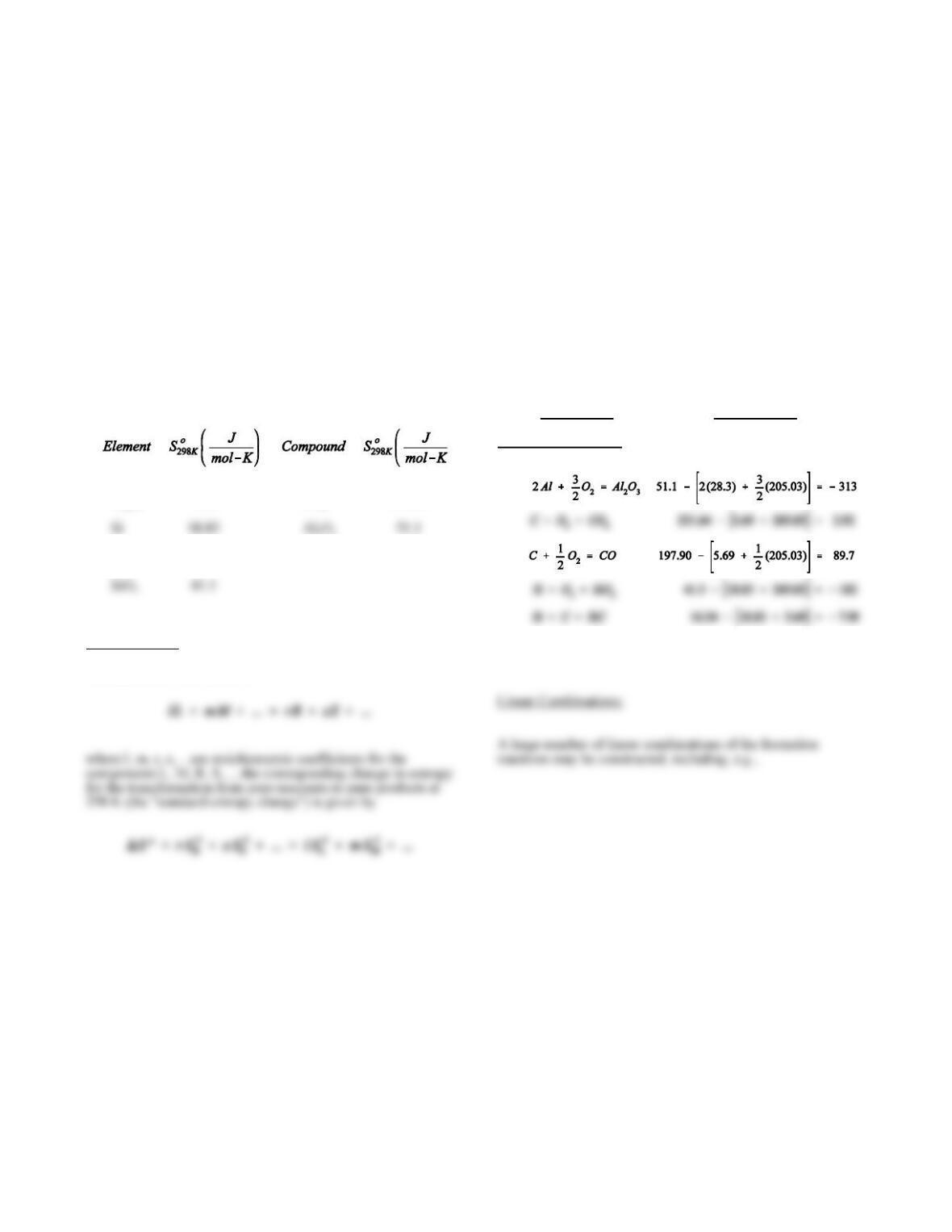
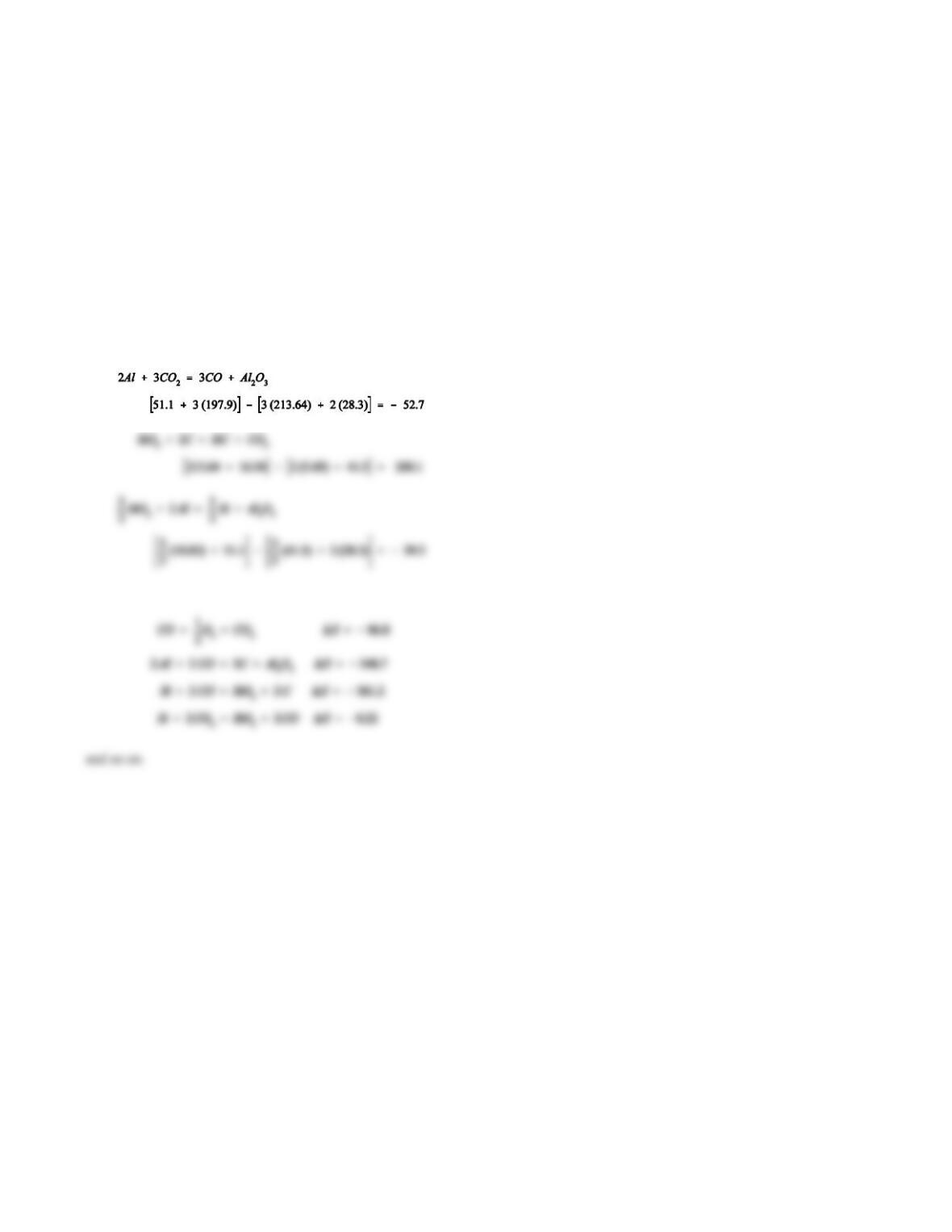
3.16. Use the following values of absolute entropies of
elements and compounds at 298K to compute the standard
entropy changes associated with as many chemical reactions as
you can generate from this list.
Chapter 3. The Laws of Thermodynamics 10
Al 28.3 CO 197.9
C(gr) 5.69 CO2213.64
O2 205.03 SiC 16.54
Answer to 3.16.
For any reaction of the form
The following list of reactions can be generated among these
components is not exhaustive.
REACTION • •So (J/mol K)
Formation Reactions:
Chapter 3. The Laws of Thermodynamics 11